Reporting for Duty – book review

I have just finished reading Reporting for Duty, a coffee table book written by Tracy Libby.  This book is presented well, with small vignettes interspersed with text, photos, and profiles of 15 veterans and their assistance dogs.

Reporting for duty by Tracy Libby

The book’s first chapter explains  PTSD (post traumatic stress disorder, a term that didn’t come into use until after the Vietnam War), TBI (traumatic brain injury), and MST (military sexual trauma) – pretty gut-wrenching content.

The chapters that follow include coverage of therapy dogs in history, prison puppy programs and combat and operational stress-control dogs.  The final chapter is about how dogs read us, with references to the various research findings about canine cognition and the human-animal bond (a favourite subject of mine).

There are many photographs in this book, which are lovingly presented.  It provides a good selection of case studies – veterans and their dogs – with veterans from different wars and each requiring different levels of assistance and support.

But it is the book’s Foreward that will remain with me for some time.  Written by Karen D Jeffries (retired Commander in the US Navy, and co-founder of Veterans Moving Forward, Inc – a charity which will benefit from some of the proceeds of sales), the Foreward contains some sobering statistics and facts:

  • The US Veteran’s Administration is unable to meet the needs of the disabled veteran population
  • More that 540,000 veterans of the wars in Iraq and Afghanistan have PTSD or depression (or both)
  • More than 260,000 veterans have been diagnosed with traumatic brain injuries
  • Even if all of the service dog organisations currently operating in the United States increased their annual output by a factor of 100, the mental health challenges of veterans would still not be met
  • The present policy of the Veteran’s Administration is to provide service dogs only to veterans with visual or hearing impairment or some selected mobility challenges – a small sub-set of the range of uses and support that can be given by trained dogs

This is a book that is best enjoyed in hard copy – flick through the photos and thank heaven for the people who volunteer, fund raise, and train assistance dogs.

My copy of the Reporting for Duty was provided free-of-charge by the book’s publisher.  I will cherish it as part of my dog book collection.

Kathleen Crisley, specialist in dog massage, rehabilitation and nutrition/food therapy, The Balanced Dog, Christchurch, New Zealand


Dogs were domesticated not once, but twice

The question, ‘Where do domestic dogs come from?’, has vexed scholars for a very long time. Some argue that humans first domesticated wolves in Europe, while others claim this happened in Central Asia or China. A new paper, published in Science, suggests that all these claims may be right. Supported by funding from the European Research Council and the Natural Environment Research Council, a large international team of scientists compared genetic data with existing archaeological evidence and show that man’s best friend may have emerged independently from two separate (possibly now extinct) wolf populations that lived on opposite sides of the Eurasian continent.

Domestication photo

Man’s best friend. Dogs were domesticated not once, but twice… in different parts of the world. Credit: © lenaivanova2311 / Fotolia

This means that dogs may have been domesticated not once, as widely believed, but twice.

A major international research project on dog domestication, led by the University of Oxford, has reconstructed the evolutionary history of dogs by first sequencing the genome (at Trinity College Dublin) of a 4,800-year old medium-sized dog from bone excavated at the Neolithic Passage Tomb of Newgrange, Ireland. The team (including French researchers based in Lyon and at the National Museum of Natural History in Paris) also obtained mitochondrial DNA from 59 ancient dogs living between 14,000 to 3,000 years ago and then compared them with the genetic signatures of more than 2,500 previously studied modern dogs.

The results of their analyses demonstrate a genetic separation between modern dog populations currently living in East Asia and Europe. Curiously, this population split seems to have taken place after the earliest archaeological evidence for dogs in Europe. The new genetic evidence also shows a population turnover in Europe that appears to have mostly replaced the earliest domestic dog population there, which supports the evidence that there was a later arrival of dogs from elsewhere. Lastly, a review of the archaeological record shows that early dogs appear in both the East and West more than 12,000 years ago, but in Central Asia no earlier than 8,000 years ago.

Combined, these new findings suggest that dogs were first domesticated from geographically separated wolf populations on opposite sides of the Eurasian continent. At some point after their domestication, the eastern dogs dispersed with migrating humans into Europe where they mixed with and mostly replaced the earliest European dogs. Most dogs today are a mixture of both Eastern and Western dogs — one reason why previous genetic studies have been difficult to interpret.

The international project (which is combining ancient and modern genetic data with detailed morphological and archaeological research) is currently analysing thousands of ancient dogs and wolves to test this new perspective, and to establish the timing and location of the origins of our oldest pet.

Senior author and Director of Palaeo-BARN (the Wellcome Trust Palaeogenomics & Bio-Archaeology Research Network) at Oxford University, Professor Greger Larson, said: ‘Animal domestication is a rare thing and a lot of evidence is required to overturn the assumption that it happened just once in any species. Our ancient DNA evidence, combined with the archaeological record of early dogs, suggests that we need to reconsider the number of times dogs were domesticated independently. Maybe the reason there hasn’t yet been a consensus about where dogs were domesticated is because everyone has been a little bit right.’

Lead author Dr Laurent Frantz, from the Palaeo-BARN, commented: ‘Reconstructing the past from modern DNA is a bit like looking into the history books: you never know whether crucial parts have been erased. Ancient DNA, on the other hand, is like a time machine, and allows us to observe the past directly.’

Senior author Professor Dan Bradley, from Trinity College Dublin, commented: ‘The Newgrange dog bone had the best preserved ancient DNA we have ever encountered, giving us prehistoric genome of rare high quality. It is not just a postcard from the past, rather a full package special delivery.’

Professor Keith Dobney, co-author and co-director of the dog domestication project from Liverpool University’s Department of Archaeology, Classics and Egyptology, is heartened by these first significant results. ‘With the generous collaboration of many colleagues from across the world-sharing ideas, key specimens and their own data — the genetic and archaeological evidence are now beginning to tell a new coherent story. With so much new and exciting data to come, we will finally be able to uncover the true history of man’s best friend.’

Source:  Science Daily

Does your dog understand you?

Research by a Brigham Young University psychology professor shows how dogs perceive and use human emotional cues and gestures.

Professor Ross Flom conducted two experiments where he looked at the frequency in which dogs followed a pointing gesture to locate a hidden reward. Those gestures were paired with either positive or negative behaviors from the person pointing. Positive behaviors included smiling and speaking in a pleasant tone. Negative behaviors included frowning, a furrowed brow and speaking in a harsh tone.

The main finding of the study is that dogs use human emotions in determining how quickly or how slowly they’re going to go and explore an unfamiliar location. While positive behaviors didn’t improve response time from the control group, negative behaviors, which simulated emotions closely tied to anger, delayed the response time.

The bottom line:  your dog doesn’t trust you when you’re angry.

Doggy quote of the month for June

Bill and Hilary Clinton

“He’s a hard dog to keep on the porch”

– Presidential candidate Hillary Clinton, on her husband Bill

A special yearbook photo

Yearbooks are a tradition.  They provide the chance to capture a moment in time which is usually a milestone in a young person’s education.

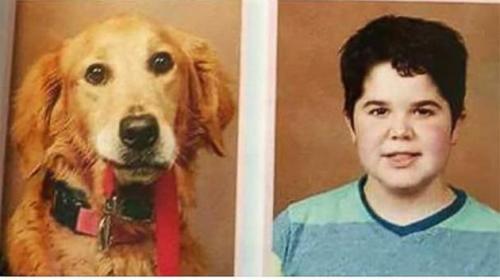
In West Monroe, Louisiana, a special yearbook photo was taken this year, of Presley who is Seph Ware’s service dog.

yearbook

Presley and Seph Ware are featured side by side in the class yearbook at Good Hope Middle School. (Holtzclaw Photography)

Seph, age 14, has Duchenne Muscular Dystrophy which is  a progressive genetic muscle disorder that causes a loss of muscle function.  Presley’s job is to help help him with daily activities at school like picking things up off the floor, opening and closing doors and turning the lights on and off.

The Good Hope Middle School felt it was only right to have Presley featured in the yearbook since she has been at school every day.

Special dog!

Source:  ABC 13

August deadline for pet relief areas

All airports in the United States that service over 10,000 passengers per year must have a pet relief area in every terminal by this August, according to federal regulation.

This is great news for the traveling public.

Initially, pet relief areas were focused on providing areas for service animals.  But interest and need has grown particularly in providing pet relief areas after passengers pass through airport security (not just in an outdoor area).


Pet relief area LAX

An outdoor pet relief area at LAX

I’ve blogged about pet relief areas before.  Here are the links.

Kathleen Crisley, specialist in dog massage, rehabilitation and nutrition/food therapy, The Balanced Dog, Christchurch, New Zealand
The little pit bull who survived a fire

Firefighter William Linder was washing his car last year when he smelled smoke.  A neighbor’s shed was on fire and when he entered, he found a little pit bull puppy cowering in the corner.

Jake

He revived the puppy with mouth-to-snoot resuscitation and the puppy was admitted to a veterinary hospital with burns over 75% over his body.

The puppy endured six weeks of antibiotics and morphine to survive his injuries.  His owners abandoned him because they couldn’t pay for his care.  So Linder, who works in Hanahan, South Carolina, adopted him.

Jake as firefighter

Although Jake has bald spots from the burns where fur will never grow, he’s become a station mascot and Linder takes him to elementary schools to teach fire prevention.

Another pit bull showing the world that, just like other dogs, they only want be loved.

Kathleen Crisley, specialist in dog massage, rehabilitation and nutrition/food therapy, The Balanced Dog, Christchurch, New Zealand


All dogs matter


All dogs matter

I often get asked ‘what type of dog benefits most from massage and laser?’

People think that a certain breed or size of dog has the most problems.  While it is true that some breeds have a higher likelihood of problems due to genetics – obesity or hip dysplasia in Labradors, for example – the reality is that all dogs benefit from touch therapies.  That’s purebreds and mixed breeds, toy dogs, medium and large dogs and extra-large dogs.

People also think that you only massage a dog once they are elderly and showing signs of discomfort.  While of course you should seek help in these instances, you can keep your dog more flexible in the joints and with good blood flow to the muscles by instituting a regular wellness program that includes massage.

And by regular, I only see some of my clients six- or eight-weekly, because we have their dog responding well to their treatments.  They move more freely and comfortably now and only need a ‘top up’ to keep in good shape.

So the other message I have in this post is that your dog’s massage therapy doesn’t have to break your budget.  If you get your dog into a regular massage program, you can easily plan for this expense and accommodate it.   This is so much better than trying to fund the ‘ambulance at the bottom of the cliff’ approach.

I practice on a mobile basis, and so with lower overheads (no clinic to rent, heat and insure), I pass on these savings to my customers.

Kathleen Crisley, specialist in dog massage, rehabilitation and nutrition/food therapy, The Balanced Dog, Christchurch, New Zealand


Fossil dog represents a new species

Fossil dog

A fossil found in Maryland was identified by a University of Pennsylvania doctoral student as belonging to a new species of ancient dog. The hyena-like canine, with massive jaws capable of crushing bone, would have lived approximately 12 million years ago, at a time when massive sharks like megalodon swam in the oceans. Credit: Illustration of Cynarctus from “Dogs, Their Fossil Relatives and Evolutionary History.” Reprinted and used with permission of the publisher and Mauricio Antón, author of the illustration and copyright owner [2008]; Courtesy of University of Pennsylvania

A doctoral student at the University of Pennsylvania has identified a new species of fossil dog. The specimen, found in Maryland, would have roamed the coast of eastern North America approximately 12 million years ago, at a time when massive sharks like megalodon swam in the oceans.

The newly named species is Cynarctus wangi, named for Xiaoming Wang, curator at the Natural History Museum of Los Angeles County and a renowned expert on mammalian carnivores. This coyote-sized dog was a member of the extinct subfamily Borophaginae, commonly known as bone-crushing dogs because of their powerful jaws and broad teeth.

“In this respect they are believed to have behaved in a similar way to hyenas today,” said the study’s lead author, Steven E. Jasinski, a student in the Department of Earth and Environmental Science in Penn’s School of Arts & Sciences and acting curator of paleontology and geology at the State Museum of Pennsylvania in Harrisburg.

Fossils from terrestrial species from this region and time period are relatively rare, thus the find helps paleontologists fill in important missing pieces about what prehistoric life was like on North American’s East Coast.

“Most fossils known from this time period represent marine animals, who become fossilized more easily than animals on land,” Jasinski said. “It is quite rare we find fossils from land animals in this region during this time, but each one provides important information for what life was like then.”

Whenco-researchers Jasinski and Wallace first began their investigation of the specimen, which had been found by an amateur collector along the beach under the Choptank Formation in Maryland’s Calvert Cliffs region and was then held by the Smithsonian Institution, they presumed it was a known species of borophagine dog, a species called marylandica that was questionably referred to as Cynarctus, a fossil of which had been found in older sediment in the same area. But when they compared features of the occlusal surfaces, where the top and bottom teeth meet, of the previously known and the new specimens, they found notable differences. They concluded that the specimen represented a distinct species new to science.

“It looks like it might be a distant relative descended from the previously known borophagine,” Jasinski said.

Borophagine dogs were widespread and diverse in North America from around 30 million to about 10 million years ago. The last members went extinct around 2 millions of years ago during the late Pliocene. C. wangi represents one of the last surviving borophagines and was likely outcompeted by ancestors of some of the canines living today: wolves, coyotes and foxes.

Despite its strong jaws, the researchers believe C. wangi wouldn’t have been wholly reliant on meat to sustain itself.

“Based on its teeth, probably only about a third of its diet would have been meat,” Jasinski said. “It would have supplemented that by eating plants or insects, living more like a mini-bear than like a dog.”

“This new dog gives us useful insight into the ecosystem of eastern North America between 12 and 13 million years ago,” Jasinski said.

Source:  PennNews media release

Haus the rescue dog returns the favour

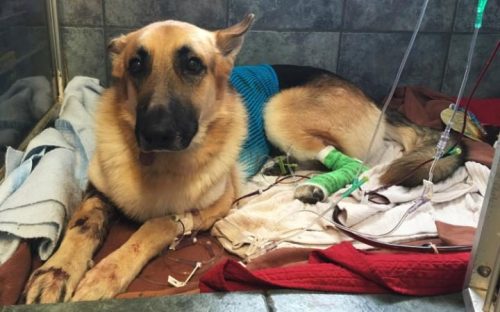
The DeLuca family of Tampa, Florida are very happy they chose to adopt Haus, a German Shepherd two months ago.

Last week, Haus stepped in to keep their 7-year old daughter from being attacked by a rattlesnake, an Eastern Diamondback to be precise.

Haus

Haus suffered several snake bites and it was touch-and-go for a while when he was admitted to the local veterinary hospital and put on an anti-venom drip and given pain relief.

The family appealed for funds for his care and were amazed at how quickly the funds added up to over $50,000.  They then issued a statement “PLEASE — we feel we have plenty to care for Haus’ needs” and encouraged people to donate to other worthwhile charities – where the excess funds will also be donated.

At last report, Haus’ condition is improving.

And it makes me very glad that New Zealand is a land without snakes!

Kathleen Crisley, specialist in dog massage, rehabilitation and nutrition/food therapy, The Balanced Dog, Christchurch, New Zealand