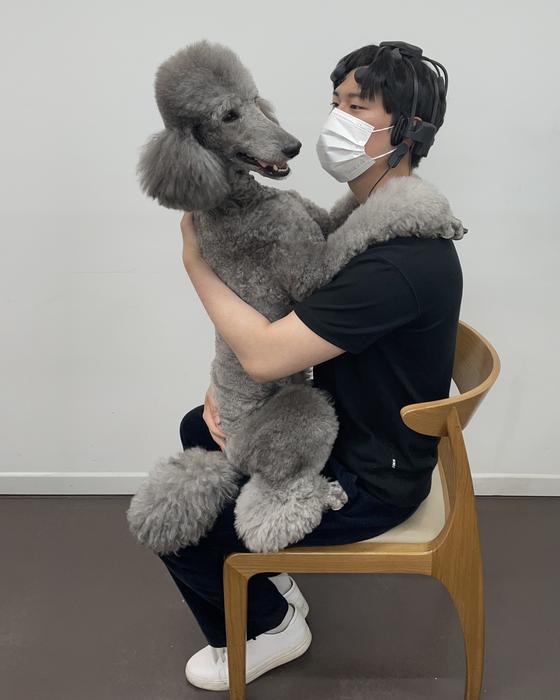
Interactions with dogs can increase brainwaves associated with stress relief and heightened concentration

Spending quality time with dogs reduces stress and increases the power of brain waves associated with relaxation and concentration, according to a study published on March 13, 2024 in the open-access journal PLOS ONE by Onyoo Yoo from Konkuk University, South Korea, and colleagues.

An animal-assisted activity (hug) performed by a participant. Photo credit
Yoo et al., 2024, PLOS ONE, CC-BY 4.0

Animal-assisted interventions, like canine therapy, are widely used in hospitals, schools, and beyond to help reduce anxiety, relieve stress, and foster feelings of trust. Studies of the potential benefits of animal interactions often take a holistic approach, comparing people’s mood or hormone levels before and after spending time with a service animal. But this approach doesn’t differentiate between types of interactions, like grooming, feeding, or playing with an animal, limiting our understanding of how each specific interaction impacts a person’s health and well-being.

To better understand how such animal-related activities affect mood, Yoo and colleagues recruited a small sample of 30 adult participants to each perform eight different activities with a well-trained dog, such as playing with a hand-held toy, giving her treats, and taking pictures with her. Participants wore electroencephalography (EEG) electrodes to record electrical activity from the brain while they interacted with the dog, and they recorded their subjective emotional state immediately following each activity.

The relative strength of alpha-band oscillations in the brain increased while participants played with and walked the dog, reflecting a state of relaxed wakefulness. When grooming, gently massaging, or playing with the dog, relative beta-band oscillation strength increased, a boost typically linked to heightened concentration. Participants also reported feeling significantly less fatigued, depressed, and stressed after all dog-related activities.

While not all participants had pets of their own, their fondness for animals likely motivated their willingness to participate in the experiment, potentially biasing the results. Nonetheless, the authors state that the unique relationships between specific activities and their physiological effects could serve as a reference for programming targeted animal-assisted interventions in the future.

The authors add: “This study provides valuable information for elucidating the therapeutic effects and underlying mechanisms of animal-assisted interventions.”

Source: Eurekalert

Bone broth vs stock vs broth

Over the last few weeks, our weather in Christchurch has turned noticeably autumnal. Last week, we even had one morning when it was 3 degrees C.

Whenever the weather turns cooler, I think our interest in cooking and baking increases. A warm kitchen is inviting and cosy on colder days.

I find that some people are using the term ‘bone broth’ interchangeably with the terms ‘stock’ or ‘broth’ and there are key differences. Your dog might find all three tasty additions to their diet, but the health support is very different.

Bone broth (my favourite) is made by simmering bones for a long period of time with the addition of an acid such as apple cider vinegar which helps to leach out the minerals from the bones. Bone broth contains nutrients, collagen and gelatin which are supporting to the gut and helpful for anti-inflammatory support with additions like turmeric.

Stock is also prepared by simmering bones, but you add vegetables and spices and cook for less time. We use stock as a base for sauces, stews and soups – and stock does add flavour to the water bowl or food bowl which can make it helpful for dogs who need to be encouraged to drink or eat. (With obvious consideration of not adding foods that are harmful to dogs – like onions.)

Broth is made by simmering meat and vegetables for a short time which can be eaten strained or with the meat and vegetable ingredients. Humans eat broth when they are unwell because it encourages hydration and is gentle on the stomach. Broths can also be used as a flavour base.

Be mindful of what you are cooking for your dog. I heartily endorse cooking for dogs and adding fresh ingredients to the diet.

Kathleen Crisley, Fear-Free certified professional and specialist in dog massage, rehabilitation and canine fitness,  The Balanced Dog, Christchurch, New Zealand

Doggy quote of the month for March

Tom Hayden was an activist, author and politician who served in both the California State Senate and the California State Assembly during his career.

He was the author of the Hayden Act to amend state law for companion animals. Dogs or cats impounded by public pounds or shelters could be killed after only 72 hours; when the Act came into effect in 1999, the minimum impound time expanded to 4-6 business days and required that the animal be released to a nonprofit animal rescue or adoption organization in certain circumstances.

Oxidation of commercial pet foods

Over the world, dog owners are finding ways to cut costs in the face of high inflation.

Many who feed commercial foods (commonly referred to as kibble), will look to buying the largest size bag of food possible because typically the price per pound/kg is best when you buy a large bag.

When using kibble, you need to understand the process of oxidation. Oxidation happens as soon as you open the bag and expose the food to air and that process continues until your dog eats the food.

Oxidation happens to human food, too, by the way.

Oxidation degrades the nutrients in the food and chemically changes the fats in a process known as “going rancid.”

It’s tempting to want to empty the bag into a more convenient container and often this container will be plastic. The problem is that most containers that can hold a large bag of dog food are not food-grade plastic.

Food-grade plastics are designed to come into contact with food, to have a strong seal, and to avoid leaching of chemicals into food. Food grade plastics don’t have dyes or other additives and they often are not made from 100% recycled plastic because there is no guarantee on the quality of materials in the supply chain.

Bags for commercial dog food are produced to help protect against oxidation; it’s actually better to seal the bag as soon as you take out what you need and to keep the bag in a cool, dry and dark place rather than emptying it into another container. If a container is needed, I prefer metal to plastic because it won’t leach nasties into the food and can be washed and dried at high temperature in the dishwasher. I only transfer enough food to last between 5 and 7 days.

Regular washing of containers to remove residual fats and crumbs is essential and something that dog owners are notoriously bad at doing. It’s just too easy to refill a container without washing it.

I’m old enough to remember when dog food companies produced larger metal tins for dog food as part of their brand promotions; I still own one from Iams/Eukanuba that is over 20 years old and that’s the container I use for temporary food storage. It fits in the dishwasher and I’m confident that it is being cleaned and sterilised in the dishwasher.

Sadly, even the pet food companies have jumped on the plastic bandwagon in more recent years and now only produce plastic containers when/if they have a promotion. I’m not sure if these containers are food grade plastic, either.

There are many opinions about how much food you should buy at any given time. A good rule of thumb is 4-6 week’s worth. Of course, if your dog is small, then a 20 kg bag of food is going to last way longer than this – so that’s a good indication that the large bag is not right for you.

Sox easily goes through his 12 kg bag of gastrointestinal food in less than six weeks; so I’m comfortable with my decision to buy the bag.

In summary, when feeding kibble:

  • buy only 4-6 week’s worth at a time
  • keep the bag sealed after every use
  • store the bag in a cool, dry and dark place
  • if a container is convenient for you, transfer only a few days worth of food into the container, preferably metal
  • if you can’t find metal ensure you are using a food-grade plastic container
  • thoroughly wash and dry your container each time you empty it

Kathleen Crisley, Fear-Free certified professional and specialist in dog massage, rehabilitation and canine fitness,  The Balanced Dog, Christchurch, New Zealand

Fabergé – more than eggs

Peter Carl Fabergé, the Russian jeweler, is best known for his Easter eggs using precious metals and gemstones that were crafted for the Russian royal family.

But, in an exhibit celebrating the miniature at the Museum of Fine Arts in Boston, there is a miniature bulldog expertly crafted by Fabergé for ballerina Elizabeth Balletta to immortalize her bulldog, Cody. The collar on the miniature dog even includes her address in Paris.

Today, dog lovers can buy miniatures and other novelties featuring their dogs, but the craftsmanship of these will never reach the standard of Fabergé.

Kathleen Crisley, Fear-Free certified professional and specialist in dog massage, rehabilitation and canine fitness,  The Balanced Dog, Christchurch, New Zealand

Probiotics help overweight dogs shed weight

Scientists have made significant strides in addressing a common yet concerning issue: overweight pets. This research unveils the potential of specific probiotics to combat obesity in dogs.

Leading the charge is Dr. Younghoon Kim, a distinguished professor at Seoul National University’s Department of Agricultural Biotechnology.

Understanding pet obesity

Dr. Kim’s team, with a focus on metabolic diseases in companion animals, embarked on a mission to identify probiotics that could offer a safe, long-term treatment for dog obesity.

“The initial challenge involved selecting specific metabolic diseases for examination, leading us to focus on the prevalent issue of ‘obesity in pets,’” Dr. Kim explained.

The global trend of pet obesity is alarming, with about 50% of the pet population across various age groups being affected, particularly older pets.

Many of these pets are already receiving treatments, including dietary interventions. Dr. Kim and his team set out with a clear objective: to find probiotics that could effectively reduce body fat percentage in pets.

Tackling dog obesity with probiotics

Dr. Kim’s vision goes beyond just addressing specific health issues. He advocates for a broader recognition of the therapeutic potential of probiotics across a spectrum of diseases affecting companion animals.

“By promoting this awareness, my aspiration is to catalyze increased attention, funding and collaborative efforts in the scientific community to explore the expansive landscape of probiotic applications in pet health,” Dr. Kim stated.

To pinpoint the right probiotic candidates, the research delved into the variations in intestinal microbiota between younger and older dogs.

This investigation highlighted a decline in certain beneficial bacteria, such as lactic acid bacteria, Bifidobacterium species, and Enterococcus species in older dogs.

These findings guided the researchers in selecting specific strains for their experiment.

Two probiotics helped dogs lose weight

The study then progressed to its experimental phase, where two selected strains, Enterococcus faecium IDCC 2102 and Bifidobacterium lactis IDCC 4301, were administered to a group of beagles on a high-fat diet.

The results were striking. “The strains we carefully selected demonstrated remarkable success in reducing the body fat percentage in dogs,” said Kim.

These probiotics effectively reduced body weight, cut down subcutaneous fat, and boosted energy metabolism even on a high-calorie diet, shifting the body’s focus from fat storage to fat consumption.

“What set these strains apart was their ability to not only limit dietary intake or enhance excretion to reduce body weight but, more importantly, activate energy metabolism. Even when exposed to a high-calorie diet, we observed a decrease in body weight, alleviation of subcutaneous fat accumulation and an increase in energy metabolism. This confirmed a shift in the body’s metabolic orientation toward fat consumption, rather than fat accumulation,” Kim explained.

Significantly, this study also highlighted the strains’ impact on systemic inflammation and hormone metabolism.

Long-term benefits of probiotics for dogs

The dogs that received these probiotics showed reduced inflammation and improved metabolic activities, like insulin production.

The strains also increased beneficial commensal bacteria, enhancing the body’s defense mechanisms and immunity.

Dr. Kim emphasized the lasting impact of these changes, indicating sustained benefits for pets incorporating these probiotics into their health regimen. This enduring effect is pivotal in managing long-term health in pets.

With the rise in pet ownership, there’s a growing interest in health functional foods for pets, especially probiotics.

However, research in this area, particularly tailored probiotics for companion animals, lags far behind human studies.

“While types of probiotics suitable for human consumption or commercial livestock have been identified and established, the absence of standardized guidelines for companion animals is a glaring gap,” said Dr. Kim.

“Our study aimed to address this deficiency by striving to broaden the spectrum of probiotics applicable to pets across various environments.”

Promising future of pet probiotics

In summary, this important study led by Dr. Younghoon Kim marks a significant milestone in the fight against pet obesity, unveiling the remarkable potential of specific probiotics to combat this widespread issue.

By meticulously selecting and testing strains, the research team demonstrated their effectiveness in reducing body fat and enhancing metabolism in dogs, while highlighting the long-term health benefits these probiotics offer.

This research paves the way for more tailored health solutions in pet care, encouraging further exploration and development in this vital field.

It stands as a beacon of hope for pet owners worldwide, offering a new, sustainable approach to managing the health and well-being of their beloved companions.

The full study was published in the journal Microbiology Spectrum.

More about probiotics

In the realm of health and wellness, probiotics have emerged as unsung heroes, revolutionizing our understanding of gut health and beyond.

As discussed above, these live microorganisms, often referred to as “good” or “friendly” bacteria, play a critical role in maintaining a balanced intestinal microbiome, which is crucial for overall health.

Balancing the gut

Probiotics primarily work by enhancing the gut flora, which is a complex community of microorganisms living in our digestive tracts.

This boost in beneficial bacteria aids in various digestive processes and fortifies the body’s defense mechanisms against harmful pathogens.

Regular consumption of probiotics has been linked to improved digestion, enhanced immune function, and even a reduction in the risk of certain chronic diseases.

Treating digestive disorders

One of the most significant benefits of probiotics is their ability to treat and prevent gastrointestinal issues, such as irritable bowel syndrome (IBS), inflammatory bowel disease (IBD), and antibiotic-related diarrhea.

By restoring the balance of good bacteria in the gut, which can be disrupted by factors like antibiotics or poor diet, probiotics alleviate these digestive disorders.

Furthermore, emerging research suggests that probiotics may have a broader impact on our health than previously thought.

Studies indicate potential benefits in areas such as mental health, where probiotics are believed to play a role in mood regulation and reducing symptoms of depression and anxiety.

This connection, often referred to as the gut-brain axis, opens new avenues for mental health treatments.

Benefits of probiotics on humans and dogs

Probiotics also show promise in enhancing heart health by lowering LDL (bad) cholesterol levels and blood pressure.

This cardioprotective effect is another feather in the cap of these microscopic powerhouses.

Incorporating probiotics into one’s diet is relatively straightforward. They are found naturally in fermented foods such as yogurt, sauerkraut, kefir, and kimchi.

For those who prefer supplements, a wide range of probiotic capsules and powders are available on the market.

In summary, probiotics are a key component of a holistic approach to health, both for humans and dogs alike. Their wide-ranging benefits, from improving gut health to potentially boosting mental well-being, make them a valuable ally in our quest for a healthier life.

As research continues to uncover their myriad benefits, probiotics are set to play an even more prominent role in our daily health regimen.

Source: Earth.com

Doggy quote of the month for February

Painting of Eos by Landseer

She had been his constant and faithful companion for 10-1/2 years and she was only 6 months old, when he first had her. She was connected with the happiest years of his life . . . such a beautiful & sweet creature and used to play so much with the children.”

– Queen Victoria in her journal, writing about the passing of Eos, Prince Albert’s greyhound, on 31 July 1844

Some mysteries remain about why dogs wag their tails

When it comes to tail wagging among dogs, some questions still hound researchers.

We know that domesticated dogs (Canis familiaris) use their tails to communicate — with other dogs as well as humans — and even what various types of wags mean, researchers note in a new review of the scientific literature. But we don’t know why dogs seem to wag more than other canines or even how much of it is under their control, ethologist Silvia Leonetti and colleagues report January 17 in Biology Letters.

“Among all possible animal behavior that humans experience in everyday life, domestic dog tail wagging is one of the most common,” says Leonetti, who is now at the University of Turin in Italy. “But a lot of dog behavior remains a scientific enigma.”

So Leonetti and her colleagues pored through previous studies to figure out what elements of tail wagging are understood and which remain mysterious. They also hypothesized about the behavior’s origins: Perhaps tail wagging placates some human need for rhythm, the researchers suggest, or maybe the behavior is a genetic tagalong, a trait tied to others that humans bred into domesticated dogs.

“People think wagging tail equals happy dog. But it’s actually a lot more complicated than that,” says Emily Bray, an expert in canine cognition at the University of Arizona in Tucson who was not involved with the work. Understanding why dogs wag their tails is important partly from an animal welfare perspective, she says, as it could help dog owners read their pups’ cues better.

One main thing that researchers know about tail wagging is that it’s used predominantly for communication instead of locomotion, like a whale, or swatting away bugs, like a horse. Wagging also means different things depending on how the tail is wagged, such as its height or side-to-side movement.

For example, when the tail wags more to the right, the researchers say, it typically means the dog is interested in a stimulus or wants to approach something. But when it wags more to the left, it signals uncertainty or wanting to withdraw. When wagged low and near the legs, it’s a sign of submission or insecurity. Dogs can interpret and react differently to these varied wags (SN: 11/1/13).

But for such a ubiquitous behavior, questions abound. One gap is how much tail wagging is under dogs’ conscious control, the team reports. Several studies have also observed that dogs wag their tails more than other canines, particularly compared with their closest relative, the wolf (C. lupus) — but scientists don’t yet know why.

One idea is the domesticated rhythmic wagging hypothesis, Leonetti and colleagues suggest. Scientists know that humans’ brains respond positively to rhythm, and because tail wagging is a rhythmic behavior, the authors suggest it could be that humans consciously or unconsciously preferred dogs that wag more.

Or the domestication syndrome hypothesis could be at work. It’s an existing theory that unintended, genetically linked traits can pop up when specific traits are bred for through domestication. Perhaps, the researchers propose, the canine characteristics that humans found desirable to breed for — such as temperament — might be genetically linked to tail wagging. 

Evolutionary biologist Tom Reimchen isn’t so sure about either hypothesis. He’s skeptical that domestic dogs do wag their tails more than other canines. More research is needed to compare tail wagging between nondomestic canine species and the epigenetic influences behind  canids’ tail wagging, says Reimchen, of the University of Victoria in British Columbia.

Leonetti, who did the work while at the Max Planck Institute for Psycholinguistics in Nijmegen, Netherlands, says a multidisciplinary approach would be helpful in future tail wagging research, for example combining neurology, cognition and physiology. Because the domestication process was also an evolutionary process — one humans were involved in — studying dog behavior and their wags could reveal something about us too, she says (SN: 9/7/22). 

It “can shed light not only on our understanding of dog behavior, but also we’ll then understand something about human psychology.”

Source: Science News

Knowing what dogs like to watch could help veterinarians assess their vision

Ever wonder what kind of TV shows your dog might choose if they could work the remote control? New research from the University of Wisconsin–Madison’s School of Veterinary Medicine provides some answers, but the study was more interested in solving a longstanding problem in veterinary medicine than turning canine companions into couch potatoes.

According to Freya Mowat, veterinary ophthalmologist and professor in the School of Veterinary Medicine’s department of surgical sciences, researchers wanted to determine factors, including age and vision, that influence a dog’s interest in interacting with video content. Ultimately, the goal of the study, which launched two years ago (in 2022), was to support development of more sensitive ways to assess canine vision — something that has been sorely lacking in veterinary medicine.

“The method we currently use to assess vision in dogs is a very low bar. In humans, it would be equivalent to saying yes or no if a person was blind,” says Mowat. “We need more sensitive ways to assess vision in dogs, using a dog eye chart equivalent. We speculate that videos have the potential for sustaining a dog’s attention long enough to assess visual function, but we didn’t know what type of content is most engaging and appealing to dogs.”

Published recently in the journal Applied Animal Behaviour Sciencethe study found that dogs are most engaged when watching videos that feature other animals. Content featuring other dogs was the most popular. But if a National Geographic documentary about canine evolution seems too highbrow for your four-legged friend, Scooby Doo might be a perfectly acceptable option as well.

To better understand the type of content dogs might be most attracted to on screen, Mowat created a web-based questionnaire for dog owners around the globe to report the TV-watching habits of their canine companions.

Participants responded to questions about the types of screens in their homes, how their dogs interacted with screens, the kinds of content their dogs interacted with the most, as well as information about their dog’s age, sex, breed and where they live. They also provided descriptions of their dogs’ behavior when watching videos. Most commonly, dog owners described their pets’ behavior as active — including running, jumping, tracking action on screen and vocalizing — compared with passive behaviors like lying down or sitting. Dog owners also had the option to show their dog(s) four short videos featuring subjects of possible interest, including a panther, a dog, a bird and traffic moving along a road. They were then asked to rate their dog’s interest in each video and how closely the dog tracked the moving objects on the screen.

Mowat received 1,600 responses from dog owners across the world, including from the United States, Canada, the United Kingdom, the European Union and Australasia. Of those respondents, 1,246 ultimately completed the study. The following are some of the most interesting highlights:

  • Age and vision were related to how much a dog interacted with a screen.
  • Sporting and herding dog breeds appear to watch all content more than other breeds.
  • Video content featuring animals was the most popular, with other dogs being by far the most engaging subjects to watch.
  • Humans do not appear to be very appealing for dogs to watch, ranking ninth out of 17 predetermined categories.
  • Cartoons were engaging for more than 10% of dogs.
  • Movement on screens was a strong motivator for screen attention.

Mowat says she plans to build on the results of this study. Future research will focus on the development and optimization of video-based methods that can assess changes in visual attention as dogs age as well as answer questions that could help our four-legged friends age as gracefully as possible.

“We know that poor vision negatively impacts quality of life in older people, but the effect of aging and vision changes in dogs is largely unknown because we can’t accurately assess it,” she says. “Like people, dogs are living longer, and we want to make sure we support a healthier life for them as well.”

Another goal for Mowat is to compare how a dogs’ vision ages compared with the human or humans they share a home with.

“Dogs have a much shorter lifespan than their owner, of course, and if there are emerging environmental or lifestyle factors that influence visual aging, it might well show up in our dogs decades before it shows up in us,” she explains. “Our dogs could be our sentinels — the canine in the proverbial coal mine.”

This study was supported in part by an NIH career development grant to Mowat (K08EY028628), a Companion Animal Fund Grant from the UW–Madison School of Veterinary Medicine, a grant from Research to Prevent Blindness, Inc. to the UW–Madison Department of Ophthalmology and Visual Sciences and a core grant for Vision Research from the NIH to UW–Madison (P30 EY016665).

Source: Scienceblog.com

Pandemic puppy owners struggle with behaviour, according to study

For many, pets can be good companions, quickly becoming an important part of the family.

The UK lockdowns in 2020 saw lots of people make the decision to purchase their very own pooches to keep them company.

However, some dogs bought during the coronavirus pandemic have high levels of problem behaviours, a new study from the Royal Veterinary College (RVC) suggests.

Just over 1,000 UK owners who bought their dogs during the first nine months of the pandemic responded to an online survey as part of the research. They were asked to identify problem behaviours they saw in their young dogs from a list of 24.

This included behaviours like jumping up, clinginess, aggression towards other dogs and fear around people and loud noises.

On average, owners said their dogs had five of the listed problem behaviours, while one in five said they had eight or more.

The three most common were pulling on the lead (67%), jumping up at people (57%) and not coming back when called (52%).

The study also estimates that almost a third of dogs had something called separation anxiety at 21 months. This is when dogs struggle to be away from their owners.

When asked about how they trained their dogs during the first 21 months of their lives, 96% of the owners who took part in the survey said they verbally praised their dogs.

However, 80% also reported using one or more punishment methods to get their dogs under control, like physically moving or pushing them, shouting at them, and yanking on their lead if they pulled. Vets say behaviours like this can increase fear and anxiety in pups.

Why is this a big deal?

Dr Rowena Packer, who is the lead author of the new RVC study, warned owners struggling with problem behaviour – combined with the current cost of living crisis – could lead to them “reaching the end of their tether” and giving up their dogs.

She said that in addition to the problematic behaviour recorded, some new owners struggled to know what was normal for dogs and what could be making behaviours worse through the use of “punishment-based training techniques.”

Dr Packer said that although these kinds of behaviours could be frustrating for owners, “they are often a sign a dog is struggling to cope or that they haven’t been taught an appropriate response in a situation, rather than dogs intentionally behaving ‘badly'”.

Robert Bays, who is the senior animal behaviour manager at the rescue charity Battersea, says proper support is needed to make sure lockdown dogs, many of which face unique challenges compared to other dogs, and their owners are given the help they require.

“At Battersea, we have seen a significant increase in the number of dogs coming to our centres with certain behavioural issues, such as separation anxiety, which can often be linked to the pandemic and the training challenges this unusual time presented.

“Without the right kind of positive training and support, a small behaviour problem in a puppy or dog can quickly escalate into a serious issue.”

Source: BBC