Tag Archives: anxiety

Animal therapy’s positive effects on college students

Animal-assisted therapy can reduce symptoms of anxiety and loneliness among college students, according to researchers at Georgia State University, Idaho State University and Savannah College of Art and Design. Their findings are published in the latest issue of the Journal of Creativity in Mental Health.

German Shepherd Sophie is a trained assistance dog.  Photo courtesy of Georgia State University

German Shepherd Sophie is a trained assistance dog. Photo courtesy of Georgia State University

The researchers provided animal-assisted therapy to 55 students in a group setting at a small arts college in the southeastern United States.  They found a 60 percent decrease in self-reported anxiety and loneliness symptoms following animal-assisted therapy, in which a registered therapy dog was under the supervision of a licensed mental health practitioner.

Eighty-four percent of the participants reported their interaction with the therapy dog, Sophie, was the most significant part of the program.

The group sessions were held twice monthly during an academic quarter. Students were invited to stop by and interact with the therapy dog as long as they wished, up to two hours. They were allowed to pet, hug, feed, brush, draw, photograph, sit near and play fetch with the therapy dog.

Dr. Leslie Stewart of Idaho State, who led the study, began the research as a Ph.D. student at Georgia State. She collaborated with Drs. Franco Dispenza, Lindy Parker and Catherine Chang of Georgia State and Ms. Taffey Cunnien of Savannah College of Art and Design.

The prevalence of anxiety and loneliness on college campuses has increased, placing extra demands on college counseling centers. Budget strains have made it necessary for these centers to find creative ways to meet the needs of their students.

This study suggests animal-assisted therapy could be an effective way for college counseling centers to meet the growing demands of their students. It is one of the first to apply animal-assisted therapy in a group, college setting and use a systematic form of measurement.

“College counseling centers are also becoming more and more reflective of community mental health agencies,” Dispenza said. “That’s something that’s been noted in the field in probably the last 10 to 15 years. College counseling centers aren’t seeing students struggling with academics, which major to pick or how to study. They’re coming in with post-traumatic stress disorder, anxiety disorders, pervasive mood disorders and considerable contextual strains that are happening out in the world, such as poverty and experiences of homelessness, as well as a history of medical issues and family health issues.”

To become a registered therapy dog, the animal and handler must complete a series of evaluations and courses, which involve their grooming, temperament, previous training and relationship with their handler. Dogs can be ideal therapy animals because they have become so domesticated and the seeming ability to read cues between dogs and humans is probably the most pronounced. For instance, a dog can tell when a human is sad, Dispenza said.

“The presence of a therapy dog facilitates a therapeutic connection between the client and the mental health professional,” Parker said. “When you’re trying to do mental health work with someone, establishing that therapeutic relationship and rapport is so important. Any way to do it faster or more effectively only helps facilitate the therapeutic process.”
Source:  Georgia State University media release

Teddy’s journey: pain and anxiety come to the fore

The past week has been a tough one for Teddy and for Jill.

When Teddy first came home from the hospital, he seemed to be adjusting quickly.  He’s always been an independent boy and so he has rejected any support such as a strap or harness when taken out for toileting.

However, this week, Teddy became noticeably withdrawn.  For much of the time, he was restless and would whimper frequently.  We were sure he was in pain.  Because he was so out of sorts, we also felt that he was suffering from anxiety.

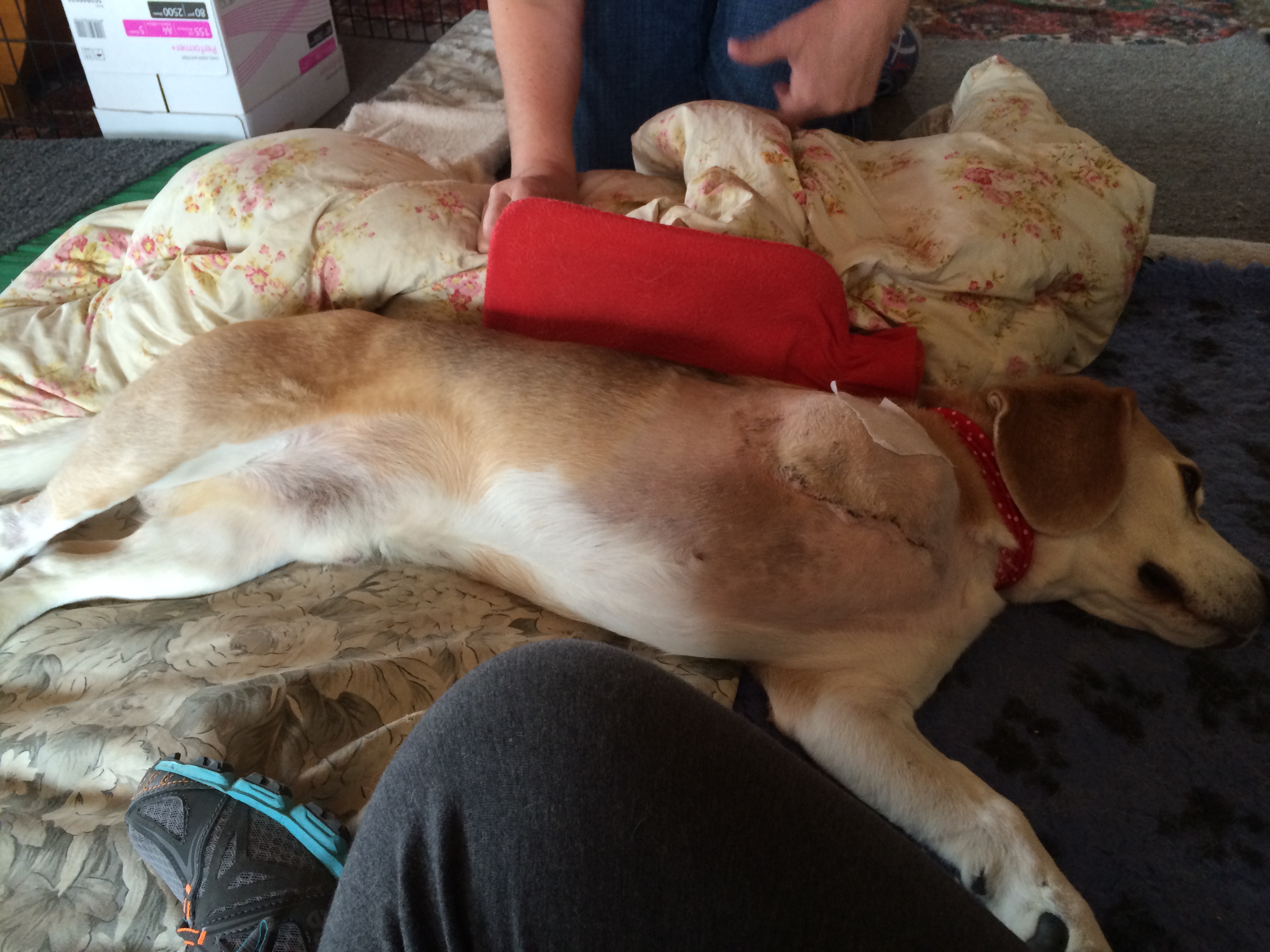
When I saw Teddy on Monday, Jill was stressed and Teddy was clearly not himself.  We introduced a hot water bottle (or ‘hottie’ as they are known here) on his back which seemed to provide relief and comfort.  I also gave Jill a CD from the Through a Dog’s Ear range.  This music is designed specifically for dogs to help calm and treat anxiety.  These seemed to assist Teddy in the short term to relax and rest.

But Teddy needed better pain management…

Teddy and his 'hottie'

Teddy and his ‘hottie’

Jill took Teddy back to his vet several times this week to discuss pain relief.  She freely admits, “I didn’t feel that I was being listened to as the owner.  I knew Teddy better than anyone.  Persistence, in my case, finally paid off.”

We seemed to agree on Monday that he was taken off his pain medication too quickly – he was taking only Previcox at the time –  and his body had been left vulnerable.  A Fentanyl patch was re-introduced on Monday and replaced again on Thursday.  Jill also started Teddy on Tramadol on Thursday and Teddy received a ketamine injection, too.

Meanwhile, I could tell that Teddy’s back muscles were stiff; his top line did not seem normal, and he was clearly distressed at being handled along the withers and the back.  Thankfully, since Teddy was too uncomfortable for deep massage, I was able to use the low level laser along his spine and muscles to help with blood flow and pain relief.  I know I want to passively stretch Teddy’s spine but we agreed to wait until Teddy was more comfortable before attempting this.  I was able to do passive range of motion stretching on Teddy’s legs.

Armed with this information Jill took Teddy for acupuncture on Tuesday and an osteopathic adjustment on Friday.  Both his acupuncture vet and his osteopath agreed that Teddy was in pain and that support with traditional veterinary medicines were needed.  The osteopath used gentle traction on Teddy’s back since she found his spine has become compressed.

With his pain properly managed, we can do more to help Teddy’s muscles, tendons and ligaments to adjust to his new gait.  And then true rehabilitation and exercise can begin including a greater focus on core muscle strength.

During this stressful week, Jill took to the Internet for help with Teddy’s condition.  She found a wonderful site – Tripawds Blogs – for owners of amputee dogs.  Owners soon responded with news that helped to assure Jill she had made the right decision for Teddy and gave her information to help her discuss pain management with her vet.

Owners who have been through similar adjustments with their dogs said:

  • Amputees go through an initial ‘good’ period after coming home, only to suffer because they do too much, too soon
  • The muscles of the body are under incredible strain because the body’s mechanics have changed rapidly
  • In Teddy’s case, his amputation was not preceded by a period of pain or dysfunction in the front leg – so his body had no time to adjust (such as would be the case for an osteosarcoma patient, for example)
  • Pain management medication is critical; the switch from Fentanyl to Tramadol was recommended
  • Teddy’s size is a big advantage – he’s a lot smaller than, say, a Labrador with the same conditions
  • Every dog is different and it takes a little time to find the right balance of therapies

Jill says, “In hindsight, we really took things too quickly and allowed Teddy to move around the garden area with enthusiasm.  I wish I had thought of this sooner and we may have avoided him seizing up so badly.  The Tripawds site has been a fabulous resource for me  knowing that there are others who have been through this before us.

I do feel that vets should listen to owners when it comes to understanding their animal.  And if you are not happy with your vet, you need to find someone who you are more comfortable with.  The vet can’t have all the answers when they are not with the dog as often as the owner is.  This proves that vets are not the final word in recovery – and I’m grateful that complementary practitioners are part of Teddy’s healthcare team”

It’s a new week – and we are all hopeful that Teddy is back on track to recovery.  He’s booked for massage and acupuncture this week.

Kathleen Crisley, specialist in dog massage, rehabilitation and nutrition/food therapy, Canine Catering Ltd, Christchurch, New Zealand

4th of July anxiety

My heart goes out to all of the dogs in the USA who have to suffer through 4th of July celebrations and their associated fireworks.

For many dogs, fireworks are no fun…

4th of July anxietyIf your dog is anxious (or worse) because of fireworks, here are some of the things you can do to help them through:

  • Thundershirts and anxiety wraps.  These shirts work on the basics of acupressure and  they help to stimulate acupressure points that induce a calming effect.
  • DAP  = Dog Appeasing Pheromone A pheromone is a natural chemical that animals, especially mammals, secrete.  D.A.P. is the pheromone that bitches secrete when they have puppies and are lactating.  Within 3-5 days of giving birth, the bitch secretes this pheromone and it has a calming effect on her puppies.  Scientists have isolated the chemical structure of the pheromone and re-created it. I recommend spraying it in your house and around the dog’s bedding in the later afternoon – before sunset.
  • Sedatives – for a dog that is truly overwhelmed by fireworks, prescribed sedatives from your vet are a short-term solution
  • Diversion and management – this consists of things like isolating your dog in your basement or garage (inside the car, with the radio on) to divert their attention.  By removing them to an environment where they can hear the fireworks less readily, you are removing them from the stressor – and hence, the stress response that follows.
  • Remove your dog to a quieter location, perhaps a holiday home in the country or a friend’s place out of town.  If they can’t hear the fireworks, they can’t get stressed.
  • Massage – get your massage therapist to recommend massage strokes and acupressure points that you can stimulate to encourage your dog to relax.

Long term solution:  Please lobby your local communities to ban the use of private fireworks and to limit fireworks to licensed public displays.  That way, people can enjoy fireworks but also limit our dogs’ exposure to this stressful event.

Understanding your dog’s fear of noise

Researchers from the University of Bristol School of Veterinary Sciences have investigated the occurrence of anxiety from exposure to noise and the risk factors for these behaviours.

Almost half of the owners who were interviewed reported that their dog showed at least one behavioural sign typical of fear when exposed to noises such as fireworks, thunder and gunshots, even though only a quarter had reported their dog as ‘fearful’ of noises.

scared dog of fire works

This suggests that while owners are aware of their pet’s behavioural response when exposed to a loud noise, they do not necessarily recognise this as being indicative of fear or anxiety.

And when owners don’t recognise anxiety, they don’t seek help for it.  Less than one-third of dog owners sought help for their dog’s anxiety.

The most commonly reported behavioural signs were vocalising, trembling/shaking, hiding, and seeking the comfort of people.  Since trembling and shaking are human responses to fear and anxiety, it seems like these behaviours were recognised more easily.

Other behavioural signs, such as decreased activity or salivation, did not appear to be recognised as often (possibly resulting in under-reporting). Also, signs of urination, salivation and destruction may make owners disappointed or angry, and this may over-ride the association with anxiety.

Risk of anxiety induced by noise increased with age and origin.  If dogs lived with the owner who bred them, they had a reduced risk compared to dogs purchased from the breeder by a second owner.  The researchers suggest a dog’s early life experience is an important factor in the development of fear response.

The researchers recommend there is a need for veterinarians to increase awareness among the general dog owning public about anxiety induced by loud noises and to direct them towards appropriate sources of help.  (By the way, I’ve worked with dogs using a programme of de-sensitization and relaxation techniques to help treat anxiety).

Source:  University of Bristol media statement


