Tag Archives: Dog

Proud Mum

It has been a great week for Izzy (and it’s only Wednesday!).

Over the weekend, she was my ‘demo dog’ at workshops to teach owners how to give their own dogs a relaxation massage.   Izzy is very comfortable on  my massage table and chose to remain there during the last half of the workshop rather than getting down on the floor…

Izzy relaxes on my massage table during my "Learn Dog Massage" workshop

Izzy relaxes on my massage table during my “Learn Dog Massage” workshop

And then on Monday night, she visited a local scout group so our local coordinator for Greyhounds as Pets could talk about the re-homing of retired greyhounds.  Izzy loves children, and soaked up all their love and affection.

Izzy at ScoutsIMG_0380


I’m so proud!

Kathleen Crisley, specialist in dog massage, rehabilitation and nutrition/food therapy, Canine Catering Ltd, Christchurch, New Zealand

Throwaway pups…

This article from the Guardian, Throwaway pup trend makes Britons dogs’ worst enemies is sobering.  It talks about disposable pups, bought with little or no knowledge of how to care for them, and fueling a demand for irresponsible breeding with the subsequent flow-on effects for animal welfare and adoptions.

But what I found really interesting is a quote from the People’s Dispensary for Sick Animals spokeswoman, Vicki Larkham.  “Millions of dogs aren’t getting off-the-lead exercise outside their home or garden for 10 minutes or more on a daily basis.  Close to a quarter of a million never go for walks on their lead for 10 minutes or more at all.  ”

A minimum of 10 minutes?  Are you kidding?

I support a minimum of 30 minutes, and twice a day.  Most sources I read suggest a minimum of 30 minutes once a day…but 10 minutes?  Where did that come from?

If you think walking a dog for 10 minutes a day will result in a happy, healthy and well-adjusted dog, you are kidding yourself.  Do everyone a favour and don’t get a dog…

Kathleen Crisley, specialist in dog massage, rehabilitation and nutrition/food therapy, Canine Catering Ltd, Christchurch, New Zealand


Moving house with a dog

Shifting homes is rated amongst the top 10 stressful life events.  And it is well documented that dogs are also affected by this stress.

Tips to help your dog settle in include:

  • Remove them from the house on moving day to a familiar place (at a friend’s or relative’s)
  • Keep to routine as much as possible (morning/afternoon walks, meal times)
  • Bring your dog’s toys, blankets and crate with you and set them up early in the new residence
  • Reinforce fences and gates to ensure your dog isn’t tempted to return home

…but I have another suggestion, based on our recent house move with Izzy…

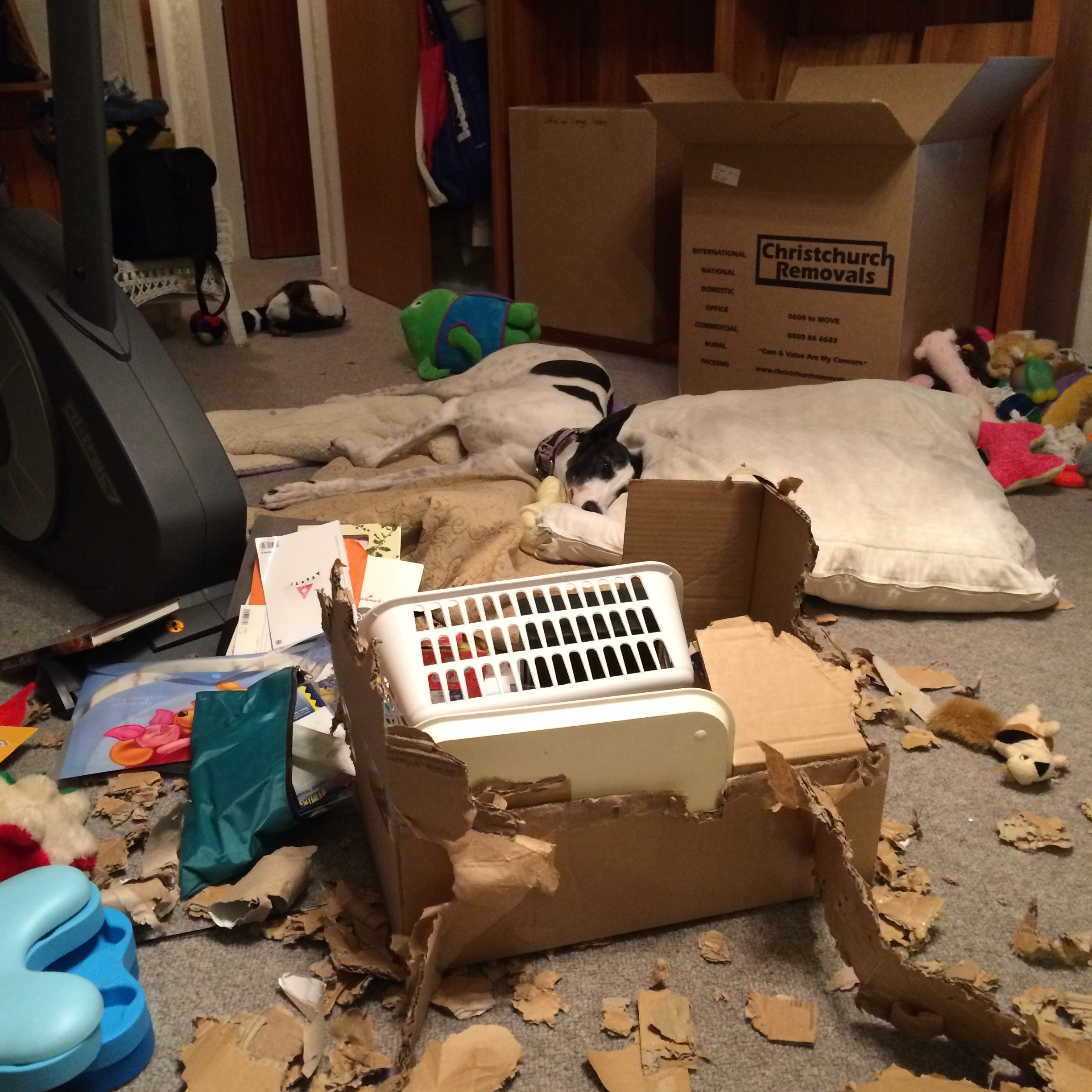
Let your dog unpack boxes!

Izzy's unpacking job 29 June 2015


Kathleen Crisley, specialist in dog massage, rehabilitation and nutrition/food therapy, Canine Catering Ltd, Christchurch, New Zealand

In Memory of Denali (a fitting 1000th post)

****Warning****   For anyone who has loved and lost a dog, this video will bring you to tears.  It certainly did for me.  But I couldn’t think of a more fitting 1000th post for this blog – a tribute to the human/dog bond.

This short film is about Denali, photographer/cinematographer Ben Moon’s dog, and their life story together.

Kathleen Crisley, specialist in dog massage, rehabilitation and nutrition/food therapy, Canine Catering Ltd, Christchurch, New Zealand


A therapy dog to help mourners

Say ‘therapy dog’ and most people will think of hospitals, rest homes, and mental health services.  Some may also think about dogs supporting witnesses when they have their day in court….but now there’s a growing use of therapy dogs in funeral homes.

This video, from the Ballard-Durand funeral home in New York, promotes Lulu, a Goldendoodle, who can be booked on request for funeral services.

The loss of a loved one and funerals, in general, are times of great emotional stress.  How nice it is that dogs are offering comfort in these situations and that they are being accepted by professional funeral directors.

Kathleen Crisley, specialist in dog massage, rehabilitation and nutrition/food therapy, Canine Catering Ltd, Christchurch, New Zealand

A unique photo series

Professional photographer Fred Levy of Maynard, Massachusetts heard about Black Dog Syndrome at the local dog park and decided to use his skills to help combat it.

As described here in my 2013 post, Black Dog Syndrome is a phenomenon reported by many shelters and rescues.  Black dogs are often depicted in movies and other media as mean, vicious and menacing.   And since many shelter don’t have lighting for ‘ambiance’ these dogs are often not seen in a flattering light.

“A dog shouldn’t be overlooked just because of its coat,” Levy said. “That’s a minor element when it comes to the dog.”

So he’s created a lovely photo series of black dogs using a black background to show off their beauty.

Here are a couple of examples:

Springer spaniel Aki

Aki, a Springer Spaniel

In this Oct. 2013 photo provided by Fred Levy, a black Labrador retriever named Denver poses in Levy's studio in Maynard, Mass. Levy, a pet photographer, first heard about “Black Dog Syndrome” in a 2013 conversation at a dog park. It’s a disputed theory that black dogs are the last to get adopted at shelters, perhaps because of superstition or a perception that they’re aggressive. The idea inspired Levy to take up a photo project on their behalf. (Fred Levy via AP)

A black Labrador retriever named Denver

And view more of the series on Fred’s website…

Great idea!

Source:  Yahoo news

The consequences of rescuing a dog

Last week, a Georgia man named Michael Hammons spotted a Yorkie-type dog inside a hot car parked at a Athens, Georgia shopping mall.  He broke the window to rescue the dog.

When the dog’s owner returned, she was angry that he had damaged her vehicle and insisted that police charge him.  His and the dog’s story have gone viral in what I consider a welcome debate about animal welfare and the rights of individuals who step in to intervene.

It seems that Georgia isn’t one of the 16 US states that prohibits leaving animals in cars in unsafe conditions.   Advocates are now using this latest situation as evidence as to why the law needs changing.

Last year, I saw a couple leave their dog parked in the full sun at a local shopping mall with a large breed Lab cross in the back seat.  I phoned the police on 111 (New Zealand’s version of 911) and then waited by the car until they arrived.   I monitored the dog closely to see if he was showing signs of heat stress.

The police, followed by the SPCA, responded to my call quite quickly and the policeman took my details should I be needed as a witness.  And then he encouraged me to leave the scene since they would take care of the situation and wait for the people to come back to speak with them.

Have you ever helped rescue a dog from a hot car?  How were you treated?

Kathleen Crisley, specialist in dog massage, rehabilitation and nutrition/food therapy, Canine Catering Ltd, Christchurch, New Zealand

Doggy quote of the month for May

‘People teach their dogs to sit; it’s a trick.  I’ve been sitting my whole life, and a dog has never looked at me as though he thought I was tricky.’

– Mitch Hedberg, comedian (1968-2005)

Chaos returns…

Fairfax newspapers in New Zealand are reporting on the return of Chaos, a deaf dog who went missing on 15th March.  A great story, read it here.

Waitara man Marc Glover, partner Alicia James and their 3-year-old daughter Saphire-Rose, are over the moon that their dog, Chaos, was found after going missing for eight days.  (Photo by Sam Scannell, Fairfax NZ)

Waitara man Marc Glover, partner Alicia James and their 3-year-old daughter Saphire-Rose, are over the moon that their dog, Chaos, was found after going missing for eight days. (Photo by Sam Scannell, Fairfax NZ)

Kathleen Crisley, specialist in dog massage, rehabilitation and nutrition/food therapy, Canine Catering Ltd, Christchurch, New Zealand

Hear bark or C-Barq?

I’ve just signed Izzy up so we can complete a C-Barq questionnaire for her.

I know what you are thinking:  you don’t ‘see’ barks, you hear them.  Well actually, C-Barq stands for ‘Canine Behavioral Assessment and Research Questionnaire’ and it’s another example of citizen – or participatory – science.

Created by Dr. James Serpell who is a behaviorist at the Center for the Interaction of Animals and Society (CIAS) in Pennsylvania, the questionnaire is designed to provide dog owners and professionals with standardized evaluations of temperament and behavior.    The Center is based within the School of Veterinary Medicine at the University of Pennsylvania.
Penn University medicine

Tested extensively for reliability and validity on large samples of dogs of many breeds,  the current version consists of 101 questions describing the different ways in which dogs typically respond to common events, situations, and stimuli in their environment. It should take about 15 minutes to complete (I haven’t done this yet).

Please pay attention, however, to the sign-in page where questions are asked about your dog’s breed, background, and behavior.  This helps in coding the answers for analysis.

So far, over 80,000 dogs have been included in the study. Dr Serpell says, “There is no other breed or species of animal with such a wide variety of appearance and behavior.”

Between 10 percent and 15 percent of dogs can show very high levels of aggression, Serpell says, while 20 or 30 percent show no aggression.

Pit bulls and Akitas, popular breeds for fighting and guard dog duty, show serious aggression toward other dogs. But the title for most aggressive overall actually goes to tiny dachshunds, which display heightened aggression toward dogs, strangers and even their owners.

Source:  Science Friday on pri.org

Kathleen Crisley, specialist in dog massage, rehabilitation and nutrition/food therapy, Canine Catering Ltd, Christchurch, New Zealand