‘People teach their dogs to sit; it’s a trick. I’ve been sitting my whole life, and a dog has never looked at me as though he thought I was tricky.’
– Mitch Hedberg, comedian (1968-2005)

‘People teach their dogs to sit; it’s a trick. I’ve been sitting my whole life, and a dog has never looked at me as though he thought I was tricky.’
– Mitch Hedberg, comedian (1968-2005)
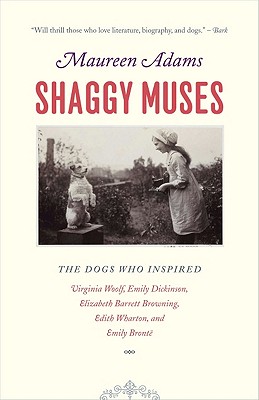
Shaggy Muses by Maureen Adams offers a new twist in understanding the writing and lives of five famous women authors.
This book is about the dogs who inspired Virginia Woolf, Emily Dickinson, Elizabeth Barrett Browning, Edith Wharton and Emily Brontë.
In this book, you will understand the role that Flush a golden Cocker Spaniel, who kept Elizabeth Barrett Browning company, had on her life and writing. Her life was isolated and frequented by ill health. That is, of course, until Robert Browning enters the scene. When Elizabeth marries Robert in a secret ceremony and leaves her family home without her father’s permission, she makes sure Flush goes too.
Virginia Woolf also had a Cocker Spaniel, named Pinka.
Emily Dickinson found solace with Carlo, a Newfoundland. Edith Wharton’s comparatively long life was filled with the companionship of a series of Pekingese.
I was, however, unprepared for the story of Emily Brontë and her Mastiff, Keeper. One day, after finding Keeper resting on a bed inside the house, Emily beats the dog bloody with her bare hands. The author relates the story in terms of ‘typical’ domestic violence behavior and the apparent struggle of wills between Keeper and Emily. Keeper, in truly dog style, remained loyal to her until the end, accepting her ministrations to his swollen face and eyes. (I’m afraid, however, that this story has put me off reading any more of Brontë‘s work, most likely for life).
If you like literature and dogs, this book is for you. I liked the historical context as the author relates the stories of each woman in chronological order. It puts into perspective the influences on each woman’s life and also how society was changing (Virginia Woolf, for example, had a notable lesbian love affair with fellow author Vita Sackville-West).
Kathleen Crisley, specialist in dog massage, rehabilitation and nutrition/food therapy, Canine Catering Ltd, Christchurch, New Zealand
The Department of Homeland Security (USA) has been conducting independent assessments and developing products to assist canine explosive teams.
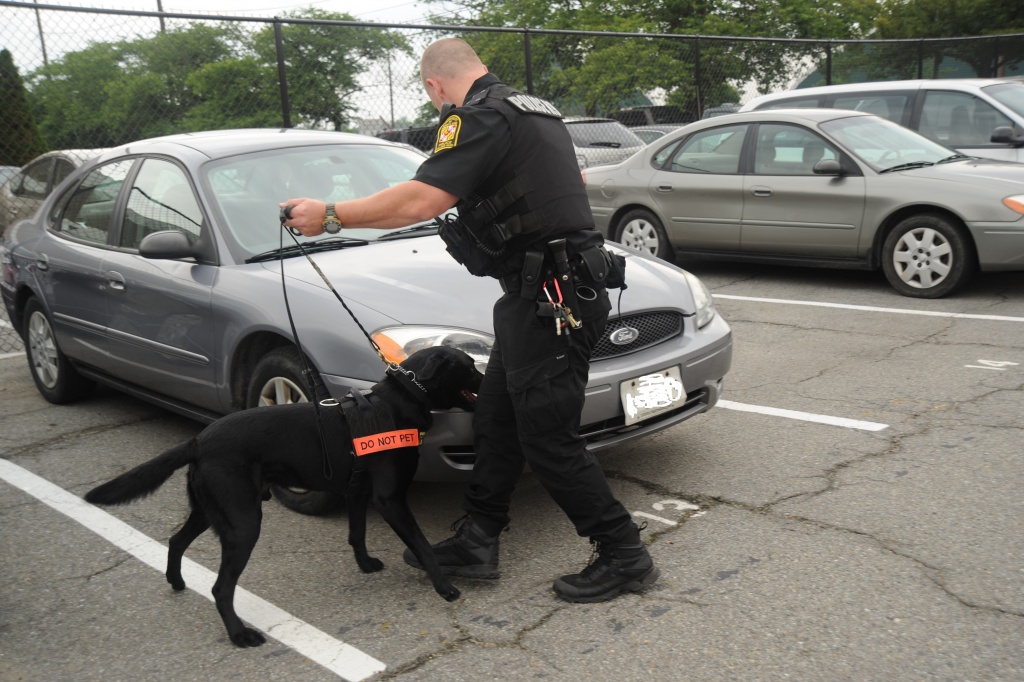
An explosive detection dog in action. Photo courtesy of the Department of Homeland Security
One of the biggest challenges in the training and testing of canine teams results from the explosives materials themselves – especially new homemade explosives. Due to the potential safety risks of explosives, only specially trained federal explosive technicians can provide the material for training and testing. This not only limits training times and opportunities, but also increases the costs since the technicians must travel to a central location for multi-day training events.
Researchers have been developing a new training aid that matches the scent of explosive materials but poses no danger to the trainers, the canines or the environment. It is currently undergoing field testing within federal, state and local canine detection teams. A key objective was to for the canines to react to the non-hazardous, non-explosive training aid the same way they would actual explosive material.
“It doesn’t go boom if you drop it, hit it or light it on fire,” said Canine Program Manager, Don Roberts. “That allows teams to take the training from the very controlled environment we currently have to train in for safety reasons and put it in a real-world scenario – for example putting the odor in a cinderblock and seeing if the dog can find it. We can put this new training aid in car wheel wells, airports etc., without fear that they’ll explode.”
S&T’s partner, Johns Hopkins Applied Physics Lab, developed the new training aid, Roberts said. After a number of trials, they’re ready to transfer the technology to the Transportation Security Administration, the primary customer for the aid. The bigger news, according to Roberts, is that the product was also designed to fit first responders’ needs as well.
“The design price point and usability factor has been geared to the first responder community – state and local explosive detection dogs who don’t have the regular training support TSA has. They are the ones who really need these products,” said Roberts.
The training aids are made to be thrown away after being used. These aids can last for over eight hours and can be stored up to two years. The scent can be dissolved in water, as opposed to the previous explosive training materials, which required special handling, transport and had to be stored in a bunker.
Next steps for this program include developing a second scent for training the dogs, and licensing so that the products can be produced outside of the federal government.
Source: Department of Homeland Security media release
Read my other blog posts about explosives detector dogs:
“It is the same with dogs as with children, if one wants them to be loved, they must be well brought up.”
– Madame Charles Boeswilwald, 19th century French author
Posted in dog quotes
Tagged 19th century, children, dogs, French author, Madame Charles Boeswilwald
I’ve just signed Izzy up so we can complete a C-Barq questionnaire for her.
I know what you are thinking: you don’t ‘see’ barks, you hear them. Well actually, C-Barq stands for ‘Canine Behavioral Assessment and Research Questionnaire’ and it’s another example of citizen – or participatory – science.
Created by Dr. James Serpell who is a behaviorist at the Center for the Interaction of Animals and Society (CIAS) in Pennsylvania, the questionnaire is designed to provide dog owners and professionals with standardized evaluations of temperament and behavior. The Center is based within the School of Veterinary Medicine at the University of Pennsylvania.

Tested extensively for reliability and validity on large samples of dogs of many breeds, the current version consists of 101 questions describing the different ways in which dogs typically respond to common events, situations, and stimuli in their environment. It should take about 15 minutes to complete (I haven’t done this yet).
Please pay attention, however, to the sign-in page where questions are asked about your dog’s breed, background, and behavior. This helps in coding the answers for analysis.
So far, over 80,000 dogs have been included in the study. Dr Serpell says, “There is no other breed or species of animal with such a wide variety of appearance and behavior.”
Between 10 percent and 15 percent of dogs can show very high levels of aggression, Serpell says, while 20 or 30 percent show no aggression.
Pit bulls and Akitas, popular breeds for fighting and guard dog duty, show serious aggression toward other dogs. But the title for most aggressive overall actually goes to tiny dachshunds, which display heightened aggression toward dogs, strangers and even their owners.
Source: Science Friday on pri.org
Kathleen Crisley, specialist in dog massage, rehabilitation and nutrition/food therapy, Canine Catering Ltd, Christchurch, New Zealand

I have just finished reading Animals in Emergencies: Learning from the Christchurch earthquakes by Annie Potts and Donelle Gadenne. This was a must-read book for me. Why? I’m in it!
Published in late 2014, this book is largely a compilation of stories about people and animals caught up in the earthquakes of 2010 and 2011. However, since it is also a text produced by university academics, it aims to serve a purpose as “an introduction to the specialised area of animal welfare management during emergencies.”
I found the first 90% of the book the most enjoyable. Filled with stories of rescue, sheltering and individual owner’s tales of the earthquakes, the book serves to document – largely in the first person – the historical accounts of the days, weeks and months following the quakes. And I like the fact that the book doesn’t just focus on companion animal dogs and cats, but also includes stories about horses, fish, hedgehogs and other species.
But the last 10% of the book is rather disappointing (and it hurts me to have to say this). Since New Zealand is a production-based economy, this book had to focus on the fate of production animals. But this is also where the book loses its tone and momentum. Either the authors asked for interviews with farmers and researchers and were rejected, or they simply didn’t ask – we’ll never know.
Perhaps because of the lack of firsthand accounts, the book becomes too formal in its approach to describing the impact on farm animals and animals used in research. The text uses citations from newspaper articles at this point and becomes ‘preachy’ in terms of animal welfare. As someone with a personal interest in animal welfare management, the issues raised in the book are not new but the distinct ‘lessons learned from Christchurch’ is very much lost on the reader.
I’m pleased this book has been produced and I’m very honored to have my story told although I know that I’m a very small contributor to the overall efforts to assist animals following the quakes.
Animals in Emergencies has been distributed to booksellers worldwide and a paperback version is available on Amazon.com.
Kathleen Crisley, specialist in dog massage, rehabilitation and nutrition/food therapy, The Balanced Dog Ltd, Christchurch, New Zealand
“I like big butts and I cannot lie…”
– Sir Mix ALot, Baby Got Back (rapper)
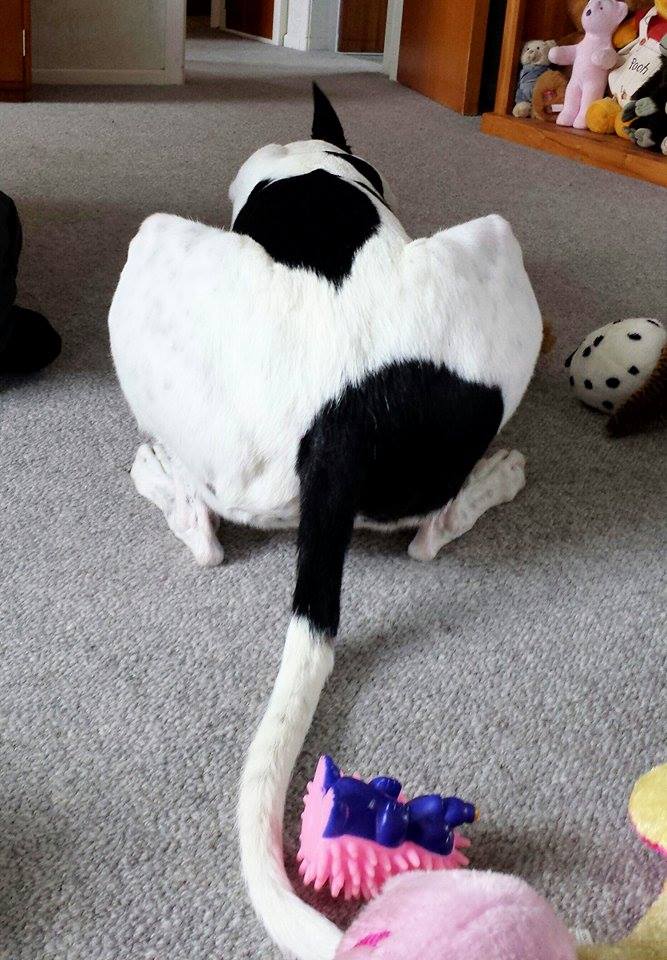
Izzy, Greyhound, adopted in October 2014 and turning 6 this month (Photo by Dany Wu)
I just had to share this…very funny!
Kathleen Crisley, specialist in dog massage, rehabilitation and nutrition/food therapy, Canine Catering Ltd, Christchurch, New Zealand
A new study suggests that dogs may have first successfully migrated to the Americas only about 10,000 years ago, thousands of years after the first human migrants crossed a land bridge from Siberia to North America.

Photo by Angus McNab
The study, which looked at the genetic characteristics of 84 individual dogs from more than a dozen sites in North and South America, is the largest analysis so far of ancient dogs in the Americas. The findings appear in the Journal of Human Evolution.
Unlike their wild wolf predecessors, ancient dogs learned to tolerate human company and generally benefitted from the association: they gained access to new food sources, enjoyed the safety of human encampments and, eventually, traveled the world with their two-legged masters. Dogs also were pressed into service as beasts of burden, and sometimes were served as food, particularly on special occasions.
Their 11,000- to 16,000-year association with humans makes dogs a promising subject for the study of ancient human behavior, including migratory behavior, said University of Illinois graduate student Kelsey Witt, who led the new analysis.
“Dogs are one of the earliest organisms to have migrated with humans to every continent, and I think that says a lot about the relationship dogs have had with humans,” Witt said. “They can be a powerful tool when you’re looking at how human populations have moved around over time.”
Human remains are not always available for study “because living populations who are very connected to their ancestors in some cases may be opposed to the destructive nature of genetic analysis,” Witt said. Analysis of ancient dog remains is often permitted when analysis of human remains is not, she said.
Previous studies of ancient dogs in the Americas focused on the dogs’ mitochondrial DNA, which is easier to obtain from ancient remains than nuclear DNA and, unlike nuclear DNA, is inherited only from the mother. This means mitochondrial DNA offers researchers “an unbroken line of inheritance back to the past,” Witt said.
The new study also focused on mitochondrial DNA, but included a much larger sample of dogs than had been analyzed before.
Source: University of Illinois press release
Yet another piece of research that points to the value of dogs and other animals. This time the research was done at the University of Missouri and focused on the social skills of autistic children.
You guessed it – the children who lived with pets developed better social skills including assertiveness. “When I compared the social skills of children with autism who lived with dogs to those who did not, the children with dogs appeared to have greater social skills,” said Gretchen Carlisle, Research Fellow.
Posted in research
Tagged assertiveness, autism, autistic children, children, dogs, Gretchen Carlisle, pets, social skills, University of Missouri







 DoggyMom.com