Tag Archives: domestic violence

People in crisis do better with their pets, researchers say

Evidence shows human and pet support services should be integrated to avoid people having to relinquish their pets in a time of crisis. Keeping them often results in better health outcomes for both the owner and animal.

Sonya McDowall with her dog, Dashii. Photo credit: La Trobe University

Sonya McDowall, a Ph.D. student presenting her research at the Big Hairy People & Pets Summit and Workshops held 10–14 October on the Gold Coast, wants policy makers to understand the documented positive outcomes when human support services work with animal support services.

“It’s cost-effective for the community, and people are healthier if they can keep their animals during a time of crisis,” Sonya McDowall said.

“Social, physical and economic factors affecting human health can easily flow onto pets and companion animals.”

A 2020 survey by Domestic Violence NSW found that 42% of respondents said victim-survivors delayed leaving a perpetrator for over 12 months due to barriers to accessing support related to their animals.

A recent U.S. survey showed 91% of people had experienced some degree of financial stress in the past year related to the cost of pet care.

Statistics from relevant research:

  • In Australia, social return on investment for programs that support people experiencing a crisis to help keep their companion animal is $8.21 for each $1 invested, (Source: Emergency Animal Boarding: A Social Return on Investment)
  • Even before the cost of living and rental market crisis, a study in the United States found between 35.1% and 42.1% of participants relinquished their pet due to moving as the landlord would not allow pets. (Source: Moving as a reason for pet relinquishment: a closer look)
  • Studies have shown that between 26% and 71% of female companion animal guardians experiencing family violence reported that the offender had seriously harmed or killed the companion animal.
  • 48% of domestic violence survivors are reportedly hesitant to escape their domestic violence environment due to the fact of being concerned about what will happen to the family pet. (Source: An exploratory study of domestic violence: Perpetrators’ reports of violence against animals)
  • 18%–48% of domestic violence survivors have delayed entering a domestic violence shelter due to the presence of welfare concerns for their pet that they have had to leave behind. (Source)
  • Foodbank Australia hunger report 2022 highlighted that over half a million people in Australia are struggling with the cost of food; of this population 67% have pets. This has resulted in a challenge for pet owners of which studies have reported between 30% and 50% of participants identifying that having access to low-cost or free pet food would have prevented them from relinquishing their pet.

Source: La Trobe University

Safe Steps for Australian pets

The Victorian Government has announced a new program to help victims of domestic violence.

“Pets are an integral part of families and we know that women and children are making decisions not to flee violence because they are concerned about the future and welfare of their pet,” said Families and Children Minister Jenny Mikakos, at the launch.

It is difficult for [family violence] refuges to accept pets.”

Support group Safe Steps said threats against pets were often used as weapons by perpetrators of family violence

Support group Safe Steps said threats against pets were often used as weapons by perpetrators of family violence

“We want to be able to provide them with the support to be able to place the pet with an animal welfare shelter.”

The Government said it would provide $100,000 over the next four years and Safe Steps would work with animal welfare agencies like the RSPCA to implement the program.

The additional funding will lift capacity to house pets at risk while their family members go to shelters to escape abuse.  Until now, there has been a smaller volunteer network to take in pets in foster homes.

The connection between family violence and violence against animals is well documented.  Pets in abusive homes are often targeted and threatened and so women living in abusive situations often do not escape for fear that their animals will be harmed.

Source:  ABC News

Related post:  Sheltering people and pets from domestic violence

Sheltering people and pets from domestic violence

In the late 1990s, Dr Frank Ascione from Utah State University published some scary statistics:  48 percent of domestic violence victims will stay in an abusive situation because they fear leaving their pets behind.

In New York City in 2013, the Urban Resource Institute teamed up with sponsorship from Purina to launch a pilot program:  People and Animals Living Safely (PALS).  PALS is a co-sheltering program that allows pets to escape domestic violence and remain with their owners in pet-friendly apartments.  A first for New York City, it’s been remarkably successful.  The apartments are always full.

So this year, the program was expanded to include a dog park and play area for the sheltered animals.  Aptly called the Purina Play Haven and Dog Park, this park, full of enrichment activities, was designed by a professional architect.

In these videos on YouTube, have a look at the dog park and hear about how this program fills a need for those unfortunate enough to have become the victims of domestic violence.

Sometimes ‘big corporate’ money can be used for a higher purpose!

Kathleen Crisley, specialist in dog massage, rehabilitation and nutrition/food therapy, Canine Catering Ltd, Christchurch, New Zealand


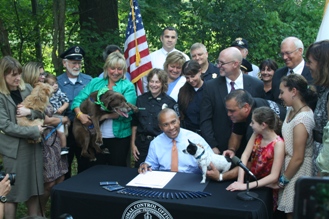
Congratulations, Massachusetts – a job well done

I’m very proud of my home state of Massachusetts.   Last week, Governor Patrick signed bill  S. 2192 “An Act Further Regulating Animal Control” into law.

The new law:

  • Creates a statewide spay/neuter program to reduce the number of homeless animals and will, in turn, also reduce the cost to cities and towns for housing and sheltering these animals. This is funded by a voluntary tax check off.
  • Adds enforcement provisions to section 139A (the spay/neuter deposit law for animals adopted from shelters and animal control facilities) to ensure homeless animals can’t reproduce.
  • Requires animal control officers to receive training.  This is funded by the tax check off.
  • Prohibits carbon monoxide and carbon dioxide gas as a means to “euthanize” dogs and cats.  (Anyone who saw the HBO documentary One Nation Under Dog knows why this important)
  • Improves the dangerous dog law in a breed neutral manner
  • Allows pets to be included in domestic violence protection orders

The law will also create some statewide oversight for animal control, which previously did not exist in the state; creates categories for kennel licensing; creates consistency in the holding time for stray dogs and provide other meaningful updates to the state’s antiquated animal control laws.  An amendment to the bill also added some restrictions on the tethering of dogs.

This new law will not cost money, it will actually minimize costs to cities and towns by reducing the number of homeless animals and the associated cost to house and take care of them. In addition, ensuring that animal control officers are trained, and improving the dangerous dog law to protect public safety, will provide indirect cost savings.

Best of all, this bill proves that animal welfare agencies can work together.  The bill was drafted as a collaboration between the Animal Control Officers Association of Massachusetts (ACOAM), the Massachusetts Society for the Prevention of Cruelty to Animals (MSPCA), the Animal Rescue League of Boston, the state’s Bureau of Animal Health within the Department of Agricultural Resources and the Massachusetts Veterinary Medical Association (MVMA).