Tag Archives: family

The survey says…

A new UK survey conducted on behalf of Purina has revealed what previous studies have shown, that the human-animal bond is important and that society benefits from our supportive relationship with animals.

Over two-thirds of pet owners feel a stronger bond with their pets than their family and friends.

Top ten ways the human-pet bond helps people feel better

10. Coping with Break-Ups 
For 32% of pet owners, the bond with their pets has been instrumental in helping them navigate the emotional turmoil of a break-up.

9. Support Through Health Conditions 
Approximately 42% of pet owners have found emotional support through their pets while dealing with health challenges.

8. Navigating Interpersonal Conflicts 
Pets serve as a source of comfort during interpersonal conflicts, helping 44% of owners cope with emotional stress.

7. Snuggling for Comfort 
46% find comfort in snuggling with their pets, providing emotional warmth and support.

6. Bringing Smiles 
49% reported that their pets bring joy into their lives and make them smile.

5. Alleviating Loneliness 
For 52% of pet owners, the presence of their pets significantly reduces feelings of loneliness, providing companionship and love.

4. Joyful Greetings 
A warm greeting at the door from a pet can bring joy, as experienced by 52% of pet owners.

3. Distraction from Worries 
Pets help their owners take their minds off things, with 54% of pet owners benefiting from this comforting distraction.

2. Uplifting Spirits When Feeling Low 
The companionship of pets provides comfort for 59% of owners when they are feeling low, helping to brighten their mood.

1. Support During Sadness and Life Changes 
61% of pet owners asked find solace in their pets during moments of sadness or significant life changes, including after a tough day at work.

Source: Nestle UK

About half of U.S. pet owners say their pets are as much a part of their family as a human member

Families come in all shapes and sizes. And for a majority of Americans, family includes their pets.

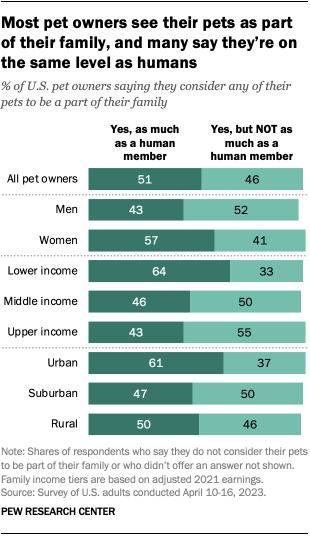
A bar chart that shows most pet owners see their pets as part of their family, and many say they’re on the same level as humans.

Most Americans (62%) own a pet, including about a third (35%) who have more than one. And nearly all U.S. pet owners (97%) say their pets are part of their family, according to a new Pew Research Center survey.

About half of pet owners (51%) not only consider their pets to be a part of their family but say they are as much a part of their family as a human member. Groups that are more likely to say this include:

  • Women: 57% of women pet owners say their pets are just as much a part of their family as a human member, compared with 43% of men who own pets.
  • People with lower family incomes: 64% of pet owners in this group consider their pets to be as much a part of their family as a human member, compared with 46% of those with middle incomes and 43% of those with higher incomes.
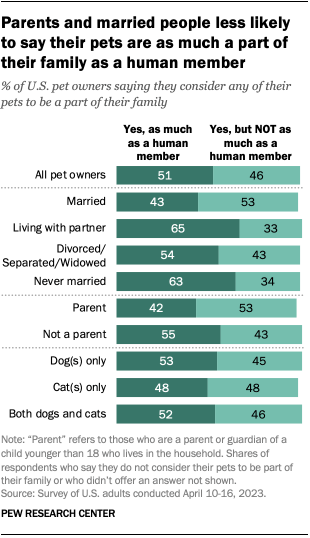
A bar chart showing that parents and married people are less likely to say their pets are as much a part of their family as a human member.
  • People living in urban areas: 61% of pet owners in urban areas say their pets are as much a part of their family as a human member, compared with 50% of those in rural areas and 47% of those in the suburbs.

The share of pet owners who think of their pets as part of their family as much as a human member doesn’t vary notably by age, race or ethnicity.

Pet owners’ family situation is also related to how they think about their pets. Unmarried pet owners and those who do not have children younger than 18 at home are the most likely to consider their pets to be as much a part of their family as a human member.

What about dog owners versus cat owners? The difference is narrow, but those who only have dogs (53%) are more likely than those who only have cats (48%) to think of their pets in the same way they think of a human family member.

Who is most likely to own pets?

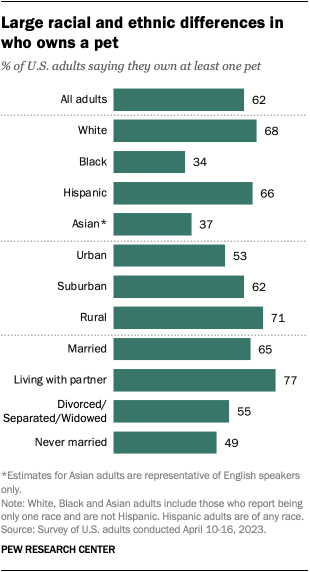
A bar chart that shows large racial and ethnic differences in who owns a pet.

Most Americans own pets, but some groups stand out as being more likely to do so:

  • White and Hispanic adults: 68% of White and 66% of Hispanic adults own a pet. By comparison, just 37% of Asian and 34% of Black adults are pet owners.
  • Rural Americans: 71% of adults living in rural areas have a pet – much higher than the shares in suburban and urban areas. Rural Americans also stand out as the most likely to have multiple pets: 47% of adults in rural areas have more than one pet, compared with 32% in the suburbs and 26% in urban areas.
  • People who are living with a partner or married: 77% of partnered and 65% of married adults have pets. That share drops much lower to 55% among people who are divorced, separated or widowed and to 49% among those who have never been married.

To a lesser extent, women and people in middle-income families are also more likely than others to own pets. People younger than 65 are the age group most likely to have pets.

Dog versus cat ownership

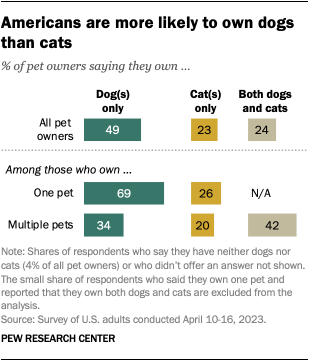
Dog ownership is more common than cat ownership in the United States.

A bar chart that shows Americans are more likely to own dogs than cats.

Among all pet owners:

  • 49% say they have dogs only
  • 23% have cats only
  • 24% have both dogs and cats
  • 4% have neither cats nor dogs

Most pet owners with only one pet say that pet is a dog (69%). Among those with multiple pets:

  • 34% say all their pets are dogs
  • 20% say all their pets are cats
  • 42% say they have both dogs and cats

How Americans think pets are treated

We asked Americans how they think pets are treated compared with people in the U.S.

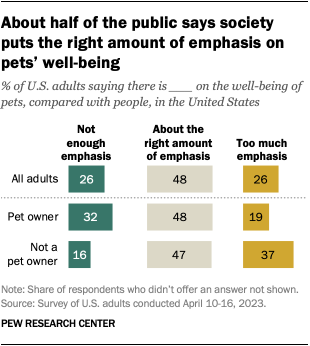
A bar chart that shows about half of the public says society puts the right amount of emphasis on pets’ well-being.

Some 26% of Americans say there is not enough emphasis on the well-being of pets, and an equal share say there is too much. Roughly half (48%) say there’s about the right amount of emphasis on the well-being of pets.

Pet owners are twice as likely as non-pet owners to say there is not enough emphasis on pets’ well-being. Non-pet owners are about twice as likely as pet owners to say there is too much emphasis.

Among pet owners, 51% of those who say their pet is as much a part of their family as a human member say there isn’t enough emphasis on the well-being of pets. Just 13% of those who say their pet is a part of their family but not as much as a human member say the same.

In turn, 32% of those who say their pets are part of their family but not as much as a human member say there’s too much emphasis on pets’ well-being. Just 6% of those who see their pets the same as a human member of their family say this.

Note: Here are the questions used for this analysis, along with responses, and its methodology.

Source: Pew Research Center

Survey Finds Over Half of Dog Owners Kiss Their Pooches More Than Their Partners

If I am totally honest, I like this kind of simple research at times!

– DoggyMom.com


kissing-dog

Photo: Getty

Pucker up, pup!

Riley’s Organics, an organic dog treat company, recently conducted a survey to see just how close pet parents are to their dogs.

The company asked dog owners across the U.S. how much TLC they give their canines, and found that dogs often get more love than humans.

According to Riley’s results, 52% of respondents admitted to kissing their dog more than their partner. This trend continued into the respondents’ sleep habits. Out of those surveyed, 52% said they prefer to sleep in bed with their dog over their partner.

These numbers, while likely surprising to some who don’t own pets, make more sense when you learn that 94% of pet parents surveyed by Riley’s said they consider their dog to be one of their best friends.

Significant others can’t compete with the overwhelming love of a true blue BFF.

Source:  People.com

Image

A thought for Monday

Dogs and family

Palliative care for dogs

In humans, palliative care is provided to patients to help relieve symptoms of chronic or serious illnesses, such as Alzheimer’s disease or cancer.  This type of treatment includes pain relief but also stress relief to enhance quality of life.

Palliative care is also available for dogs and is a viable alternative to immediate euthanasia when the vet and the family feel that the dog still has quality of life and any pain can be managed.

As a canine massage and rehab practitioner, I get involved in palliative care cases.  Some dogs are at the palliative care phase when I am called in.  Others have been my clients for a while and their life situation has changed.  Using acupressure, massage and/or low level laser, I’m able to help with pain management and give the dog a bit of TLC.  I often play relaxing music for the dog to make the time even more special.

In my experience, palliative care can be a very positive, transitional phase for the family.  It’s a time to say goodbye. If there are children in the household, parents are able to explain what will happen when a dog is put to sleep and the children learn to understand the vulnerabilities of a dog who is old or who is ill.

It will never be easy to say goodbye, but thanks to quality veterinary care and a greater understanding of pain management, more owners can opt for a palliative care phase for their dog – so they can enjoy as much time together as possible.