Tag Archives: human-animal bond

Quantifying the Effects of Service Dogs for Veterans with PTSD

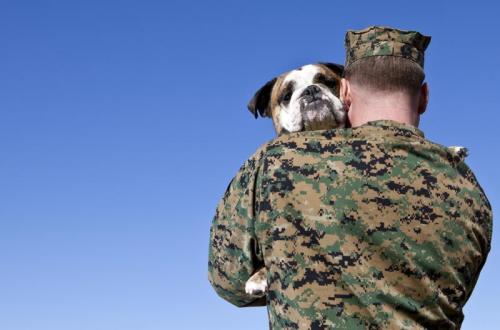
veteran with dog


Researchers from the Purdue University College of Veterinary Medicine’s Center for the Human Animal Bond will analyze the influence service dogs have on the lives of military veterans suffering from post-traumatic stress disorder (PTSD) in a unique clinical trial.

According to the United States Veterans Administration, 22 veterans commit suicide each day, and at least 40 percent have been diagnosed with PTSD. The rate could be even higher, as many cases of PTSD go undiagnosed.

Previous studies have suggested that individuals who bond with their pet dogs exhibit elevated levels of oxytocin – sometimes referred to as the “cuddle hormone” because it sparks emotional responses that contribute to relaxation and trust. Additionally, the National Center for PTSD claims dogs can encourage veterans to communicate more through commands and training, and prompt them to spend more time outdoors and meet new people.

These benefits support anecdotal reports that show an increase in the prevalence of service dogs for individuals with PTSD, but scientific evidence examining this growing trend and its effects on PTSD patients is still lacking.

“Many veterans are increasingly seeking complementary interventions for PTSD, including service dogs,” stated Maggie O’Haire, lead researcher and assistant professor of human-animal interaction at Purdue. “Yet, even with the well-meaning intentions of service dog organizations that are working to meet the demand, our systematic review of scientific literature confirms a lack of published, empirical research on the effects that service dogs have on veterans and their spouses.”

To help carry out the study, the research team has partnered with K9s for Warriors – one of the nation’s leading providers of service dogs to military vets suffering from a variety of conditions including PTSD, traumatic brain injuries, or sexual trauma as a result of service post-9/11.

The team hopes to determine what sort of PTSD symptom changes veterans may experience as a result of having a service dog, as well as any effects on social functioning and physiological biomarkers.

According to a university release, standardized survey instruments and objective measures of physiology will be used to track stress and functioning. The researchers will also use a novel ecological momentary assessment protocol to capture the role and function of the dogs in everyday life.

The results will be the first evidence-based data to be published that quantitatively identifies the roles and effects of service dogs for military veterans with PTSD.

The study is unique because it applies research methodology and evidence-based science to an area that has typically relied on emotion, according to O’Haire.

“Without scientifically sound studies that establish proof-of-concept for the therapeutic efficacy of PTSD service dogs, this animal-assisted intervention strategy will continue to be minimized as an unsupported and potentially unsound practice, despite anecdotal reports that the dogs may have a significant impact,” added O’Haire.

Source:  www.laboratoryequipment.com
Sharing your bed with your pet (or other humans)

About half of all pet owners share their beds or bedrooms with their pets at night. Although this has been the case through the ages, remarkably few studies have been done about the benefits and drawbacks of this practice.

In an article in Springer’s journal Human Nature, the authors argue that society regards both human-animal and adult-child co-sleeping with the same unnecessary apprehension. These concerns should, however, be set aside because both practices have their benefits, says lead author Bradley Smith of Central Queensland University in Australia.

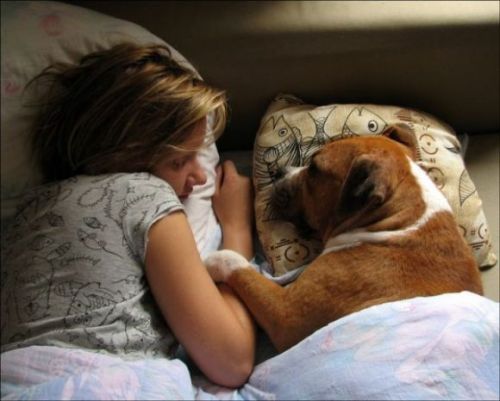
sleeping together

Sleeping arrangements between humans have evolved over time and across cultures. In medieval Europe, for instance, sleep was a public and communal affair. It was not uncommon to receive visitors in the bedroom, or for many people to sleep in the same bed. Sleeping with others was a way to increase personal security, conserve resources, and generate warmth. Sleeping with children from birth is still the norm in many cultures, for instance in Egypt and among indigenous cultures in unindustrialized populations. Intergenerational co-sleeping is generally more prevalent in collectivist Asian countries than in contemporary, individualistic or industrialized Western cultures.

In the West, sleep is nowadays regarded as an individual and private experience that helps the body and mind to optimally rest and recuperate. The normative shift from sleep as a public and social affair to a private one arose through a complex “civilizing” process starting in the Victorian era. Social norms and rules began to dictate that each person should sleep in a single bed, in a private place away from public view, and wear appropriate sleeping attire. This gradually introduced the concept of the private bedroom and private sleep to many social classes.

In their paper, Smith and his co-authors use dogs as an example of human-animal co-sleeping. They compare human-canine sleeping with adult-child co-sleeping and argue that both forms of co-sleeping share common factors for establishment and maintenance, and have similar advantages and disadvantages.

According to the Australian researchers, current apprehension about human-animal co-sleeping and bed sharing between parents and their children focuses too much on possible negative aspects or consequences, such as poor health, impaired functioning, the development of problematic behavior, and even sexual dysfunction.

“Apart from its clear reproductive function for the survival of the species, as well as physiological support for the quality and quantity of sleep that are essential to individual health and well-being, co-sleeping fulfils basic psychological needs and reinforces and maintains social relations,” highlights Smith. “Throughout history, humans have shared their sleeping spaces with other humans and other animals.”

“We propose that human-animal and adult-child co-sleeping should be approached as legitimate and socially relevant forms of co-sleeping,” says Smith, who believes that more research should be done on human-animal co-sleeping practices. “Moreover, a comprehensive understanding of human-animal co-sleeping has significant implications for human sleep, human-animal relations, and animal welfare.”

Reference: Smith, Bradley P. et al. (2017). A Multispecies Approach to Co-Sleeping: Integrating Human-Animal Co-Sleeping Practices into Our Understanding of Human Sleep, Human Nature, DOI: 10.1007/s12110-017-9290-2

Source:  Springer publishing media statement

Who Rescued Who?

I hear about it a lot from my clients and I’ve experienced it myself.

Your dog came into your life at a time when you really needed them.  Unconditional love & companionship.

So my thought for the day is simple:

Who Rescued Who

Kathleen Crisley, specialist in dog massage, rehabilitation and nutrition/food therapy, The Balanced Dog Ltd, Christchurch, New Zealand

Mutual Rescue™

Mutual Rescue™ is a trademarked initiative of the Humane Society Silicon Valley.  Aimed at changing the way people think of animal welfare and adoption, each year the Society asks for submissions from people to share their story about a special connection they have made with an animal.

These stories of inspiration and transformation have come about because a person walked into an animal shelter and adopted a pet.

Four new videos will be released in early 2017 after over 400 stories were submitted for consideration.

Below is the first Mutual Rescue™ video released last year – the story of Eric & Peety.  I particularly love the way the drawings have been introduced to the film.

Please also note that Eric’s naturopathic doctor recommended a dog as a key part of his treatment for obesity…

Kathleen Crisley, specialist in dog massage, rehabilitation and nutrition/food therapy, The Balanced Dog, Christchurch, New Zealand

Workplace fostering

Most rescue and adoption groups are familiar with fostering programs – these are programs when a dog is taken to a home on a temporary basis so it can learn to adapt to a domestic living situation.

Foster carers are very special people who bring animals into their homes knowing that they may have had a rough start in life; they expect some teething problems.  Adopters will often ask to look at dogs who have been fostered because these dogs have a ‘head start’ in terms of settling in and can be less challenging for the adoptive family.

The folks at PetRescue, which supports 800 independent rescue groups in Australia, have taken fostering to a whole new level by developing a Workplace Foster Care Programme.  The rationale for the programme relies on research evidence into the human-animal bond and the positive impacts that pets in the workplace can have on productivity.

Things like encouraging staff to interact with one another, stress relief with a dog who wants pats or walkkies, and breaking the ice when new staff are introduced, are all aspects of workplace life that benefit when there’s a dog around.

Workplace Foster Care Programmes also raise awareness, so staff, clients and the general public learn about the benefits of adoption.

workplace foster dog

Vinomofo, a wine retailer based in Melbourne, was an early addition to the Workplace Foster Care Programme (photo by StartUp Daily)

The Sydney Morning Herald has recently covered the story of one company with a greyhound as its workplace foster dog.  Click here to view.

If I was looking for employment, I’d definitely be attracted by companies with a foster dog included in the benefit package.  (Sign me up!)

Kathleen Crisley, specialist in dog massage, rehabilitation and nutrition/food therapy, The Balanced Dog, Christchurch, New Zealand

Praise or food?

Given the choice, many dogs prefer praise from their owners over food, suggests a new study published in the journal Social, Cognitive and Affective Neuroscience. The study is one of the first to combine brain-imaging data with behavioral experiments to explore canine reward preferences.

“We are trying to understand the basis of the dog-human bond and whether it’s mainly about food, or about the relationship itself,” says Gregory Berns, a neuroscientist at Emory University and lead author of the research. “Out of the 13 dogs that completed the study, we found that most of them either preferred praise from their owners over food, or they appeared to like both equally. Only two of the dogs were real chowhounds, showing a strong preference for the food.”

food-or-praise

Praise Pooch: Most of the dogs in the experiments preferred praise over food, or liked them both equally. Kady, a Labrador-golden retriever mix, was the top dog when it came to the strength of her preference for praise.

Dogs were at the center of the most famous experiments of classical conditioning, conducted by Ivan Pavlov in the early 1900s. Pavlov showed that if dogs are trained to associate a particular stimulus with food, the animals salivate in the mere presence of the stimulus, in anticipation of the food.

“One theory about dogs is that they are primarily Pavlovian machines: They just want food and their owners are simply the means to get it,” Berns says. “Another, more current, view of their behavior is that dogs value human contact in and of itself.”

Berns heads up the Dog Project in Emory’s Department of Psychology, which is researching evolutionary questions surrounding man’s best, and oldest friend. The project was the first to train dogs to voluntarily enter a functional magnetic resonance imaging (fMRI) scanner and remain motionless during scanning, without restraint or sedation. In previous research, the Dog Project identified the ventral caudate region of the canine brain as a reward center. It also showed how that region of a dog’s brain responds more strongly to the scents of familiar humans than to the scents of other humans, or even to those of familiar dogs.

chowhound

Chowhound: Ozzie, a shorthaired terrier mix, was the only dog in the experiments that chose food over his owner’s praise 100 percent of the time. “Ozzie was a bit of an outlier,” Berns says, “but Ozzie’s owner understands him and still loves him.”

For the current experiment, the researchers began by training the dogs to associate three different objects with different outcomes. A pink toy truck signaled a food reward; a blue toy knight signaled verbal praise from the owner; and a hairbrush signaled no reward, to serve as a control.
The dogs then were tested on the three objects while in an fMRI machine. Each dog underwent 32 trials for each of the three objects as their neural activity was recorded.

All of the dogs showed a stronger neural activation for the reward stimuli compared to the stimulus that signaled no reward, and their responses covered a broad range. Four of the dogs showed a particularly strong activation for the stimulus that signaled praise from their owners. Nine of the dogs showed similar neural activation for both the praise stimulus and the food stimulus. And two of the dogs consistently showed more activation when shown the stimulus for food.

The dogs then underwent a behavioral experiment. Each dog was familiarized with a room that contained a simple Y-shaped maze constructed from baby gates: One path of the maze led to a bowl of food and the other path to the dog’s owner. The owners sat with their backs toward their dogs. The dog was then repeatedly released into the room and allowed to choose one of the paths. If they came to the owner, the owner praised them.

“We found that the caudate response of each dog in the first experiment correlated with their choices in the second experiment,” Berns says. “Dogs are individuals and their neurological profiles fit the behavioral choices they make. Most of the dogs alternated between food and owner, but the dogs with the strongest neural response to praise chose to go to their owners 80 to 90 percent of the time. It shows the importance of social reward and praise to dogs. It may be analogous to how we humans feel when someone praises us.”

The experiments lay the groundwork for asking more complicated questions about the canine experience of the world. The Berns’ lab is currently exploring the ability of dogs to process and understand human language.

“Dogs are hypersocial with humans,” Berns says, “and their integration into human ecology makes dogs a unique model for studying cross-species social bonding.”

Source:  Emory University media release

Awareness of the human-animal bond and how it impacts pet care

The Human Animal Bond Research Initiative (HABRI) Foundation partnered with Cohen Research Group to conduct an online survey of 2,000 pet owners, which had a margin of error of plus or minus 2.2%.

This is the first survey of its kind to explore how pet owners’ knowledge of the health benefits of the human-animal bond impacts pet care and welfare. The survey also looked for generational differences among pet owners on this subject.

img_0743

Key findings are as follows:

There is strong awareness of the health benefits of pet ownership

  • 71% of pet owners have heard about scientific research on the human-animal bond that demonstrates pet ownership can help improve physical or mental health in people
  • 88% of pet owners were aware that pets reduce stress
  • 86% of pet owners were aware that pets reduce depression
  • 84% of pet owners were aware that pets reduce anxiety
  • 81% of pet owners were aware that pets increase our sense of well-being
  • 80% of pet owners were aware that pets help with conditions like PTSD in war veterans
  • 68% of pet owners were aware that pets support healthy aging
  • 65% of pet owners were aware that pets help with conditions like autism
  • 60% of pet owners were aware that pets improve heart health
  • 56% of pet owners were aware that pets help with conditions like Alzheimer’s disease
  • 47% of pet owners were aware that pets support child cognitive development and reading skills
  • 45% of pet owners were aware that pets support classroom learning
  • 32% of pet owners were aware that pets help prevent child allergies

The majority of pet owners have personal experience with the health benefits of pets.

  • 74% of pet owners reported mental health improvements from pet ownership
  • 75% of pet owners reported a friend’s or family member’s mental health has improved from pet ownership
  • 54% of pet owners reported physical health improvements from pet ownership
  • 55% of pet owners reported a friend’s or family member’s physical health has improved from pet ownership
  • 83% of baby boomers and 82% of greatest/silent generations reported more personal experience with mental health improvements from pets than millennials (62%) and generation X (72%)

The more pet owners learn about scientific research on the benefits of the human-animal bond, the more likely they are to take actions to improve pet health.

When educated on the scientific research on the health benefits of pets:

  • 92% of pet owners are more likely to maintain their pet’s health, including keeping up with vaccines and preventative medicine
  • 89% of pet owners are more likely to take their pet to the vet for regular check-ups
  • 88% of pet owners are more likely to provide their pets with high-quality nutrition
  • 62% of pet owners are less likely to skip visits to the veterinarian
  • 51% of pet owners (78% of millennials) are more likely to purchase pet health insurance

Knowledge of the scientific research on the benefits of the human-animal bond improves animal welfare.

When educated on the scientific research on the health benefits of pets:

  • 89% of pet owners are more likely to take better care of their pets
  • 75% of pet owners are more likely to microchip a pet to ensure it can be found if lost or stolen
  • 74% of pet owners are less likely to give up a pet for any reason

In addition:

  • 77% of pet owners believe that pets benefit from the human-animal bond as much as people
  • 80% of pet owners who were aware of the health benefits of pets reported spending most of the day or a big part of their day with their pets, compared to 71% of pet owners who were unaware

Knowledge of the scientific research on the benefits of the human-animal bond boosts pet ownership.

When educated on the scientific research on the health benefits of pets:

  • 87% of pet owners are more likely to recommend a pet to a friend or family member
  • 81% of pet owners are more likely to get another pet in the future (if the one they have now passes away)
  • 49% of pet owners (74% of millennials) are more likely to get an additional pet
  • 57% of pet owners that currently reported having multiple pets are more likely to get yet another pet

Veterinarians are trusted resources for scientific information on the human health benefits of pets and have an opportunity to further strengthen their relationships with pet owners, especially millennials.

  • Virtually all pet owners (97%) have a favorable opinion of their veterinarian
  • 66% of pet owners (77% of millennials) would have a more favorable view of their veterinarian if they discussed the health benefits of the human-animal bond with them
  • 61% of pet owners (74% of millennials) would be more likely to visit their veterinarian if they discussed the health benefits of the human-animal bond with them
  • 25% of millennials always talk to their veterinarians about the health benefits of pet ownership, more than generation X (16%), baby boomers (6%), or greatest/silent generation (4%)

Doctors can also benefit from increased communication on the human-animal bond.

  • 88% of pet owners agree doctors and specialists should recommend pets to patients for healthier living
  • 65% of pet owners would have a more favorable view of a doctor who discussed the health benefits of the human-animal bond with them
  • 59% of pet owners would be more likely to visit a doctor who discussed the health benefits of the human-animal bond with them

Pet owners believe society should be more pet friendly and should act on the scientific research that shows pets improve human health.

  • 93% of pet owners agree the government should provide service animals to veterans with PTSD
  • 69% of pet owners (83% of millennials) agree the government should help make it more affordable to own a pet
  • 84% agree health and life insurance companies should give discounts for owning a pet
  • 87% would be more likely to buy products from pet-friendly businesses
  • 58% of pet owners (74% of millennials) agree employers should consider allowing employees to bring pets to work

Pets are family

  • 98% of pet owners agree that their pet is an important part of their family
  • 95% of pet owners could not imagine giving up their pet for any reason

Source:  HABRI

Does your dog understand you?

Research by a Brigham Young University psychology professor shows how dogs perceive and use human emotional cues and gestures.

Professor Ross Flom conducted two experiments where he looked at the frequency in which dogs followed a pointing gesture to locate a hidden reward. Those gestures were paired with either positive or negative behaviors from the person pointing. Positive behaviors included smiling and speaking in a pleasant tone. Negative behaviors included frowning, a furrowed brow and speaking in a harsh tone.

The main finding of the study is that dogs use human emotions in determining how quickly or how slowly they’re going to go and explore an unfamiliar location. While positive behaviors didn’t improve response time from the control group, negative behaviors, which simulated emotions closely tied to anger, delayed the response time.

The bottom line:  your dog doesn’t trust you when you’re angry.

Words we say to our dogs and other things

Yet more research on the human-animal bond.  This time the research was based at Barnard College’s Dog Cognition Lab.

Researchers Alexandra Horowitz and Julie Hecht asked members of the public to send them videos of playtime with their dogs.

Dog with frisbee

They received 187 videos from dog owners in 19 different countries and watched them all, looking for patterns in human behaviour and the dog’s responses.

For example, they created a list of the top 35 words owners used with their dogs:

List of words dog owners use

The research team also noticed gender differences.  Female owners touch their dogs more when at play; half of male owners didn’t touch their dogs at all.

There is a practical application for this research (although I do agree that it sounds like a fun job).  There is a growing interest in helping to train dogs as assistance dogs and understanding how humans and dog interact may help to refine training techniques.

The research has been published in the journal Animal Cognition.

Source:  Discover magazine

Pet friendly senior living

TigerPlace is a retirement community that helps residents care for their pets as both age.

Located in Colombia, Missouri, this retirement community offers one-floor living to make it easy for owners and pets to enjoy the outdoors.  And there’s on-site veterinary care!Senior gentleman and dog sitting on ground and posing in a park

Described as “pet encouraging” as opposed to “pet tolerating”, this facility even offers dog walkers for older residents who are finding it difficult to give their dog the exercise it needs.

This article in the Missourian gives greater insight into the facility and its value to its residents.  This includes following 90-year old Elizabeth Kennedy who lives at TigerPlace with her 12-year old Boston Terrier, Dolly.

The article mentions a growing trend for retirement communities to offer pet care and the  recognition and evidence that pets keep us living longer, more active, and happier lives.

Kathleen Crisley, specialist in dog massage, rehabilitation and nutrition/food therapy, The Balanced Dog, Christchurch, New Zealand