Tag Archives: learning

Some dogs can learn new words by eavesdropping on their owners

“Honey, will you take Luna to the P-A-R-K?” both parents and dog owners know that some words should not be spoken, but only spelled, to prevent small ears from eavesdropping on the conversation. At the age of 1.5 years toddlers can already learn new words by overhearing other people. Now, a groundbreaking study published in Science reveals that a special group of dogs are also able to learn names for objects by overhearing their owners’ interactions.
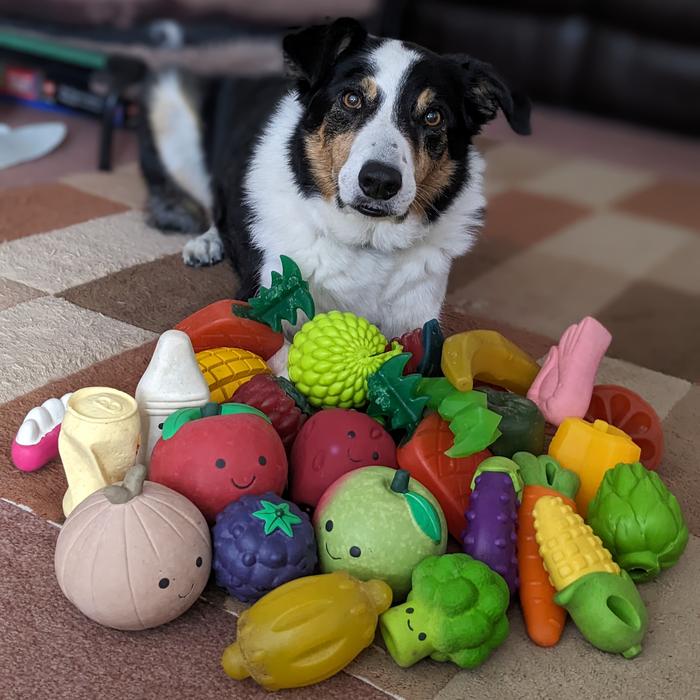
Bryn, an 11-year-old male Border Collie from the UK, that knows the names of about 100 toys. Photo credit: Helen Morgan

Similarly to 1.5 -year-old toddlers, that are equally good in learning from overheard speech and from direct interactions, these gifted dogs also excel in learning from both situations.

What makes this discovery remarkable

Although dogs excel at learning actions like “sit” or “down”, only a very small group of dogs have shown the ability to learn object names. These Gifted Word Learner (GWL) dogs can quickly learn hundreds of toy names through natural play sessions with their owners. Toddlers can easily learn new words through a variety of different processes. One of these processes is learning from overheard speech, where child learns new words by passively listening to interactions between adults. To do this, children must monitor the speakers’ gaze and attention, detect communicative cues, and extract the target words from a continuous stream of speech. Until now, it was unknown whether GWL dogs could also learn new object labels when not directly addressed.

“Our findings show that the socio-cognitive processes enabling word learning from overheard speech are not uniquely human,” says lead scientist Dr. Shany Dror, from ELTE and VetMedUni universities. “Under the right conditions, some dogs present behaviors strikingly similar to those of young children.”

How the researchers found that Gifted dogs learn toy names by eavesdropping

In the first experiment, the research team tested 10 Gifted dogs in two situations:
1. Addressed condition: Owners introduced two new toys and repeatedly labeled them while interacting directly with the dog.
2. Overheard condition: The dogs passively watched as their owners talked to another person about the toys, without addressing the dog at all.

VIDEO ABSTRACThttps://www.youtube.com/watch?v=bvFwYQ2pPSs 

Overall, in each condition, the dogs heard the name of each new toy for a total of only eight minutes, distributed across several brief exposure sessions. To test whether the dogs had learned the new labels, the toys were placed in a different room, and the owners asked the dogs to retrieve each toy by name (e.g., “Can you bring Teddy?”)

The result: In both conditions, seven out of ten dogs learned the new labels

The dog’s performance was very accurate already at the first trials of the test, with 80% correct choices in the addressed condition and 100% in the overhearing condition. Overall, the Gifted dogs performed just as well when learning from overheard speech, as when they were directly taught, mirroring findings from infant studies.

But that’s not all: Gifted dogs overcome one of the key challenges in learning labels

In a second experiment, the researchers introduced a new challenge: owners first showed the dogs the toys and then placed them inside a bucket, naming the toys only when they were out of the dogs’ sight. This created a temporal separation between seeing the object and hearing its name. Despite this discontinuity, most of the Gifted dogs successfully learned the new labels.

“These findings suggest that GWL dogs can flexibly use a variety of different mechanisms to learn new object labels” says senior scientist Dr. Claudia Fugazza, from ELTE University in Budapest.

What we can learn from this study

The study suggests that the ability to learn from overheard speech may rely on general socio- cognitive mechanisms shared across species, rather than being uniquely tied to human language.

However, Gifted Word Learners are extremely rare, and their remarkable abilities likely reflect a combination of individual predispositions and unique life experiences.

These dogs provide an exceptional model for exploring some of the cognitive abilities that enabled humans to develop language” says Dr. Shany Dror “But we do not suggest that all dogs learn in this way – far from it.”

Is your dog a Gifted Word Learner dog?

This research is part of the Genius Dog Challenge research project which aims to understand the unique talent that Gifted Word Learner dogs have. The researchers encourage dog owners who believe their dogs know multiple toy names, to contact them by email (geniusdogchallenge.official@gmail.com), Facebook or Instagram

Source: EurekAlert!

Teaching the basics of massage

Last weekend, my greyhound Izzy and I taught another Learn to Massage Your Dog workshop. I have lost count as to how many dog parents we have taught together, but there are always more who should sign up. In fact, I’d like every dog owner to be able to massage their dog with the basic knowledge of where to massage, why, how and also when not to massage.

Massage is a skill that should be learned hands-on and live. What better way than to attend a class with your own dog and learn together?

Massage is one of the oldest healing skills. It dates back to 3,000 BCE (Before the Common Era) in India and long before pharmaceutical and surgical choices were considered (by many) to be the only options for health care.

Koda was re-homed by Carey and attended Learn to Massage Your Dog; Koda is also a regular customer for professional massage because she has a repaired hind leg injury which she compensates for

Massage by an owner has many benefits. If done regularly, the owner is the best position to pick up on changes that may require professional attention. Lumps and bumps, for example, should always be investigated. When a dog has been injured in some way, even a minor injury, the owner is a great position to help relieve the initial stress through their massage without waiting to see a professional.

Massage is also a great way to spend quality time with your dog – enhancing your love and bond.

For clients of my professional practice, I feel much more confident in giving them a home care program when they have been to a massage class. It’s also very satisfying when an owner gets in touch to say that their dog has had a minor injury, such as a back strain, and I’m able to advise them which strokes of their massage sequence to use for home care.

The winner is, of course, the dog.

My love of dogs and the passion to see them cared for using traditional, natural options alongside veterinary care is the reason I chose this line of work. Teaching and sharing skills is an honor that I hope to share with more dogs and their families in the years to come.

Kathleen Crisley, Fear-Free certified professional and specialist in dog massage, rehabilitation and nutrition/food therapy, The Balanced Dog, Christchurch, New Zealand

Izzy is a seasoned professional demo-dog who is happy to spend most of the class on my massage table

Teaching wolves new tricks

The process of learning often involves mimicry or imitation.  In research published in the journal PLoS One, scientists from the Messerli Research Institute at the University of Veterinary Medicine, Vienna report on their behaviour experiments involving wolves and dogs.

The results show that wolves observe one another more closely than dogs and so are better at learning from one another. 

Photo Credit: Walter Vorbeck

Photo Credit: Walter Vorbeck

The scientists found that wolves are considerably better than dogs at opening a container, providing they have previously watched another animal do so. Their study involved 14 wolves and 15 mongrel dogs, all about six months old, hand-reared and kept in packs.

Each animal was allowed to observe one of two situations in which a trained dog opened a wooden box, either with its mouth or with its paw, to gain access to a food reward. Surprisingly, all of the wolves managed to open the box after watching a dog solve the puzzle, while only four of the dogs managed to do so. Wolves more frequently opened the box using the method they had observed, whereas the dogs appeared to choose randomly whether to use their mouth or their paw.

The researchers think that it is likely that the dog-human cooperation originated from cooperation between wolves. During the process of domestication, dogs have become able to accept humans as social partners and thus have adapted their social skills to include interactions with them, concomitantly losing the ability to learn by watching other dogs.

Source:  University of Vienna media release

How your dog matches words to objects

Researchers at the University of Lincoln (UK) have published a study based on the learning patterns of a Border Collie named Gable.  They wanted to see if Gable could match words with objects based on shape, which is the learning pattern in humans of toddler age.

Credit: Sally Smith; van der Zee E, Zulch H, Mills D (2012) Word Generalization by a Dog (Canis familiaris): Is Shape Important?

Gable could identify an object by name, but over time he associated the same word with objects of similar texture or size (not shape).

The researchers concluded that where shape matters for humans, size or texture appears to be the dominating issue for a dog.

This is small study (using only one dog) but it does provide insight into the learning and development of dogs.  I’m sure there is more to come in this research field.

Source:  Word Generalization by a Dog (Canis familiaris): Is Shape Important?


