Tag Archives: New York times

War Came to Ukraine and Its Dogs Are Not the Same

Four years ago, there were heartbreaking photos of Ukrainians fleeing their country, some with their dogs on leash, in prams, and in backpacks. Many dogs were not so lucky.

Now, there is new research to show how the dog population has changed in just those four short years. A kind of natural selection, expedited by the impacts of living in a war zone. Small dogs survive because they are less likely to trigger land mines, there’s less body mass to be impacted by shrapnel and they are more able to hide in confined spaces. Troops and researchers alike report the impacts of ongoing fear, anxiety and stress in the dogs – the trauma of living in a war zone when once they were a loved pet.

Below I share this New York Times piece in its entirety to spread the word that wars are environmental disasters which are entirely man made…


The human cost of the war in Ukraine has been well documented. But Russia’s invasion is also affecting the country’s pets in surprising ways.

In a study published in December 2025, in the journal Evolutionary Applications, a group of researchers found that exposure to the conflict in Ukraine had, in a short period, transformed dogs that were formerly pets into the kind of dogs found in more wild environments.

Scientists gathered a variety of data from 763 dogs across nine regions of Ukraine. The team worked with animal shelters, while veterinarians and volunteers gathered data from stray dogs in potentially safe areas and, sometimes, areas designated as dangerous territories.

But gathering data on the front line was more difficult. That work was led by Ihor Dykyy, a zoologist at the Ivan Franko National University of Lviv. Dr. Dykyy served on the front line — near the city of Lyman in the Donetsk region, and later close to Kharkhiv near the border with Russia — for two years starting in 2022 as a volunteer with the Ukrainian Armed Forces.

“Many stray dogs lived with us in the village of Zarichne,” Dr. Dykyy remembered. “They were terrified by the hostilities; some suffered from shell shock. One small dog had a broken leg that hadn’t healed properly, leaving it with a permanent limp. Another was blind in one eye, having lost it in an explosion.”

Dr. Dykyy and his fellow soldiers “fed all of them, gave them shelter and provided medical care whenever possible,” he said.

Although the research focused on domestic dogs, many were no longer under the care of their owners, and were living as strays.

“From the beginning of the war, we saw a very sad situation with pets in Ukraine,” said Mariia Martsiv, who was the paper’s lead author and is a zoologist at the University of Lviv. “Some people took their pets with them, but some were simply left at train stations or left behind in the occupied territories.”
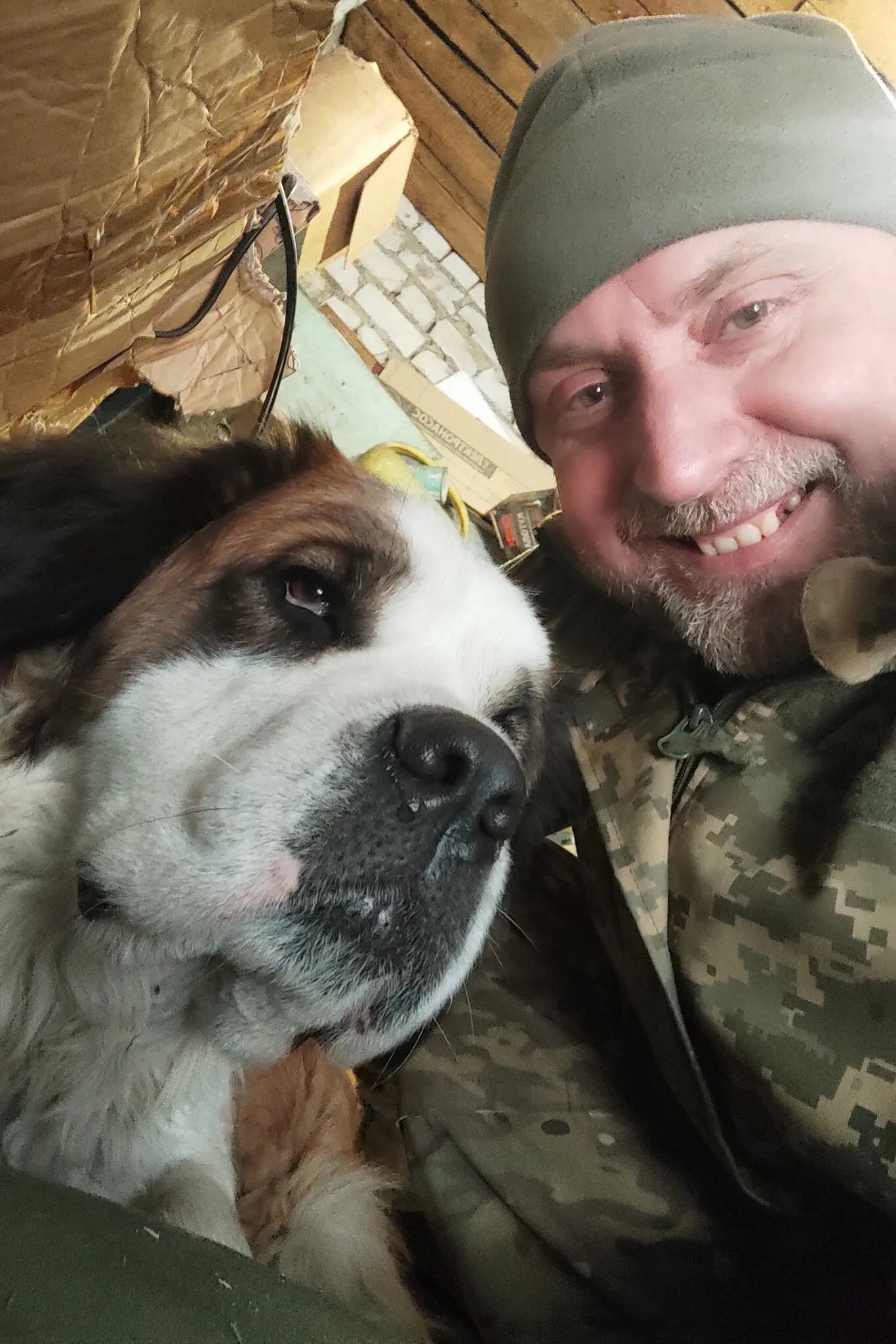
Ihor Dykyy, a zoologist at the Ivan Franko National University of Lviv, with Linda, a Saint Bernard who perished from a vehicle strike. Photo credit: Ihor Dykyy

Most of the team’s findings suggested that dogs on the front line, in a remarkably short period of time, had become more like wild dog species, such as wolves, coyotes or dingoes.

Examples of the transformation abounded in the data: The frontline dogs rarely had snouts that were either short like a French bulldog’s or elongated like a dachshund’s. Many also had reduced body mass. Even their ears took on a different shape, with pointed ears more frequent than floppy ears.

“On the front lines, dogs with signs of a ‘wild’ phenotype do indeed survive more often: straight ears, straight tail, less white,” Dr. Martsiv wrote in an email.

“War acts as a powerful filter, favoring traits that improve survival under extreme conditions,” said Małgorzata Witek, an author of the study and a doctoral student at the University of Gdansk in Poland.

Other characteristics more commonly associated with wild dog species were found in Ukraine’s conflict zones: There were fewer old, ill and injured dogs, and dogs on the front line were more likely to be found living in groups.

“What surprised us most was how quickly these changes appeared,” Ms. Witek said. “The war had been ongoing for a relatively short time, yet the differences between frontline dogs and other populations were already very pronounced.”

But the scientists did not want their findings interpreted as war-fueled accelerated evolution.

“The changes we observe in dogs are happening too quickly to be explained by molecular evolution,” Ms. Witek said.

What’s really happening is that the conditions of war favor animals that have certain characteristics. For example, a dog with less body mass is less likely to trigger land mines and more able to hide in confined spaces, and presents a smaller target for shrapnel.

Despite evidence of apparently wild personality traits and physical characteristics, most of the dogs remained dependent on humans for food, only supplementing their diet with plants and occasional hunting. At times, dogs survived by scavenging the bodies of fallen soldiers. Some were adopted by Ukrainian troops.

But the scientists did observe some dogs on the front line that no longer depended on people for their survival.

“This can be considered as feralization, a return to living independent of humans,” said Małgorzata Pilot, leader of the project and a biologist at the University of Gdansk.

While the study was restricted to dogs, it raises questions about the broader implications of environmental damage caused by war.

“Evidence that dogs are being strongly negatively affected by the horrors of war should serve as an alarm for other species that are far less mobile and more restricted in their diets and habitat requirements,” said Euan Ritchie, a wildlife ecologist at Deakin University in Australia who was not involved in the project.

Or as Dr. Pilot put it, “Wars are not only humanitarian crises. They are also environmental disasters.”

Source: Anthony Ham, New York Times
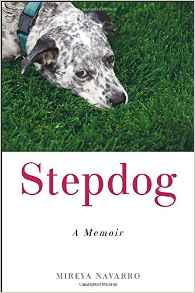
A truce with my aging stepdog

Stepdog

Mireya Navarro is a reporter for The New York Times and the author of the memoir Stepdog.  In this piece in the New York Times, she describes her relationship with Eddie and how it improved as Eddie aged.

“There’s one good thing about my old dog’s fading memory: He seems to have forgotten he hates me….”

Enjoy the weekend reading!

Kathleen Crisley, specialist in dog massage, rehabilitation and nutrition/food therapy, The Balanced Dog, Christchurch, New Zealand

Dogs at the wedding

Wedding photo

Penny, front and center, posed with the family following the wedding of Linnea Elizabeth Sanderson and Dr. Robert Collier Davidson, right, in February. Credit Kieran Kesner for The New York Times

Dogs are part of the family and, increasingly, they are being included in their owner’s Big Day.  (I’m invited to a wedding in October that will include the couple’s dogs – Bernese Mountain Dogs –  and look forward to sharing that with my readers).

In this article from the New York Times, a Vermont-based photographer says that half of the weddings on his schedule this season involve a dog. And most of the owners interviewed say that they wouldn’t think of not involving their beloved dog in the ceremony.

Did you include your dog in your wedding?  I’d love to see the photos!

Kathleen Crisley, specialist in dog massage, rehabilitation and nutrition/food therapy, The Balanced Dog, Christchurch, New Zealand

Therapy dog helps woman testify at court hearing

This post is definitely filed under the heading of Special Dogs & Awards.  Another example of how our dogs can work with us and for us…. A courtroom therapy dog named Paz, a Labradoodle, has helped a woman testify in court about her multiple assaults and captivity, an ordeal endured with her 5-year old daughter. It is the first time a judge has allowed a therapy dog in court to support an adult (rather than a child).

 The appearance on Tuesday of Paz, a therapy dog, in a New York City courtroom to help an adult witness testify was said to be unprecedented. Credit Kevin Hagen for The New York Times

The appearance on Tuesday of Paz, a therapy dog, in a New York City courtroom to help an adult witness testify was said to be unprecedented. Credit Kevin Hagen for The New York Times

More details about this story in the New York Times link below. Well done, Paz, and may you continue to provide support to this woman – no one deserves that kind of treatment.  And kudos to the judge who recognized the value of the dog to the court’s proceedings. Source:  New York Times

Dogs are people, too

In this New York Times opinion piece, Professor Gregory Berns discusses the MRI findings of brain activity in dogs, the evidence for ‘sentience’ and the reasons why dogs’ rights should go beyond consideration of animals as property.

For anyone involved in animal welfare advocacy, it is essential to have animal welfare laws that recognise dogs as sentient beings – with the ability to experience emotions like love and grief – because abuse and harm done to sentient beings carries a higher penalty in law than if an item of property is damaged.  (In many areas, dogs are considered nothing more than property.)

Jane Evelyn Atwood/Contact Press Images

Jane Evelyn Atwood/Contact Press Images

Picking up the scent on the road to bliss

As a woman with a long history of enjoying life with canine company, I found this article, by Tatjana Soli, particularly good.

What do you think?

Blue’s compromise

Last month, I wrote about Blue, an elderly Australian Cattle Dog who was facing an uncertain future in Elephant Butte, New Mexico.

This week, it was announced that the town officials had reached a compromise with Blue’s nominated owners (Blue was abandoned early in life and formed connections with some residents more than others).

Blue will be exempt from the city’s leash law, but his owners will need to keep him contained on their commercial property through the use of an electric fence.

Read more about Blue’s compromise here in the New York Times.

No pets left behind – pet disaster planning in San Francisco

The City of San Francisco is providing leadership in the area of disaster planning for pets.  Following the disaster of Hurricane Katrina in 2005, when  pet owners were refused shelter if they brought their pets with them, the Pets Evacuation and Transportation Standards Act of 2006 made federal funding available for authorities to plan to help companion animals that are affected by disasters.

In San Francisco,  pet-disaster responders will have authorised training and they will use a network of 125 temporary shelters to evacuate animals.  Injured animals will be treated in a $300,000 mobile animal disaster medical command unit (funding for this is still pending).

Best of all, the city’s department of Animal Care and Control has a No Pets Left Behind policy.  Whenever a citizen is rescued, their pets will be rescued too.

For those of us who have lived through a major disaster like Christchurch’s 2010 and 2011 earthquakes, we know the importance of having supplies and an evacuation plan for your pets.  It’s also a challenge to get authorities coordinated to respond to animal welfare problems during major events.

Read more about San Francisco’s disaster planning in this New York Times article.

Kathleen Crisley, specialist in dog massage, rehabilitation and nutrition/food therapy, The Balanced Dog, Christchurch, New Zealand

Lessons from a Freethinking Dog

I have just finished reading Merle’s Door (Lessons from a Freethinking Dog) by Ted Kerasote.  This book was published in 2007 and became a national bestseller.  That’s not a surprise.

Mr Kerasote is an accomplished author.  He has written for publications including National Geographic, the New York Times, and Science.  And he has other books to his name.

Merle’s Door, however, has to be one of Mr Kerasote’s top literary accomplishments and something that will be remembered as a hallmark of his writing career.  Buy it (don’t just download it into your Kindle).

Merle’s Door is a biography of Merle, a dog adopted by Kerasote when they met totally by accident in 1991.  Merle was ‘living rough’ in the Utah desert and Ted was on one of his many trips with friends to enjoy nature.

“You need a dog, and  I’m it” says Merle.  And so begins a lifetime of 13 years together where Ted learns to translate Merle’s thoughts, to give him free reign to learn about life and his surroundings and, in turn, Ted learns many things from Merle.

Using his dog door and the freedom that Ted allowed him, Merle becomes the unofficial mayor of Kelly, Wyoming and makes many friends.  Along the way Ted establishes a ‘dedicated quadruped couch’ in his house and Merle leaves lasting footprints in the varnish of the balcony of the house they built together (and where Kerasote still lives).

Merle’s Door is Merle’s biography.  Lovingly written by Ted, we learn about Merle’s trademark “Ha ha ha” as he would converse with Ted in a language all his own.  He’d go hunting for elk, but was gun-shy when hunting birds  (and we find out why later in the book).  He has his scraps with other dogs and comes out learning valuable life lessons.

Later in life, Merle’s back end starts to deteriorate and Ted employs the use of acupuncture and massage to help his dog recover (no wonder why I like this book!).  With respect, he lets Merle define what will be a good day and a bad day and they enjoy one another’s company to the end.

Mr Kerasote does a wonderful job in depicting the human-dog bond that so many of us dog lovers have appreciated in our lives.  And he does it with the flair of an accomplished writer.

Like all true dog stories, be prepared for the end of Merle’s life in 2004 which is  obviously written by someone who has lived through the last days of their dog’s life.  Have a box of tissues handy – you’ll need it.  (I did)

This is a book I intend on keeping and adding to my dog book collection.  I’m grateful for Mr Kerasote’s writing talent because, not only is this Merle’s story, but it is well referenced with footnotes to key pieces of dog research (15 pages of references in total).

Through Mr Kerasote’s writing, Merle’s story lives on for all of us to share.  A wonderful dog that walked this earth for almost 14 years and left pawprints on many hearts….

The role of the dog in the family unit

A recently-published New York times article explains the role of the pet in the family unit and various research projects that are attempting to define the human-pet bond.  This article goes onto explain why personal orientation about the role of the pet in the family can lead to disagreements and conflict.

My personal favourite is the 2007 research that categorises pet owners into one of three categories.

Humanists treat their dogs as a member of the family or primary companion.  They will do things such as allowing the dog into bed or onto the furniture, cook it special meals, and mourn it when it passes.  Humanists tend to look down on dominionists.

Protectionists consider themselves the animal’s advocate with strong personal views on how an animal should be treated.  Protectionists are critical of humanists.

Dominionists view their dog as a useful helper, below that in status of the humans.  Dogs, in their opinion, are replaceable.    Rural people often fall into this category, according to the research.

I’m a proud humanist, by the way!

Kathleen Crisley, specialist in dog massage, rehabilitation and nutrition/food therapy, The Balanced Dog, Christchurch, New Zealand


