Tag Archives: summer

Toxic algae warnings – an enduring message

New Zealand is in the heart of its summer season with record-breaking temperatures in many regions. Not surprisingly, dogs will want to go swimming to cool off.

Each summer, we have warnings about toxic algae and how it can kill your dog.  I first wrote about this subject over 10 years ago, in 2013, for NZ Dog World magazine. This post updates the original.


Photo courtesy of Susie Wood, Cawthron Institute

There’s a deadly toxin lurking in many of New Zealand’s rivers and lakes.  The savvy dog owner needs to understand it so you can protect your dog.

That toxin is produced naturally by blue-green algae, or cyanobacteria.  ‘Blue-green algae have existed on earth for millions of years,’ says Mark Heath, a researcher whose PhD thesis focused on why algal blooms form in rivers.  ‘However, it is human-induced changes to the environment that have created the ideal situations for the algae to flourish’.

‘We know that the algae have optimal growing conditions during the summer months, when there has been a stable period of little to no rainfall and warm conditions,’ says Susie Wood, Heath’s supervisor and a researcher at the Cawthron Institute‘Nutrients, which are often increased in waterways by land–use intensification, act as the algae’s food source and climate change means longer periods of little rainfall and warm temperatures.’

The algal mats float to the surface and collect on the margins of rivers and in stagnant pools of water.  Dogs are attracted to the earthy smell of the algae and they will readily lick or eat it.  The algae exude a powerful neurotoxin and only a small amount is enough to cause a dog to become ill and die.

Symptoms may include panting, twitching, convulsions, muscle tremors and lethargy.  There is no antidote to the poison and so if you suspect your dog has ingested the toxin, you need to rush to the nearest vet to have its stomach pumped and have activated charcoal administered.  Since the toxin is very fast-acting (some dogs die within 30 minutes of ingestion), prevention is the better course of action.

Dog owners need to be able to ‘spot’ the algae, which often is a dark green/brown to black colour as seen in the photo.  These mats have a velvety texture and a musky smell. If there has been a period of about two weeks without rainfall (which induces ‘flushing flows’ in rivers), then you should assume that conditions are ideal for the algae.  Walking a dog on lead is advised so you can keep a close watch on what your dog takes an interest in. ”If in doubt, keep them out.”

Vets should report a dog death to the regional council but reporting is not mandatory, meaning that many cases are likely to go unreported.

Rivers known for algal blooms include the Hutt River (Wellington region), the Selwyn and Ashley rivers (Canterbury region) and the Tukituki River (Hawke’s Bay).  The algae can also form in lakes which act as a sink for nutrient-enriched waters. In lakes, ponds, and lagoons, the algae is likely to be present if the water is cloudy or discoloured or has scums or small globules suspended in the water.

Dog owners should familiarise themselves with their regional council’s website for algal blooms in their area.

Toxic algae is such a prominent issue in Canterbury that the regional council has published an If In Doubt, Keep them Out brochure this year that is available through your veterinarian.

Kathleen Crisley, Fear-Free certified professional and specialist in dog massage, rehabilitation and canine fitness,  The Balanced Dog, Christchurch, New Zealand

Dog bites increase as the temps rise, study finds

Science has shown that violence among monkeys, rats, and mice increases when the weather is warm. Now it seems we can add dogs to the list.

New findings from researchers at Harvard Medical School and Spaulding Rehabilitation Hospital show that the incidence of dog bites rises with the temperature. In an analysis of 69,525 cases in eight U.S. cities, the team found that dog bites increased 3 percent on days with high ozone pollution, 4 percent on days with higher temperatures, and 11 percent on days with elevated ultraviolet radiation, a marker of increased sunshine.

Clas Linnman, assistant professor of physical medicine and rehabilitation at Harvard Medical School and Spaulding Rehabilitation Hospital, was an author on the paper. We asked him about the team’s key findings in a conversation edited for clarity and length.

Q&A

Clas Linnman

GAZETTE: Does this work show that dogs are just like us in the summertime — cranky when the weather gets hot and uncomfortable?

LINNMAN: Probably, but one needs to keep in mind that the interaction between humans and dogs is crucial to reduce dog bites.

GAZETTE: Are the results limited to warm-weather months?

LINNMAN: No. In sensitivity analysis, we found that the effect is actually somewhat stronger in winter months.

GAZETTE: Doesn’t that negate the finding that bite risk rises on hot, sunny, smoggy days?

LINNMAN: No. We are looking at the relative risk on warmer versus cooler days, so, if you only look at winter months, the effect of temperature on risk is still there, and even somewhat stronger. This does not mean that the risk is higher on winter vs. summer days. It means that the effect is still present if you remove the hottest days from the analysis.

GAZETTE: You found that rising temps, ozone levels, and UV radiation are linked to a higher rate of dog bites. Is it just discomfort or are there biological reasons behind the phenomenon?

LINNMAN: We know from animal studies that the HPA axis — the brain’s hypothalamic pituitary adrenal axis, important in responding to stress — is impacted by these factors, and there is some evidence suggesting a change in striatal dopamine turnover with exposure to ozone, but there is a lot of work needed to understand how these phenomena may work in dogs and humans.

GAZETTE: Dopamine is a hormone responsible for making you feel good — how might that affect aggressive behavior?

LINNMAN: Dopamine is involved in short-term rewarding behavior, or impulsivity, and while reward is typically associated with pleasant things, aggression is often impulsive and can also be short-term rewarding, so we think there may be a link here.

GAZETTE: So together, we know that temperature, ozone, and UV affect parts of the brain responsible for stress responses and perhaps lowers inhibition to aggression?

LINNMAN: We cannot really conclude that just yet, but we are looking into both behavioral and neuroimaging data to see if there are subtle effects of these factors.

GAZETTE: The study found an effect from one common summertime pollutant — ozone — but not another, the tiny damaging particles in PM 2.5. What accounts for the divergence?

LINNMAN: Great question. Short-term PM 2.5 has been linked to aggression in humans in multiple studies, so we were expecting to see it here as well. It is possible that anatomical differences between snouts and noses play a part here.

GAZETTE: You also saw increasing precipitation reducing aggression. Why might that be?

LINNMAN: Dogs love to run in the rain! It may be as simple as fewer interactions between humans and dogs on rainy days.

GAZETTE: How well does this agree with what’s been found in humans and other species?

LINNMAN: It fits quite well into the picture. People are also more aggressive with higher temperature and air pollution. There are even studies demonstrating higher rates of violent crime downwind of major highways, and this shifts when the wind shifts.

GAZETTE: There’s also an indication in the journal article that the effects may be related to the way humans interact with dogs on these hot days. How likely is that a factor rather than biological factors within the dogs themselves?

LINNMAN: We don’t have the type of data needed to assess the behavior of the victim in these reports. But dogs typically do not bite without some type of provocation, and they usually warn us first, so the behaviors of the human may be a factor.

GAZETTE: Have you ever been bitten by a dog?

LINNMAN: Yes, actually, once in an aggressive situation.

GAZETTE: What happened?

LINNMAN: I love dogs, I grew up with several family dogs, although I am currently not a dog owner. What happened was that I was parking my bicycle as my neighbor walked by with her dog, and perhaps it was the bike that triggered it to bite me. It was nothing serious, gave me a bruise and put a hole in my T-shirt. Maybe it was a hot, smoggy day. I do not recall.

GAZETTE: As we come into the summer months, any advice for dog owners or people visiting others with dogs?

LINNMAN: Keep your dogs happy, cool, and under control. And learn to read the behavior of dogs — that is probably the most protective thing one can do. Most bites occur with dogs we know.

Source: The Harvard Gazette

Paw activated drinking fountain

We’ve had a touch of spring weather this week (which is about to change – and fast – back to winter) and because of the hint of warmth in the air, I’m thinking of what I will plant in the garden this year – and looking at Izzy’s little paddling pool which will need a good scrubbing out before it can be used.

And then I found this video – a paw-activated drinking fountain.  I have been meaning to video Izzy drinking from the fountain at the dog park because it is cute to watch her aim for the flow of water.  I think she would like something like this and it would act as another activity for mental stimulation.

Maybe we can add it to her wish list for Santa?

Kathleen Crisley, specialist in dog massage, rehabilitation and nutrition/food therapy, Canine Catering Ltd, Christchurch, New Zealand

How hot does it get in a parked car?

Okay, New Zealanders and other Antipodeans – summer is just around the corner and we are already experiencing clear, warm and sunny days.

And every year, sadly, dogs die from heat stress because their owners decided to leave them in a parked car ‘just for a few minutes.’

This video by Dr Ernie Ward illustrates just how quickly the temperature in a car increases in hot weather.   Imagine what is  is like for a dog that can’t open the door and escape the heat!

It is best to leave your dog at home during summer if you have to make any stops and ensure that you use your car’s air conditioner to keep your dog comfortable when driving.

Pay attention to the thermometer that Dr Ward uses.  You can clearly see the temperatures in Celsius on it, although he talks in degrees Fahrenheit

Doggy shot glasses for the hot summer

It’s been a really hot summer here in Christchurch and, as Daisy is a senior dog, I want her to be as comfortable as possible.

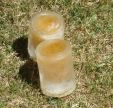
In the spring, the folks at Jose Cuervo tequila gave me some molds for freezing water into shot glasses when I bought a bottle of their tequila.  Well, I use them, but I fill the insides with beef stock and then re-freeze…

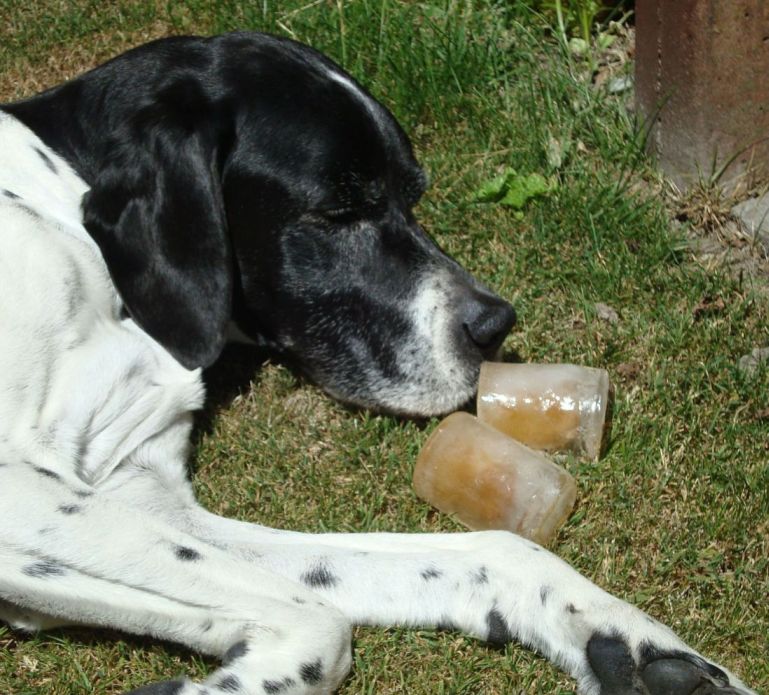
The result?  Doggy shot glasses filled with frozen stock!  It probably won’t be much of a marketing tool for Jose Cuervo, but Daisy loves them.

These shot glasses of ice are re-frozen after I fill them with beef stock

These shot glasses of ice are re-frozen after I fill them with beef stock

Daisy loves her specially made ice blocks

Daisy loves her specially made ice blocks

Algal bloom warnings commence again for summer season

The first of the this season’s algal bloom warnings has been issued by the Canterbury District Health Board.   Dogs can become very sick and die from exposure to toxic algae (cyanobacteria), so heed this warning about contact with Lake Forsyth, Te Wairewa:

CDHB MediaRelease Toxic Algae Lake Forsyth November 3 2011