Tag Archives: volunteers

Outfitting Smokey

In Tennessee, college football is a religion. When I studied in Knoxville in 2023, I was told that on Fridays the staff have to clear their car parks by a certain time (no overtime on Fridays!) because all of the car parking is needed for football fans who descend with their vans, campers and gear to make a weekend of it.

Smokey, a Bluetick Coonhound, is the team mascot and the Knoxville campus is dotted with Smokey statues:
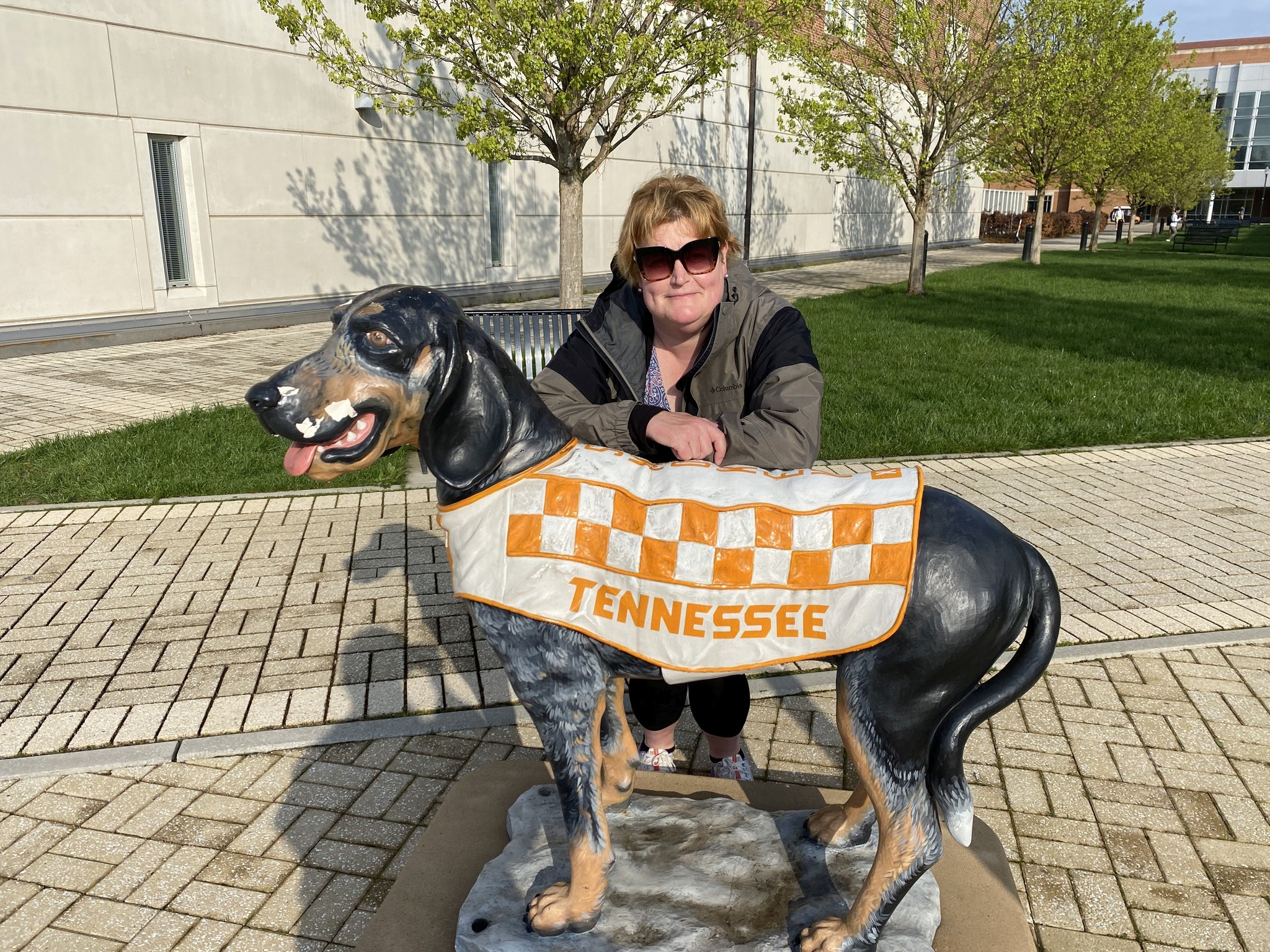
There have been a succession of real-life Smokeys; below is a story about the woman who outfits the current mascot, Smokey X…

Kathleen Crisley is Fear-Free certified dog massage therapist and canine fitness trainer. She has a particular passion for working with dogs and their families to ensure injury prevention and quality of life. She specialises in working with anxious and emotionally damaged dogs. Her mobile practice, The Balanced Dog, is based in Christchurch, New Zealand

________________________

There’s nothing quite like sitting in the stands of Neyland Stadium on a fall Saturday as the T opens and Smokey leads the football team out to the field of battle.
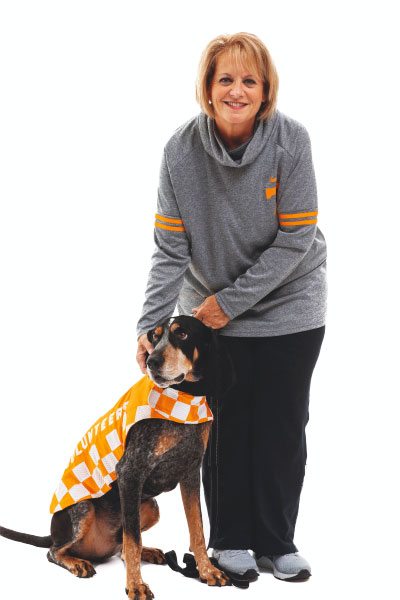
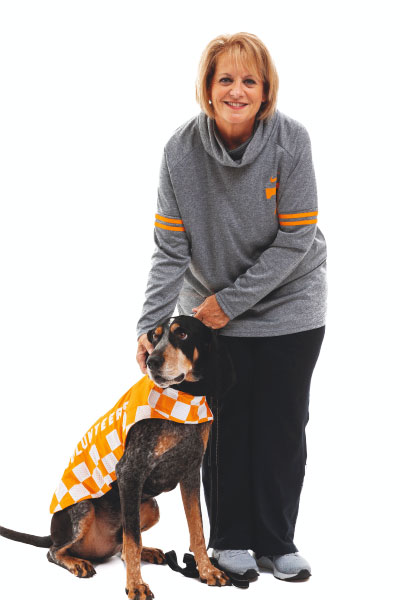
Jill Mayfield with Smokey X

For more than 70 years, Smokey has been an icon in college sports, and his game day gear, made by Tennessee Athletics’ own Jill Mayfield, is just as iconic.

Mayfield, a facility operations and support specialist for UT Athletics, has dedicated a prodigious amount of time brainstorming, stitching, and sewing for the beloved canine.

And it all began with some cheerleaders and a paint mishap.

Before Mayfield began working at UT, she had a friend whose son was on the cheer team. One game day morning, the team was painting the Rock, and without thinking they threw the paint cans in the back of their truck.

“Paint got all over the big flag they had back there for the football game that night,” Mayfield says. Knowing she was a seamstress, they called her in a panic.

The cheerleaders brought the flag to Mayfield’s house, giving her the opportunity to fashion a pattern of the Power T. Half of the team went to find white material, and the other half went to find orange, and they made a temporary flag for the night.

The Cedar Rapids, Iowa, native attributes her love for sewing to her maternal grandmother, who ran a drapery business out of her home. 

“My mom would help her at the shop, and to keep me entertained they would have me pick up pins they dropped on the floor,” Mayfield recalls. “Just being around it led me to want to sew.” 

In 2000, Mayfield began working for the UT ticket office and reconnected with the head of the cheer team. Shortly afterward, she was asked to try her hand at crafting the outfits worn by the costume mascot. 

Though she doesn’t sew much for the costume mascot currently, Mayfield was responsible for the fan favorite Big Orange tuxedo.

It was in 2014 that she was asked if she was interested in making the live mascot’s vest—and she jumped at the opportunity.

Her first task was figuring out the timing. Smokey’s senior handler, a member of the Alpha Gamma Rho fraternity, designs the vests for each football season. Depending on how intricate the design is, the garment may take up to two days to make. 

After the design is approved by the spirit program director, Mayfield will tweak it, measure Smokey, and then gather the orange and white fabric to pull the design together.

“I start at the back section first, then the side sections to finish. I’ll put them together and send a picture to the team. Once it looks good, I’ll start assembling and bring Smokey in for a final fitting.”

Mayfield is on the sidelines for each game and loves to see Smokey on duty and interacting with fans.

“I always want to make the handler’s vision come through just like he wanted it,” she says. “I’ve seen Smokey run through the T a million times, but each time feels like the first.”

Source: Torchbearer, the magazine of the University of Tennessee

An end to a valuable community resource

When I adopted Sox in March 2022, he was triggered by walking along the main road near our home, with the exception of very early mornings when there was no traffic. He didn’t like the traffic noise and he didn’t like the reflections of the vehicles in the shop windows.

Given our suburban location, his reactivity on the main road was going to be a problem and so it was time to think about how to apply de-sensitisation and counter-conditioning.

Our local SPCA Op Shop became a cornerstone to Sox’s training.

Located on the main road, it allowed well-behaved dogs, on lead, inside. Sox quickly learned that we could walk through the scary glass windows and inside were friendly people who greeted him with pats and cuddles.

He also made a special friend, a regular Sunday volunteer named Beth.

Within 8 weeks, Sox was happily walking along the main road without fear.

With few exceptions, we have visited the shop every fortnight since our first visit in 2022. Sadly, a couple of weeks ago, these posters appeared in the window – the shop is closing!

Visits to the op shop have become a regular part of Sox’s routine and a source of ongoing enrichment (think of him as the Official Greeter of the SPCA Op Shop whenever he is on site).

I am sure he will be confused when we no longer visit this shop front, and I do wonder whether he will think of his Special Friend Beth when we pass by, not knowing what has become of her and why she isn’t there to cuddle.

We will visit the shop up until the last Sunday they are open next month.

Kathleen Crisley, Fear-Free certified professional and specialist in dog massage, rehabilitation and canine fitness,  The Balanced Dog, Christchurch, New Zealand.

New canine lab seeks four-legged research participants

A new lab at UBC’s Vancouver campus is looking for research participants—and not just anyone will do. The criteria? Must be furry and four-legged. Enjoy belly rubs and yummy treats? That’s a bonus, too.

The new Human-Animal Interaction Lab at UBC has officially opened and will soon be inviting pet dogs and their owners to engage in canine cognition research. Researchers are hoping to discover new knowledge that will improve animal shelter practices and companion animal welfare in shelters and homes with pets. They will also conduct studies on animal-assisted interventions using trained therapy dogs to benefit the wellbeing of dogs working in assistance roles, as well as refining methods of using therapy dogs in educational settings for the benefit of both the child and dog.

“The goal is to uncover knowledge about why dogs do the things they do and how do we determine the individual differences of specific dogs,” says Dr. Alexandra (Sasha) Protopopova, the lab’s director and an assistant professor in UBC’s Animal Welfare Program in the faculty of land and food systems.

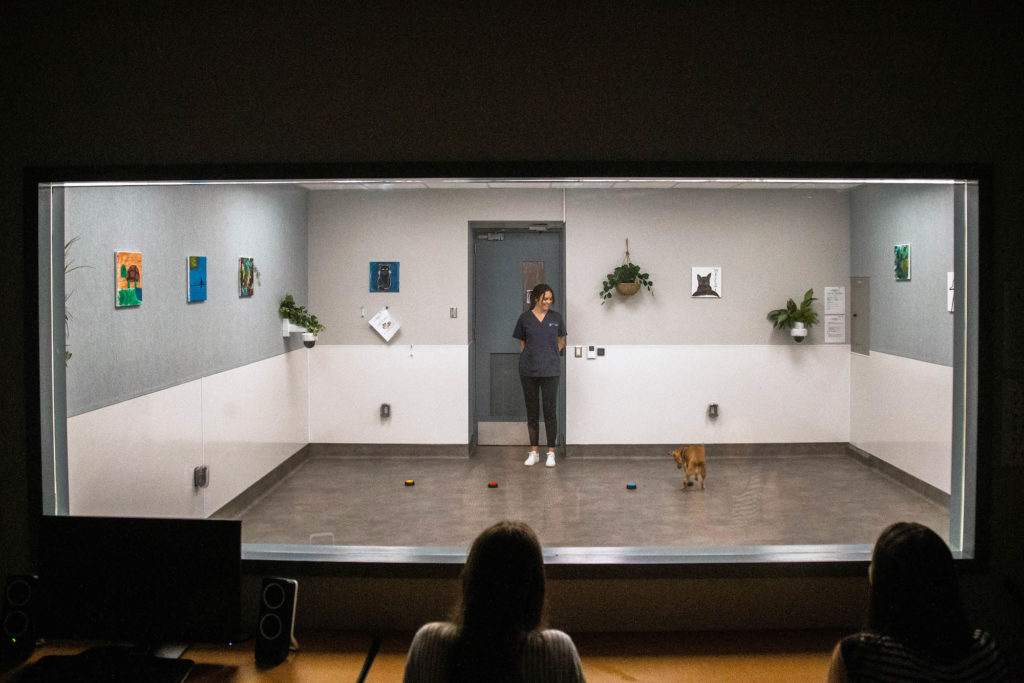
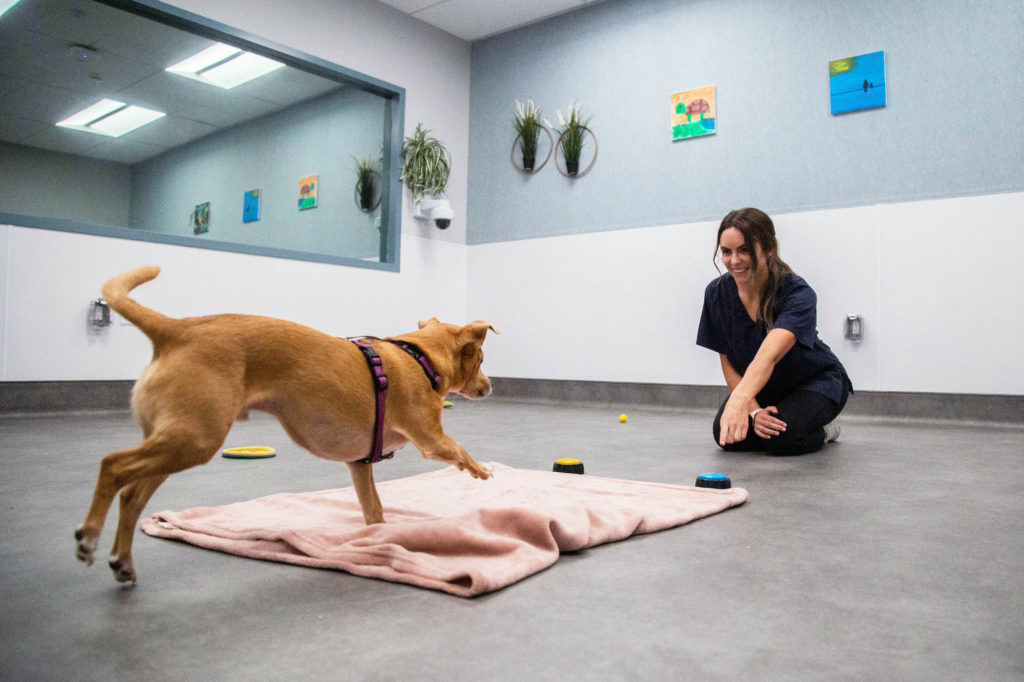
The lab, which was renovated thanks to federal and provincial funding via the Canada Foundation for Innovation and the BC Knowledge Development Fund, has recently undergone inspections by UBC veterinarians to ensure it is safe for pups and their humans. The room is outfitted with specialized flooring for easy cleaning, high-tech 360-degree cameras, and a two-way mirror with an observation room next door where researchers can observe the dogs without being noticed.

Although the room is a laboratory, the researchers have worked to make it feel warm and inviting with the careful placement of silly artwork, faux plants (to disguise the cameras), and dog toys, so that the animals and their companions feel safe and comforted.

“The comfort of the animal is a priority,” says Dr. Protopopova, who also holds the NSERC/BC SPCA Industrial Research Chair in Animal Welfare. “Our work is completely non-invasive, and we take that very seriously. All research is made to benefit the welfare of animals and the dogs that come in.”

Research aims to investigate dog cognition and therapy dog programs

UBC PhD student Bailey Eagan and her dog Rupert demonstrate the new Human-Animal Interaction Lab at UBC. Credit: Lexis Ly/UBC

UBC PhD student Bailey Eagan and her dog Rupert demonstrate the new Human-Animal Interaction Lab at UBC. Credit: Lexis Ly/UBC

While there will be a variety of different studies underway in the lab, the overarching goal of the research is to understand individual differences in dog cognition, both in terms of breed differences and individual differences in dogs, says Dr. Protopopova.

“We take a behavioural angle to our research and look for differences between dogs on a small-scale level,” she explains. “For example, we will be looking at how dogs interact with the world and what kinds of differences we might observe in fundamental aspects of their learning, like speed of knowledge acquisition and how quickly or slowly the dog might engage with a new item.”

An example of a simple cognitive experiment that the lab could run involves the “touch” command, where the pup is taught to touch its nose to the palm of the owner’s hand. The researchers might then change the rules by having the dog learn to touch both palms of the owner’s hand. They would then monitor to determine how long it takes the dog to both learn the task and adapt to the new rules.

The lab will also serve a teaching purpose to help students understand how dogs learn, see the world, and navigate their environment. Ultimately, the research will also help inform behaviour rehabilitation practices for dogs and cats and help improve resources and knowledge for animal shelters to support the behavioural needs of the animals in their care.

From the moment a dog arrives at the lab for their appointment, Dr. Protopopova says they are continuously assessed to determine their willingness to take part. After consent is obtained from the dog owner, the dog must also demonstrate their active willingness to participate throughout the research process.

“It’s important for us to ask the dogs if they would like to participate in the same way we would invite children to participate in studies,” she says. “While we have consent forms for the owner, we also have assent procedures for the dog as well, just like we would have for children. The dogs are always given the opportunity to engage and re-engage in the experiment. If the dog does not want to go forward, or if we observe any stress signs, we let the owner know and immediately stop the experiment.”

Regardless of whether they finish, all pups earn a certificate for participating—complete with a photo of them wearing a doggie graduation cap and sash, if they wish.

“We like to think of it as earning their Ph-Dog,” says Dr. Protopopova with a laugh.

For more information on how to apply, please click here.

Source: University of British Columbia