Monthly Archives: July 2017

Eddie

Eddie is a one-year old Staffordshire Bull Terrier, and a regular client for massage.

This little boy gets up on the table all by himself…

Kathleen Crisley, specialist in dog massage, rehabilitation and nutrition/food therapy, The Balanced Dog, Christchurch, New Zealand

Another date

Izzy and Bergie had a Date Night Afternoon yesterday.  It’s incredibly satisfying to have them off-lead and able to run and play even with the cold winter weather.

Bergie likes to dig holes.  Izzy seems to admire his skills, taking a front row seat to watch.

These two mean something special to one another and it is a joy to watch them play together.

Kathleen Crisley, specialist in dog massage, rehabilitation and nutrition/food therapy, The Balanced Dog, Christchurch, New Zealand

Sun Seekers

IMG_1552

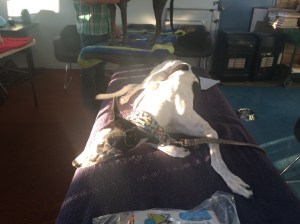
Izzy the greyhound rests in the late winter sun after a day of teaching a massage workshop for other greyhound owners

Our dogs are warm-blooded mammals, just like we are.  It’s no wonder that so many dogs love sitting in the sun and will move as the sun moves.

Based on the meridian theory of Traditional Chinese Medicine, it makes sense to me that the sun’s warmth will gently warm acupoints, stimulating blood and qi flow and releasing endorphins which make the dog feel better.

Dogs also produce Vitamin D in their skin, it’s a bit like humans only harder because the sun’s rays have to penetrate through their fur.  Dogs aren’t as efficient in converting 7-Dehydrocholesterol, which is the precursor to vitamin D.

If there’s a wound on the dog, sunlight will help to dry it out.  Sunlight is also a natural anti-bacterial (which is why our mothers and grandmothers swore by the need to hang towels and sheets in the sunlight to brighten and freshen them.)  Sunlight can help kill excess yeast which is particularly useful for dogs that fight skin problems relating to yeast.

Even though a dog can sit inside during winter to enjoy the warmth of the sun, windows will filter out some of the sun’s rays which we probably want to have in terms of penetrating through the fur to help with Vitamin D production.  That’s why in winter, I like to exercise Izzy on sunny days without her coat so she receives the full effect of the sun.

Thin coated dogs (like Izzy) have to be protected from UV radiation during summer and the warmer months.  White-coated dogs and those with thin skin over the muzzle or under the arms also need to be protected from sun damage.

But that’s not much of a worry right now, during the depths of the southern hemisphere winter.

Kathleen Crisley, specialist in dog massage, rehabilitation and nutrition/food therapy, The Balanced Dog, Christchurch, New Zealand

Training of explosive-detecting dogs

With a sense of smell much greater than humans, dogs are considered the gold standard for explosive detection in many situations. But that doesn’t mean there isn’t room for improvement.

In a study appearing in the journal Analytical Chemistry, scientists report on a new, more rigorous approach to training dogs and their handlers based on real-time analysis of what canines actually smell when they are exposed to explosive materials.

Vapor analysis training

New training techniques based on real-time analysis of what a dog smells could improve explosives detection. Credit: wellphoto/Shutterstock.com

Explosives are often used in terrorist attacks. Dogs trained to detect odors emanating from TNT, nitroglycerin and other explosives are a crucial part of the first-line defense against these incidents. But delivering low-concentration vapor during training sessions is a challenging task. Cross-contamination of training materials with samples from different explosives can skew results and confuse both dogs and handlers. To address these concerns, Ta-Hsuan Ong and colleagues sought to better understand the components within explosive odors that cue a dog’s reaction.

The researchers developed a real-time vapor analysis mass spectrometer to more accurately measure the vapor plumes from explosives that trigger a canine response.

In field trials, they used the device and found that some mistakes the dogs made were indeed correct identifications. For example, some “blanks” were used that were ostensibly prepared without explosive material, but the dogs indicated an explosive was present. When the researchers used the mass spectrometer on such blanks, they found evidence of explosive vapors, indicating cross contamination occurred or other interferents were present.

Based on these findings, the researchers suggest that use of real-time vapor analysis could help differentiate canine mistakes from cross contamination and other issues during training.

Source:  American Chemical Society