Monthly Archives: July 2017

Doggy quote of the month for August

“The charming relations I have had with a long succession of dogs results from their happy spontaneity.  Usually they are quick to discover that I can not see or hear.  Considerately they rise as I come near, so that I may not stumble.  It is not training but love which impels them to break the silence about me with the thud of a tail rippling against my chair, or gambols round the study, or news conveyed by expressive ear, nose, and paw.  Often I yearn to give them speech, their motions are so eloquent with things they can not say.  Truly, as companions, friends, equals in opportunities of self-expression, they unfold to me the dignity of creation, and in their joy smiles the blessing of St. Francis.”

– Helen Keller in A Tribute to a Dog

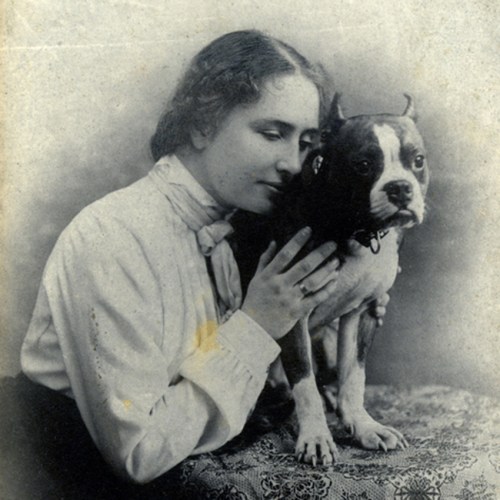
Helen Keller with companions

Helen Keller with Phiz (a Boston Terrier). Photo courtesy of Perkins School for the Blind

Dog walking could be key to ensuring activity in later life

A new study has shown that regularly walking a dog boosts levels of physical activity in older people, especially during the winter.

Published in the Journal of Epidemiology and Community Health, the study used data from the EPIC Norfolk cohort study, which is tracking the health and wellbeing of thousands of residents of the English county of Norfolk.

The researchers from the University of East Anglia (UEA) and Centre for Diet and Activity Research (CEDAR) at the University of Cambridge found that owning or walking a dog was one of the most effective ways to beat the usual decline in later-life activity, even combatting the effects of bad weather.

Dog owners were sedentary for 30 minutes less per day, on average.

More than 3000 older-adults participating in the study were asked if they owned a dog and if they walked one. They also wore an accelerometer, a small electronic device that constantly measured their physical activity level over a seven-day period.

As bad weather and short days are known to be one of the biggest barriers to staying active outdoors, the researchers linked this data to the weather conditions experienced and sunrise and sunset times on each day of the study.

Lead author of the paper, Dr Yu-Tzu Wu, said “We know that physical activity levels decline as we age, but we’re less sure about the most effective things we can do to help people maintain their activity as they get older.

“We found that dog walkers were much more physically active and spent less time sitting overall. We expected this, but when we looked at how the amount of physical activity participants undertook each day varied by weather conditions, we were really surprised at the size of the differences between those who walked dogs and the rest of the study participants.”

The team found that on shorter days and those that were colder and wetter, all participants tended to be less physically active and spent more time sitting. Yet dog walkers were much less impacted by these poor conditions.

Project lead Prof Andy Jones, from UEA’s Norwich Medical School, said: “We were amazed to find that dog walkers were on average more physically active and spent less time sitting on the coldest, wettest, and darkest days than non-dog owners were on long, sunny, and warm summer days. The size of the difference we observed between these groups was much larger than we typically find for interventions such as group physical activity sessions that are often used to help people remain active.”

The researchers caution against recommending everyone owns a dog, as not everyone is able to look after a pet, but they suggest these findings point to new directions for programmes to support activity.

Prof Jones said: “Physical activity interventions typically try and support people to be active by focussing on the benefits to themselves, but dog walking is also driven by the needs of the animal. Being driven by something other than our own needs might be a really potent motivator and we need to find ways of tapping into it when designing exercise interventions in the future.”

Source:  University of East Anglia press release


A perspective on time, a precious resource

Time is a precious resource.  We only have so much time in our day – you don’t get any more or any less than anyone else.

I have often said that one of the most important things we have to give our dogs is our time.  Time for play, time for love, time for care…That said, since I often work with sick or elderly dogs in my massage practice, I am also very mindful of how time can get away on us.

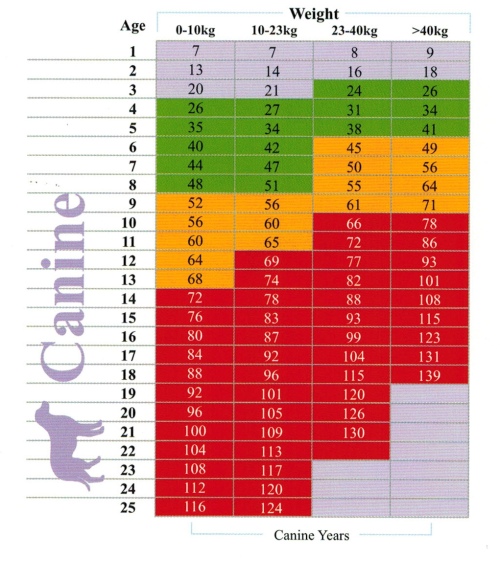
Our dogs live at a different time scale than we do.  There are many illustrations of the this  – here’s just one:

dog age chart

With our dogs aging at a faster rate than we do,  we don’t always understand the impact of a delay.

For example:

I meet many dog owners who come to see me because they have a fear of putting their dog on medications such as those that are used for arthritis.  Let me be clear on this – although I practice natural therapies – I am not against using traditional medications like non-steroidal anti-inflammatory drugs (NSAIDs).  Actually, quite the opposite.

Many dogs benefit from pain relief just like we humans do.

One of the better ways to assess the levels of pain in a dog is to give it a short course of NSAIDs and simply watch for changes in the dog’s behaviour and levels of activity.   If the dog improves, this is often the best indicator we have about the dog’s level of discomfort.

If pain is managed, then we can do even more hands-on work like acupressure, stretching, acupuncture and massage and this often means dosages of the ‘hard drugs’ can be reduced without sacrificing pain management.

In this example, the owner is hesitating to make a decision on using medication – even with the idea that we go into the arrangement knowing the medications will be used for only a short period – perhaps 2-3 weeks.

The dog weighs 25 kg and is 10 years old.

I start working with the dog and suggest a number of times that I believe the dog is in pain or at a minimum – uncomfortable.

The owner takes 2 months to make a decision before agreeing to try some pain relief.

In human years, since the dog is aging at a rate of 6 years to 1 human year at this life stage… 

The owner has waited the equivalent of one human year to make a decision!

 I will ask– if this was your grandma/grandpa/father/mother –  would you allow them to live like this without pain relief?

The answer has always been ‘no.’

We have a duty to care for our dogs which involves acting in their best interests.  They can’t tell us in words how much pain they are in, it’s up to us to figure it out.  And in deciding what to do, we must always be mindful of how precious time is.

Kathleen Crisley, specialist in dog massage, rehabilitation and nutrition/food therapy, The Balanced Dog, Christchurch, New Zealand

Search and rescue dogs do their job despite travel stress

When disaster strikes, you want the very best tools, functioning at their peak. In the case of catastrophic earthquakes, tornadoes, or even bombings in war zones, those tools are search and rescue dogs. But researchers have found that getting dogs to disaster sites can add to the animals’ stress.

“We’ve spent $16 billion in this country trying to come up with a machine that can sniff better than dogs, and we haven’t done it yet. Search and rescue animals can save lives, protect our soldiers in the field, and locate survivors after a disaster. We want to know how we can manage them so we can protect their performance, because their performance impacts human lives. That’s the reason behind what we do,” says Erin Perry, an assistant professor in the Department of Animal Science, Food and Nutrition at Southern Illinois University.

Perry, who has also been a canine handler in the Department of Homeland Security for the past 14 years, teamed up with University of Illinois animal scientist Kelly Swanson and others at U of I to learn how stress affects the animals’ performance on the job.

Search and rescue dogs fly on a moment’s notice to the site of a disaster, where they are expected to perform at the top of their game. But, just like for humans, flying can be stressful for dogs. The research team designed two preliminary studies to evaluate the effect of air travel stress on the animals’ physiology and job performance.

“Some dogs are like, ‘I’ve flown before, no big deal,’ but others, even if they’ve flown before, still show stress behaviors, and can have elevated body temperature or diarrhea,” says Swanson, Kraft Foods Human Nutrition Endowed Professor in the Department of Animal Sciences and the Division of Nutritional Sciences at U of I.

Dog owners may be familiar with the tendency towards loose stools when their animals are stressed. One of the reasons for that may be a stress-induced change in gut physiology and shift in the gut microbiome, the community of microbes that inhabit the mammalian gut. Paired with a more permeable [or leaky] gut lining, also triggered by stress, “bad” microbes can gain an advantage and cause upset stomachs. These symptoms have been observed in search and rescue dogs when traveling to a work site, but no one had ever studied the dogs’ microbiome.

In one of the studies by Perry and Swanson’s team, search and rescue dogs were flown for 2.5 hours in the cabin of a commercial airliner to the job site. In the other, dogs were “hot loaded” into a helicopter – blades whirling – for a quick 30-minute flight to the site. The team looked at slightly different factors in each study, but for both, they examined changes in the makeup of the microbiome and performance on the job.

Helicopter Study dogs approaching_1

Dogs being loaded into a helicopter

The helicopter flight caused spikes in body temperature and the stress hormone cortisol, but the researchers didn’t observe changes in the makeup of the dogs’ microbiomes. Dogs that entered an airport, went through security, and flew for a longer period on the commercial flight showed an interesting microbial shift.

“Microbial beta diversity, which is a measure of the presence and abundance of bacterial taxa, was different between dogs that traveled compared to those that did not. Travel led to greater relative abundances of Clostridia and Bacteroidaceae populations, two of the more predominant microbial groups in the gastrointestinal tract,” Swanson explains. He says more research is needed to understand how such changes may impact the long-term health of search and rescue dogs.

But the most impressive finding in both studies was the fact that there was no effect of air travel stress on the dogs’ job performance. “They showed behavioral stress, their gut was completely turned upside down, their bloodwork showed significant effects, and it didn’t matter. They still went to work and performed beautifully,” Perry says. “Even though we see physiological impacts on these dogs, they’re such amazing athletes that they overcome the physical and environmental stress and just do their job.”

Although travel didn’t impact the dogs’ performance in these preliminary studies, the researchers emphasized that stress can occasionally cause search and rescue dogs to miss work. But gaining new insight into canine stress responses, particularly the way stress affects the microbiome, may pave the way towards potential solutions for both working and companion animals.

“We’ve all owned dogs that were scared of lightning, vacuum cleaners, those innocuous day-to-day experiences,” Perry says. “Having a better understanding of what causes stress and how to compensate for it helps every dog, not just the ones that are out there saving lives.”

Swanson adds, “These small studies are just a starting point. In the future, we hope to apply these findings to larger studies focused on various stressor types and a longer duration of stress, similar to that experienced in the field during times of emergency. Our goals will be to develop and evaluate nutritional interventions and/or management strategies that avoid negative physiologic effects and maintain performance.”

Source:  University of Illinois media release

The truffle dog

In Canterbury (New Zealand), we are halfway through the third annual Truffle Festival.

This is a celebration of the gourmet fungus known as truffles and of course the food and wine that go with these delicacies.  You can think of truffles as a sort of underground mushroom that only grows in certain soils.

The alkaline soils of Waipara and surrounding areas of North Canterbury make ideal growing media for truffles.

Hard at work in Waipara is Rosie the Beagle who lives at Limestone Hills.  Back in 2013, I visited the farm and watched Rosie in action – she’s a truffle dog – trained to sniff out the truffles so they can be harvested.

Good girl, Rosie!

Rosie the Beagle 2013

Kathleen Crisley, specialist in dog massage, rehabilitation and nutrition/food therapy, The Balanced Dog, Christchurch, New Zealand


Researchers identify a common underlying genetic basis for social behavior in dogs and humans

Dogs’ ability to communicate and interact with humans is one the most astonishing differences between them and their wild cousins, wolves. A new study published in the journal Science Advances identifies genetic changes that are linked to dogs’ human-directed social behaviors and suggests there is a common underlying genetic basis for hyper-social behavior in both dogs and humans.

An interdisciplinary team of researchers, including those from Princeton University, sequenced a region of chromosome 6 in dogs and found multiple sections of canine DNA that were associated with differences in social behavior. In many cases, unique genetic insertions called transposons on the Williams-Beuren syndrome critical region (WBSCR) were strongly associated with the tendency to seek out humans for physical contact, assistance and information.

In contrast, in humans, it is the deletion of genes from the counterpart of this region on the human genome, rather than insertions, that causes Williams-Beuren syndrome, a congenital disorder characterized by hyper-social traits such as exceptional gregariousness.

“It was the remarkable similarity between the behavioral presentation of Williams-Beuren syndrome and the friendliness of domesticated dogs that suggested to us that there may be similarities in the genetic architecture of the two phenotypes,” said Bridgett vonHoldt, an assistant professor in ecology and evolutionary biology at Princeton and the study’s lead co-author.

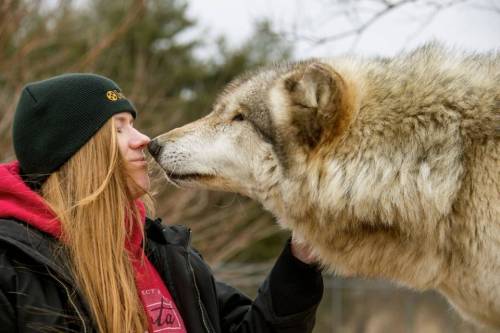
Dogs ability to communicate

Dogs’ ability to communicate and interact with humans is one of the most astonishing differences between them and their wild cousins, wolves. Shown here, Lauren Brubaker, a graduate research assistant in the Department of Animal and Rangeland Sciences at Oregon State University and one of the study’s authors, interacts with a gray wolf. Photo by Monty Sloan

VonHoldt had identified the canine analog of the WBSCR in her publication in Nature in 2010. But it was Emily Shuldiner, a 2016 Princeton alumna and the study’s other lead co-author, who, as part of her senior thesis, pinpointed the commonalities in the genetic architecture of Williams-Beuren syndrome and canine tameness.

By analyzing behavioral and genetic data from dogs and gray wolves, vonHoldt, Shuldiner and their colleagues reported a strong genetic aspect to human-directed social behavior by dogs. Monique Udell, an assistant professor of animal and rangeland sciences at Oregon State University and the paper’s senior author, collected and analyzed the behavioral data for 18 domesticated dogs and 10 captive human-socialized wolves, as well as the biological samples used to sequence their genomes.

First, Udell quantified human-directed sociability traits in canines, such as to what extent they turned to a human in the room to seek assistance in trying to lift a puzzle box lid in order to get a sausage treat below or the degree to which they sought out social interactions with familiar and unfamiliar humans. Then, vonHoldt and Shuldiner sequenced the genome in vonHoldt’s lab and correlated their findings.

Consistent with their hypothesis, the researchers confirmed that the domesticated dogs displayed more human-directed behavior and spent more time in proximity to humans than the wolves. The also discovered that some of these transposons on the WBSCR were only found in domestic dogs, and not in wolves at all.

VonHoldt’s findings suggest that only a few transposons on this region likely govern a complex set of social behaviors. “We haven’t found a ‘social gene,’ but rather an important [genetic] component that shapes animal personality and assisted the process of domesticating a wild wolf into a tame dog,” she said.

Anna Kukekova, an assistant professor in the Department of Animal Sciences at the University of Illinois at Urbana-Champaign who is familiar with the research but had no role in it, said that the paper points to these genes as being evolutionarily conserved, or essentially unchanged throughout evolution. “The research provides evidence that there exist certain evolutionary conservative mechanisms that contribute to sociability across species,” she said. “That they have found that this region contributes to sociability in dogs is exciting.”

The researchers’ evidence also calls into question the role of domestication in the evolution of canine behavior. Most experts agree that the first domesticated dogs were wolves that ventured into early human settlements. These proto-dogs evolved not only in their looks, but also their behavior, a process likely influenced by the species’ cohabitation, according to vonHoldt.

However, unlike previous research which suggests that, during the process of domestication, dogs were selected for a set of cognitive abilities, particularly an ability to discern gesture and voice, vonHoldt and Shuldiner’s research posits that dogs were instead selected for their tendency to seek human companionship.

“If early humans came into contact with a wolf that had a personality of being interested in them, and only lived with and bred those ‘primitive dogs,’ they would have exaggerated the trait of being social,” vonHoldt said.

Source:  Princeton University media statement

The Diplomatic Dog

Gracie is the fun, feisty, cute and sporty Yorkie owned by US Ambassador Scott Brown, who recently relocated to New Zealand for his diplomatic post.

Gracie has her own Twitter account.

That makes perfect sense, given that Gracie is an extended member of President Trump’s administration – and Mr Trump is well known for his like and use of Twitter.

News from Gracie so far has been limited because she’s been in quarantine since arriving in New Zealand (she got out yesterday).   New Zealand is blessed with some very unique flora and fauna and it relies on a strong agricultural economy.  Because of this (and the fact that our country is free of diseases like heartworm and rabies), dogs that arrive here from other countries need to have a period of quarantine.

Unlike most dogs who arrive in New Zealand, however, Gracie didn’t arrive as baggage.  Ambassador Brown tweeted a photo of Gracie sitting on his lap on the plane trip to New Zealand.  The perks of being a diplomatic dog!

Scott Brown with Gracie

Scott Brown and his dog, Gracie, on their flight to New Zealand. —Scott Brown via Twitter

According to Gracie, Brown and his wife visited her in quarantine earlier this month.

Ambassador Brown with Gracie in quarantine

Scott Brown with Gracie in quarantine

Since Gracie is now out of quarantine, she’ll be able to experience all that New Zealand has to offer.

If you ask me (a transplanted American of 23+ years), Scott Brown is very lucky in his posting to this beautiful country.

We hope Scott brings Gracie for a massage.

Kathleen Crisley, specialist in dog massage, rehabilitation and nutrition/food therapy, The Balanced Dog, Christchurch, New Zealand

Dogs help in breast cancer research

Cancer is one of the most frequent diseases not only in people, but in pets as well. Like people, dogs can also suffer from cancer of the mammary glands (mammary tumors). Dog mammary tumors are very similar to breast carcinoma in humans, and much more so than those of rats or mice, for example. For this reason, research on canine mammary tumors is important for human medicine as well. A study performed at the University of Zurich has now shown how similar mammary tumors are in both people and dogs.

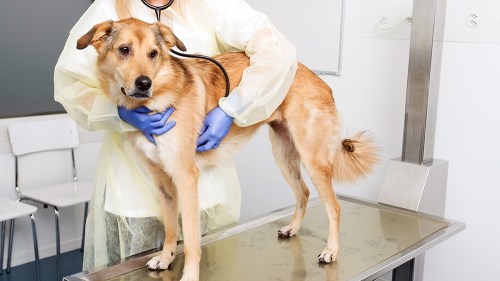
Enni Markkanen, Vetsuisse-Fakultät Zürich, Untersuch Hund

Cancerous cells reprogram healthy cells

For the development of tumors and the progression of a carcinoma, not only the characteristics of the cancer cells themselves are decisive, but also the cells surrounding the tumor play a major role in this. Many tumors even have the capability to reprogram healthy cells in the tumor environment in a way that they start to support the growth of the cancerous cells. This mechanism plays an essential role in human breast carcinoma – but is it the same for dogs? The similarity of breast carcinoma in dogs and humans has been known for a long time. “But whether these tumor cells also influence the surrounding tissue in dogs the same way they do in humans was unknown until now”, explains Enni Markkanen of the Institute of Pharmacology and Toxicology of the Vetsuisse Faculty of the University of Zurich.

Archived tissues are of great value to the research

The researchers analyzed the surrounding tissue of canine mammary tumors using molecular biology and immunohistological methods. To do this, they could access the tissue archive of the Institute of Veterinary Pathology located at the Animal Hospital. “With the permission of our patient’s owners, we conduct pathological tests to better understand diseases,” says animal pathologist Alexandra Malbon. “In the process, we archive samples of various organs and tissues as these samples can be of great value to answer future research questions.”

Dogs suffering from cancer aid cancer research for humans

In the archived samples of mammary tumors from dog patients, Enni Markkanen and her team were able to prove that some cells in the vicinity of tumors behave the same way as the corresponding cells in humans: In the healthy tissue surrounding the tumor, substances are produced that promote tumor growth. “Simply speaking, the tumor enslaves its environment: It forces the surrounding cells to work for its benefit,” Markkanen adds. This mechanism works the same in both humans and dogs. For research on breast carcinoma, tumor tissue of dogs is therefore, among other reasons, much better suitable than tissue from rats or cells cultivated in the laboratory. “Importantly, however, we don’t view our dog patients as test subjects for cancer research,” Markkanen says. “But they can help us to better understand breast carcinoma in both dogs and humans and fight it more effectively.”

Source:  University of Zurich media statement

Ben and Mouse have a birthday

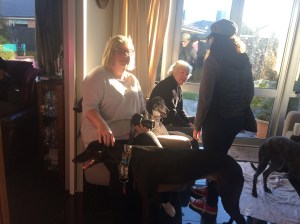
Today Ben and Mouse celebrated their 5th birthday and we were invited.

Ben and Mouse

Mouse (left) and Ben (right)

We see Ben and Mouse at greyhound walks and we are lucky that we have developed friendships with their humans and other humans/greyhounds who were at the party.

In total, 7 hounds attended the party – with no incidents including feeding them their own doggy birthday cake.

Here are some photos of the day:


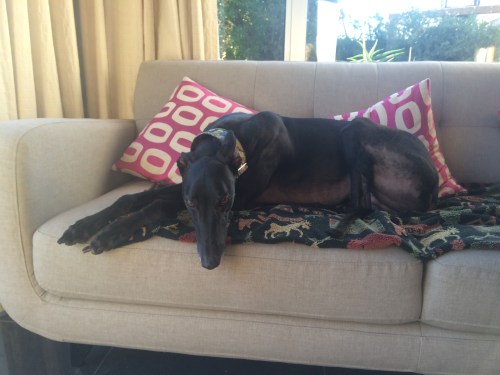
Ben

Ben makes himself at home on the sofa at Mouse’s house

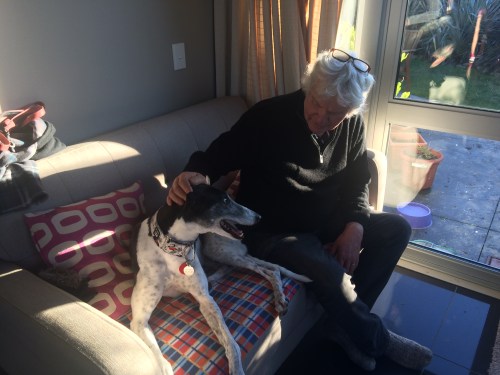
Geoff and Elsie

Elsie charms Geoff

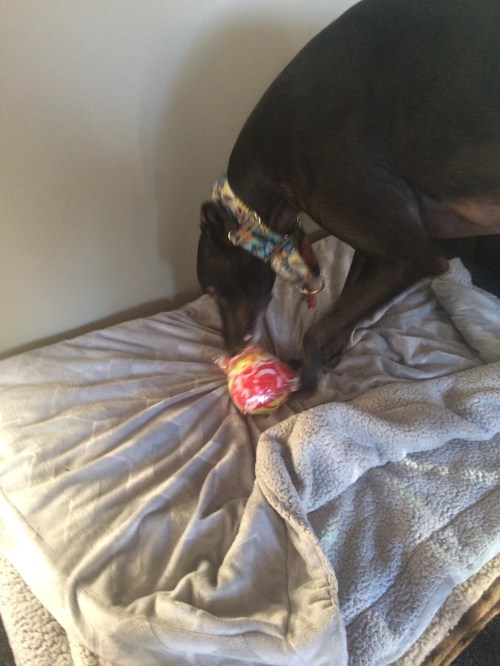
Ben opens his present

Ben opens his present

IMG_1605

A good time was had by all.

Kathleen Crisley, specialist in dog massage, rehabilitation and nutrition/food therapy, The Balanced Dog, Christchurch, New Zealand

Origami dogs

It’s been a terrible week of weather in Canterbury – we’re experiencing deep winter with lots of rain and cold.  It’s also school holidays and one of my clients was telling me that she uses the winter school holidays for rest with the kids.  They do outdoor activities but also lots of puzzles and crafts.

I’ve been wanting to post for a while about origami – the Japanese art of paper folding – and the large range of dogs that can be depicted using this craft.  Let’s start with the rather easy dog face:

Origami dogs

Here are the instructions for creating one:

Origami dog face instructions

Fairly easy.  But have a look at the more complicated origami designs all featuring dogs:

The above dogs were folded by Steven Casey, who has a Flickr account.

Greyhound origami by John Montroll

Greyhound origami by John Montroll

Papillon by Hideo Komatsu

Papillon by Hideo Komatsu

The variety is endless!

Just don’t let these dogs go outside in the rain or snow….

Kathleen Crisley, specialist in dog massage, rehabilitation and nutrition/food therapy, The Balanced Dog, Christchurch, New Zealand