Monthly Archives: February 2020

Image

Doggy quote of the month for March

Jane Goodall quote

New Study Results Consistent With Dog Domestication During Ice Age

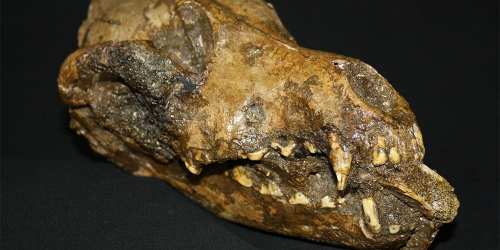
Palaeolithic-dog

Analysis of Paleolithic-era teeth from a 28,500-year-old fossil site in the Czech Republic provides supporting evidence for two groups of canids – one dog-like and the other wolf-like – with differing diets, which is consistent with the early domestication of dogs.

The study, published in the Journal of Archaeological Science, was co-directed by Peter Ungar, Distinguished Professor of anthropology at the University of Arkansas.

The researchers performed dental microwear texture analysis on a sample of fossils from the Předmostí site, which contains both wolf-like and dog-like canids. Canids are simply mammals of the dog family. The researchers identified distinctive microwear patterns for each canid morphotype. Compared to the wolf-like canids, the teeth of the early dog canids – called “protodogs” by the researchers – had larger wear scars, indicating a diet that included hard, brittle foods. The teeth of the wolf-like canids had smaller scars, suggesting they consumed more flesh, likely from mammoth, as shown by previous research.

This greater durophagy – animal eating behavior suggesting the consumption of hard objects – among the dog-like canids means they likely consumed bones and other less desirable food scraps within human settlement areas, Ungar said. It provides supporting evidence that there were two types of canids at the site, each with a distinct diet, which is consistent with other evidence of early-stage domestication.

“Our primary goal was to test whether these two morphotypes expressed notable differences in behavior, based on wear patterns,” said Ungar. “Dental microwear is a behavioral signal that can appear generations before morphological changes are established in a population, and it shows great promise in using the archaeological record to distinguish protodogs from wolves.”

Dog domestication is the earliest example of animal husbandry and the only type of domestication that occurred well before the earliest definitive evidence of agriculture. However, there is robust scientific debate about the timing and circumstances of the initial domestication of dogs, with estimates varying between 15,000 and 40,000 years ago, well into the Ice Age, when people had a hunter-gatherer way of life. There is also debate about why wolves were first domesticated to become dogs. From an anthropological perspective, the timing of the domestication process is important for understanding early cognition, behavior and the ecology of early Homo sapiens.

The study’s lead author is Kari Prassack, curator of paleontology at Hagerman Fossil Beds National Monument, which is part of the National Park Service. Co-authors were Martina Lázničková-Galetová of the Moravian Museum in Czech Republic; Mietje Germonpré of the Royal Belgian Institute of Natural Sciences; and Josephine DuBois, Ungar’s former Honors College student and now student at the University of Missouri-Kansas City School of Dentistry.

This research was supported by the Czech Science Foundation, the Ministry of Culture of the Czech Republic and the University of Arkansas Honors College. Fossil material for this study came from collections of the Moravian Museum in Czech Republic.

Source:  University of Arkansas Research Frontiers

Beyond Izzy’s pram (managing dogs through to old age) Part 4 – Food

We’re going higher up the ladder this week to the third rung:  Food & Supplements. 

In many resources, food and supplements are talked about together because food is eaten and most supplements are, too.  I’m going to write about Food now, however, and save Supplements for the next post to keep the length of the post manageable and easier to read.  There’s still a lot I want to cover.
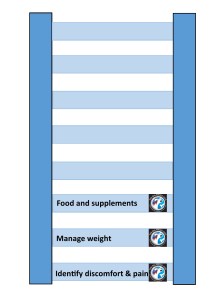
Arthritis management diagram 3rd rung

So in my last post about weight management, I mentioned that sometimes I ask my clients to simply reduce the food they are feeding by up to 1/3 per meal because a diet food is not always needed if the diet is balanced.  That advice was specifically addressing the need to lose weight.

In Part 3, I also included a diagram about body condition.  Dogs of all ages should be fed to body condition; the labels on dog food are a guide and not the Bible.  So, if a dog is gaining weight, then we may cut back on food a bit and help them reach an ideal weight again.  Sometimes, we end up cutting back too much and then we have to feed a little more.

This is where the ladder analogy helps us.  We can go up and down a ladder fairly easily.  And when managing our dog’s health, we have to be prepared to re-visit issues and change approaches accordingly.

Sometimes we go up the ladder and sometimes we go down.

Older dogs generally have a slower metabolism and combined with less physical activity because they are slowing down (with or without arthritis) –  they require less calories.

There are also other considerations for diets when your dog is older. 

For example, if your dog has been diagnosed with kidney disease, then a diet lower in protein is recommended because the kidneys process extra protein for removal in the  urine.  If the kidneys aren’t working well, we need to lessen the pressure on them.  If this is the case, your vet will probably recommend a commercial diet to meet those needs.

Protein is important for muscles – keeping them strong and helping them to repair themselves.  Proteins are a source of energy; they help keep the immune system strong, and have a role in creating enzymes and hormones.  They’re an essential part of the diet.

(When I started making my own dog treats for sale, I remember talking with a Board-certified veterinarian at the Angell Memorial Animal Hospital in Boston.  She was of the view then that all older dogs should have reduced protein diets.  But in the intervening years, more research has shown that this is not the case.  A lesson for all of us.   As we gather more information through study and research, professional advice may change.)

In TCM (Traditional Chinese Medicine), we understand that older animals don’t have the digestive energy that younger dogs do.  Therefore, protein sources should be highly digestible when you are managing an older dog.  This is a main reason why I like the homemade and topper approach to foods.  I use a good quality dry dog food, but I enhance it with many fresh ingredients.

A few sources of good protein toppers are:

  • Eggs (whole) –  I like to hard boil eggs and then slice the over the kibble before adding warm water
  • Cottage cheese
  • Sardines

I also cook my own toppers.

Toppers add palatability (taste) and because the dog’s sense of smell is much better than our own, I think the toppers add appeal through smell, too.

If a dog has an arthritis diagnosis, then “Joint Diet” foods are readily available and companies like Hill’s have undertaken feeding trials to prove their diets are balanced.  As part of the research into the product, the veterinary team observed a reduction in the clinical signs of arthritis with a subsequent reduction in the dosages of anti-inflammatory drugs that were required to manage the dog’s pain and arthritis symptoms.

That said, I have never fed a joint diet because I really dislike the ingredient panel in these highly processed foods.  I’ve always felt that if we are told to keep fresh things in our diet, then the same should go for our dogs. I can still use supplements and other modalities to manage arthritis and inflammatory pain.  I just don’t need to have a ‘complete solution in a bag.’  (This post is getting long – see why I chose to leave Supplements to their own post?)

Because digestion in an older dog is slower, if they have less physical activity such as recovery from a surgery or advancing arthritis, they can also become constipated from time to time.  Drugs like Tramadol are also constipating. (This happens in rest homes with older people, too.  An older person who lives their life in a wheelchair and unable to walk around much and on medication often finds that it is harder to get the bowels moving.)

More fibre combined with good hydration helps keep the bowels doing what they need to do (rid the body of wastes and toxins) and the best addition to food for fibre is steamed pumpkin.  I know that tinned or canned pumpkin is also very popular in the USA as well.

Parents need to watch what they are giving as treats, too.  Treats are food and add calories to the diet – but they also add variety and variety is the spice of life!  If an older dog has lost some teeth over the years, for example, harder treats may need to be avoided in favor of softer ones.  If we are focusing on hydration to help manage constipation, softer texture treats or those that can be soaked in water are a good idea.
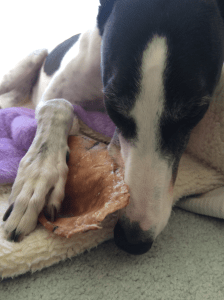
Izzy with pigs ear

Izzy the greyhound with a pigs ear. These help to clean her teeth to some extent (although we brush her teeth every night, too). Treats add variety to the diet and because I source my pigs ears locally, I am more confident in their quality.

Got questions about this post?  Please feel free to post a message or contact me through my practice, The Balanced Dog.

Kathleen Crisley, Fear-Free certified professional and specialist in dog massage, rehabilitation and nutrition/food therapy, The Balanced Dog, Christchurch, New Zealand

Pet insurance words of wisdom

I believe that things happen for a reason.  This post was motivated by two separate comments I received over the course of the week.

Dog with toothbrush

Reminder: February is Pet Dental Health Month

#1 -You need insurance before something happens

A travel agent made this comment when presenting her pitch at a business networking meeting.  She was talking about travel insurance in context of the coronavirus outbreak.

People who have had travel booked for a while are getting in touch wanting travel insurance in case their trips are cancelled due to the virus.  Her advice:  too late.  You need to buy insurance as soon as you book a trip.  Straight away.  Now that coronavirus is a known risk, no insurer is going to cover it.

The same is true of pet insurance.  Insurers will ask you for your dog’s medical records to review and if they have a diagnosis or previous injury, don’t expect coverage.  They’re called pre-existing conditions.  (There are also things like exclusions – French Bulldogs often have an exclusion for airway surgery, for example, because so many of the dogs need this surgery).

So when I see posts on Facebook saying “My dog just broke his leg and needs surgery and I need pet insurance now” I think the same thing:  too late.

#2 – If you are struggling to pay for insurance, you’re probably the person who needs it the most

This one was personal advice given by a veterinarian.

In her experience, if a pet owner can’t reasonably afford insurance payments, chances are they are even more at risk of being unable to pay when the pet’s needs are acute  – surgery or illness.

Pets are our family, companions, and friends.  They are good for our physical and mental health.  But they are not cheap.  And so anyone who is taking a pet into their life really needs to understand that most pets, at some time in their life, need more than a vaccination, health check, or flea treatment.  If you don’t have insurance, how will you pay for necessary care?

Kathleen Crisley, Fear-Free certified professional and specialist in dog massage, rehabilitation and nutrition/food therapy, The Balanced Dog, Christchurch, New Zealand

Beyond Izzy’s pram (managing dogs through to old age) Part 3

In Part 2,  I introduced a ladder concept to explain that there were steps in managing an older dog, and particularly one that is likely to have arthritis.

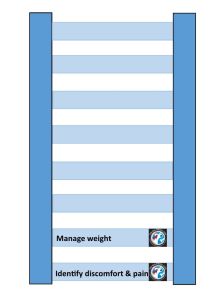
This is what our ladder looks like now, with two rungs, because today we are talking about managing weight.

Arthritis management diagram with 2 rungs

Overweight pets are a first world problem.  We love our dogs, we use treats for training, and we keep using treats to show our love.  Many of us don’t measure (or ideally, weigh) our dog’s food at feeding time.  Portion sizes start to creep up.

And then our dog starts to slow down, not playing or running around as much.  They don’t need as many calories but we keep feeding them the same as we have always done.  So with less calories burned, the dog’s body adds fat placing more stress on joints that are arthritic because they now have to move more weight than they used to (or should).

As with any change in lifestyle, a vet check is always recommended before starting a weight loss program.  We don’t want to assume that weight is the only problem in an older dog.  (Kidney and liver function, for example, should be checked).

I advise my clients to weigh their dog as a starting point and it’s also helpful to take measurements such as the waistline line (in line with the knees) and a measurement behind the elbows.

I often ask my clients to simply reduce the food they are feeding by up to 1/3 per meal (requiring them also to measure or weigh up what a ‘normal’ feed has been).  A diet food is not always needed if they are already feeding a balanced diet.

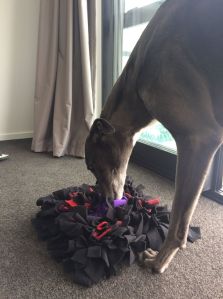
Other tricks include scattering food around the garden or living room which requires the dog to forage for its food and, while doing that, they are getting some additional low impact exercise.  Snuffle mats, which I sell in my practice, are another slow feeding option.  Kongs are another.

Kobe with snuffle mat

Kobe the greyhound with a snuffle mat

Everyone in the household has to be on board with the weight loss program – sneaking treats just doesn’t help the dog reach its weight loss goal.

Regular weigh-ins and measurements will help you stay on track and be able to celebrate each weekly (or fortnightly) weight loss.  And we celebrate with some play, a tummy rub, massage or a car ride – definitely not food!

I use massage and acupressure to help my clients through weight loss.  Because if the dog is feeling less painful with endorphin release and muscles that are stretched and supple, they will move more.  And with increased movement brings an increase in calories burned.

I also become the dog’s private weight loss coach, and a sounding board for the family so we can remain positive when we have setbacks.

It becomes a happy cycle of more weight loss, happier dog and happier family.

Many parents just don’t realise that their dog is overweight.  Overweight dogs have become something of a normal occurrence in many communities.  A good rule of thumb is to lay your hands on either side of your dog’s rib cage.  Can you feel the ribs without pressing down?  If not, your dog is probably carrying some extra weight.

Charts like this one are also useful.  They are often on display in vet practices to help the veterinarian explain to clients about body scores and condition:

Layout 1

Got questions about this post?  Please feel free to post a message or contact me through my practice, The Balanced Dog.

Kathleen Crisley, Fear-Free certified professional and specialist in dog massage, rehabilitation and nutrition/food therapy, The Balanced Dog, Christchurch, New Zealand
Scout: Super Bowl Ad Star

In the 2019 Super Bowl, Scout the Golden Retriever featured in an advertisement for WeatherTech and their PetComfort feeding system.

But this year, CEO David MacNeil  paid $6 million dollars for a 30-second ad that didn’t promote his business.  Rather, it featured Scout and the veterinary school in Wisconsin that saved his life.

In July 2019, Scout collapsed and was diagnosed with hemangiosarcoma, an aggressive cancer that formed in his heart.  Scout was treated at the University of Wisconsin in Madison and MacNeil decided to help them raise money for research by taking out the ad.

Here are both of Scout’s commercials:


Kathleen Crisley, Fear-Free certified professional and specialist in dog massage, rehabilitation and nutrition/food therapy, The Balanced Dog, Christchurch, New Zealand

Beyond Izzy’s pram (managing dogs through to old age) Part 2

According to statistics, one in every five dogs is affected by arthritis, or more specifically osteoarthritis.  It’s a disease that is progressive and is associated with a number of factors which result in degeneration of the joints.

In my opinion, the stats are probably a lot higher.  More than one in five.  And that’s because too many dog parents see the symptoms of arthritis but classify it as ‘normal slowing down with age’ and they don’t seek professional help until much later – if at all.   Arthritis can develop in young dogs – I’ve seen it in dogs between the ages of 1 and 2 –  but the odds certainly increase with age.  If a dog reaches the age of 7, then they have a 65% chance of developing arthritis.

So in this post, I want to introduce you to the ladder concept for managing dogs with arthritis.  There are various rungs to the ladder and we’re going to cover each one.  Each rung is a step up in terms of effort (and potentially cost) and, just like in real life, you can go up and down the ladder based on circumstances which can include progression of the disease.

Ladder diagram

The first rung is about identifying pain and discomfort in your dog.   Many owners expect their dog to whimper or cry out as the primary indicator that they are uncomfortable.  But that just isn’t true.  By the time a dog vocalises, chances are they have been experiencing discomfort for some time and have become very painful.

There are degrees of difference between discomfort and pain

Discomfort is tolerable.  People describing discomfort use words like lingering, annoying, or aching.

Pain is much more than discomfort.  Pain is intense.  It changes the way you do things or enjoy your day.  When people describe pain they choose words like burning, sharp, or shooting.

Discomfort tells us something is wrong and often helps us manage before the situation becomes painful.

Our dogs are non-verbal communicators.  We have to become experts at their non-verbal communication by being keen observers.

In late 2017, for example, I noticed a behavioural change in Izzy.  Over the course of about 10 days, it seemed that almost every time I looked over at her, she was licking her left carpus (wrist).  And so I took her to the vet and asked for x-rays.  These confirmed ”very minor arthritic changes” – so minor that we agreed a regular rubdown with an animal liniment would likely be sufficient rather than requiring pain medication.  Izzy was experiencing discomfort and not pain.

Changes can be subtle.  My intake questionnaire for new clients is many pages long and I ask questions about mobility and behaviour as well as personally observing the dog’s gait.  A reluctance to get out of bed in the morning may not be a sign of laziness, for example.  It could be that the dog is stiff after resting all night.

Other signs can include:

  • difficulty getting comfortable in bed
  • withdrawal from normal activities
  • snapping when touched
  • pressure sores on the elbows or other joints
  • lameness or changes in gait
  • scuffing of toe nails
  • pacing

The list goes on…

When we see someone every day (and this includes our pets), we often don’t pick up on small changes.  This is a main reason why asking for a professional’s assessment is a good thing to do.  They come into your situation with a fresh set of eyes.

Got questions about this post?  Please feel free to post a message or contact me through my practice, The Balanced Dog.

Kathleen Crisley, Fear-Free certified professional and specialist in dog massage, rehabilitation and nutrition/food therapy, The Balanced Dog, Christchurch, New Zealand