“The bond with a dog is as lasting as the ties of this earth can ever be”
– Konrad Lorenz, Austrian zoologist
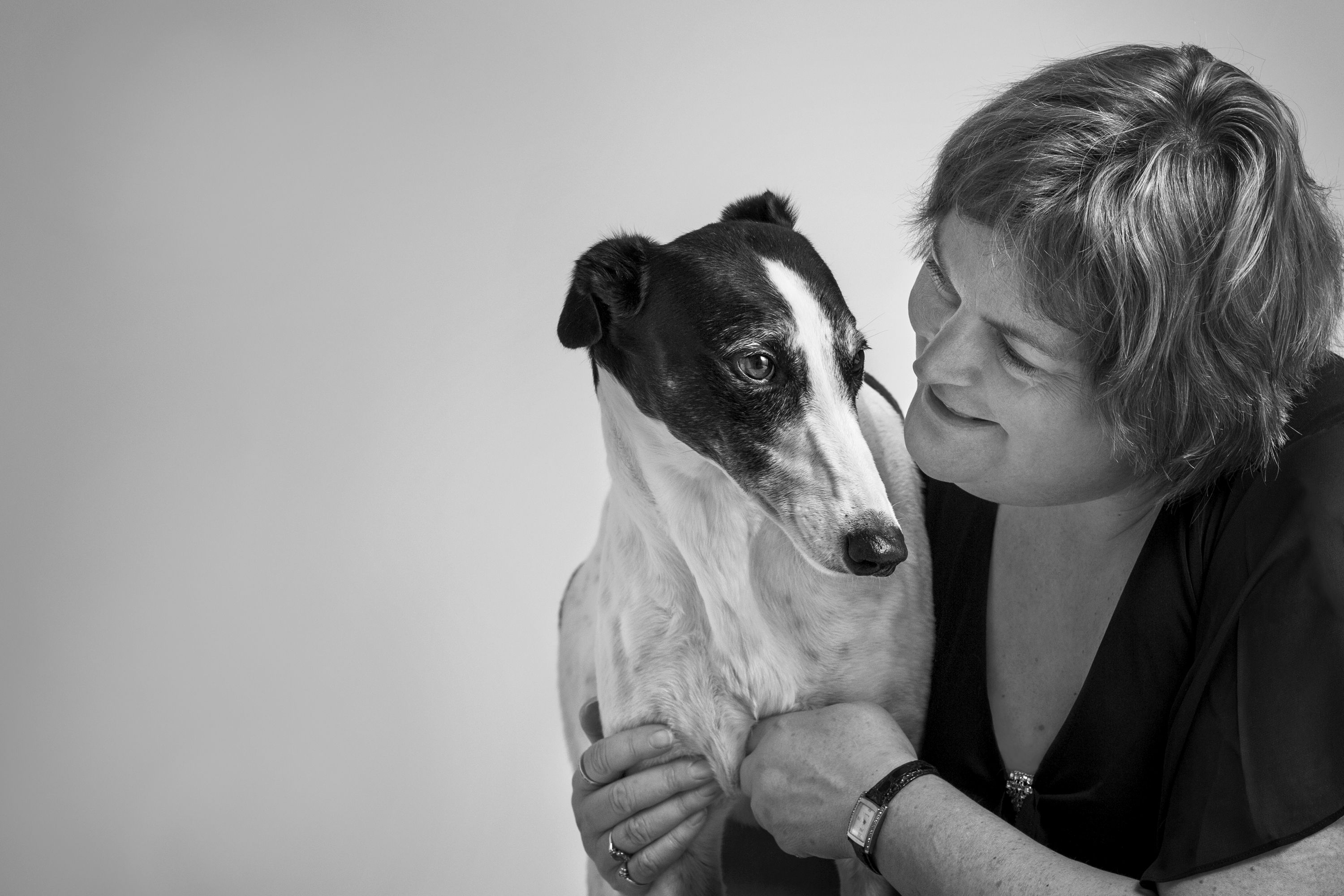

“The bond with a dog is as lasting as the ties of this earth can ever be”
– Konrad Lorenz, Austrian zoologist
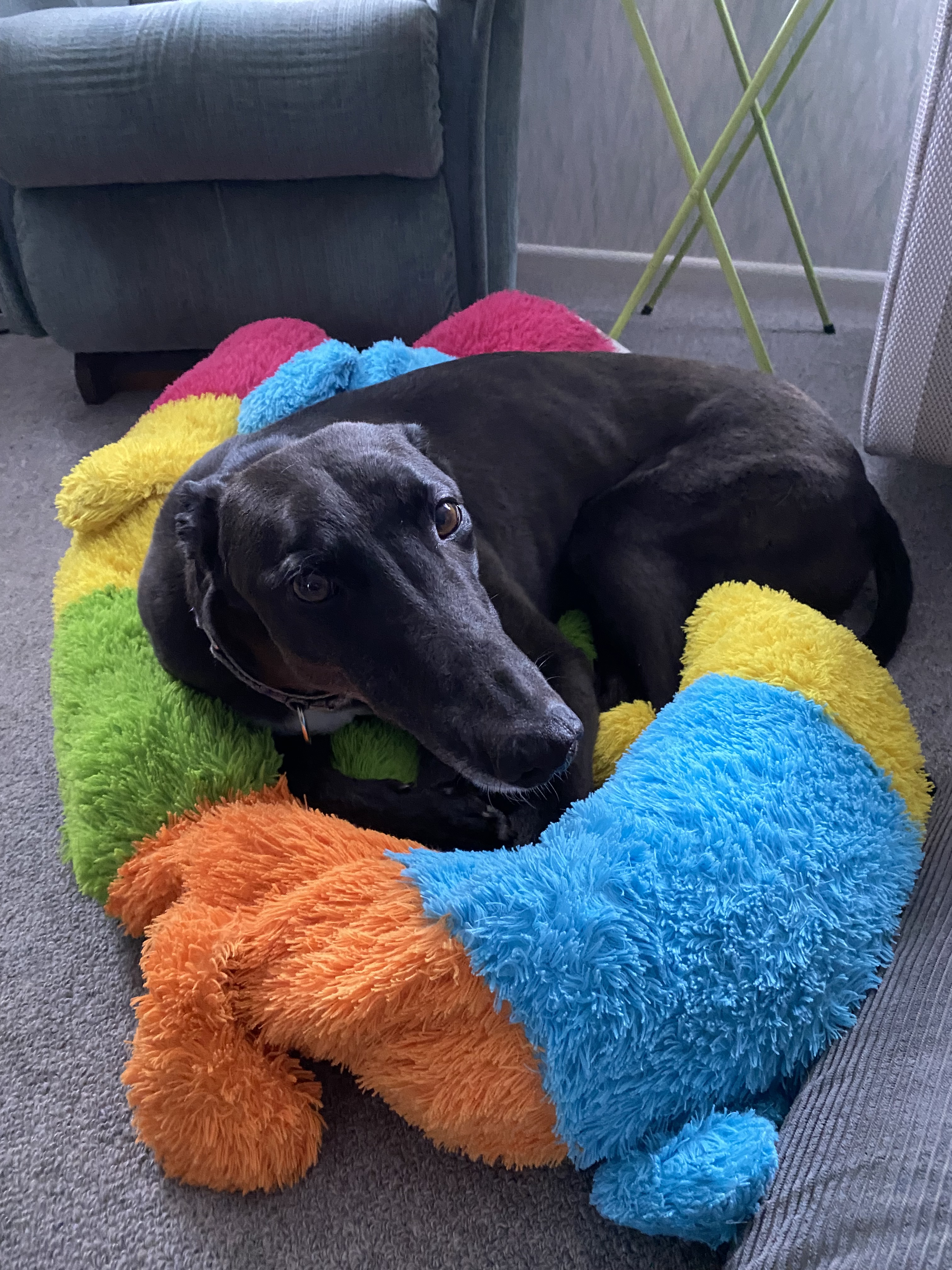
Rosie is my foster dog; she arrived one month ago exactly, on 17 December 2021.
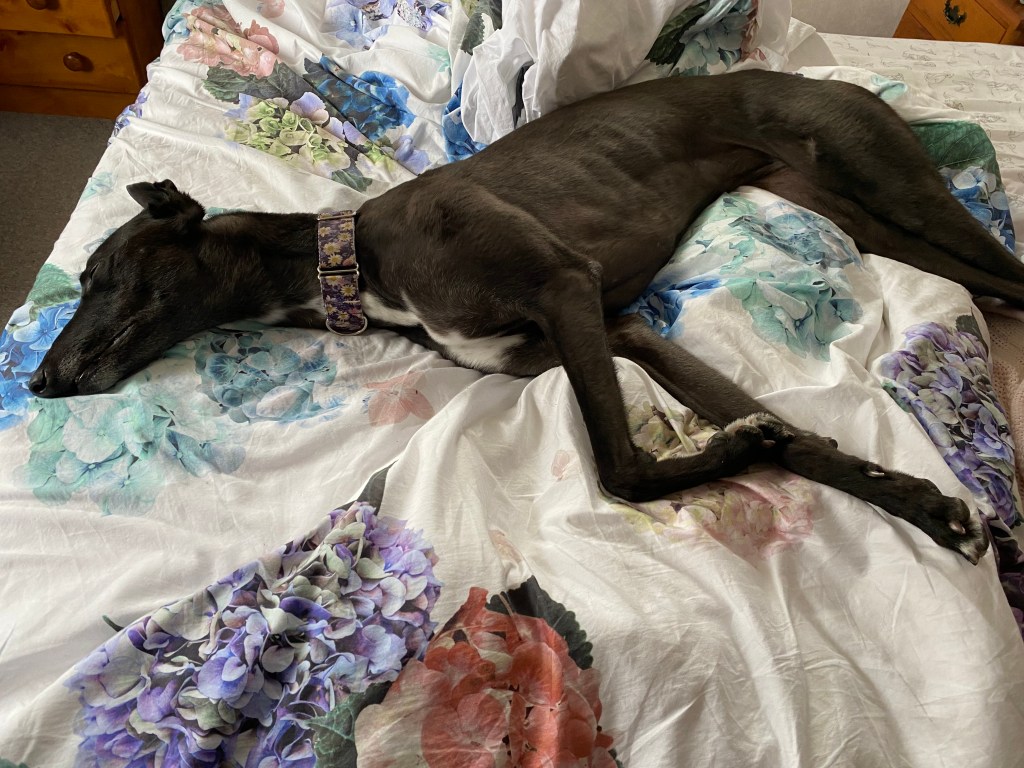
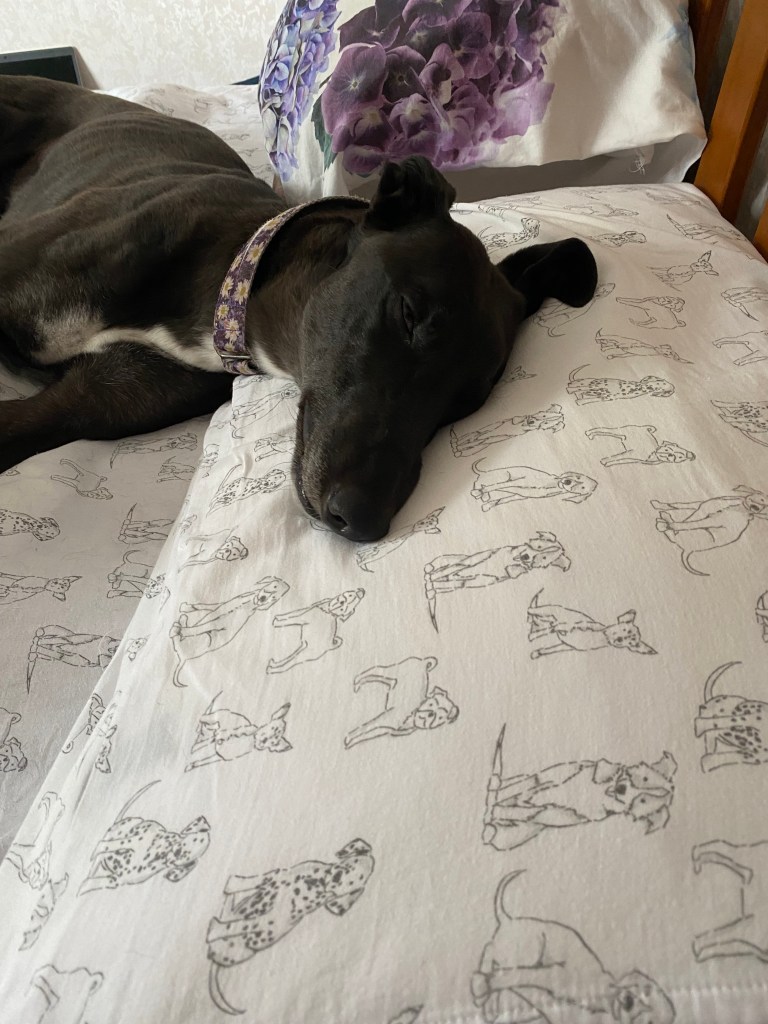
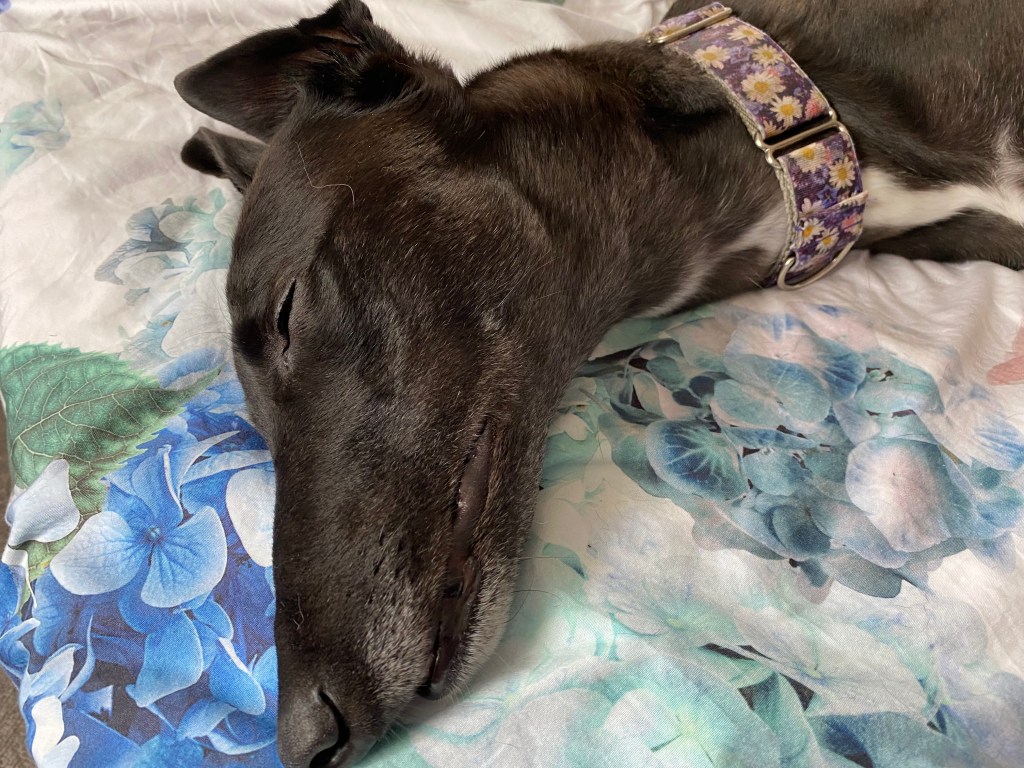
Rosie is an affectionate black greyhound who has had three unsuccessful adoption placements. You see, Rosie is profoundly deaf.
She was not born deaf, but she became deaf through ear infections – and what appears to be lots of them, or at least ones that had unsuccessful or no treatment. Her ear canals are so severely scarred that about the only sound she has reacted to was the high-pitched loud squeal of my burglar alarm which I set off accidentally last month.
But there is a lot more you need to know about Rosie to understand her
Rosie doesn’t know she is special needs. She simply lives in a world where she sees people’s lips move but no sound comes out. She is reluctant to make eye contact with new people and so can easily misread their intentions. She responds to emotional energy very well; she seems to know when someone is smiling and wants to give her a pat; I always ask them to allow her to come to them which works well.
When Izzy died, she certainly knew I was upset and came in for lots of cuddles and reassurance.
She isn’t so sure of people wearing masks because masks cover faces and Rosie needs faces to read the situation. I have been deliberately taking her places where she meets people in masks and where I am wearing mine. She even came with me to the drive-thru vaccination clinic when it was time for me to have my Covid-19 booster shot; she barked anxiously at the face outside the window.
Mask-wearing will be part of our lives for a while and Rosie needs to live successfully in a masked up world so I will continue exposing her in a controlled manner to mask-wearing people so she can become more confident. Today, for example, we went to the local SPCA op shop which welcomes pets. The shop attendants and the customers were all wearing masks. We didn’t have any issues.
Rosie has lots of energy. When the sun is up, so is she. Forget the advice that a greyhound is so placid that two, 20-minute walks per day are sufficient exercise. Rosie has been having two walks of at least 30-40 minutes each and cracks a good pace for the entire time. An hour’s long walk on the beach with greyhound Misty was not problem for her, either.
I gave Rosie a massage over the weekend (her first) and I can assure you that she has great muscle tone. For a girl who is now 6 years, 9 months old, she is in great shape!
Rosie would benefit from being adopted by a household with another dog who is well-settled and playful. Rosie likes to play (she has had several play dates and is enthusiastic about engaging with other dogs who are both off-lead and on-lead). A dog that could be Rosie’s mentor will give her someone to follow around and mimic. In my opinion, a chilled out dog who can teach Rosie the house rules will see her settle into a new adoptive home pretty quickly.
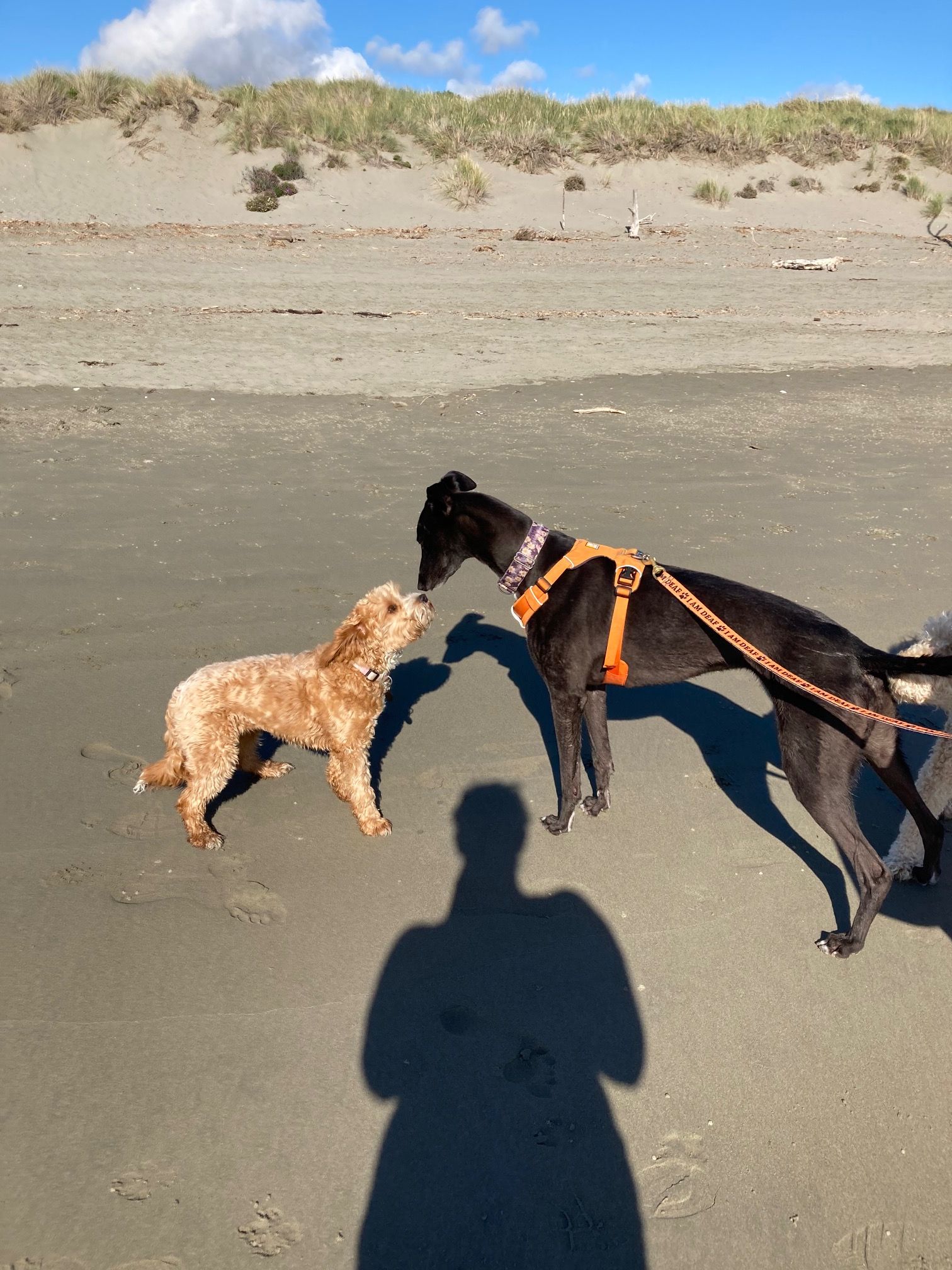
Remember, though, that Rosie is deaf. She will always be deaf no matter how much training she receives. Rosie misses out on the low growls of dogs who are giving her a warning signal.
She doesn’t hear the children on the footpath who are coming from behind on scooters (startling her in the process). Whomever adopts Rosie needs to understand that they need to be her ears when they are out of the house – at all times. And when integrating into her new home, the dog:dog interactions will need to be supervised initially. Rosie doesn’t mean to be annoying, but she could be, in her enthusiasm to play.
Every greyhound needs a securely fenced section.
Rosie definitely needs one and always will. Off-lead exercise can only happen in securely fenced areas.
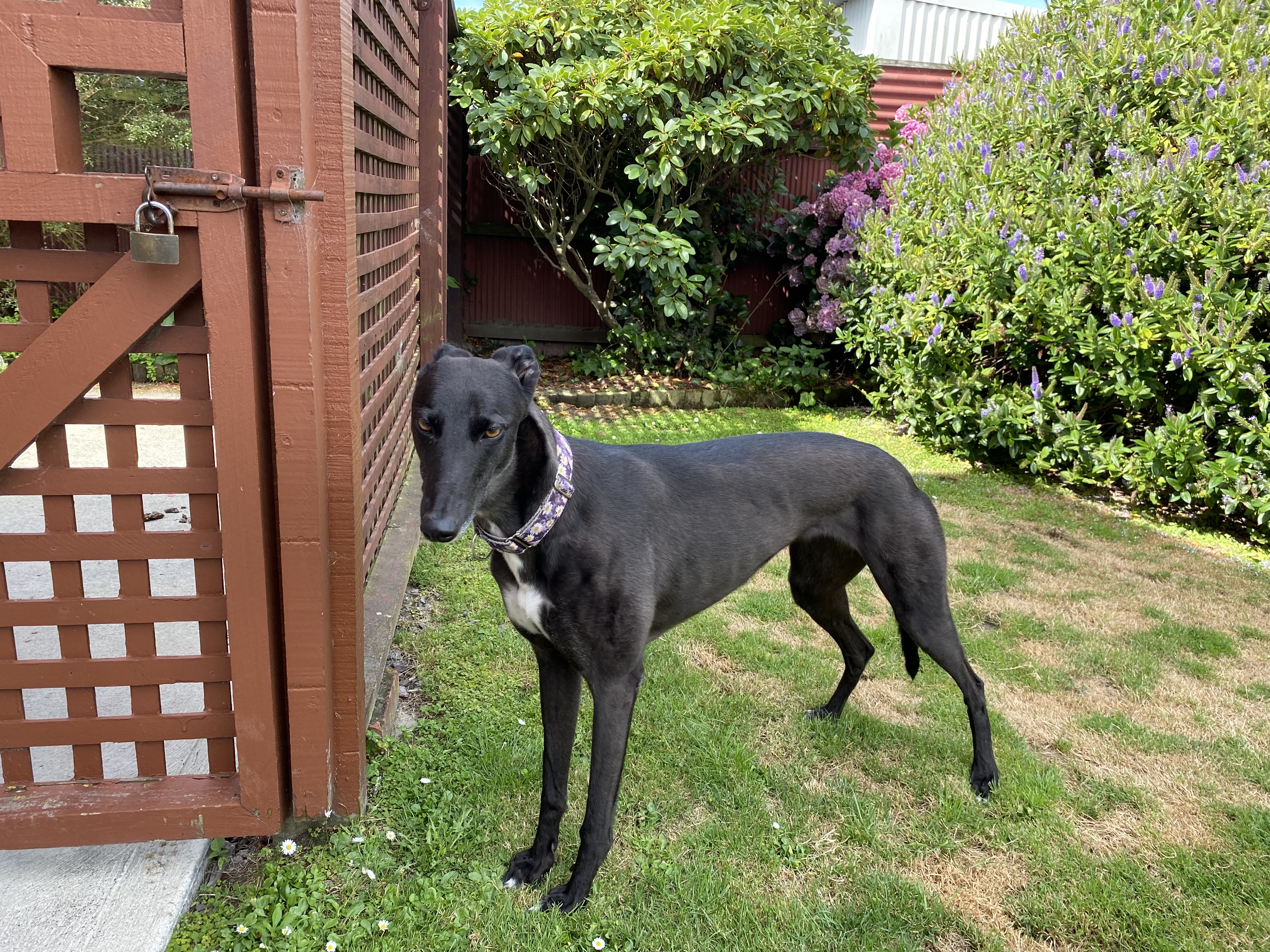
You may have heard that people who lose the their hearing seem to develop enhanced senses of touch, taste, smell, and sight. This is definitely the case with Rosie.
She is a sighthound. I can attest to the fact that Rosie triggers on all movement. So that is definitely cats, ducks, chickens, other birds, and rabbits. She also reacts to leaves, branches, pieces of rubbish and even my neighbour’s clothes on the line when they move in the breeze. Last week we were taking an afternoon walk along Papanui Road and the sunlight was reflecting off cars onto the ceiling of the shop walkway. Rosie startled at the reflections because it looked like something overhead was coming our way.
Consequently, it’s essential that anyone who walks Rosie does so with a firm grip of the leash and with it wrapped around their wrist. Always. And so that means that Rosie cannot be taken on walks by young members of an adoptive family. Adults only. Able-bodied ones, too. And please – a normal leash and not those horrible extension leads…
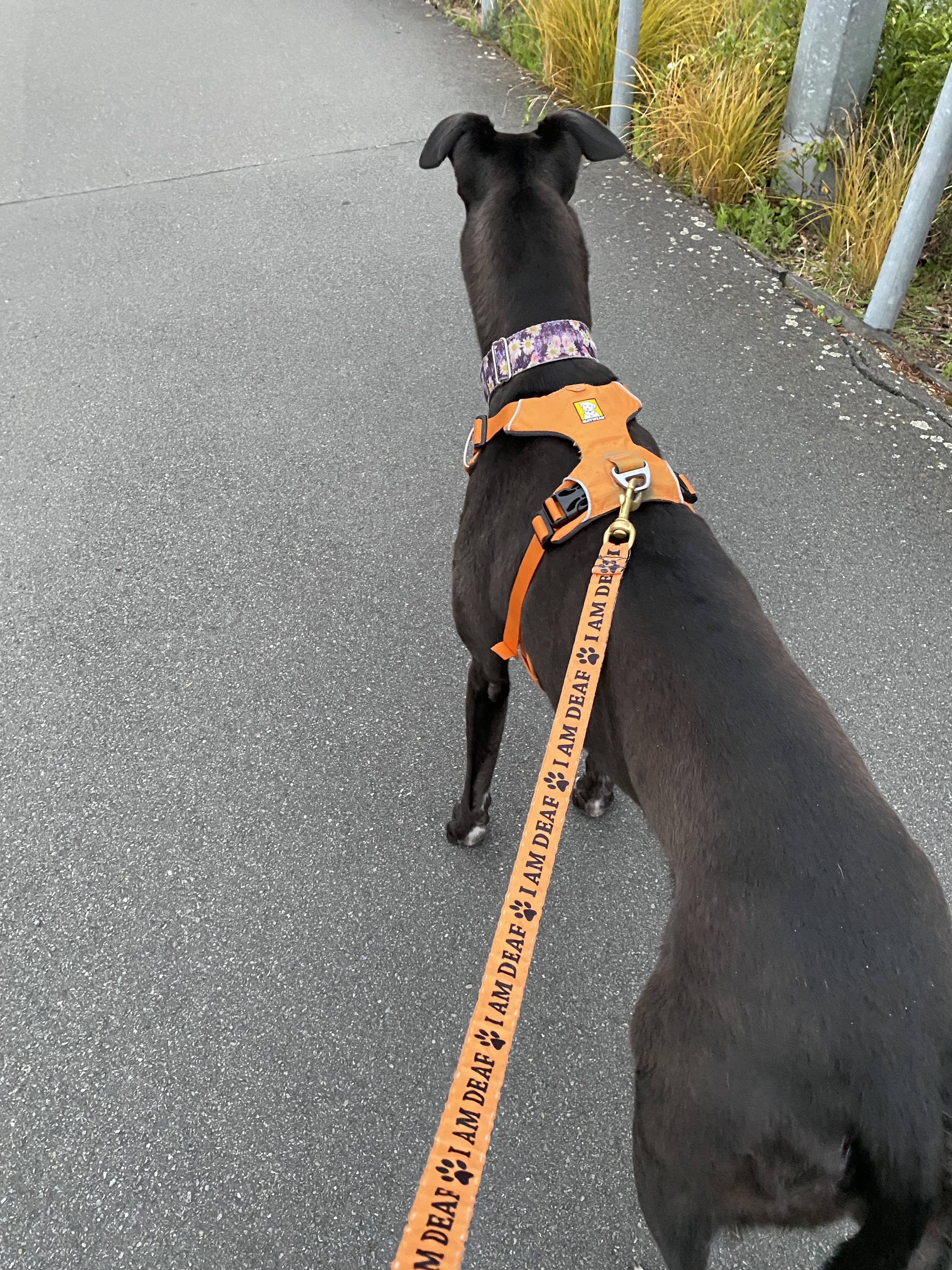
If Rosie sees something of interest – like a neighbourhood cat – she will pull and rear up on her hind legs. Hold your ground and hold on tight. Rosie should always be walked in a harness for greater control and to avoid damage to her neck.
Rosie is a deep sleeper. All greyhounds sleep. Rosie sleeps more deeply than most. We know that dogs have a different sleep pattern than we do, but since Rosie cannot hear, it seems that she goes into a deep REM-like sleep more often. (This explains her energy levels when she’s awake – refreshed and ready to go!)
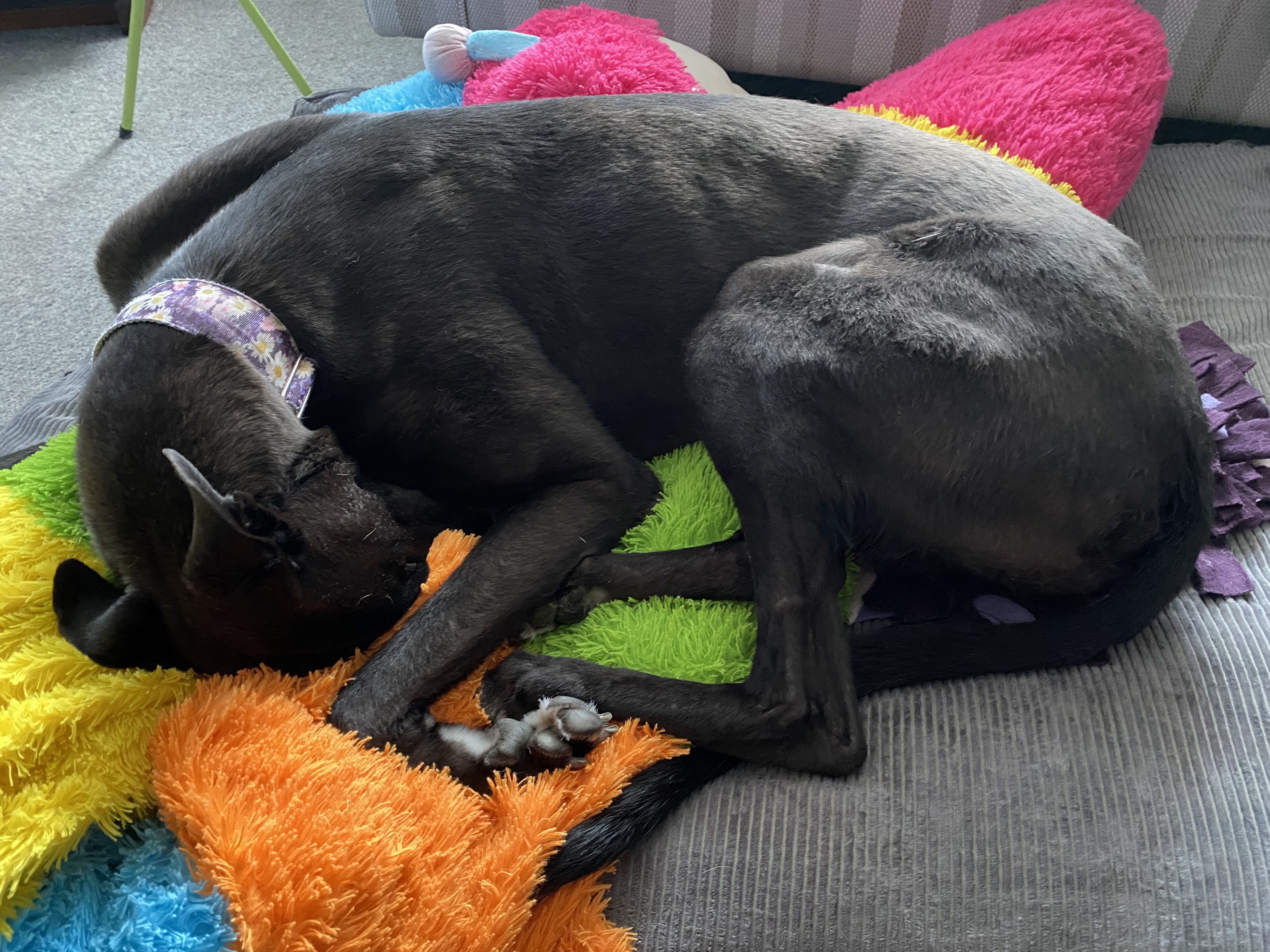
Greyhounds are known for their sleep startle – that sweet little greyhound can become a raving Cujo when wakened suddenly. In Rosie’s case, her risk of sleep startle is much greater. Therefore, I have developed a new habit of walking into a room with a good solid stomp of my foot. The vibrations will stir Rosie from her slumber.
The risk of sleep startle is another reason why Rosie cannot go to a home with small children, who are unlikely to remember the rules about engaging with a sleeping Rosie. Mature households only are needed as Rosie’s eventual adoptive family to keep everyone safe.
I mentioned earlier that Rosie is cuddly and affectionate. I have allowed her to sleep on my bed, particularly because she really wanted to snuggle and because she came one night to my bedroom at about 3 am when I was simply too tired to keep pushing her off the bed. Besides, I feel that since she has shown no interest in the sofa, she rightly deserves a chance to be a real pet greyhound and sleep on the bed.
Rosie is completely house-trained and she only barks when she is excited (such as when I am taking too much time to get dressed in the morning for our walk). I have had a pet cam running constantly for the last three weeks – she only whimpers a bit when I leave the house and then eventually settles on her bed for a deep sleep. She will sometimes go into the crate for a rest, but the crate is also strategically positioned so she can watch me in the kitchen from a safe distance.
In the interest of finding Rosie her forever home, I have begun working with Rosie on an essential cue – Look At Me. The Look At Me is the foundation for interacting with her handler so that she can then react to other visual cues which will be trained over time. I have already instituted her Come command, which is a vigourous tapping of my thigh.
We are perfecting her Look At Me and Come. Good things take time and I keep her training sessions short – only about 5-10 minutes each maximum. This ensures Rosie is set up for success. I am thoroughly happy to keep Rosie for as long as it takes until we find her the perfect match for her adoptive home and, in the meantime, we can continue our training and enjoy each other’s company.
Enquiries about adopting Rosie should be directed to Greyhounds as Pets.
Kathleen Crisley, Fear-Free certified professional and specialist in dog massage, rehabilitation and nutrition/food therapy, The Balanced Dog, Christchurch, New Zealand
Posted in dog adoption, dog breeds, Dogs
Tagged deaf dogs, Fear Free, Greyhound, Rosie, special needs, training
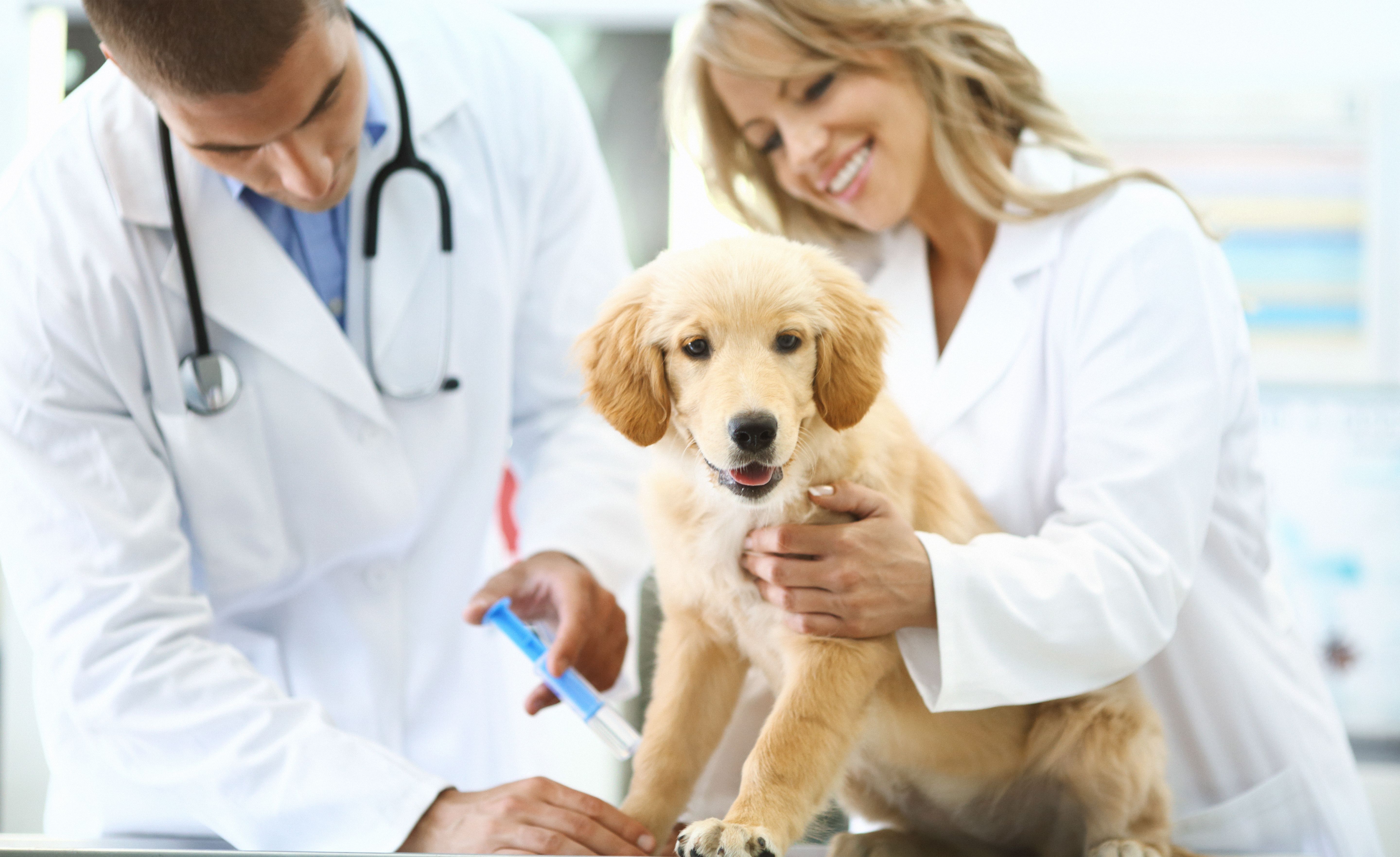
A new Synchrony study, “Lifetime of Care,”1 has revealed that 7 out of 10 pet owners consider their pets family members; however, nearly half underestimated the lifetime cost of care which ranges from $20,000 to $55,000 for dogs and $15,000 to $45,000 for cats.* In addition, about half of all pet owners who believed they were financially prepared for unexpected pet expenses, were not, and would consider a designated financial solution for pet care.
This research,1 based off on findings from 1,200 pet parents and 100 veterinarians and confirmed by veterinary clinics, offers consumer insight into the cost of lifetime care for canine or feline ownership. Conducted on behalf of Synchrony’s pet and veterinary financial solutions—CareCredit and Pets Best Pet Insurance—the research covered an extensive array of dog and cat expenses (ie, first-year expenses, food and health insurance, end-of-life expenses, etc).
According to the American Pet Products Association,2 90.5 million US homes currently have a pet, and in 2020 itself, $103.6 billion was spent on pet care. The Lifetime of Care study1 displayed dog owners can expect to spend between $1,300 to $2,800 and cat owners approximately $960 to $2,500 in the first year alone.
“Millions of Americans choose to share life with a pet, yet the true cost of ownership has historically been incredibly vague. Our Lifetime of Care study serves as a helpful tool to prepare prospective pet parents,” said Jonathan Wainberg, senior vice president and general manager, Pet, Synchrony, in a company release.3
“We want pet parents to have a deeper understanding of what to expect financially, and knowledge of the flexible payment solutions that are available to help them manage the costs of care throughout their pet’s lifetime,” he added.
Amid the COVD-19 pandemic, it is estimated that 1 in 5 households4 gained a new companion animal. This data propelled Synchrony to promote the financial preparation options available to pet parents including pet insurance like Pets Best and credit cards such as CareCredit.
Together, CareCredit and Pets Best provide a complete financial solution as cardholders can pay at the veterinary practice using their CareCredit card, and then apply the reimbursement from Pets Best towards their CareCredit account.
“Veterinarians often see pet parents struggling to balance the care their pet needs with what they can afford,” said Peter Weinstein, owner of PAW Consulting, author and veterinary industry leader, in the release.3 “This new study provides us a comprehensive look at the true costs of pet care so we can arm our clients with the information and financial solutions they need to care for their pets for a month, year and an entire lifetime.”
View the entire Lifetime of Care study here. Learn more about CareCredit and Pets Best by visiting carecredit.com or petsbest.com.
* Includes initial costs, spaying/neutering, technology cost, and end of life expense (high). Low does not include health insurance, wellness plans, or other non-basic expenses.
References
Source: dvm360.com
Tagged budgets, cost of pet care, financial, lifetime costs
Over 10,000 people in Europe use an assistance dog; think of guide dogs for the blind and visually impaired, hearing or signal dogs for the deaf and hard of hearing, medical response dogs and psychiatric service dogs.

According to European law, these dogs are welcome in stores, hospitals and other public places. However, in practice, many assistance dog users and their dogs are regularly refused entry. In the Netherlands, four out of five assistance dog users indicate that they regularly experience problems with this.
Often, hygiene reasons are given as the main argument for refusing entry to assistance dogs. Research by Utrecht University now shows that the paws of assistance dogs are cleaner than the shoe soles of their users, and thus, paw hygiene is no reason to ban assistance dogs from hospitals.
To investigate this, Jasmijn Vos, Joris Wijnker and Paul Overgaauw of Utrecht University’s Faculty of Veterinary Medicine took samples from the paws of 50 assistance dogs and the shoe soles of their users. For comparison, they also investigated an equally large group of pet dogs and their owners. Vos and her colleagues examined the samples for poop bacteria (Enterobacteriaceae), which are very common outdoors, and for an important diarrhoeal bacteria (Clostridium difficile).
“The dogs’ paws turned out to be cleaner than the soles of their shoes,” says Jasmijn Vos, Masters student at Utrecht University. “This makes the hygiene argument that is often used to ban assistance dogs from public locations invalid.” Moreover, the diarrhoeal bacteria did not occur on the dogs’ paws whatsoever, and only once on a shoe sole.
81% of assistance dogs are refused
Dutch assistance dog users were also surveyed about their experiences. 81% are still regularly refused entry to public places with their dog, even though this is prohibited by law. This is mainly down to lack of knowledge on the part of the person refusing entry: lack of knowledge on what an assistance dog is, how it can be recognised, and about the rules of law.
The study also shows that assistance dog users constitute only a small fraction of the total number of patients in Dutch hospitals. Should they decide to bring their assistance dog to the hospital, or elsewhere, this should be made possible; assistance dogs are usually well behaved and are no more of a hygiene hazard than people!
Research publication
Vos SJ, Wijnker JJ, Overgaauw PAM. A pilot study on the contamination of assistance dogs’ paws and their users’ shoe soles in relation to admittance to hospitals and (in)visible disability. Int. J. Environ. Res. Public Health. 2021; 18(2): 513.
Full text: https://www.mdpi.com/1660-4601/18/2/513
Source: Utrecht University
Have you ever noticed that the rectangular film frame is less suited to the human body shape than to the four-legged format of the dog?
That’s right: cinema was made for dogs. But some dog breeds make more movies than others. From the canine celebrity Rin Tin Tin to the uncanny CGI of Cruella and Call of the Wild, it feels like German Shepherds, Dalmatians, and Saint Bernards are better represented than other ‘makes’ of dog. But is this really the case? Or do they just do more PR?
Protect My Paws used IMDb data to identify the breeds that appear in the most films and TV shows of the past century-and-a-bit. We found some stuff that will change what you thought you knew about dogs in movies.
Today we present our guide to the Michael Caines and Samuel L. Jacksons of the canine world: the dog breeds that never turn down a role.
With the dependability of a four-legged James Stewart and the ruggedness of a young Steven Seagal, the mighty German Shepherd is the canine king of Hollywood. German Shepherds – also known as Alsatians – have collected nearly twice as many credits as the second most active dog breed, the bulldog.
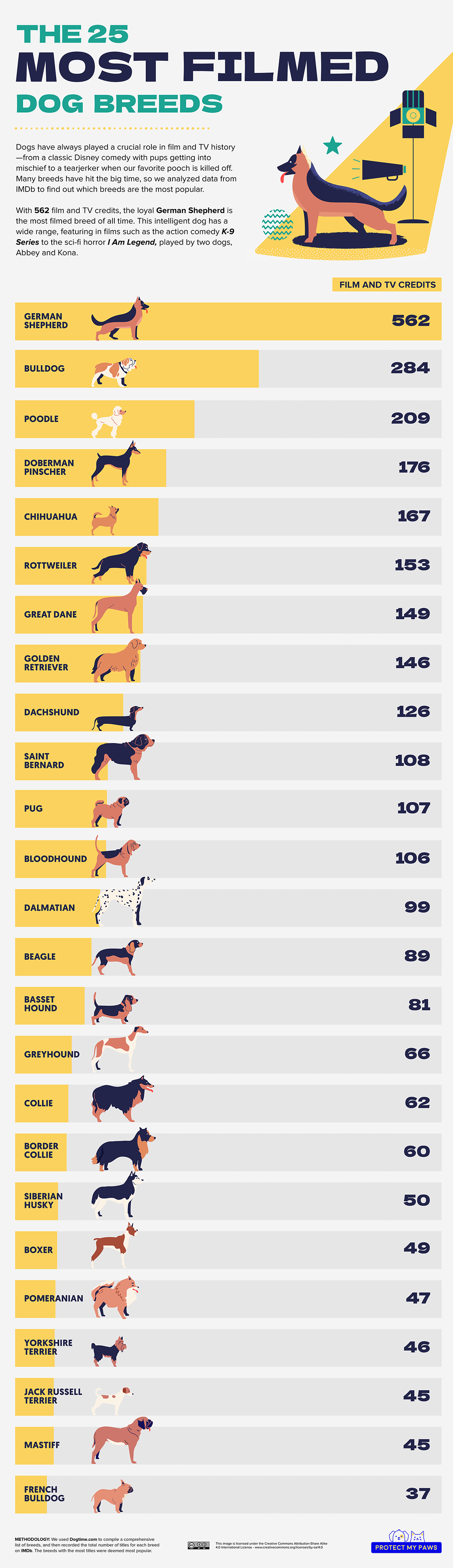
The Saint Bernard tends to be a limelight grabber with its James Belushi-esque presence in pictures such as Beethoven and Daddy Daycare. But nine other breeds, including the poodle and the Chihuahua, have more films to their name. And the Dalmatian? Since we counted number of films, not number of dogs, the Dalmatian is two movies short of achieving 101 credits, and does not even make the top 10.
How have audiences’ preferences for dog talent changed over the years? Well, the original Alsatian superstar, Rin Tin Tin, racked up the credits during the ‘Rinty’ craze of the 1920s. But his descendants and namesakes worked with only sporadic success.
It was not until the 1960s that the German Shepherd became the most-cast breed once again. The long-beaked hound was spotted in seminal zombie flick Night of the Living Dead (1968) and arthouse classic The Diary of a Chambermaid (1964), among more than 50 titles in the 1960s. But his most iconic role was as The Littlest Hobo, a homeless dog who walks the Earth solving problems for strangers.
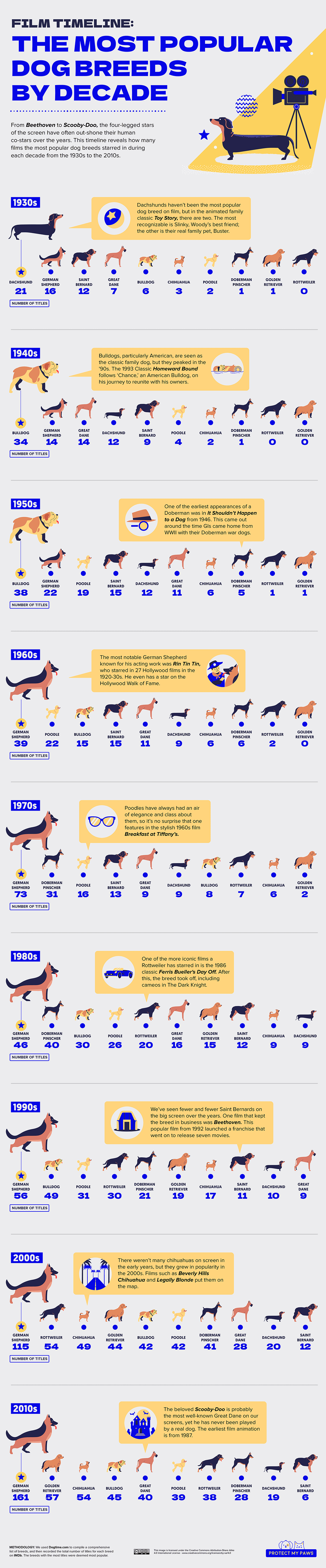
The German Shepherd has dominated every period since the 1960s. But Hollywood’s golden age was an era of bulldogs. This wrinkle-faced bruiser can claim 34 titles in both the 1940s and the 1950s. The bulldog played alongside Judy Garland in Meet Me In St. Louis (1944) and raised laughs with Abbott and Costello and the Three Stooges. But most of the bulldog’s golden age credits are due to appearances in cartoons, particularly as Spike – a canine foil to Tom and Jerry.
That just leaves a surprise winner for the 1930s: the dachshund, or wiener dog. Why a surprise? Because the dachshund is clearly a better fit for either widescreen or CinemaScope, and neither were commonplace until the 1950s. Sure, there was a role in Hitchcock’s Secret Agent and all-star drama Grand Hotel – but most of the wiener dog’s 1930s roles came from cartoons. While bulldogs tickled 1950s audiences, in the 1930s people found dachshunds hilarious.
Next, we used Metacritic to find the average rating each dog breed has across their whole back catalog. From this perspective, finally the German Shepherd’s Hollywood crown starts to look wonky. With an average rating of 56.5, the German Shepherd is only the 14th most critically acclaimed dog breed.
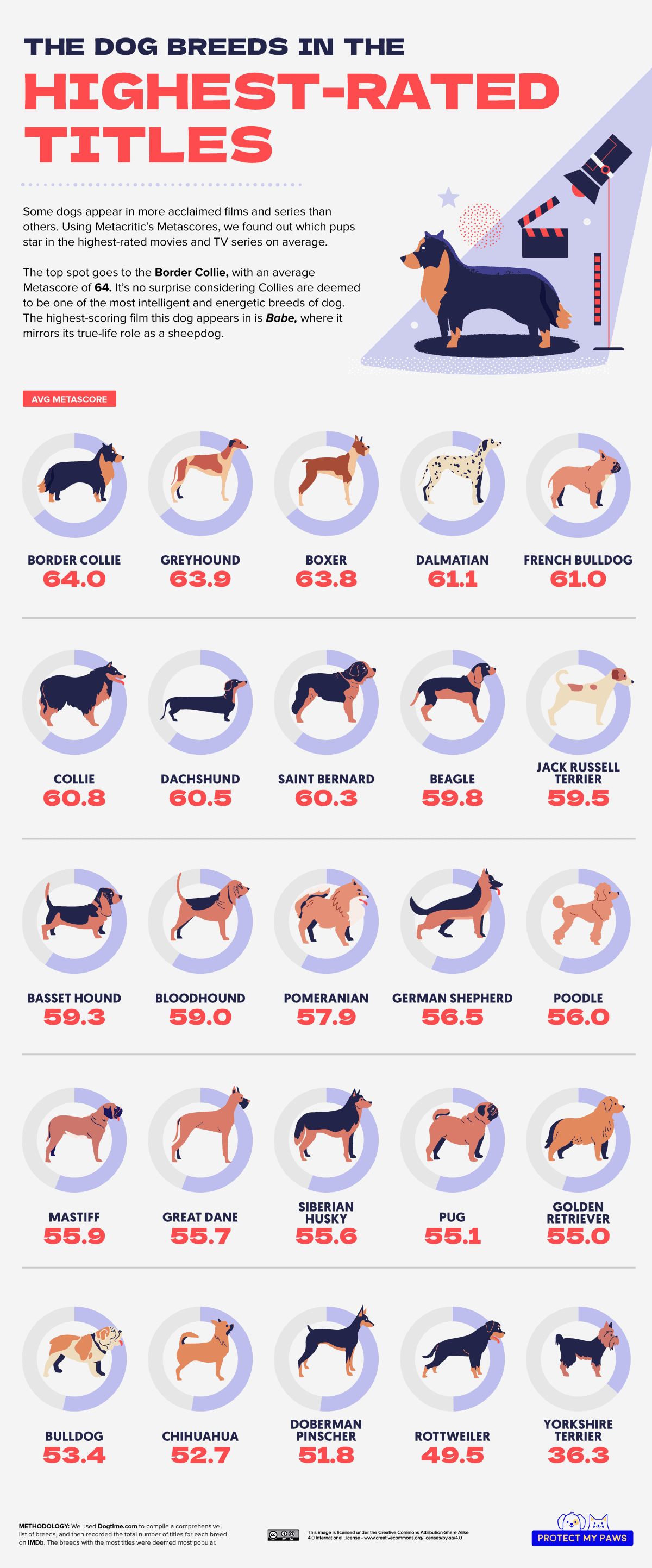
But the critic’s darling, our lifetime achievement nominee, is the border collie. As sharp as Joan Crawford, as tenacious as Sigourney Weaver, as adorable as Heath Ledger, the border collie picks their roles carefully. Choice cuts include supporting parts in Babe (1995) and The Lobster (2015), while the collie has also played the ‘quintessential dog’ in dog movies, including A Dog Year (2009), Hotel for Dogs (2007), and Duke (2012).
As a final note, never see a film with a Yorkshire terrier in it. With an average rating of 36.3, they are all stinkers.
This year was a big year for dogs in movies. The coveted Palm Dog (the canine answer to the prestigious Cannes Palme d’Or) was won not by one but three springer spaniels. All three belong with their co-star, the actor Tilda Swinton, who didn’t win a thing.
Could Rose, Dora, and Snowbear usher in a new era of springer spaniel domination in Hollywood? Could multiple dogs in the billing mean cinema is finally shaping up to fulfill its destiny – as a medium for actors who are longer than they are tall and who shout their lines in short, loud bursts, like furry Al Pacinos?
Our initial list of dog breeds was compiled using Dogtime.com. Each dog breed was then looked up on IMDB custom search engine in two variations: with and without “dog,” e.g., “German Shepherd” and “German Shepherd dog,” recording a total number of unique titles (films and tv series), as well as their year of release, and their Metascore, where available.
Dog breeds with the highest number of unique titles they appeared in were deemed the most popular. Dog breeds with the highest average Metascore of the titles they appeared in were deemed the highest rated.
Data was collected in July 2020.
Source: ProtectMyPaws.com
Over the last few days I have thought a lot about what to write about Izzy, my best friend who joined my life in October 2014 and sadly had to leave it on 27 December 2021.
When I first met Izzy, she didn’t pay me much attention. She was staying at the kennel base of Greyhounds as Pets and, because she was in season, she was unable to come home with me straight away on a foster-to-adopt arrangement. I would drive out to the kennels every couple of days to walk with her and she plodded along by my side with a confident indifference.
I would soon realise that her seeming aloofness was from her independent nature – which was an asset in a dog that would need to spend periods of time alone while I was out working and to be confident at public and social events.

(She would also assert her independence at inopportune moments such as when I needed us to take a shorter walk and she wanted to go the long way. I would remind myself that she was matched with me because of that independence; it was unfair for me to be upset with her simply because she was being herself.)
Izzy was by my side as I expanded my dog massage and rehab practice, leaving full-time employment to pursue my passion to help other dogs and their families with an exclusively in-home practice. A constant presence, she was happy to settle for the day after her walk and breakfast – with an activity toy of some sort to reward her.
She benefited from a number of modalities to treat her corns and developing arthritis over the years, including massage, laser, PEMF, swimming, water treadmill and the use of a pram. This made her a great advertisement for multi-modal health care.

One of my best investments was her pram, which I purchased in 2019 when Izzy started to be troubled by painful corns – that pram would see her achieve mobility and support engagement through to her last days, including one last greyhound Christmas walk just 8 days before her passing.
Izzy was also an ambassador for her breed – meeting the public at numerous events such as the Riccarton Sunday Market, organised greyhound walks, our charity garage sale for Greyhounds as Pets in 2017 and our Greyt Fashions fundraiser in 2018, where she strutted down the runway with her friends in numerous greyhound outfits (raising almost $5,000 in the process).

In early 2020, before the pandemic took hold, Izzy also led a doga class with some of her fellow greyhounds and this featured on Newshub. It was a shame we couldn’t continue these classes after lockdown, but business priorities had changed.

During our lengthy lockdown in March and April 2020, Izzy hosted Word of the Day on our Facebook page to keep our clients and followers entertained.

In 2021, since I sponsor the 4 Paws Marathon, her photo was featured on the 5 km finishers medal and we were also filmed by accounting software company Xero in a customer story about the business.

I will forever be grateful for the professional photos and video that resulted from the Xero campaign because they show Izzy at her finest – at home, in her pram and at her beloved beach.
Izzy was the demo-dog at my Learn to Massage Your Dog and Greyhound Massage and Stretching classes; she taught countless dogs and their owners the benefits of regular massage including in the online version of Greyhound Massage and Stretching, which we filmed just prior to the 2020 lockdown.
Her friend Spot will now teach class with me starting later this month – plans we put in place in earnest when her health started to decline.
Her last contribution to her kind was to welcome deaf foster greyhound, Rosie, into our home – something that was planned from early November. We decided to proceed with fostering in the hope that another dog in the house would provide a diversion and, possibly, some competition for food to encourage her to eat. Izzy was a capable mentor to Rosie for only 10 days before she passed – but I would often find Rosie laying next to Izzy and in the same body position.

As a dog parent, you are never ready for your life’s journey to end. Yet, when we sign onto the lifetime commitment to a dog, we are in the privileged position of being able to end suffering (something that in most places around the world we are unable to do easily or legally for our human loved-ones).
Izzy was diagnosed in August with chronic kidney disease as part of an annual check-up. She was not showing any outward signs of disease at the time and, through diet changes, medication and herbal supplements, we did our best to preserve the kidney function that she had remaining. In November, she suffered an attack of canine vestibular disease and had two more of these in the weeks that followed. Looking back on the last five weeks of her life, I would have to say that her health was in a steady decline starting with that first episode of vestibular.
Ironically, the vestibular disease presented on the evening following a beach walk and birthday party for two of her greyhound friends, Spot and Luke. Izzy’s happy place was at the beach and we were able to get in a few more beach walks, including on Christmas morning and again on Boxing Day (her last walk). I had hoped we would have one final summer together this year and celebrate her 13th birthday with a princess-themed cake.
As they say, man plans and God laughs.

Izzy left in me in no doubt that she was ready to go – refusing to eat and drink with a stubborn turn of her head. As the day went on, it was clear she was in end-stage kidney failure and in pain. Thanks to in-home euthanasia service Our Pet’s Goodbye, we were able to be together to the final second in the comfort of our home where she was surrounded by her loved ones – me and her beloved Mr Caterpillar.
She is now over the Rainbow Bridge, at the beach, where it will always be a breezy and warm summer day so she can splash in the waves to her heart’s content.
I will join her there someday.


Kathleen Crisley, Fear-Free certified professional and specialist in dog massage, rehabilitation and nutrition/food therapy, The Balanced Dog, Christchurch, New Zealand
Posted in Dogs
Tagged dog massage, euthanasia, Greyhound, greyhounds as pets, in-home care, Izzy, kidney disease, memorials








 DoggyMom.com