Author Archives: DoggyMom.com

Pampered Pooches at the Opus Vancouver

The Opus Vancouver, a boutique hotel named one of the “Top 5 Trendiest Hotels in the World” by Trip Advisor, offers a Pampered Pooch add-on for guests traveling with their dogs.

The package includes:

  • A locally-designed designer dog bandana
  • A photo shoot with a pet photographer (with one 5×7 print and 6 high resolution images on disc or provided online via dropbox)
  • And a 1-hour in-room massage for your dog (I particularly liked this part)
"I'm ready for my close up" Photo by Tanya King, pet photographer to the Opus Vancouver

“I’m ready for my close up” Photo by Tanya King, pet photographer to the Opus Vancouver

Pet-friendly travel is a niche market that is growing; dog owners are looking for ways that they can treat their pets as well as themselves when on vacation.

What’s your favorite place to stay when traveling with your dog?

Kathleen Crisley, specialist in dog massage, rehabilitation and nutrition/food therapy, Canine Catering Ltd, Christchurch, New Zealand


Dog-human cooperation is based on social skills of wolves

Dogs are man’s best friend and partner. The origins of this dog-human relationship were subject of a study, published recently in the journal Frontiers in Psychology,  by behavioural scientists from the Messerli Research Institute at the Vetmeduni Vienna and the Wolf Science Center.

They showed that the ancestors of dogs, the wolves, are at least as attentive to members of their species and to humans as dogs are. This social skill did not emerge during domestication, as has been suggested previously, but was already present in wolves. 

Photo by the Wolf Science Center

Photo by the Wolf Science Center

Commonly accepted hypotheses about domestication suggest: “Dogs have become tolerant and attentive as a result of humans actively selecting for these skills during the domestication process in order to make dogs cooperative partners.”

Friederike Range and Zsófia Virányi from the Unit of Comparative Cognition at the Messerli Research Institute question the validity of this view and have developed the “Canine Cooperation Hypothesis”. Their hypothesis states that since wolves already are tolerant, attentive and cooperative, the relationship of wolves to their pack mates could have provided the basis for today’s human-dog relationship. An additional selection, at least for social attentiveness and tolerance, was not necessary during canine domestication.

The researchers believe that wolves are not less socially attentive than dogs. Dogs however cooperate more easily with humans because they more readily accept people as social partners and more easily lose their fear of humans. To test their hypothesis, Range and Virányi examined the social attentiveness and tolerance of wolves and dogs within their packs and toward humans.

Various behavioural tests showed that wolves and dogs have quite similar social skills. Among other things, the researchers tested how well wolves and dogs can find food that has been hidden. Both wolves and dogs used information provided by a human to find the hidden food.

In another study, they showed that wolves followed the gaze of humans. To solve the task, the animals may need to be capable of making a mental representation of the “looker’s” perspective. Wolves can do this quite well. 

Another experiment gave dogs and wolves the chance to observe conspecifics as they opened a box. When it was the observer’s turn to do the same, the wolves proved to be the better imitators, successfully opening the box more often than dogs. “Overall, the tests showed that wolves are very attentive to humans and to each other. Hypotheses which claim that wolves have limited social skills in this respect in comparison to dogs are therefore incorrect,” Range points out. 

At the Wolf Science Center in Ernstbrunn in Lower Austria, Range and Virányi investigated the social behaviour of dogs and wolves that grew up with members of their species and with humans. “The animals are socialized both with conspecifics and with humans. To be able to compare the behaviour of dogs and wolves and to investigate the effects of domestication, it is important that the animals live in the same conditions,” Virányi explains.

Source:  Vetmeduni Vienna media release

Read my other post about the Institute’s research with wolves here

Kathleen Crisley, specialist in dog massage, rehabilitation and nutrition/food therapy, Canine Catering Ltd, Christchurch, New Zealand

Dog people vs cat people

As you know, I enjoy writing about research that gives us new insights into  all things dog.

Earlier this year, I blogged about research into personality and what makes a good pet parent.

But I think the debate will continue for some time in terms of characterizing dog people vs cat people.

Here’s another video to add to the debate:

Kathleen Crisley, specialist in dog massage, rehabilitation and nutrition/food therapy, Canine Catering Ltd, Christchurch, New Zealand

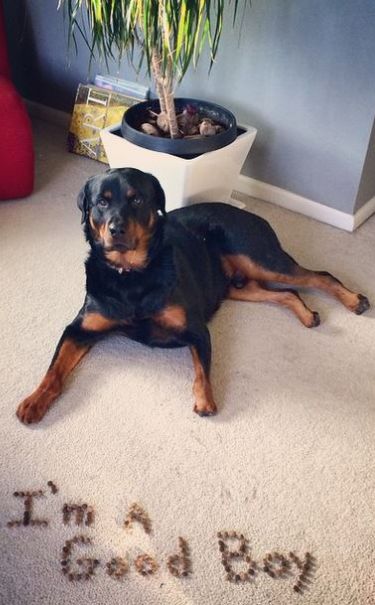
Better paws for Brutus

When Brutus was just a puppy, his breeder left the young Rottweiler outside in freezing temperatures.

The pup suffered frostbite in all four paws, and the breeder tried to salvage the puppy’s paws with an at-home amputation. But Brutus was maimed and couldn’t walk without pain.
Brutus

Brutus

Now 2 years old, Brutus is living with a new and dedicated owner in Loveland, Colorado, and has become the second dog ever known to receive four prosthetic limbs. He is learning to walk again with help from OrthoPets, an animal prosthetics developer in Denver, and pet orthopedics experts at Colorado State University’s James L. Voss Veterinary Teaching Hospital.

“I believe prosthetics will play a big role in the future of veterinary orthopedics,” said Dr. Felix Duerr, an assistant professor in the Department of Clinical Sciences who practices small animal orthopedics and sports medicine at the university’s Veterinary Teaching Hospital.

“Brutus shows how we can explore new technologies to find solutions, and how our partnerships with companies like OrthoPets really help.”
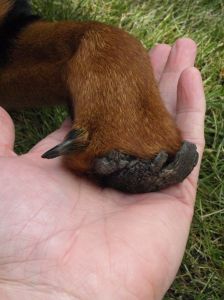
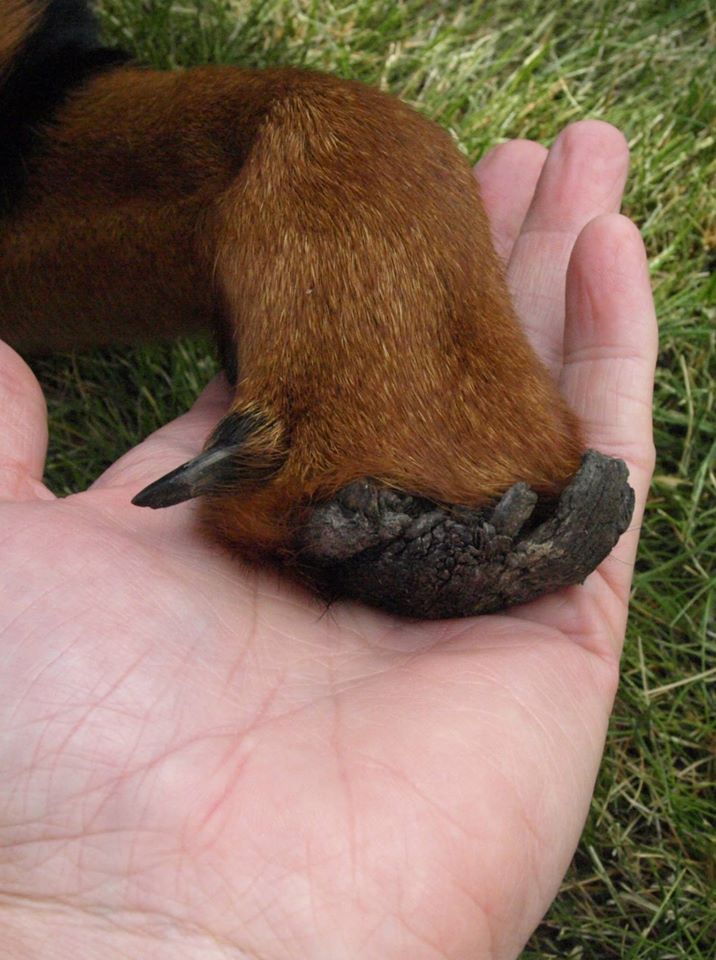
Brutus' paw

Brutus’ paw

Laura Aquilina, the dog’s owner, has provided a caring home for Brutus for seven months in an attempt to find “better paws” for the young rottie. She began fostering Brutus, and more recently adopted him, after he had trouble navigating hardwood floors and stairs in his first foster home, and the family couldn’t meet the disabled dog’s needs.

Aquilina and a pet rescuer in Canon City joined forces to raise nearly $12,500 for Brutus’ prosthetics and physical therapy through Go Fund Me, an online fundraising site. The crowdfunding project was aptly named “Better Paws for Brutus.”
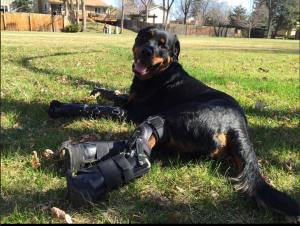
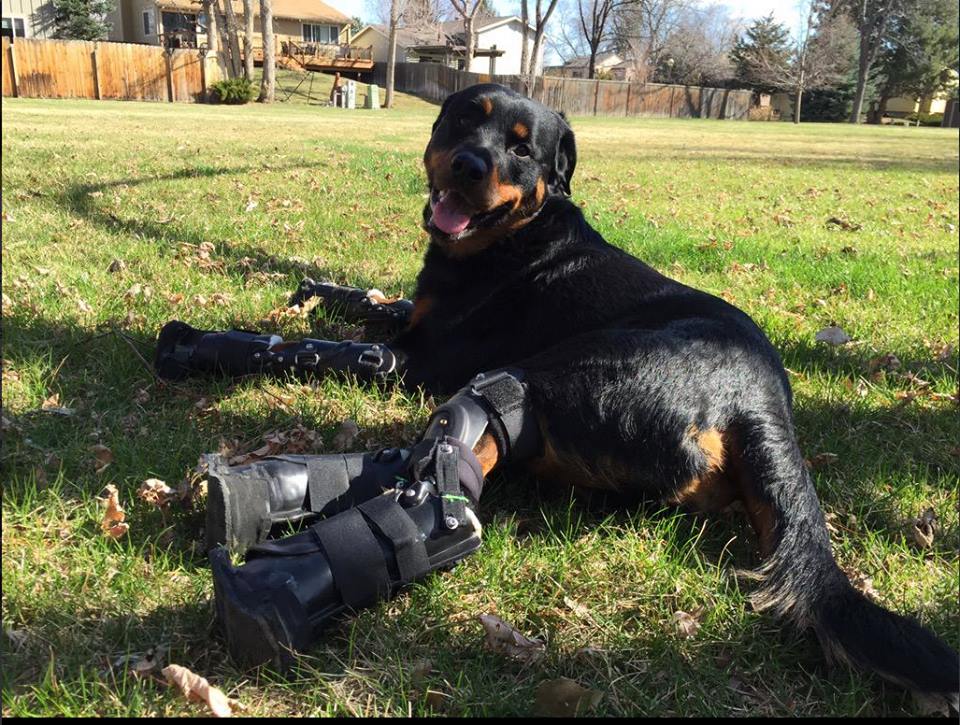
Brutus with his prosthetics

Brutus with his prosthetics

In preparation for prosthetics, Brutus underwent corrective paw surgery with Dr. Trent Gall, a CSU veterinary alumnus working in Longmont. The procedure removed bone fragments, dew claws, and two toes left from the botched amputation.

After recovery from surgery, Brutus and Aquilina worked with Denver-based OrthoPets, the world’s largest veterinary orthotic and prosthetic company, to undergo the process of prosthetics fitting. OrthoPets adapts the same technologies used in the field of human orthotics to care for animal patients.

Martin Kaufmann, company founder, partnered with Colorado State’s Veterinary Teaching Hospital for its research and rehabilitation services.

“I don’t want to be part of a world that settles for ‘fine,’ and neither does CSU,” Kaufmann said. “There’s a common mission between CSU and OrthoPets to return animals’ lives to ‘great.’”

Since the collaboration began, CSU and OrthoPets have successfully developed techniques to treat Achilles tendon injuries in dogs and are investigating how specific injuries correlate with successful orthotic techniques and long-term prosthetic use.

Kaufmann compared the Rottweiler’s story to that of Nakio, the other dog known to live with four prosthetics. “We learned a lot from Nakio’s story and were able to apply that knowledge to Brutus’ case,” he said.

OrthoPets veterinarians learned that both of Brutus’ wrist joints had collapsed. “It’s similar to a human rolling his ankle completely to the side, left grossly unstable,” Kaufmann said, noting that the dog also has a troublesome callus that makes movement difficult.

The unique prosthetics have three purposes: to protect and make Brutus’ limbs more comfortable, to support his front collapsed legs, and to realign each leg to an equal length.

As his devices are refined, Brutus has entered a new phase of rehabilitation with physical therapy guided by Sasha Foster, CSU’s certified canine rehabilitation therapist.

“We’re working with Brutus to help him adjust to wearing his new prosthetics,” Foster said. “He’s learning how to move with them on. Once he’s mastered that, we will help him achieve higher-level functioning activities, like hiking and playing with other dogs.”

In upcoming months, Foster will use underwater treadmill therapy, balance activities, exercise balls and other neuro re-education therapies to help Brutus adjust to his new limbs.

Foster said her work is motivated by helping her patient – and the animal’s family. “When you improve the quality of life for a dog, you improve the quality life for the entire family,” Foster said.

It’s likely Brutus will need physical therapy intermittently for the rest of his life. But Aquilina is hopeful.

“You need a good team behind you, and we found that at CSU,” she said.

Follow Brutus’s recovery on Facebook and Instagram at @BetterPawsForBrutus

Source:  CSU media release

Doggy quote of the month for April

“He and I are inseparable companions, and I have vowed him my perpetual society in exchange for his devotion.”

– English poet Elizabeth Barrett Browning, about her dog, Flush

Elizabeth Barrett Browning and Flush

Chaos returns…

Fairfax newspapers in New Zealand are reporting on the return of Chaos, a deaf dog who went missing on 15th March.  A great story, read it here.

Waitara man Marc Glover, partner Alicia James and their 3-year-old daughter Saphire-Rose, are over the moon that their dog, Chaos, was found after going missing for eight days.  (Photo by Sam Scannell, Fairfax NZ)

Waitara man Marc Glover, partner Alicia James and their 3-year-old daughter Saphire-Rose, are over the moon that their dog, Chaos, was found after going missing for eight days. (Photo by Sam Scannell, Fairfax NZ)

Kathleen Crisley, specialist in dog massage, rehabilitation and nutrition/food therapy, Canine Catering Ltd, Christchurch, New Zealand

Lola the therapy dog

Lola, as photographed by Nancy Rubin Stuart

Lola, as photographed by Nancy Rubin Stuart

Meet Lola, a nine-year old Golden Retriever, who accompanies her owner, Dr Bodrie of Bourne, Cape Cod, to his office and on Wednesday rounds to one of six nursing facilities.    She’s a certified therapy dog!

In this article from Cape Cod.com, you can read about the Therapy Dogs International certification process that she and Dr Bodrie underwent to make her a certified therapy dog.

Lola and Dr Bodrie

Lola and Dr Bodrie

Lola's official therapy dog badge

Lola’s official therapy dog badge


A biological trigger for canine bone cancer?

Researchers at the University of Wisconsin-Madison School of Veterinary Medicine have identified the biological mechanism that may give some cancer cells the ability to form tumors in dogs.

Yurtie, a canine cancer patient, in the UW Veterinary Care oncology ward.  Photo: Nik Hawkins

Yurtie, a canine cancer patient, in the UW Veterinary Care oncology ward.
Photo: Nik Hawkins

The recent study uncovered an association between the increased expression of a particular gene in tumor cells and more aggressive behavior in a form of canine bone cancer. It may also have implications for human cancers by detailing a new pathway for tumor formation.

The findings of the research have been published  in the journal Veterinary and Comparative Oncology and may eventually provide oncologists with another target for therapy and improve outcomes for canine patients with the disease.

The researchers examined cell lines generated from dogs with osteosarcoma, a common bone cancer that also affects people, with the intent of uncovering why only some cells generate tumors. After the dogs underwent tumor-removal surgery, cells from the tumors were grown in the lab.

This led to six different cancer cell lines, which were then transplanted into mice. The researchers then looked to see which lines developed tumors and which did not and studied the differences between them.

“We found several hundred genes that expressed differently between the tumor-forming and nontumor-forming cell lines,” said Timothy Stein, an assistant professor of oncology. However, one protein called frizzled-6 was present at levels eight times higher in cells that formed tumors.

“It’s exciting because it’s kind of uncharted territory,” says Stein “While we need more research to know for sure, it’s possible that frizzled-6 expression may be inhibiting a particular signaling pathway and contributing to the formation of tumor-initiating cells.”

The team’s genetic research will continue on dogs and be extended to humans.

Source:  University of Wisconsin-Madison media release

The Beaurepaires dog

Anyone in New Zealand notice that we have another dog-themed commercial to be proud of?

This time it is Beaurepaires, a chain of tyre (tire) retail outlets offering wheel alignments and related vehicle services.

The dog’s name is Mate and he replaces actor Vince Martin who was the face of the chain for almost 30 years.  Advertising execs felt that the marketplace is changing and they needed a hero to attract a younger audience.

Kathleen Crisley, specialist in dog massage, rehabilitation and nutrition/food therapy, Canine Catering Ltd, Christchurch, New Zealand

Ike the dog gets a new set of wheels

Ike in his new wagon (photo courtesy of ABC News)

Ike in his new wagon (photo courtesy of ABC News)

Ike is a 15-year old dog living in California.  He’s been diagnosed with bone cancer and so only has a few months to live.  His owner, Risa Feldman, wanted to give Ike as much quality of life as possible and the traditional hind end harnesses for helping him around weren’t cutting it.

So she went into Home Depot to ask for help and two employees there did even better.  They built Ike (free of charge) a new wagon complete with a little ramp so he can get in and out easily (the back end of the wagon lifts down to form the ramp).

Ike and Risa (photo courtesy of Risa Feldman)

Ike and Risa (photo courtesy of Risa Feldman)

Risa says the wagon will help Ike enjoy their walks along Manhattan Beach for a while yet.  Whilst Risa sits down at a local cafe for a coffee, Ike usually has an order of bacon…

Kathleen Crisley, specialist in dog massage, rehabilitation and nutrition/food therapy, Canine Catering Ltd, Christchurch, New Zealand

Source:  ABC News