Author Archives: DoggyMom.com

Medical marijuana for dogs?

A bill in the legislature of the State of Nevada was introduced this week that would legalize the use of marijuana in the treatment of animals.

The bill is sponsored by Democrat Tick Segerblom.  It would let owners obtain the drug for their animals if a veterinarian confirmed it “may mitigate the symptoms or effects” of a chronic or debilitating medical condition.

The same bill has provisions for the use of medical marijuana by people.

Companion Cannabis, a product as seen in a medical marijuana dispensary in Los Angeles (Photo by Damian Dovarganes, Associated Press)

Companion Cannabis, a product as seen in a medical marijuana dispensary in Los Angeles (Photo by Damian Dovarganes, Associated Press)

There isn’t a lot of research about the use of marijuana in animals, although there are stories of owners using it to alleviate illness symptoms in their pets – usually as a last resort when traditional therapies haven’t helped.

Physiologically speaking, dogs have a high concentration of THC receptors in their brains (THC is an active ingredient in marijuana).  As a consequence, dogs are more susceptible to marijuana and this can lead to a toxic dose.  There is evidence that in states such as Colorado, which has already legalized marijuana use, more dogs are being admitted for treatment because of marijuana toxicity after they’ve eaten their owner’s supply.

The American Veterinary Medical Association, not surprisingly, does not have an official stance on the use of medical marijuana.  Since research into the topic isn’t ‘evidence based,’ the Association merely suggests that vets make treatment decisions based on sound clinical judgment that stay in compliance with the law.

The Association says that even in states where medical marijuana is legal, it is still a Class I narcotic under federal law which means vets are not legally allowed to prescribe it; meaning that in essence the Association is saying that vets shouldn’t prescribe marijuana unless federal law is changed and they are satisfied that there is a clinical reason for doing so.

Kathleen Crisley, specialist in dog massage, rehabilitation and nutrition/food therapy, Canine Catering Ltd, Christchurch, New Zealand

Winning at Crufts after a broken paw

This year’s Crufts competition was overshadowed by claims of poisoning and unethical conduct amongst competitors.  Unfortunately, this means some of the better, good-news stories have not been given the air time they normally would.

Take Kamba, for example.  A Rhodesian Ridgeback, Kamba had a piece of floating bone in his paw which was diagnosed last year after x-rays.  Kamba hadn’t been using his leg as expected and so his owner looked into the cause.

Kim Hodge and her Rhodesian Ridgeback, Kamba

Kim Hodge and her Rhodesian Ridgeback, Kamba

After the diagnosis, she pursued rehabilitation which included physical rehab and hydrotherapy which occurred from September 2014 with increasing frequency in the weeks leading up to the Crufts show.

Kamba won first prize in both the Post Graduate Class and Reserve Dog Challenge Certificate for his breed at the four-day event.  He beat more than 100 other dogs.

“Kamba loves meeting other dogs and really seems to enjoy doing shows, so it was great to see how the crowd and the judges reacted to him too. Usually, top prizes tend to go to the more seasoned dogs so it was really lovely that Kamba impressed them.”

Source:  Derby Telegraph

Kathleen Crisley, specialist in dog massage, rehabilitation and nutrition/food therapy, Canine Catering Ltd, Christchurch, New Zealand

Teddy’s journey ends

This is a blog post I didn’t think I would be writing for some years.  Unfortunately, some things are just not meant to be.

Teddy, the Beagle who so bravely came back from a front leg amputation last year, passed away on Saturday.  He was only 8 years old – gone too soon.

TeddyTeddy 10_9_14

Cancer took Teddy’s life away very quickly.  For the last 8 weeks or so, Jill had been saying things like ‘he’s not himself’ ‘he’s tired today’ or ‘he hasn’t been right since we changed his medication.’

We discussed diet, a different mixture of supplements, different medications, and different acupressure sequences…

Some days he seemed like his old self, others not.  Sometimes his liver function tests came back as abnormal, then re-tests would show an improvement after changing his core food.

But late last week, things turned quickly.

Teddy vomited up his breakfast on Tuesday and then stopped eating and drinking.  Another blood test showed highly escalated liver enzymes and Teddy was in trouble.  He was booked initially for an ultrasound on Monday but then he had to go to the vet on Friday for fluids and stayed overnight.  The ultrasound was moved up to Saturday.

And the ultrasound specialist had terrible news.  His report reads “These findings are consistent with metastatic neoplasia (likely sarcoma, adenocarcinoma, or carcinoma).  There is hepatic and splenic involvement (with likely metastases to lymph nodes and lungs).  Unfortunately Teddy’s prognosis is grave.”

Jill took a distressed Teddy home and her regular vet came to give him his final injection.  As Jill said, there was no choice.

When I saw Jill yesterday, she just said that in writing Teddy’s last story, she wanted his story to matter.

I’ve thought really hard about this.  I think everything about Teddy mattered.  He was a Beagle that was just a little too large to win in the show ring (despite winning best baby puppy several times).  Early on, Jill discovered that Teddy was born with bilateral hip dysplasia and she set about keeping him happy and healthy (I came into the picture in 2010 after an unsuccessful attempt at hydrotherapy, because Teddy also had neck problems that were aggravated by swimming).

When I lost Daisy last July, it was Teddy who would come and sit beside me in sympathy.

And then last August’s horrible accident and the amputation which was going to affect Teddy’s mobility as he aged.  And he came through it like a trooper.  When I adopted Izzy (my greyhound), I took her for a visit and a 3-legged Teddy was zooming after her as if nothing had changed.

So, what do Teddy’s last days tell us?

I think they tell us that no matter how well we take care of our dogs, and with our best intentions for seeing them to old age, we really have very little influence when the end comes.  We do our best.  And we have to make the right decisions for our dogs in the face of critical or terminal illness.

I’m glad that Teddy came through his amputation so well and that he and Jill had months together that they wouldn’t have had if she had decided to end his life then.  And I’m glad Teddy didn’t suffer for days and days like people suffering from terminal cancer do.

Teddy is one of those special clients that I will carry in my heart for the remainder of my days.  He was My Favourite Beagle.  Everything about him matters.

Kathleen Crisley, specialist in dog massage, rehabilitation and nutrition/food therapy, The Balanced Dog Ltd, Christchurch, New Zealand

Dog shovels snow!

The northeast United States has received record snowfalls this year.  And as a word of encouragement to all of those who are sick and tired of shovelling snow, here comes a video to give you confidence:

a Canadian man has trained his Yellow Labrador, Elsa, to shovel snow!

In this YouTube video, Elsa is hard at work clearing snow from the family’s ice rink (yes, it gets so cold and snowy there that families have their own ice skating rinks at home!)

Kathleen Crisley, specialist in dog massage, rehabilitation and nutrition/food therapy, Canine Catering Ltd, Christchurch, New Zealand
Infection control guidelines for animal visitation

The use of dogs in hospitals and other therapy institutions is on the rise, as more medical professionals acknowledge the positive effects of dogs on human patients.

New expert guidance by the Society for Healthcare Epidemiology of America (SHEA) outlines recommendations for developing policies regarding the use of animals in healthcare facilities, including animal-assisted activities, service animals, research animals and personal pet visitation in acute care hospitals.

The guidance was published online in Infection Control & Hospital Epidemiology, the journal of SHEA.

“Animals have had an increasing presence in healthcare facilities,” said David Weber, MD, MPH, a lead author of the recommendations. “While there may be benefits to patient care, the role of animals in the spread of bacteria is not well understood. We have developed standard infection prevention and control guidance to help protect patients and healthcare providers via animal-to-human transmission in healthcare settings.”

Guidance is grouped by the role of animals – animal-assisted activities (i.e., pet therapy and volunteer programs), service animals, research animals and personal pet visitation. Select recommendations include:

Animal-Assisted Activities

  • Facilities should develop a written policy for animal-assisted activities. An animal-assisted activity visit liaison should be designated.
  • Allow only dogs to serve in animal-assisted activities, such as pet therapy.
  • Animals and handlers should be formally trained and evaluated.
  • Animal interaction areas should be determined in collaboration with the Infection Prevention and Control team and clinical staff should be educated about the program.
  • Animal handlers must have all required immunizations, restrict contact of their animal to patient(s) visited and prevent the animal from having contact with invasive devices, and require that everyone who touches the animal to practice hand hygiene before and after contact.
  • The hospital should maintain a log of all animal-assisted activities visits including rooms and persons visited for potential contact tracing.

Service Animals

  • The policy allowing service animals of patients and visitors into the facility should be compliant with the Federal Americans for Disability Act (ADA), other applicable state and local regulations and include a statement that only dogs and miniature horses are recognized as Service Animals under federal law.
  • If an inpatient has a service animal, notification should be made to the Infection Prevention and Control Team, followed by discussion with the patient to make sure the owner of the service animal complies with institutional policies.
  • Healthcare providers or staff may ask the patient or visitor to describe what work/tasks the dog performs for the patient, but may not ask for a “certification” or “papers.”

Personal Pet Visitation

  • Pets should, in general, be prohibited from entering the healthcare facility.
  • Exceptions can be considered if the healthcare team determines that visitation with a pet would be of benefit to the patient and can be performed with limited risk. Even then, visitation should be restricted to dogs.
  • The patient must perform hand hygiene immediately before and after contact with the animal.

The authors of the guidance also note that as the role of animals in healthcare evolves, there is a need for stronger research to establish evidence-based guidelines to manage the risk to patients and healthcare providers.

This guidance on animals in healthcare facilities has been endorsed by the Association for Professionals in Infection Control and Epidemiology (APIC), the leading professional association for infection preventionists with more than 15,000 members.

Source:  EurekAlert! media release

Previous blogs about therapy dogs include:

Unseasonable weather affects the Iditarod

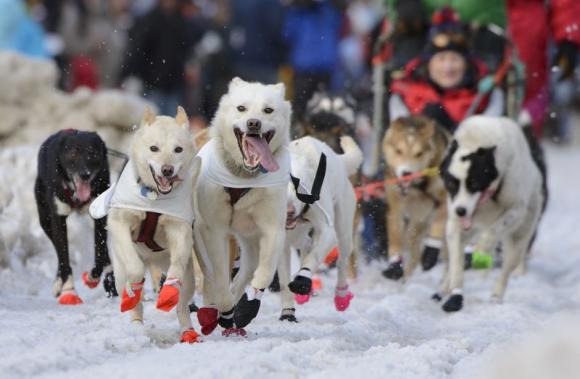
 Kelly Maixner's team charges out of the chute at the 2015 ceremonial start of the Iditarod Trail Sled Dog race in downtown Anchorage, Alaska March 7, 2015. Credit: Reuters/Mark Meyer


Kelly Maixner’s team charges out of the chute at the 2015 ceremonial start of the Iditarod Trail Sled Dog race in downtown Anchorage, Alaska March 7, 2015.
Credit: Reuters/Mark Meyer

It’s been an unseasonably warm winter in Alaska (unlike in Boston, which I have featured on my Facebook page a number of times since I have family and friends there).  And for only the second time in the 43 year history of the Iditarod dog sled race, the race route has had to be shifted due to lack of snow pack and unsafe conditions.

The 1,000 mile race has begun following a new route that has never been used before – starting in Fairbanks instead of Willow.

The race takes about 9 or more days to complete and will finish in Nome.

Mush!

Kathleen Crisley, specialist in dog massage, rehabilitation and nutrition/food therapy, Canine Catering Ltd, Christchurch, New Zealand


Amtrak required to accept small pets

 Rep. Jeff Denham, R-Calif., gives some attention to Lily, his 15-pound French bulldog, Feb. 15 in his office on Capitol Hill in Washington. Lily once was rejected by Amtrak, but the House passed a measure Wednesday that would let her ride with her owner.  Photo by J. Scott Applewhite/AP

Rep. Jeff Denham, R-Calif., gives some attention to Lily, his 15-pound French bulldog, Feb. 15 in his office on Capitol Hill in Washington. Lily once was rejected by Amtrak, but the House passed a measure Wednesday that would let her ride with her owner. Photo by
J. Scott Applewhite/AP

The Passenger Rail Reform and Investment Act passed last week by a vote of 316-101 (132 Republicans joined 184 Democrats in voting for the bill; 101 Republicans voted against).  The Act holds funding for Amtrak, the USA’s national rail network, at current levels.

But, the big news for dog lovers is that the rail line  will designate at least one car per train, where feasible, for pets, so that passengers “may transport a domesticated cat or dog in the same manner as carry-on baggage.”

Representative Jeff Denham, a Republican from California, supported the bill because he likes to travel with Lily, his French Bulldog.  Lily can ride on airplanes with Denham but has been unable to do so on train trips.

In 2014, Amtrak initiated a trial project into pet-friendly travel.  That trial was only in the Chicago area – now Amtrak must accept pets on a much wider basis.

Kathleen Crisley, specialist in dog massage, rehabilitation and nutrition/food therapy, Canine Catering Ltd, Christchurch, New Zealand


Happy faces/sad faces

This is the experimental set-up used to test whether dogs can discriminate emotional expressions of human faces.  Photo by Anjuli Barber, Messerli Research Institute

This is the experimental set-up used to test whether dogs can discriminate emotional expressions of human faces. Photo by Anjuli Barber, Messerli Research Institute

Dogs can tell the difference between happy and angry human faces, according to a research published recently in the journal Cell Biology.

The discovery represents the first solid evidence that an animal other than humans can discriminate between emotional expressions in another species, the researchers say.

Previous attempts had been made to test whether dogs could discriminate between human emotional expressions, but none of them had been completely convincing. In the new study, the researchers trained dogs to discriminate between images of the same person making either a happy or an angry face. In every case, the dogs were shown only the upper or the lower half of the face. After training on 15 picture pairs, the dogs’ discriminatory abilities were tested in four types of trials, including (1) the same half of the faces as in the training but of novel faces, (2) the other half of the faces used in training, (3) the other half of novel faces, and (4) the left half of the faces used in training.

The dogs were able to select the angry or happy face more often than would be expected by random chance in every case, the study found. The findings show that not only could the dogs learn to identify facial expressions, but they were also able to transfer what they learned in training to new cues.

“Our study demonstrates that dogs can distinguish angry and happy expressions in humans, they can tell that these two expressions have different meanings, and they can do this not only for people they know well, but even for faces they have never seen before,” says Ludwig Huber, senior author and head of the group at the University of Veterinary Medicine Vienna’s Messerli Research Institute.

This research adds to the body of knowledge about the human-animal bond.  The researchers believe it is likely that the dogs associate a smile with a positive meaning and an angry expression with a negative one.

Source:  EurekAlert! media release


A day in the life of a therapy dog

I love it when we hear about dogs who are able to use their instincts, talents and charm for good.  There is a growing body of knowledge about how the company of dogs can assist with human therapies.

In this video, the pet therapy program at HCA Virginia’s Chippenham and Johnston-Willis hospitals is featured.  Meet Fraser, a Black Labrador/Golden Retriever mix.  Fraser’s canine colleague, Schaffer, doesn’t feature in this video.  But, as full-time employees of HCA Virginia, the dogs receive benefits which include supplies and paid veterinary care.

Kathleen Crisley, specialist in dog massage, rehabilitation and nutrition/food therapy, Canine Catering Ltd, Christchurch, New Zealand

Diary of a Dog-Walker – book review

Diary of a dog walker

Edward Stourton, a journalist in UK radio, television and print, writes about his thoughts when out walking his dog, Kudu, and shares stories of their adventures together.

The book was based on a series of articles that Stourton wrote in The Daily Telegraph newspaper – all based on his dog walks.  Already a celebrated journalist who had appeared regularly on The Today Show, Kudu came into his life when he was taking a step back from high profile assignments.

This book has some observations that are thoroughly enjoyable, particularly for the dog person. For example:

Kudu’s response to one of those growling broad-shouldered types that sometimes swagger up with evil intent on the common is to stand very still with a wagging tail.  Everything offers friendship, but there is something of substance about the way he holds himself.  He never barks – but very, very occasionally, and only if the back-end sniffing turns nasty, he can do a decent throat-gurgle.

The book is very English in its humor and so won’t appeal to everyone.  I liked it – but I didn’t love it.  I’m glad I read it, but it isn’t a ‘keeper’ in terms of my doggy book collection.

Kathleen Crisley, specialist in dog massage, rehabilitation and nutrition/food therapy, Canine Catering Ltd, Christchurch, New Zealand


