Over 10,000 people in Europe use an assistance dog; think of guide dogs for the blind and visually impaired, hearing or signal dogs for the deaf and hard of hearing, medical response dogs and psychiatric service dogs.
Assistance dog user Iris and her dog Sandy in the recovery room after surgery. After a severe epileptic seizure, Iris was not doing well and Sandy was brought to the hospital in the hopes she could help improve Iris’ condition, which was indeed the case. Sandy even accompanied Iris to the OR, where Iris had to undergo a major surgery. One year earlier, bringing Sandy along was not negotiable in this particular hospital. Photo: private photo of Iris and Sandy.
According to European law, these dogs are welcome in stores, hospitals and other public places. However, in practice, many assistance dog users and their dogs are regularly refused entry. In the Netherlands, four out of five assistance dog users indicate that they regularly experience problems with this.
Often, hygiene reasons are given as the main argument for refusing entry to assistance dogs. Research by Utrecht University now shows that the paws of assistance dogs are cleaner than the shoe soles of their users, and thus, paw hygiene is no reason to ban assistance dogs from hospitals.
To investigate this, Jasmijn Vos, Joris Wijnker and Paul Overgaauw of Utrecht University’s Faculty of Veterinary Medicine took samples from the paws of 50 assistance dogs and the shoe soles of their users. For comparison, they also investigated an equally large group of pet dogs and their owners. Vos and her colleagues examined the samples for poop bacteria (Enterobacteriaceae), which are very common outdoors, and for an important diarrhoeal bacteria (Clostridium difficile).
“The dogs’ paws turned out to be cleaner than the soles of their shoes,” says Jasmijn Vos, Masters student at Utrecht University. “This makes the hygiene argument that is often used to ban assistance dogs from public locations invalid.” Moreover, the diarrhoeal bacteria did not occur on the dogs’ paws whatsoever, and only once on a shoe sole.
81% of assistance dogs are refused
Dutch assistance dog users were also surveyed about their experiences. 81% are still regularly refused entry to public places with their dog, even though this is prohibited by law. This is mainly down to lack of knowledge on the part of the person refusing entry: lack of knowledge on what an assistance dog is, how it can be recognised, and about the rules of law.
The study also shows that assistance dog users constitute only a small fraction of the total number of patients in Dutch hospitals. Should they decide to bring their assistance dog to the hospital, or elsewhere, this should be made possible; assistance dogs are usually well behaved and are no more of a hygiene hazard than people!
Research publication Vos SJ, Wijnker JJ, Overgaauw PAM. A pilot study on the contamination of assistance dogs’ paws and their users’ shoe soles in relation to admittance to hospitals and (in)visible disability. Int. J. Environ. Res. Public Health. 2021; 18(2): 513. Full text: https://www.mdpi.com/1660-4601/18/2/513
Have you ever noticed that the rectangular film frame is less suited to the human body shape than to the four-legged format of the dog?
That’s right: cinema was made for dogs. But some dog breeds make more movies than others. From the canine celebrity Rin Tin Tin to the uncanny CGI of Cruella and Call of the Wild, it feels like German Shepherds, Dalmatians, and Saint Bernards are better represented than other ‘makes’ of dog. But is this really the case? Or do they just do more PR?
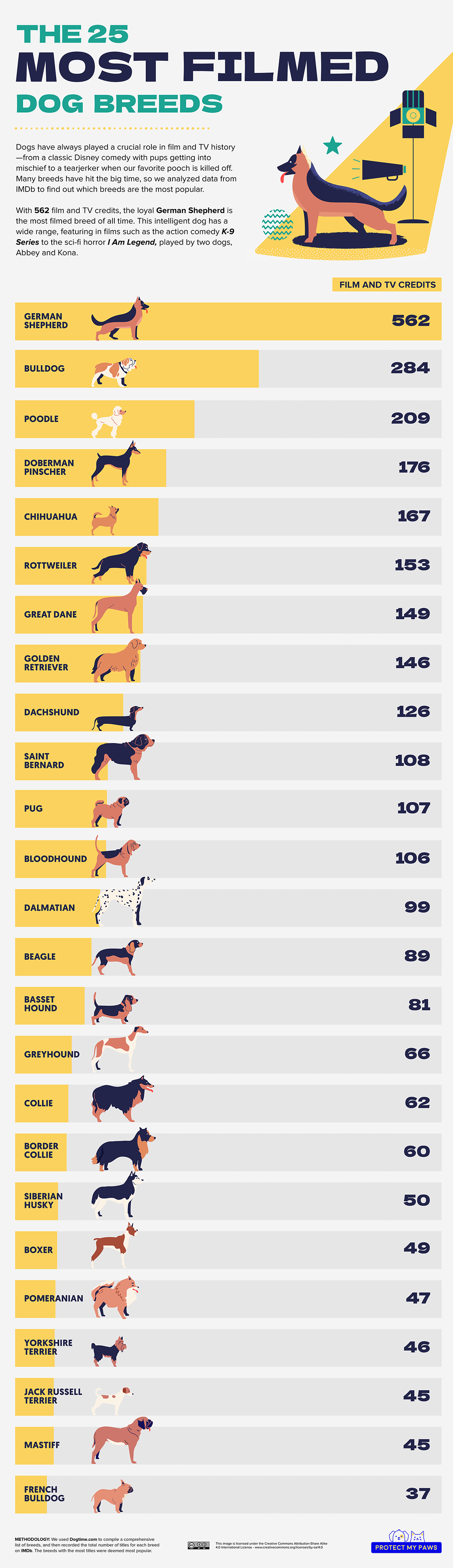
Protect My Paws used IMDb data to identify the breeds that appear in the most films and TV shows of the past century-and-a-bit. We found some stuff that will change what you thought you knew about dogs in movies.
Today we present our guide to the Michael Caines and Samuel L. Jacksons of the canine world: the dog breeds that never turn down a role.
The German Shepherd Appears in More Movies Than Any Other Breed
With the dependability of a four-legged James Stewart and the ruggedness of a young Steven Seagal, the mighty German Shepherd is the canine king of Hollywood. German Shepherds – also known as Alsatians – have collected nearly twice as many credits as the second most active dog breed, the bulldog.
The Saint Bernard tends to be a limelight grabber with its James Belushi-esque presence in pictures such as Beethoven and Daddy Daycare. But nine other breeds, including the poodle and the Chihuahua, have more films to their name. And the Dalmatian? Since we counted number of films, not number of dogs, the Dalmatian is two movies short of achieving 101 credits, and does not even make the top 10.
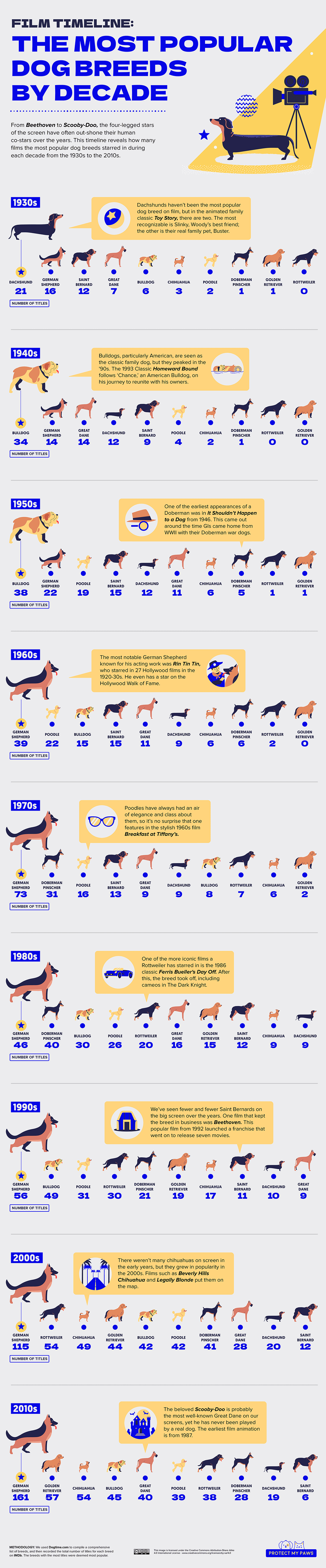
Cinema’s ‘Funny Dogs’ dominate 1930s, ‘40s, ‘50s
How have audiences’ preferences for dog talent changed over the years? Well, the original Alsatian superstar, Rin Tin Tin, racked up the credits during the ‘Rinty’ craze of the 1920s. But his descendants and namesakes worked with only sporadic success.
It was not until the 1960s that the German Shepherd became the most-cast breed once again. The long-beaked hound was spotted in seminal zombie flick Night of the Living Dead (1968) and arthouse classic The Diary of a Chambermaid (1964), among more than 50 titles in the 1960s. But his most iconic role was as The Littlest Hobo, a homeless dog who walks the Earth solving problems for strangers.
The German Shepherd has dominated every period since the 1960s. But Hollywood’s golden age was an era of bulldogs. This wrinkle-faced bruiser can claim 34 titles in both the 1940s and the 1950s. The bulldog played alongside Judy Garland in Meet Me In St. Louis (1944) and raised laughs with Abbott and Costello and the Three Stooges. But most of the bulldog’s golden age credits are due to appearances in cartoons, particularly as Spike – a canine foil to Tom and Jerry.
That just leaves a surprise winner for the 1930s: the dachshund, or wiener dog. Why a surprise? Because the dachshund is clearly a better fit for either widescreen or CinemaScope, and neither were commonplace until the 1950s. Sure, there was a role in Hitchcock’s Secret Agent and all-star drama Grand Hotel – but most of the wiener dog’s 1930s roles came from cartoons. While bulldogs tickled 1950s audiences, in the 1930s people found dachshunds hilarious.
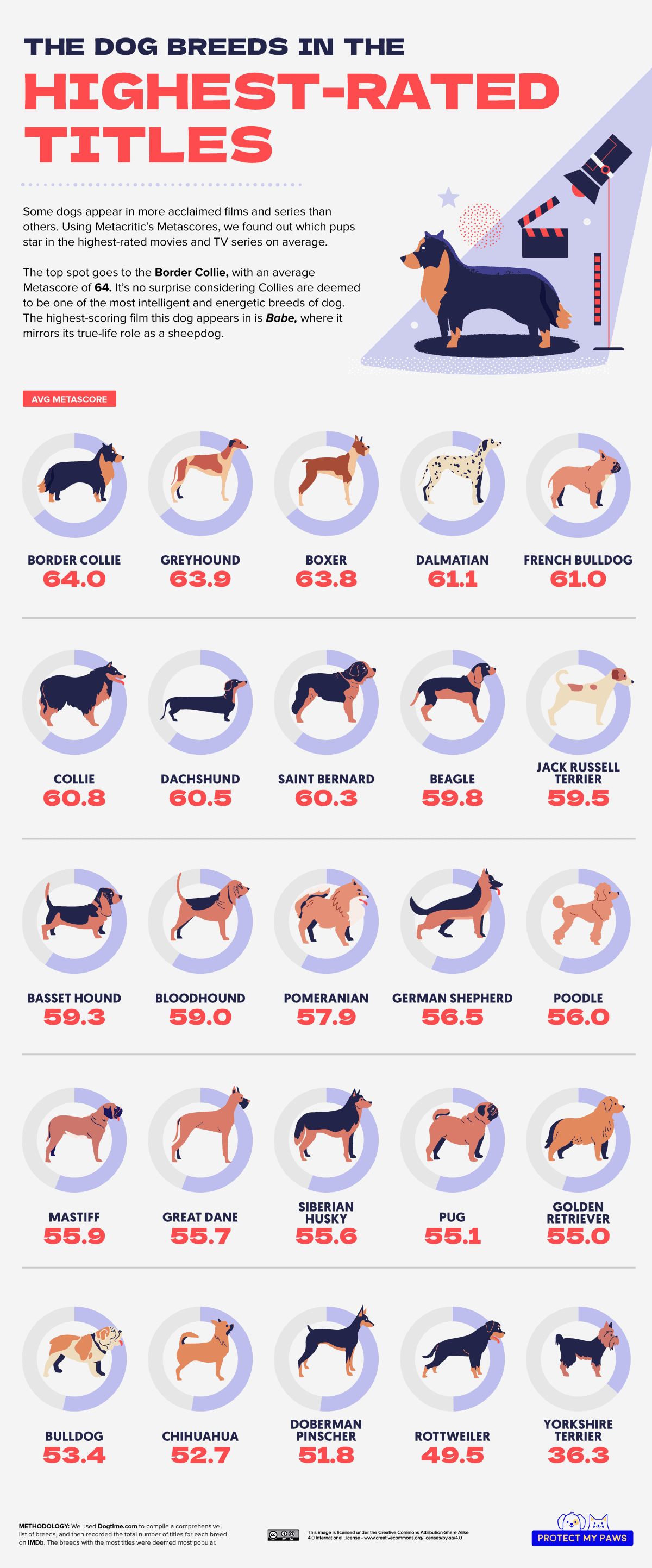
Sheepdog Breed Is Most Critically Acclaimed Dog
Next, we used Metacritic to find the average rating each dog breed has across their whole back catalog. From this perspective, finally the German Shepherd’s Hollywood crown starts to look wonky. With an average rating of 56.5, the German Shepherd is only the 14th most critically acclaimed dog breed.
But the critic’s darling, our lifetime achievement nominee, is the border collie. As sharp as Joan Crawford, as tenacious as Sigourney Weaver, as adorable as Heath Ledger, the border collie picks their roles carefully. Choice cuts include supporting parts in Babe (1995) and The Lobster (2015), while the collie has also played the ‘quintessential dog’ in dog movies, including A Dog Year (2009), Hotel for Dogs (2007), and Duke (2012).
As a final note, never see a film with a Yorkshire terrier in it. With an average rating of 36.3, they are all stinkers.
The Start of a Beautiful Friendship
This year was a big year for dogs in movies. The coveted Palm Dog (the canine answer to the prestigious Cannes Palme d’Or) was won not by one but three springer spaniels. All three belong with their co-star, the actor Tilda Swinton, who didn’t win a thing.
Could Rose, Dora, and Snowbear usher in a new era of springer spaniel domination in Hollywood? Could multiple dogs in the billing mean cinema is finally shaping up to fulfill its destiny – as a medium for actors who are longer than they are tall and who shout their lines in short, loud bursts, like furry Al Pacinos?
Methodology
Our initial list of dog breeds was compiled usingDogtime.com. Each dog breed was then looked up onIMDB custom search engine in two variations: with and without “dog,” e.g., “German Shepherd” and “German Shepherd dog,” recording a total number of unique titles (films and tv series), as well as their year of release, and their Metascore, where available.
Dog breeds with the highest number of unique titles they appeared in were deemed the most popular. Dog breeds with the highest average Metascore of the titles they appeared in were deemed the highest rated.
Over the last few days I have thought a lot about what to write about Izzy, my best friend who joined my life in October 2014 and sadly had to leave it on 27 December 2021.
When I first met Izzy, she didn’t pay me much attention. She was staying at the kennel base of Greyhounds as Pets and, because she was in season, she was unable to come home with me straight away on a foster-to-adopt arrangement. I would drive out to the kennels every couple of days to walk with her and she plodded along by my side with a confident indifference.
I would soon realise that her seeming aloofness was from her independent nature – which was an asset in a dog that would need to spend periods of time alone while I was out working and to be confident at public and social events.
(She would also assert her independence at inopportune moments such as when I needed us to take a shorter walk and she wanted to go the long way. I would remind myself that she was matched with me because of that independence; it was unfair for me to be upset with her simply because she was being herself.)
Izzy was by my side as I expanded my dog massage and rehab practice, leaving full-time employment to pursue my passion to help other dogs and their families with an exclusively in-home practice. A constant presence, she was happy to settle for the day after her walk and breakfast – with an activity toy of some sort to reward her.
She benefited from a number of modalities to treat her corns and developing arthritis over the years, including massage, laser, PEMF, swimming, water treadmill and the use of a pram. This made her a great advertisement for multi-modal health care.
One of my best investments was her pram, which I purchased in 2019 when Izzy started to be troubled by painful corns – that pram would see her achieve mobility and support engagement through to her last days, including one last greyhound Christmas walk just 8 days before her passing.
Izzy was also an ambassador for her breed – meeting the public at numerous events such as the Riccarton Sunday Market, organised greyhound walks, our charity garage sale for Greyhounds as Pets in 2017 and our Greyt Fashions fundraiser in 2018, where she strutted down the runway with her friends in numerous greyhound outfits (raising almost $5,000 in the process).
On the runway, in her favourite colour – purple
In early 2020, before the pandemic took hold, Izzy also led a doga class with some of her fellow greyhounds and this featured on Newshub. It was a shame we couldn’t continue these classes after lockdown, but business priorities had changed.
Doga class was hard work
During our lengthy lockdown in March and April 2020, Izzy hosted Word of the Day on our Facebook page to keep our clients and followers entertained.
Word of the Day
In 2021, since I sponsor the 4 Paws Marathon, her photo was featured on the 5 km finishers medal and we were also filmed by accounting software company Xero in a customer story about the business.
I will forever be grateful for the professional photos and video that resulted from the Xero campaign because they show Izzy at her finest – at home, in her pram and at her beloved beach.
Izzy was the demo-dog at my Learn to Massage Your Dog and Greyhound Massage and Stretching classes; she taught countless dogs and their owners the benefits of regular massage including in the online version of Greyhound Massage and Stretching, which we filmed just prior to the 2020 lockdown.
Her friend Spot will now teach class with me starting later this month – plans we put in place in earnest when her health started to decline.
Her last contribution to her kind was to welcome deaf foster greyhound, Rosie, into our home – something that was planned from early November. We decided to proceed with fostering in the hope that another dog in the house would provide a diversion and, possibly, some competition for food to encourage her to eat. Izzy was a capable mentor to Rosie for only 10 days before she passed – but I would often find Rosie laying next to Izzy and in the same body position.
Izzy (left) and Rosie (right)
As a dog parent, you are never ready for your life’s journey to end. Yet, when we sign onto the lifetime commitment to a dog, we are in the privileged position of being able to end suffering (something that in most places around the world we are unable to do easily or legally for our human loved-ones).
Izzy was diagnosed in August with chronic kidney disease as part of an annual check-up. She was not showing any outward signs of disease at the time and, through diet changes, medication and herbal supplements, we did our best to preserve the kidney function that she had remaining. In November, she suffered an attack of canine vestibular disease and had two more of these in the weeks that followed. Looking back on the last five weeks of her life, I would have to say that her health was in a steady decline starting with that first episode of vestibular.
Ironically, the vestibular disease presented on the evening following a beach walk and birthday party for two of her greyhound friends, Spot and Luke. Izzy’s happy place was at the beach and we were able to get in a few more beach walks, including on Christmas morning and again on Boxing Day (her last walk). I had hoped we would have one final summer together this year and celebrate her 13th birthday with a princess-themed cake.
As they say, man plans and God laughs.
With Mr Caterpillar, in happier times
Izzy left in me in no doubt that she was ready to go – refusing to eat and drink with a stubborn turn of her head. As the day went on, it was clear she was in end-stage kidney failure and in pain. Thanks to in-home euthanasia service Our Pet’s Goodbye, we were able to be together to the final second in the comfort of our home where she was surrounded by her loved ones – me and her beloved Mr Caterpillar.
She is now over the Rainbow Bridge, at the beach, where it will always be a breezy and warm summer day so she can splash in the waves to her heart’s content.
I will join her there someday.
“You were my favourite hello and my hardest goodbye”
Kathleen Crisley, Fear-Free certified professional and specialist in dog massage, rehabilitation and nutrition/food therapy, The Balanced Dog, Christchurch, New Zealand
“Me sitting respectfully and quietly just outside our comfort room located in our hospice center while my clients say goodbye to their beautiful and beloved pet. Sometimes I meditate, other times I cry silently, but I always pray for my clients to find peace during this time of grief. 💖”
Could pets offer “probiotic” benefits to their owners?
Researchers at the University of Pennsylvania School of Veterinary Medicine (Penn Vet) are set to investigate whether pets could be a source of microbiota that can help restore deficiencies in their owner’s gut microbiome (i.e. collection of microbes in the intestines).
The study, which has received funding from the Human Animal Bond Research Institute (HABRI), will follow pet owners (60 years or older) who are taking antibiotics for dental implant placement. Antibiotics disrupt the native gut microbiome, HABRI reports, which can result in adverse outcomes, ranging from mild diarrhea to severe “C. diff” (Clostridioides difficile) infection.
Researchers hypothesize the gut microbiomes of owners and their pets will resemble each other prior to the course of antibiotics, diverge during the disruption phase, then steadily converge during the recovery phase.
“A growing number of studies have documented the ability of animal contact to impact the human microbiome in ways that may help prevent certain types of disease, such as cardiovascular disease and asthma,” says principal investigator, Laurel Redding, VMD, PhD, DACVPM, an assistant professor of epidemiology at Penn Vet. “In conducting this study, our goal is to shed light on the microbial exchanges that occur between pets and pet owners and assess whether pets can mitigate disruption of their owner’s gut microbiome following antibiotic therapy.”
Researchers say the study’s results could support the promotion of contact between older adults and household pets, HABRI reports.
“HABRI is proud to fund research that will contribute to our understanding of the physiological health benefits of the human-animal bond,” says the group’s president, Steven Feldman. “We know pets and people are good for each other, and it’s exciting we can still discover new evidence underlying this powerful, mutually-beneficial relationship.”
Scientists have identified a series of molecular candidates for those parts of dog allergens that cause immune reactions in people—the first step in developing a vaccine against most causes of dog allergies.
There have been many research efforts describing the nature and progression of dog allergies, but there have been very few applied studies that use this information to try to cure people of dog allergies entirely by artificially inducing immune tolerance. But researchers have now for the first time identified candidates for those parts of the molecules that make up dog allergens that could give us precisely that: a ”dog allergy vaccine.”
Their findings were published in the Federation of European Biochemical Societies journal on October 26, 2021.
Being allergic to dogs is a common malady and one that is growing worldwide. Over the years, scientists have been able to identify seven different dog allergens—molecules or molecular structures that bind to an antibody and produce an unusually strong immune response that would normally be harmless.
These seven are named Canis familiaris allergens 1 to 7 (Can f 1-7). But while there are seven, just one, Can f 1, is responsible for the majority (50-75 percent) of reactions in people allergic to dogs. It is found in dogs’ tongue tissue, salivary glands, and their skin.
Researchers have yet to identify Can f 1’s IgE epitopes—those specific parts of the antigens that are recognized by the immune system and stimulate or ‘determine’ an immune response (which is why epitopes are also called antigen determinants). More specifically, epitopes are short amino acid sequences making up part of a protein that induces the immune response.
Epitopes bind to a specific antigen receptor on the surface of immune system antibodies, B cells, or T Cells, much like how the shape of a jigsaw puzzle piece fits the specific shape of another puzzle piece. (The part of the receptor that binds to the epitope is in turn called a paratope). Antibodies, also known as immunoglobulin, come in five different classes or isotypes: IgA (for immunoglobulin A), IgD, IgE, IgG, or IgM. The IgE isotype (only found in mammals) plays a key role in allergies and allergic diseases. There is also an IgE epitope that is the puzzle piece that fits the IgE isotype’s paratope.
In recent years, there has been extensive effort at developing epitope-focused vaccines—in this case, a vaccine against dog allergies.
“We want to be able to present small doses of these epitopes to the immune system to train it to deal with them, similar to the principle behind any vaccine,” said Takashi Inui, a specialist in allergy research, professor at Osaka Prefecture University and a lead author of the study. “But we can’t do this without first identifying the Can f 1’s IgE epitope.”
So the researchers used X-ray crystallography (in which the diffraction of x-rays through a material is analyzed to identify its ‘crystal’ structure) to determine the structure of the Can f 1 protein as a whole—the first time this had ever been done.
They found that the protein’s folding pattern is at first glance extremely similar to three other Can f allergens. However, the locations of surface electrical charges were quite different, which in turn suggest a series of ‘residues’ that are good candidates for the IgE epitope.
Using this basic data, further experimental work needs to be performed to narrow the candidates down, but the findings suggest the development of a hypoallergenic vaccine against Can f 1—a dog-allergy vaccine—is within our grasp.
The production of a ‘hypoallergenic vaccine’ by use of such epitopes would not just be a world-first with respect to dog allergies but is rare with respect to any allergic reaction. If the researchers’ work is indeed used to develop a dog allergy vaccine, the principles behind it could be used much more widely against various allergies.
Paper Information Journal title: Federation of European Biochemical Societies journal Paper title: Structure-based prediction of the IgE epitopes of the major dog allergen Can f 1 DOI: 10.1111/febs.16252
It’s time to slip on your boots and grab the lead because walking a dog is better at combating stress that strolling alone, a new study has found.
Darrya/Getty Images
According to scientists at the University of Animal Health Technology in Tokyo, sharing a daily ramble with a pet reduces the chances of depression, stress and anxiety. We know that heading outside with your pup provides dogs with the opportunity to get regular physical activity, but it can also help boost the calming GABA chemical in your body, too.
Researchers in the team took saliva samples from 14 dog owners for a week to see whether it was better to walk alone or with a pet. The results, published in the journal Animals, revealed that levels of stress (including the stress-inducing MHPG chemical) were much lower when owners took their dogs on a walk. Meanwhile, the levels of the GABA chemical were also 40% higher.
This isn’t the first time dog walks have been praised for their mental and health benefits, either. In fact, a previous 2017 study found that humans get just as much as their pups from regular strolls.
Rather than social or physical health benefits, it was found the ability of the walk to make them happy was the biggest drive, while findings also discovered that owners were happier when they believed they were making their four-legged friend happier too.
Dog breeds are often recognized for distinctive traits — the short legs of a dachshund, wrinkled face of a pug, spotted coat of a Dalmatian. Unfortunately, the genetics that give various breeds their particular attributes are often the result of inbreeding.
A study shows the majority of canine breeds are highly inbred, contributing to an increase in disease and health care costs throughout their lifespan. (Getty)
In a recent study published in Canine Medicine and Genetics, an international team of researchers led by University of California, Davis, veterinary geneticist Danika Bannasch show that the majority of canine breeds are highly inbred, contributing to an increase in disease and health care costs throughout their lifespan.
“It’s amazing how inbreeding seems to matter to health,” Bannasch said. “While previous studies have shown that small dogs live longer than large dogs, no one had previously reported on morbidity, or the presence of disease. This study revealed that if dogs are of smaller size and not inbred, they are much healthier than larger dogs with high inbreeding.”
Inbreeding affects health
The average inbreeding based on genetic analysis across 227 breeds was close to 25%, or the equivalent of sharing the same genetic material with a full sibling. These are levels considered well above what would be safe for either humans or wild animal populations. In humans, high levels of inbreeding (3-6%) have been associated with increased prevalence of complex diseases as well as other conditions.
“Data from other species, combined with strong breed predispositions to complex diseases like cancer and autoimmune diseases, highlight the relevance of high inbreeding in dogs to their health,” said Bannasch, who also serves as the Maxine Adler Endowed Chair in Genetics at the UC Davis School of Veterinary Medicine.
The researchers partnered with Wisdom Health Genetics, a world leader in pet genetics, to obtain the largest sample size possible for analysis. Wisdom Health’s database is the largest dog DNA database in the world, helping researchers collect data from 49,378 dogs across 227 breeds — primarily from European sources.
Some breeds more inbred
So, what makes a dog breed more inbred than others? Bannasch explained that it’s often a combination of a small founding population followed by strong selection for particular traits in a breed — often based on looks rather than purpose. While she has always had an interest in the population structure of some of these breeds, she became particularly interested in the Danish-Swedish farmdog several years ago. She fell in love with their compact size, disposition and intelligence, and ended up importing one from Sweden.
Bannasch discovered that Danish-Swedish farmdogs have a low level of inbreeding based on their history of a relatively large founding population of 200, and being bred for function, rather than a strong artificial selection for looks. And according to the insurance health data on breeds collected from Agria Insurance Sweden and hosted online by the International Partnership for Dogs, the farmdog is one of the healthiest breeds.
The study also revealed a significant difference in morbidity between brachycephalic (short skull and snout) and non-brachycephalic breeds. While that finding wasn’t unexpected, the researchers removed brachycephalic breeds from the final analysis on effects of inbreeding on health.
Preserving genetic diversity
In the end, Bannasch said she isn’t sure there is a way out of inbred breeds. People have recognized that creating matches based solely on pedigrees is misleading. The inbreeding calculators don’t go back far enough in a dog’s genetic line, and that method doesn’t improve overall high levels of population inbreeding.
There are other measures that can be taken to preserve the genetic diversity and health of a breed, she said. They include careful management of breeding populations to avoid additional loss of existing genetic diversity, through breeder education and monitoring of inbreeding levels enabled by direct genotyping technologies.
Outcrosses are being proposed or have already been carried out for some breeds and conditions as a measure to increase genetic diversity, but care must be taken to consider if these will effectively increase overall breed diversity and therefore reduce inbreeding, Bannasch said. In particular, in the few breeds with low inbreeding levels, every effort should be made to maintain the genetic diversity that is present.
Ed, a Bull Terrier, loves his regular massage sessions. Ed responds to massage much like a person does, so we decided to cover him in a blanket and take a video.
I have launched this video on social media as a promotion for gift vouchers for Christmas 2021. Dog massage is the calorie-free gift which supports wellness, relaxation, and can provide an early warning for sinister lumps and bumps. It helps arthritic dogs like Ed with pain relief and mobility and should be an essential part of any rehab program following an injury or surgery.
Kathleen Crisley, Fear-Free certified professional and specialist in dog massage, rehabilitation and nutrition/food therapy, The Balanced Dog, Christchurch, New Zealand












 DoggyMom.com