Author Archives: DoggyMom.com

Fighting Fractures

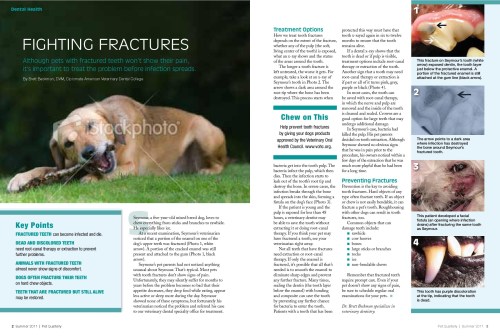
Sometimes, I come across resources on the internet that just have to be shared.  Here’s one of them.  It’s a fact sheet by Dr Brett Beckman, a veterinary dentist, about fractured teeth, how to prevent them, and the treatments available.

Fighting Fractures

You can download a .pdf of this fact sheet from www.dentalvets.co.uk

Recommended reading for all dog parents…

Kathleen Crisley, specialist in dog massage, rehabilitation and nutrition/food therapy, The Balanced Dog, Christchurch, New Zealand

A truce with my aging stepdog

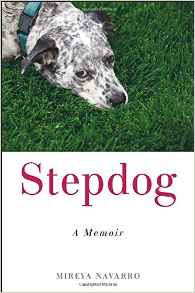
Stepdog

Mireya Navarro is a reporter for The New York Times and the author of the memoir Stepdog.  In this piece in the New York Times, she describes her relationship with Eddie and how it improved as Eddie aged.

“There’s one good thing about my old dog’s fading memory: He seems to have forgotten he hates me….”

Enjoy the weekend reading!

Kathleen Crisley, specialist in dog massage, rehabilitation and nutrition/food therapy, The Balanced Dog, Christchurch, New Zealand

Comfort in Orlando

Comfort dog in Orlando

Melissa Soto with Susie, a comfort dog, on Tuesday near a memorial site for the victims of the mass shooting in Orlando, Fla. Credit John Taggart/European Pressphoto Agency

The Golden Retriever comfort dogs which served so honorably after the Boston Marathon bombing and the Sandy Hook school shooting have been called into action again.

This New York Times article covers brilliantly what these dogs and their handlers do by sharing unconditional love and comfort.

My only wish is that there weren’t so many occasions when the dogs are needed…

Kathleen Crisley, specialist in dog massage, rehabilitation and nutrition/food therapy, The Balanced Dog, Christchurch, New Zealand

Foreign bodies

I’ve heard some people describe their dog as “A Guts” – but this list takes it to a whole new level.  Pet insurer Petplan has published a list of all the foreign bodies taken from pets insured by them.  (It’s a pretty impressive list)

Dog ate scisscorsDog ate cellphone

  • Acorns
  • Balloons
  • Batteries
  • Blanket
  • Carpeting
  • Chicken bones
  • Christmas ornaments
  • Clam shells
  • Copper wire
  • Corn cobs
  • Diapers
  • Dimes
  • Fish hook and sinker
  • Football
  • Fruit pits
  • Gloves
  • Grass
  • Hair ties
  • Hairbrush
  • Insulation
  • Leash
  • Metal skewers
  • Most of a loveseat
  • Sewing needles
  • Oven mitt
  • Pacifiers
  • Part of a book
  • Plastic hanger
  • Razor blades
  • Rocks
  • Rubber bands
  • Part of a rubber mat
  • Shoes
  • Socks
  • Staples
  • Sticks
  • String
  • Tea lights
  • Tennis balls
  • Toothpicks
  • TV remove
  • Underwear
  • Wedding rings
  • Wooden checkers

If you don’t have pet insurance and your dog is A Guts, then this list may change your mind about getting some.

Kathleen Crisley, specialist in dog massage, rehabilitation and nutrition/food therapy, The Balanced Dog, Christchurch, New Zealand


I don’t understand…

I often chat with my human clients (the ones who pay the bills) when working on their dog. This week, one my clients and I were chatting about her dog’s nutrition plan.  She mentioned that her neighbor was feeding a cheap food that wasn’t balanced.  And more importantly, he didn’t seem to care.

She said “I don’t understand why people get dogs, say they love them, and then don’t bother to feed a quality food.”

I, of course, agreed.

And then I got to thinking about the other things I don’t understand:

  • I don’t understand why some people get a dog and then never let it live inside the house with them and their family.
  • I don’t understand why dog owners think ‘cheap’ anything is appropriate for their dog’s health and well-being.
  • I don’t understand why people adopt puppies and then don’t take them to puppy training classes.
  • I don’t understand why people adopt older dogs and don’t invest the time to train them.
  • I don’t understand why anyone things it’s okay to hit a dog, or neglect it.
  • I don’t understand why some dog owners don’t take their dog out for daily exercise and enrichment.
  • I don’t understand why some people don’t accept their lifetime responsibility to their animal.
  • I don’t understand why people don’t spay or neuter their dog (and then some put it up for adoption and expect the new owner to do it).
  • I don’t understand why some people have children and then say they have to re-home their dog because they are too busy – the dog was there first.
  • I don’t understand why, when their dog is in pain or injured, the owner goes onto Facebook for advice rather than taking their dog to the vet (with urgency).

Daisy in sunshine 2014IMG_0577

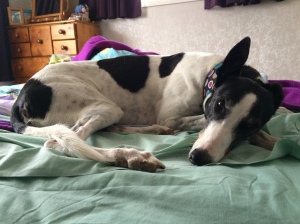
I have been lucky enough to have some incredible dogs in my life (above are Daisy (now deceased) and Izzy (my retired racing greyhound).  I proudly say that they have always come first.

Kathleen Crisley, specialist in dog massage, rehabilitation and nutrition/food therapy, The Balanced Dog, Christchurch, New Zealand

Animal research at the University of Otago

otago067812A blight on New Zealand’s animal welfare record (not the first).

The University of Otago has announced it will build a new $50 million, five-story animal research facility.

SPCA New Zealand has formally denounced the development.  “The SPCA strongly opposes any practice that causes animals unnecessary pain and suffering, including animal research,” says Ric Odom, CEO.

“Animals are sentient beings that can feel pain, fear, and distress, so we are wholeheartedly committed to the principles of the ‘3Rs’ – replacing the use of animals in research, reducing the number of animals used, and refining experimental procedure to reduce suffering.”

The SPCA would like to see the $50 million cost of this giant animal research facility used to develop further alternative techniques, rather than used to build a laboratory for conducting further experiments on sentient animals.”

Meanwhile, Professor Richard Blaikie, the University’s deputy vice-chancellor of research and enterprise, said that the facility will provide the “highest standard of care.”

That’s hard to believe considering the University was involved in a study in 2009 using live pigs who were shot in the head to study blood spatter patterns.  If the University thinks that is essential research and a high standard of care, then I shudder to think of what’s coming.

All I can say is if you are thinking of studying in New Zealand, you might want to show your support for animals by boycotting the University of Otago.

Kathleen Crisley, specialist in dog massage, rehabilitation and nutrition/food therapy, The Balanced Dog, Christchurch, New Zealand


Pets on Stamps

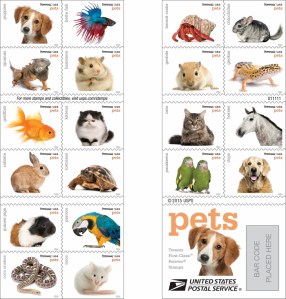
pet stamps

The US Postal Service will soon issue a stamp booklet showing 20 of America’s best loved pets.  You can see how popular dogs are – there are 2 dogs in the set of 20!

Other blogs about dogs on stamps:

Kathleen Crisley, specialist in dog massage, rehabilitation and nutrition/food therapy, The Balanced Dog, Christchurch, New Zealand


Reporting for Duty – book review

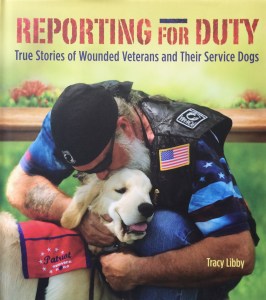
I have just finished reading Reporting for Duty, a coffee table book written by Tracy Libby.  This book is presented well, with small vignettes interspersed with text, photos, and profiles of 15 veterans and their assistance dogs.

Reporting for duty by Tracy Libby

The book’s first chapter explains  PTSD (post traumatic stress disorder, a term that didn’t come into use until after the Vietnam War), TBI (traumatic brain injury), and MST (military sexual trauma) – pretty gut-wrenching content.

The chapters that follow include coverage of therapy dogs in history, prison puppy programs and combat and operational stress-control dogs.  The final chapter is about how dogs read us, with references to the various research findings about canine cognition and the human-animal bond (a favourite subject of mine).

There are many photographs in this book, which are lovingly presented.  It provides a good selection of case studies – veterans and their dogs – with veterans from different wars and each requiring different levels of assistance and support.

But it is the book’s Foreward that will remain with me for some time.  Written by Karen D Jeffries (retired Commander in the US Navy, and co-founder of Veterans Moving Forward, Inc – a charity which will benefit from some of the proceeds of sales), the Foreward contains some sobering statistics and facts:

  • The US Veteran’s Administration is unable to meet the needs of the disabled veteran population
  • More that 540,000 veterans of the wars in Iraq and Afghanistan have PTSD or depression (or both)
  • More than 260,000 veterans have been diagnosed with traumatic brain injuries
  • Even if all of the service dog organisations currently operating in the United States increased their annual output by a factor of 100, the mental health challenges of veterans would still not be met
  • The present policy of the Veteran’s Administration is to provide service dogs only to veterans with visual or hearing impairment or some selected mobility challenges – a small sub-set of the range of uses and support that can be given by trained dogs

This is a book that is best enjoyed in hard copy – flick through the photos and thank heaven for the people who volunteer, fund raise, and train assistance dogs.

My copy of the Reporting for Duty was provided free-of-charge by the book’s publisher.  I will cherish it as part of my dog book collection.

Kathleen Crisley, specialist in dog massage, rehabilitation and nutrition/food therapy, The Balanced Dog, Christchurch, New Zealand


Dogs were domesticated not once, but twice

The question, ‘Where do domestic dogs come from?’, has vexed scholars for a very long time. Some argue that humans first domesticated wolves in Europe, while others claim this happened in Central Asia or China. A new paper, published in Science, suggests that all these claims may be right. Supported by funding from the European Research Council and the Natural Environment Research Council, a large international team of scientists compared genetic data with existing archaeological evidence and show that man’s best friend may have emerged independently from two separate (possibly now extinct) wolf populations that lived on opposite sides of the Eurasian continent.

Domestication photo

Man’s best friend. Dogs were domesticated not once, but twice… in different parts of the world. Credit: © lenaivanova2311 / Fotolia

This means that dogs may have been domesticated not once, as widely believed, but twice.

A major international research project on dog domestication, led by the University of Oxford, has reconstructed the evolutionary history of dogs by first sequencing the genome (at Trinity College Dublin) of a 4,800-year old medium-sized dog from bone excavated at the Neolithic Passage Tomb of Newgrange, Ireland. The team (including French researchers based in Lyon and at the National Museum of Natural History in Paris) also obtained mitochondrial DNA from 59 ancient dogs living between 14,000 to 3,000 years ago and then compared them with the genetic signatures of more than 2,500 previously studied modern dogs.

The results of their analyses demonstrate a genetic separation between modern dog populations currently living in East Asia and Europe. Curiously, this population split seems to have taken place after the earliest archaeological evidence for dogs in Europe. The new genetic evidence also shows a population turnover in Europe that appears to have mostly replaced the earliest domestic dog population there, which supports the evidence that there was a later arrival of dogs from elsewhere. Lastly, a review of the archaeological record shows that early dogs appear in both the East and West more than 12,000 years ago, but in Central Asia no earlier than 8,000 years ago.

Combined, these new findings suggest that dogs were first domesticated from geographically separated wolf populations on opposite sides of the Eurasian continent. At some point after their domestication, the eastern dogs dispersed with migrating humans into Europe where they mixed with and mostly replaced the earliest European dogs. Most dogs today are a mixture of both Eastern and Western dogs — one reason why previous genetic studies have been difficult to interpret.

The international project (which is combining ancient and modern genetic data with detailed morphological and archaeological research) is currently analysing thousands of ancient dogs and wolves to test this new perspective, and to establish the timing and location of the origins of our oldest pet.

Senior author and Director of Palaeo-BARN (the Wellcome Trust Palaeogenomics & Bio-Archaeology Research Network) at Oxford University, Professor Greger Larson, said: ‘Animal domestication is a rare thing and a lot of evidence is required to overturn the assumption that it happened just once in any species. Our ancient DNA evidence, combined with the archaeological record of early dogs, suggests that we need to reconsider the number of times dogs were domesticated independently. Maybe the reason there hasn’t yet been a consensus about where dogs were domesticated is because everyone has been a little bit right.’

Lead author Dr Laurent Frantz, from the Palaeo-BARN, commented: ‘Reconstructing the past from modern DNA is a bit like looking into the history books: you never know whether crucial parts have been erased. Ancient DNA, on the other hand, is like a time machine, and allows us to observe the past directly.’

Senior author Professor Dan Bradley, from Trinity College Dublin, commented: ‘The Newgrange dog bone had the best preserved ancient DNA we have ever encountered, giving us prehistoric genome of rare high quality. It is not just a postcard from the past, rather a full package special delivery.’

Professor Keith Dobney, co-author and co-director of the dog domestication project from Liverpool University’s Department of Archaeology, Classics and Egyptology, is heartened by these first significant results. ‘With the generous collaboration of many colleagues from across the world-sharing ideas, key specimens and their own data — the genetic and archaeological evidence are now beginning to tell a new coherent story. With so much new and exciting data to come, we will finally be able to uncover the true history of man’s best friend.’

Source:  Science Daily

Does your dog understand you?

Research by a Brigham Young University psychology professor shows how dogs perceive and use human emotional cues and gestures.

Professor Ross Flom conducted two experiments where he looked at the frequency in which dogs followed a pointing gesture to locate a hidden reward. Those gestures were paired with either positive or negative behaviors from the person pointing. Positive behaviors included smiling and speaking in a pleasant tone. Negative behaviors included frowning, a furrowed brow and speaking in a harsh tone.

The main finding of the study is that dogs use human emotions in determining how quickly or how slowly they’re going to go and explore an unfamiliar location. While positive behaviors didn’t improve response time from the control group, negative behaviors, which simulated emotions closely tied to anger, delayed the response time.

The bottom line:  your dog doesn’t trust you when you’re angry.