Author Archives: DoggyMom.com

First puppies born by in vitro fertilization

Researchers from Cornell University and the Smithsonian Institution have solved the decades-long puzzle of canine in vitro fertilization (IVF), resulting in the world’s first litter of IVF puppies.

Photo by Mike Carroll, Cornell University College of Veterinary Medicine

Photo by Mike Carroll, Cornell University College of Veterinary Medicine

The breakthrough, described in a study published in the journal Public Library of Science ONE, opens the door for preserving endangered canid species using assisted reproduction techniques. It could also enable researchers to eradicate heritable diseases in dogs and facilitate the study of genetic diseases in dogs and humans, which share many of the same or similar illnesses.

Researchers at the Cornell laboratory transferred 19 embryos to a host female dog, who gave birth last spring to seven healthy puppies. Genetic testing shows that two are from a beagle mother and a cocker spaniel father, and five from two pairings of beagle fathers and mothers.

“Since the mid-1970s, people have been trying to do [IVF] in a dog and have been unsuccessful,” said co-author Alex Travis, associate professor of reproductive biology at the Baker Institute for Animal Health in Cornell’s College of Veterinary Medicine.

The paper’s first author, Jennifer Nagashima, was a graduate student whose participation in the project was funded by the Smithsonian Conservation Biology Institute (SCBI) and Cornell’s Atkinson Center for a Sustainable Future. The National Institutes of Health and the Baker Institute provided funding for the project itself.

Laboratories perform successful IVF with other mammals—including humans—by retrieving mature eggs and sperm and combining them in an artificial environment to produce embryos. The embryos are transferred to a host female at the right time in her reproductive cycle.

Past attempts at canine IVF failed because a female dog’s reproductive cycle differs from that of other mammals. Canine eggs retrieved at the same stage of cell maturation as other animals failed to fertilize. By applying the oocyte biology expertise of SCBI’s Nucharin Songsasen, a research biologist and co-author, the team found that if they left the egg in the oviduct one extra day, the eggs reached the stage where fertilization was most likely to occur.

In addition, the female canine tract plays a role in preparing sperm for fertilization, so researchers had to simulate those conditions in the lab. Building on Travis’s earlier work on sperm physiology, the team found that sperm could be artificially prepared by adding magnesium to the cell culture.

“We made those two changes, and now we achieve success in fertilization rates at 80 to 90 percent,” Travis said.

The final challenge arises because female dogs can only become pregnant once or twice a year. This means embryos must be created ahead of time and preserved until the host female is at the right point in her cycle.

The birth of IVF puppies has wide implications for wildlife conservation. “We can freeze and bank sperm, and use it for artificial insemination,” Travis said. “We can also freeze oocytes, but in the absence of in vitro fertilization, we couldn’t use them. Now we can use this technique to conserve the genetics of endangered species.” The method can also be used to preserve rare breeds of show and working dogs.

In addition, embryonic dogs now offer a “powerful tool for understanding the genetic basis of diseases” in canines and humans, Travis said. Dogs share more than 350 similar heritable disorders and traits with humans, almost twice the number as any other species.

A successful IVF process for canines may one day enable researchers to remove genetic diseases and traits in an embryo, ridding dogs of heritable diseases such as lymphoma, a cancer that is more prevalent in breeds like Golden Retrievers. “With a combination of gene editing techniques and IVF, we can potentially prevent genetic disease before it starts,” Travis said.

Source:  Cornell University media release


Keeping a greyhound cool

It’s been a hot day.  Izzy and I are both feeling the heat.

I’ve kept the shades drawn today to help keep out the strong sunshine and Izzy is enjoying her fan.

Greyhound in front of fan

Izzy does her best to chill out in front of the fan

A bit later I will probably turn on the air conditioning to cool the house down for sleeping…and we’ll go for a short walk after the sun sets.

The lawn was mowed yesterday and so Izzy’s paddling pool isn’t filled right now – but luckily the forecast is for the weather to be cooler and more comfortable tomorrow.

We are both looking forward to that.

Kathleen Crisley, specialist in dog massage, rehabilitation and nutrition/food therapy, Canine Catering Ltd, Christchurch, New Zealand

Is your dog a Trekkie?

Trekkies are fans of anything to do with Star Trek.  And maybe, if you are a Trekkie, then so is your dog?

There’s an officially licensed line of dog products with a Star Trek theme (just in case you are having difficulty buying for your dog this Christmas).

The collection includes:

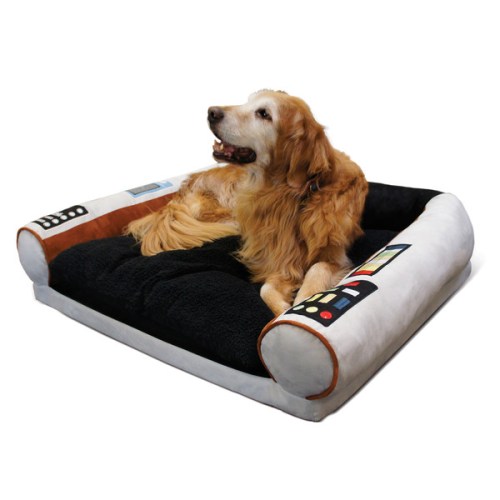
Star Trek Captain's Chair dog bed

The Captain’s Chair dog bed

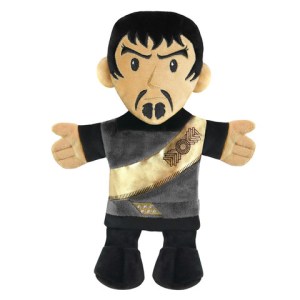
Klingon plush dog toy

The Klingon plush dog toy

Star Trek uniforms for dogs

Star Trek uniform dog t-shirts

And of course there are assorted themed collars, leashes, and toys…

So, if your dog is a Trekkie, then quicker than you can say “Beam Me Up” your dog can show it to all your friends.

(See www.thecoopshop.com for more product details)

Kathleen Crisley, specialist in dog massage, rehabilitation and nutrition/food therapy, Canine Catering Ltd, Christchurch, New Zealand

Izzy’s visit with Santa

I have made it a tradition that all my dogs get one official Christmas photograph.  Last year, Izzy had only been with me for about 6 weeks and was still adjusting to life as a pet.  I decided it was too soon for a visit with Santa.

This year is another story and so on Saturday, I took Izzy to a local ‘big retail’ pet store for a Santa photo.  I am glad we got there early and were first in line because the store was very cramped and with people rapidly lining up for photos, there was little room to move in the aisles.

Snarls and growls down the line were heard (often).

I think it is great that the store offered pet photos, but I think they could do more to welcome visitors by temporarily moving displays.  But, alas, let’s face it – Christmas is shopping season and no retailer will do this.

Izzy patiently waited her turn watching the photographer and his assistant, who were running late, set up.  And then she saw the cage of pet rats…she was very interested.

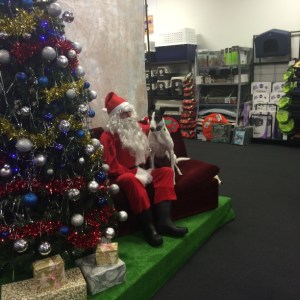
Izzy waiting for Santa

Izzy sees rats at the pet store

This is the unofficial photograph; we are expecting the official print portrait in a couple of days.   I’m looking forward to adding it to the family album.

Izzy the greyhound on Santa's knee

Kathleen Crisley, specialist in dog massage, rehabilitation and nutrition/food therapy, Canine Catering Ltd, Christchurch, New Zealand

Kids with dogs have less anxiety

A research team at Bassett Medical Center in New York has found that kids with a dog at home experience far less clinical anxiety than do children who are dog-less.

This small study adds to the growing body of knowledge about the human-animal bond and the positive health impacts of dog ownership.

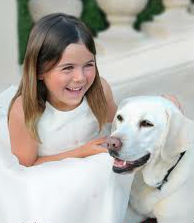
Child and dog

Read more about this study on NBC News.


Other blog posts about kids, dogs and health:

Kathleen Crisley, specialist in dog massage, rehabilitation and nutrition/food therapy, The Balanced Dog, Christchurch, New Zealand

Dogs evolved with climate change

World leaders are meeting right now in Paris to discuss climate change…but did you know that dogs evolved in part because of climate change?

A study of North American dog fossils as old as 40 million years suggests that the evolutionary path of whole groups of predators  – including dogs – can be a direct consequence of climate change.  The study has been published in the journal Nature Communications.

“It’s reinforcing the idea that predators may be as directly sensitive to climate and habitat as herbivores,” said Christine Janis, professor of ecology and evolutionary biology at Brown University, who worked with lead author Borja Figueirido, a former Brown Fulbright postdoctoral researcher who is now a professor at the Universidad de Málaga in Spain. “Although this seems logical, it hadn’t been demonstrated before.”

The climate in North America’s heartland back around 40 million years ago was warm and wooded. Dogs are native to North America. The species of the time, fossils show, were small animals that would have looked more like mongooses than any dogs alive today and were well-adapted to that habitat. Their forelimbs were not specialized for running, retaining the flexibility to grapple with whatever meal unwittingly walked by.

Early Dogs

Two early dogs, Hesperocyon, left and the later Sunkahetanka, were both ambush-style predators. As climate changes transformed their habitat, dogs evolved pursuit hunting styles and forelimb anatomy to match.
Image: Mauricio Anton

But beginning just a few million years later, the global climate began cooling considerably; the forests slowly gave way to open grasslands.

Pups of the plains

Did this transition affect the evolution of carnivores? To find out, Figueirido and the research team, including Jack Tseng of the American Museum of Natural History in New York, examined the elbows and teeth of 32 species of dogs spanning the period from ca. 40 million years ago to 2 million years ago. They saw clear patterns in those bones at the museum: At the same time that climate change was opening up the vegetation, dogs were evolving from ambushers to pursuit-pounce predators like modern coyotes or foxes — and ultimately to those dogged, follow-a-caribou-for-a-whole-day pursuers like wolves in the high latitudes.

“The elbow is a really good proxy for what carnivores are doing with their forelimbs, which tells their entire locomotion repertoire,” Janis said.

The telltale change in those elbows has to do with the structure of the base where the humerus articulates with the forearm, changing from one where the front paws could swivel (palms can be inward or down) for grabbing and wrestling prey to one with an always downward-facing structure specialized for endurance running. Modern cats still rely on ambush rather than the chase (cheetahs are the exception) and have the forelimbs to match, Janis said, but canines signed up for lengthier pursuits.

In addition, the dogs’ teeth trended toward greater durability, Figueirido’s team found, consistent perhaps with the need to chow down on prey that had been rolled around in the grit of the savannah, rather than a damp, leafy forest floor.

If predators evolved with climate change over the last 40 million years, the authors argue, then they likely will have to continue in response to the human-created climate change underway now. The new results could help predict the effects we are setting in motion.

“Now we’re looking into the future at anthropogenic changes,” Janis said.

Source:  Brown University media release

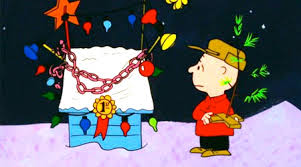
Doggy quote of the month for December

My own dog gone commercial

“My own dog…gone commercial. I can’t stand it!”

–  Charlie Brown, owner/guardian of Snoopy

Adjusting to the days and the seasons

We’ve had several very hot days this week (which my Northern Hemisphere readers may be jealous of).  For a responsible dog owner, this means being aware of the changes in temperatures and adjusting the care routine accordingly.

Whereas in the winter our early morning walks are something that we often endure with the deep winter darkness and chilling cold, now we get to stroll in moderate temperatures and enjoy sunrises like these:

Sunrise in Christchurch, New Zealand Early morning in Papanui

Of course, it’s also a season when Izzy has to stay home rather than visiting clients because the car is simply too hot for her.  If we needed any further reminder of the dangers, a dog had to be rescued from a car in Dunedin on Thursday.

So my advice is to be aware of your dog’s tolerances for both heat and cold (too many dogs are left outside in harsh winter climates, when they should be cared for with warmth and shelter).  It’s part of being a responsible dog owner.

Kathleen Crisley, specialist in dog massage, rehabilitation and nutrition/food therapy, Canine Catering Ltd, Christchurch, New Zealand


It’s just old age…

It happened again yesterday.

Someone asked me what I do for a living and I described my dog massage practice and how many of my clients are older dogs with varying degrees of arthritis and other orthopedic problems.

And then he said it.  “My friend has an old dog, he’s almost 10, and we’re pretty sure he’s got arthritis.  But then again, it’s just old age.

I tried to explain that there are many things we can do for dogs with arthritis which keeps them pain free and happy.  And because their pain is managed, they live longer.

Old Dog Buster

Buster, an older dog of 10+ is enjoying a new lease of life thanks to a combination of pain medication, massage, laser and weight loss

The message still wasn’t getting through…and then he described his friend’s dog:

  • he’s getting more aggressive; he even bit my friend one night when he went to feed him
  • he doesn’t run around much any more
  • he doesn’t come to greet me when I visit; he used to

I did my best to say that his friend needed to get his dog to a vet for an examination and that I would be too happy to see him for an assessment.  Behavior changes often occur when a dog is in pain.  And, just because the dog is older doesn’t mean the issue is arthritis.  We would need a working diagnosis from a qualified veterinarian.

He took my card; I hope his friend calls.  I can’t stand the thought of another dog who is in pain and doesn’t have to be.

It’s not about old age; it’s about the right care.

Kathleen Crisley, specialist in dog massage, rehabilitation and nutrition/food therapy, Canine Catering Ltd, Christchurch, New Zealand


Jingle and Bell for the holidays

Jingle and Bell are plush/soft toys sold by Hallmark.  This year, Hallmark is donating the sum of $100,000 to Best Friends Animal Society to support animal adoption.

Jingle and Bell

When these toys are purchased from a Hallmark Gold Crown store, Hallmark will include information about Best Friends to help spread the word about the no-kill movement and the benefits of adoption.

Corporate sponsorship in the right direction, I say.

Kathleen Crisley, specialist in dog massage, rehabilitation and nutrition/food therapy, Canine Catering Ltd, Christchurch, New Zealand