When his girlfriend Misty came to stay, I took Sox and Misty to Christchurch’s red zone for off-lead time.
In this video, the dogs run and play. Greyhounds love to run. In this video, both dogs are free to stop, change direction, dodge and weave as they see fit, and stop when they are ready. This greatly reduces the risk of injury and supports enrichment. It allows them to make choices, something that behaviourists call ‘agency.’
The definition of “to run” is “to move along, faster than walking.” The dogs choose to do this and for how often.
The definition of “to race” is “a competition between runners, horses, vehicles, etc. to see which is the fastest in covering a set course.”
Most dogs love to have a run and play, such as I explain in my post There’s a technical term for almost anything – the zoomie. To truly love to race, a sentient being, be it human or animal, must be able to opt into competition of their own free will, accept the risks associated with the race, and take pleasure in it.
Kathleen Crisley, Fear-Free certified professional and specialist in dog massage, rehabilitation and canine fitness, The Balanced Dog, Christchurch, New Zealand.
Tom Hayden was an activist, author and politician who served in both the California State Senate and the California State Assembly during his career.
He was the author of the Hayden Act to amend state law for companion animals. Dogs or cats impounded by public pounds or shelters could be killed after only 72 hours; when the Act came into effect in 1999, the minimum impound time expanded to 4-6 business days and required that the animal be released to a nonprofit animal rescue or adoption organization in certain circumstances.
However, some dogs bought during the coronavirus pandemic have high levels of problem behaviours, a new study from the Royal Veterinary College (RVC) suggests.
Just over 1,000 UK owners who bought their dogs during the first nine months of the pandemic responded to an online survey as part of the research. They were asked to identify problem behaviours they saw in their young dogs from a list of 24.
This included behaviours like jumping up, clinginess, aggression towards other dogs and fear around people and loud noises.
On average, owners said their dogs had five of the listed problem behaviours, while one in five said they had eight or more.
The three most common were pulling on the lead (67%), jumping up at people (57%) and not coming back when called (52%).
The study also estimates that almost a third of dogs had something called separation anxiety at 21 months. This is when dogs struggle to be away from their owners.
When asked about how they trained their dogs during the first 21 months of their lives, 96% of the owners who took part in the survey said they verbally praised their dogs.
However, 80% also reported using one or more punishment methods to get their dogs under control, like physically moving or pushing them, shouting at them, and yanking on their lead if they pulled. Vets say behaviours like this can increase fear and anxiety in pups.
Why is this a big deal?
Dr Rowena Packer, who is the lead author of the new RVC study, warned owners struggling with problem behaviour – combined with the current cost of living crisis – could lead to them “reaching the end of their tether” and giving up their dogs.
She said that in addition to the problematic behaviour recorded, some new owners struggled to know what was normal for dogs and what could be making behaviours worse through the use of “punishment-based training techniques.”
Dr Packer said that although these kinds of behaviours could be frustrating for owners, “they are often a sign a dog is struggling to cope or that they haven’t been taught an appropriate response in a situation, rather than dogs intentionally behaving ‘badly'”.
Robert Bays, who is the senior animal behaviour manager at the rescue charity Battersea, says proper support is needed to make sure lockdown dogs, many of which face unique challenges compared to other dogs, and their owners are given the help they require.
“At Battersea, we have seen a significant increase in the number of dogs coming to our centres with certain behavioural issues, such as separation anxiety, which can often be linked to the pandemic and the training challenges this unusual time presented.
“Without the right kind of positive training and support, a small behaviour problem in a puppy or dog can quickly escalate into a serious issue.”
It’s not often the dog but the person holding the leash who creates the conditions, often by neglect or abuse, for a dog to attack.
***This is a wonderful opinion piece by Marcela Garcia of The Boston Globe. The words are hers, but I agree entirely***
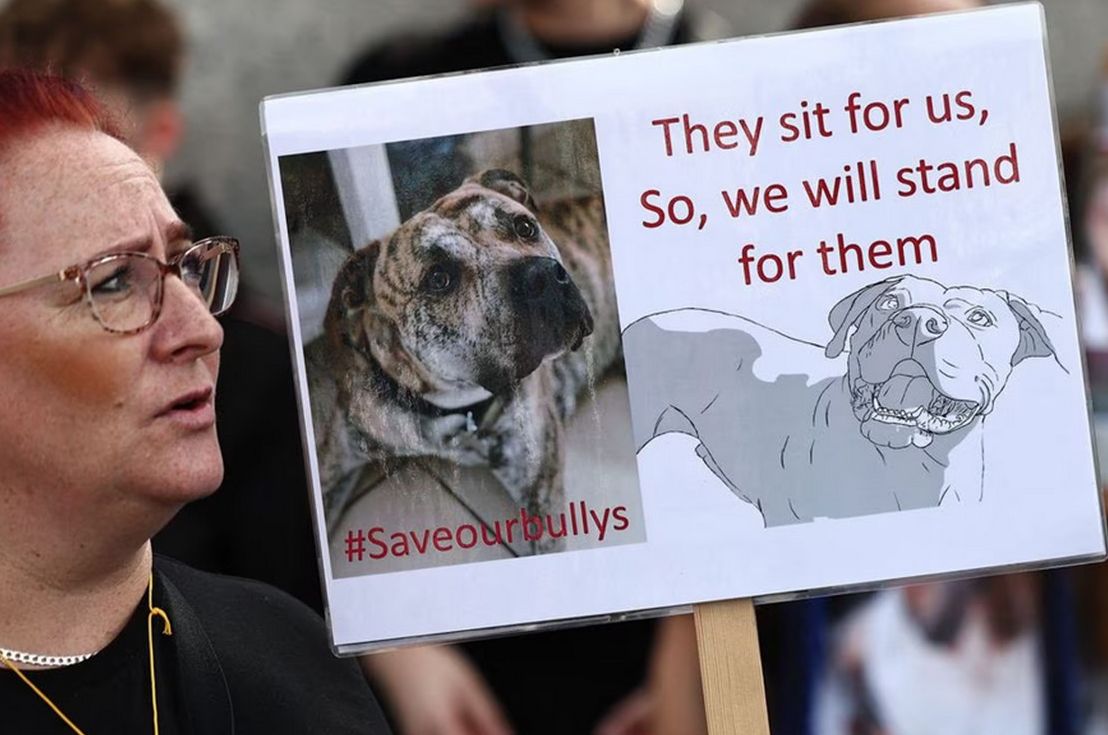
Supporters of the XL bully dog breed held placards during a protest against the UK government’s plans for the breed, in central London on Oct. 7.HENRY NICHOLLS/AFP via Getty Images
“They’re not dangerous if you raise them right. Neither are the dogs.”
Those lines are from a sign carried by one of the hundreds of demonstrators who recently took to the streets in London to protest Prime Minister Rishi Sunak’s proposed ban on the American XL bully.
Sunak’s measure came after a string of biting incidents, at least two of them fatal, involving canines believed to be American bully XL dogs, a relatively new breed. In one short but horrific incident caught on camera in Birmingham, England, an 11-year-old girl is attacked and bit by a dog.
But such a policy ignores the real cause behind aggressive and dangerous dogs. It’s not often the dog but the person holding the leash who creates the conditions, often by neglect or abuse, for a dog to attack. While it’s true that the American bully XL has a history of being used in dogfighting, the boxer, the shar-pei, the Boston terrier, and the English bull terrier also all have histories of fighting.
Kara Holmquist, director of advocacy at the Massachusetts Society for the Prevention of Cruelty to Animals, said in an interview that there are many factors that can come into play and compel a dog to bite — “how the dog is socialized, how the dog is managed, and whether it’s spayed or neutered plays a role. So when places enact policies that just look at breed, not only is it not fair, but it’s just not effective.” It’s making a blanket judgment on what a dog breed is perceived to be, she said. Nowadays it has become very difficult “to look at a dog and know or make a guess as to what type of breed it is.”
That’s why the MSPCA, Holmquist said, helped push for a law, passed in 2012, that prevents cities and towns from enacting dog breed bans. It was around the time that there was hysteria around pit bulls and Dobermans. But discrimination against certain dog breeds still occurs in some spaces, and the MSPCA is working to remove dog breed bans in housing policies.
“Responsible Massachusetts dog owners are often not welcome in certain housing markets, particularly if they own medium or large dogs, or certain dog breeds (or a dog that looks like one of these breeds),” read testimony presented jointly by animal rights advocates, including the MSPCA, during a hearing last month on a bill that would prevent some housing providers, such as condo associations and public housing, “from arbitrarily refusing responsible dog owners as tenants.” The organizations also noted that this “discrimination occurs in some publicly-funded housing, making this a particularly pernicious practice.” It makes it a housing equity issue, as well.
Massachusetts’ cities and towns do have the power to police specific dogs through the dangerous dog law, the purview of the animal control officer. “If there is a dog that is of concern that’s demonstrated some behavior that’s outlined in the law, there’s a process for addressing that through a dangerous dog hearing,” Holmquist said.
Meanwhile, it’s looking like there will be no such dog hearings for the American bully XL in England. Prime Minister Sunak has pledged to ban the dogs but, thankfully, existing ones will receive amnesty. The dogs, which can weigh over 130 pounds, have risen in popularity since the COVID-19 lockdowns, which saw dog ownership rise. Under Sunak’s plan, owners of those existing dogs will have to register them, as well as muzzle them in public places. They will also be required to neuter them in an attempt to eradicate the dog type within a decade.
What’s baffling is that the UK has evidence that banning breeds does not make the public safer. The country has in place a Dangerous Dogs Act, which was enacted more than three decades ago. It bans four breeds: the pit bull terrier, Japanese Tosa, Dogo Argentino, and Fila Brasileiro. Despite that, the number of dog bite incidents has gone up in the UK.
The English dog-owning community is not taking the proposal lying down, but it seems clear the British government has the authority to deem a breed dangerous and ban it. In the case of the American bully XL, it still isn’t officially recognized as a breed by the UK’s Kennel Club. So the breed needs to be declared a breed before it can be banned.
I’m still waiting for a ban on bad dog owners, because when you follow the trail leading to a terrible dog incident, often the owner’s treatment of the dog is to blame. The American bully XL may become extinct in Britain, but you can bet the country’s bad dog owners eventually will find another breed to mistreat. And sadly it, too, will be banned.
Evidence shows human and pet support services should be integrated to avoid people having to relinquish their pets in a time of crisis. Keeping them often results in better health outcomes for both the owner and animal.
Sonya McDowall with her dog, Dashii. Photo credit: La Trobe University
Sonya McDowall, a Ph.D. student presenting her research at the Big Hairy People & Pets Summit and Workshops held 10–14 October on the Gold Coast, wants policy makers to understand the documented positive outcomes when human support services work with animal support services.
“It’s cost-effective for the community, and people are healthier if they can keep their animals during a time of crisis,” Sonya McDowall said.
A 2020 survey by Domestic Violence NSW found that 42% of respondents said victim-survivors delayed leaving a perpetrator for over 12 months due to barriers to accessing support related to their animals.
A recent U.S. survey showed 91% of people had experienced some degree of financial stress in the past year related to the cost of pet care.
Even before the cost of living and rental market crisis, a study in the United States found between 35.1% and 42.1% of participants relinquished their pet due to moving as the landlord would not allow pets. (Source: Moving as a reason for pet relinquishment: a closer look)
Studies have shown that between 26% and 71% of female companion animal guardians experiencing family violence reported that the offender had seriously harmed or killed the companion animal.
18%–48% of domestic violence survivors have delayed entering a domestic violence shelter due to the presence of welfare concerns for their pet that they have had to leave behind. (Source)
Foodbank Australia hunger report 2022 highlighted that over half a million people in Australia are struggling with the cost of food; of this population 67% have pets. This has resulted in a challenge for pet owners of which studies have reported between 30% and 50% of participants identifying that having access to low-cost or free pet food would have prevented them from relinquishing their pet.
We treat dog walks as a chance to accomplish two (or three) things at once, leading our pooches around the neighborhood while gazing at our phones, chatting with a friend, listening to a podcast or pushing a stroller.
A dog walker checks his phone while guiding dogs on February 21, 2023, at Washington Park in Denver. Photo by: David Zalubowski/AP
The more ambitious among us even incorporate dogs into our exercise regimens, jogging or biking while our pets trot alongside.
It’s understandable. In today’s overscheduled world, this kind of multitasking can feel extra productive. And walking a dog twice a day around the same streets can get boring.
But animal behaviorists say that at best, dog walkers who aren’t paying full attention can confuse or frustrate dogs by giving them conflicting signals. And at worst, they can endanger the dog’s safety — and their own as well.
“It’s kind of like the dog-walking equivalent of distracted driving,” says Leslie Sinn, a board-certified veterinary behaviorist in Ashburn, Virginia. “You’re not paying attention to the signs that your dog is uncomfortable … and if you’re missing all those clues because your head is elsewhere, that’s a problem.”
Dogs can gobble something harmful when you’re not looking
Matt Semrad is an avid reader and devours audiobooks from the library — about one a week. He also spends several hours each day walking his two black doodles, Sirius and Sonny.
So to maximize his reading time, the suburban Atlanta resident listens to books on his dog walks.
“I would be bored just walking the dogs,” he says.
Semrad says he doesn’t worry much about his dogs’ well-being on walks because they’re well-behaved and he watches them closely when they pass other dogs on the street.
Other dog walkers may not be as vigilant. CNN spoke to a handful of animal behaviorists who say they routinely see people walking dogs in their neighborhoods who are on their phones or pushing strollers and appear to be largely ignoring their pets.
This can pose a safety problem for several reasons, dog experts say. Research has shown that only a small percentage of people can multitask effectively. Distracted dog walkers may not notice potential threats: bicyclists, joggers, cars or unleashed dogs, experts say. By the time a person looks up from their phone, their pet could be in an altercation with another dog — or worse.
“You need to be alert at all times,” says Jacob Hollier, founder of Crate Escape, a dog-walking and pet-sitting service based in Atlanta. “If there’s a car out of control or a scooter coming on the sidewalk … at any given moment, it could be dangerous and possibly be fatal.”
Hollier says he requires his employees to stay off their phones while walking dogs — except to snap photos of the dogs to send to their owners.
“I work with an 180-pound Great Dane, and I have to be watching him at all times,” he says. “He’s bigger than me.”
It’s not just the dogs that are at risk. Experts say they have seen distracted dog walkers injure themselves tripping over sidewalks or even their own dogs. One study found that humans’ injuries while dog walking increased more than fourfold from 2001 to 2020.
Also, dogs are notorious for eating stuff that’s bad for them, experts say.
“If you aren’t paying attention, dogs can pick up and eat things QUICKLY — chicken bones, cigarette butts, dead/poisoned rats, etc.,” says Amy L. Pike, a board-certified veterinary behaviorist in Fairfax, Virginia.
“If you didn’t see it, you won’t know to take them into the vet. Or if you do take them in because they are sick, you won’t know what they ingested, which helps your vet treat them.”
Distracted dog walkers can affect pets’ mental health, too
Physical safety is the most urgent concern, but distracted dog walking also can be detrimental to a dog’s behavioral training and even mental health, experts say.
A multitasking dog owner may be missing an opportunity to reinforce basic training — sit, come, stay and other commands — in a practical setting, says animal behaviorist Mary R. Burch, director of the American Kennel Club’s Family Dog program.
Someone buried in their phone also may not notice when their dog becomes agitated or shows signs of fatigue or an injury.
“Your dog ‘speaks’ primarily with their non-verbal body language,” Pike says. “If you aren’t paying enough attention to what they are ‘saying,’ you won’t know how your dog feels.”
Walks are about more than physical exercise for dogs — they offer mental benefits as well, says Valli Parthasarathy, a board-certified veterinary behaviorist at Synergy Veterinary Behavior in Portland, Oregon. Parthasarathy says dogs like structure and consistency on their walks.
If their owner is just marching forward or not paying full attention, the dog could become confused by conflicting signals — for example, being allowed to sniff one bush but jerked away from sniffing another.
Dogs experience much of the world through their nose, and can become frustrated if they’re not allowed some latitude to explore, Parthasarathy says.
“My ideal walk for a dog is one where they have a lot of time to sniff and take in their environment,” she says. “They have their own doggy priorities. Using the nose is their enrichment … it’s like they’re reading the news.”
Parthasarathy says she’s even seen oblivious dog owners yank on the leash while their dog was in the middle of peeing.
A distracted walker also may be missing an opportunity to bond with their dog, says Burch of the American Kennel Club. “Interacting and having fun together forms a bond that can last a lifetime,” she says.
Some dog owners try to multitask during walks without sacrificing their animal’s wellbeing. Teddy Thomas of suburban Atlanta likes to listen to music or audiobooks on his walks with Stella, a tan-colored rescue mix.
“I don’t feel like I look at my phone all that much while I’m walking her,” he says. “I’d say she has most of my attention — maybe not 100% of it, but enough to keep us both safe.”
Parthasarathy says she understands why some people multitask while walking their dogs. Some overworked parents can’t leave their kids behind during dog walks, so they bring the kids along. Other parents don’t have time for separate outings each day.
“Everyone’s trying the best that they can,” she says. “But going for a walk with your dog should be about building that relationship and focusing on what your dog needs. That may be the only time he gets out of the house that day.”
If you have reached the bottom of this article – congratulations and thank you. I had to share it because the reporter has done a good job of seeking commentary from a number of experts and in a range of contexts.
In my practice, I employ a standard intake questionnaire which includes behavioural questions and observations by owners. The more you observe, the better information we have to adjust your dog’s programme and to understand what is going on with your dog in the first place. I often ask owners to record their observations which helps us discern trends.
The dog trainers I work alongside often ask for recorded observations, too.
If you use a dog walker, you can ask them to observe your dog but remember that most walkers undertake group walks and have many dogs to look after. Please take the time to walk with your dog (without multitasking) to enhance your bond and to watch them!
Kathleen Crisley, Fear-Free certified professional and specialist in dog massage, rehabilitation and nutrition/food therapy, The Balanced Dog, Christchurch, New Zealand
In May, a smaller report from NZ’s Racing Integrity Board (RIB) was released.
The Supplementary Report (dated March 2023) was written at the request of the Minister of Racing. Whereas the December report talks at great lengths about all the things that would have to happen to reform the industry, the bulky report didn’t say much about options for closing down the industry.
The request of the RIB to report on options for closure was done with the express request to keep it confidential. That is, the Board could not talk with anyone working in animal welfare, or from within the industry, about how to manage closure. The report relies entirely on publicly available material from other countries with the understanding that a more detailed strategy and plan are needed.
The RIB is probably not the body that should be in charge of a closure plan, but they’ve come up with a long list of references. Had the Minister bothered to read submissions from previous reviews, he would have seen that people like me cautioned that a planned and phased closure are needed to preserve the rights and welfare of the hounds.
Such is the case, for example, with the State of Florida.
In 2018, 70% of Florida voters approved a ban on greyhound racing with an effective date of January 2021. The phase-out period was two years. The racing industry in Florida blacklisted adoption groups that had supported the industry’s closure; only adoption groups that were neutral or pro-racing were allowed to receive dogs for adoption. Nonetheless,‘it was reported that there are more willing adopters than dogs coming off the tracks.’
The Supplementary Report summarises the pros and cons of a shorter transition period vs a longer one for an industry closure. Those summaries are copied here:
Let’s face it, both options have their benefits and the risks will have to be managed. No one who truly cares about the dogs wants to see greyhounds over-raced and their welfare otherwise compromised. The RIB has already acknowledged in its longer report that progress towards animal welfare goals is only accomplished under strict supervision and watchful monitoring of the industry.
A closure of the industry will be no different.
This report is a start, but what NZ really needs is the leadership to make a decision on greyhound racing. If that leadership doesn’t eventuate, then a binding referendum will be needed and sooner rather than later.
Meanwhile, who looks after the dogs?
Kathleen Crisley, Fear-Free certified professional and specialist in dog massage, rehabilitation and nutrition/food therapy, The Balanced Dog, Christchurch, New Zealand
On 23 May 2023, MP Kieran McAnulty released a report about greyhound racing that was dated December 2022. Authored by the Racing Integrity Board (RIB), this report is 175 pages long.
There have already been three (3) reports, all reviews, of the NZ greyhound racing industry, in 2013, 2017 and 2021. All have included substantive lists of shortcomings in the industry with issues for improving the welfare of greyhounds. This latest report was to have been the final report – the industry was ‘put on notice’ that it should improve and given one year – until the end of 2022 – to do so.
Since I’m writing this blog in June 2023, I figure you can guess that government has failed to act on its promise; even the delay of five months in releasing the report is suspect in terms of who is committed to animal welfare.
I used to work for local and central government agencies in my earlier working life. Whenever a report is long, it is usually because the writers do not want to be the bearers of bad news and so wade through every possible detail to hide the glaringly obvious. Such is the case with this report.
Please bear in mind that the Racing Integrity Board’s purpose is: Promote and ensure the racing industry complies with high standards of animal welfare, integrity and professionalism for the benefit of the public, participants and racing industry
Let me repeat that – high standards, integrity and professionalism…
Key points (direct quotes from the report):
There remains much to do
The industry has a way to go to convince stakeholders that animal welfare is the overriding imperative
Race day injuries have been a long-standing concern. The injury reduction strategy has not yet delivered improved outcomes.
Progress on track standards has been slow. Track assessments were completed but did not always result in timely remediation. This leads to the inevitable conclusion that greyhounds could have been injured unnecessarily.
Adoption of the Greyhound Australasia rules was a significant undertaking, underestimated by GRNZ (Greyhound Racing NZ).
The RIB is confident progress would not have been achieved to the extent it has without the work programme in combination with close monitoring.
A broader range of greyhound registration process issues remain unresolved and are affecting traceability.
Implement education programmes that ensure all licensed persons understand their obligations under the standards, rules and policies. This is a long-standing issue, for which progress remains slow.
Should the industry continue, a high degree of monitoring will be essential.
If the RIB is asked to continue its role in the implementation and monitoring of a future work programme, there will be cost implications not currently budgeted
Inevitably there will be cost implications for the industry if greyhound racing is to continue based on a revised work programme.
If you’re reading this and wonder what’s next for NZ’s greyhounds, please ensure you focus on the last few bullet points above. If racing is allowed to continue, progress is unlikely to be achieved without close monitoring for which the RIB does not have the budget and resources to undertake. No one else in NZ is resourced to do this either, and the industry itself will face costs to improve.
What’s the odds of these things happening given NZ’s current economic situation and with the lack of leadership?
But wait, there’s more! The RIB has issued a supplementary report, another 31 pages, this time dated March 2022. I’ll cover that report in a future blog.
Kathleen Crisley, Fear-Free certified professional and specialist in dog massage, rehabilitation and nutrition/food therapy, The Balanced Dog, Christchurch, New Zealand
Following up on my previous post, the Minister for Racing, Kieran McAnulty, has responded about his report to Cabinet and release of the Racing Integrity Board report:
“The ongoing improvement of greyhound welfare remains a priority for this Government. That is why the previous Minister for Racing, Hon Grant Robertson, initiated the Robertson Review into Greyhound Racing. It is also why, following the conclusion of the Review in July 2021, the industry was put on notice to make improvements.
I received the final report from the Racing Industry Board (RIB) on the greyhound industry’s progress in December 2022. This report will form the basis of my recommendation to Cabinet on the future of the industry, alongside consultation with the industry and animal welfare groups. The report will not be released publicly until it has been duly considered by Cabinet.
I had intended to present my findings to Cabinet in February 2023. However, this year’s significant weather events have made it necessary for the Government to deal with more pressing issues, and as such the greyhound paper has been delayed but will be presented at the first opportunity. I’d like to get it started and I acknowledge this uncertainty may be causing anxiety and intend to release a statement and contact key stakeholders within the next week to provide an update on next steps.“
I am looking forward to hearing about what the Minister’s next steps will be.
Kathleen Crisley, Fear-Free certified professional and specialist in dog massage, rehabilitation and nutrition/food therapy, The Balanced Dog, Christchurch, New Zealand










 DoggyMom.com