Tag Archives: racing

Greyhound racing says it’s transparent, so we used AI to check – dog by dog

When an industry publishes its own welfare data, how can anyone check it? We built AI agents to go through the public records on fatalities in greyhound racing and found a rising death rate

By Dr Mia Cobb and Dr Simon Coghlan, University of Melbourne

When we saw data published by a greyhound racing regulator in the UK, something about the dogs didn’t add up.

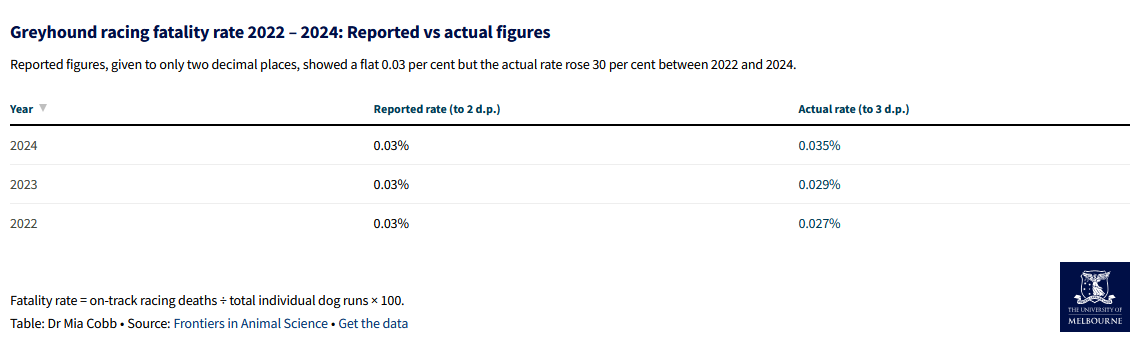
According to their report, the rate of dog deaths in races from 2022 to 2024 was stable. However, that number had actually risen from 99 to 123, while the number of races had fallen over the same period.
The maths was not mathing.

The fatality rate (which is calculated as the number of dogs that died on the track while racing, divided by the total number of individual dog runs, multiplied by 100 to express it as a percentage) was presented as 0.03 per cent across three consecutive years.

But when we ran the sums and reported them to an extra decimal place, we saw the fatality rate had risen by 30 per cent.

By reporting this information to only two decimal places, the increase in dogs dying in races was masked.

So, when an industry that relies on animals publishes welfare data, how can the public – or the policymakers making decisions about that industry’s future – know if the headline figures portray the real situation?

In the UK, there is a regulated industry with public-facing records, a governing body that publishes welfare data and a long-running debate about whether that data tells the full story.

For researchers interested in animal welfare, the UK greyhound industry also presents a genuine test case for a new method.

In fact, the question we wanted to answer was not specific to greyhound racing, it was broader.

When welfare-relevant information exists across multiple public sources but has never been systematically assembled, can AI agents do that work reliably, ethically, transparently and at scale? If so, what can we learn that the industry’s reporting doesn’t tell us?

Building our greyhound data set

The Greyhound Board of Great Britain (GBGB) is the governing body that licenses and regulates commercial greyhound racing in the UK.
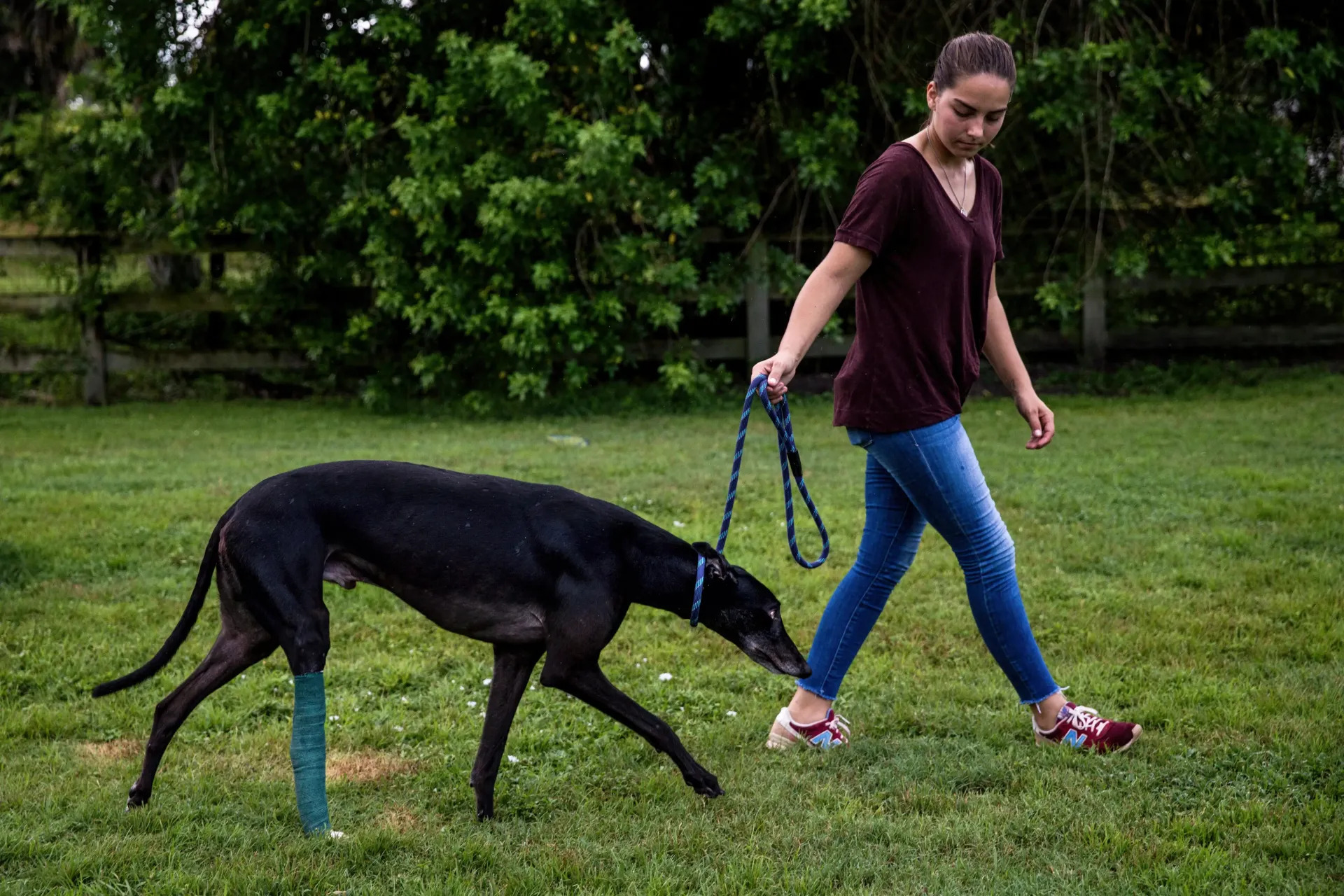
Falls affect one in six racing greyhounds. Picture: Getty Images

It holds detailed records on every dog registered there, including country of origin, racing history, injuries, destination when racing ends and reason for leaving racing.

While some of this information is publicly visible, a good deal of it is not.

We made six requests for access to GBGB data, but none gave us access to the data we needed. We were told that most of what we wanted was already on their website. It wasn’t – at least not in any form that allowed independent analysis.

So, we built the dataset ourselves.

Using AI agents – software that performs repetitive tasks under continuous human supervision – we pulled together information from several public websites to uncover animal welfare insights for 31,028 greyhounds that raced in licensed UK competitions. 

That’s around 1.27 million race starts across 22 licensed tracks between January 2022 and March 2026.

We gathered data from five public registries, and by cross-referencing these sources, we were able to get a relatively complete view of the whole population, not just a sample.

Thanks to the AI agents, what would have taken months of manual research was completed in days.

What the data tells us about greyhound racing

As we went through the data, we began to see things that the industry’s transparency has not previously revealed.

The typical greyhound’s racing career is 30 starts over 11.9 months. Most dogs race for less than a year.

More than 85 per cent of greyhounds racing in the UK were bred in Ireland.
The typical greyhound’s racing career is 30 starts over 11.9 months. Picture: Getty Images

This matters because dog breeding and rearing in Ireland falls outside the jurisdiction of the British system which is later responsible for their welfare.

One in four racing dogs – around 24 per cent – experienced at least one adverse event (including injuries or fatalities) during our observation period, with falls affecting one in six dogs.

These ‘adverse events’ are recorded by track officials at the race but have not been made available to the public at a track level, even when the Scottish and Welsh parliamentary committees asked for it.

The GBGB publishes one annual list of aggregated injury figures that covers all licensed tracks.

This has meant that the public, researchers, regulators and even greyhound trainers have not been able to independently check whether conditions at one track carry greater risk.

Our data finds that some tracks are five times more likely to result in adverse events for dogs than other venues.

Where our trail goes cold

Of the 31,028 dogs in our dataset, 73 per cent had left GBGB-regulated racing by the end of March 2026.

The GBGB publishes an aggregate of annual figures on retirement destinations. It reported that 94 per cent of dogs leaving the industry in 2024 were rehomed or ‘retained by trainers’.

But, importantly, the wellbeing of these dogs cannot be independently verified because it falls outside the registered racing regulations.
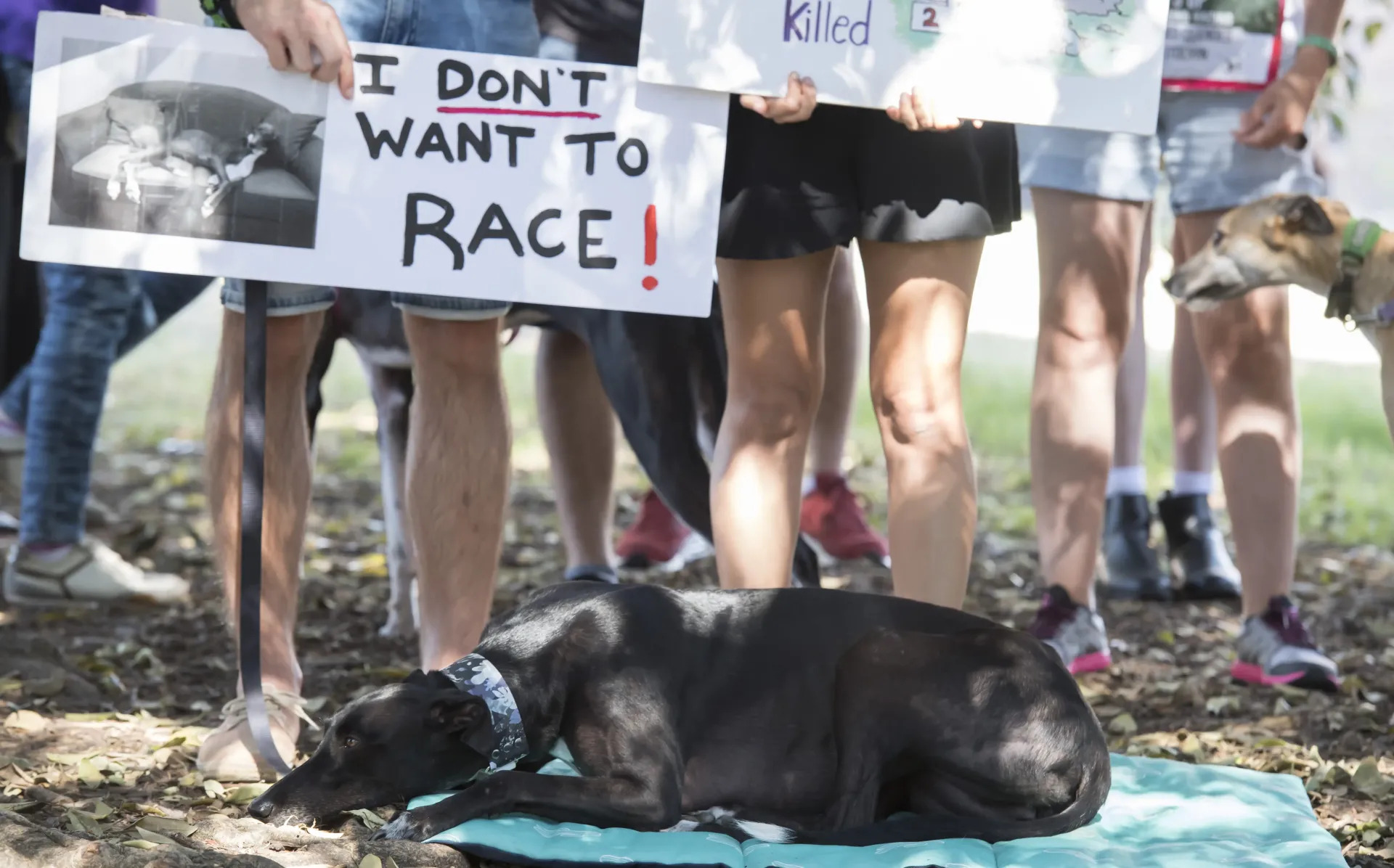
Over the last year, parliaments in New Zealand, Wales and Scotland have all decided to ban greyhound racing. Picture: Getty Images

Why this matters beyond greyhounds

An industry’s social license to operate depends on public trust. In an era of growing concern for animal welfare, that trust will increasingly require verifiable evidence.

The GBGB is not unusual in its approach to information disclosure.

Across animal-reliant industries, data tends to flow inward to self-governing bodies, and is only released outward in tightly controlled formats.

Independent researchers like us face fragmented public registries, opaque systems and, when we ask directly, deflection or refusal.

What our study shows is that technology can sometimes help overcome this information imbalance. AI agents, applied carefully and with human oversight, can compile population-level welfare datasets from publicly accessible sources, at a scale and speed that makes independent scrutiny genuinely and ethically feasible.

It does not give us the data the GBGB holds privately. Nothing can do that, short of the governing body releasing it.

Over the last year, parliaments in New Zealand, Wales and Scotland have all decided to ban greyhound racing.  

Here in Australia, Tasmania may follow. Western Australia is mid-way through a formal inquiry. South Australia’s greyhound racing industry faces a government-imposed reform deadline in July 2026.

In each of these places, the same question is being asked: how do we know the welfare assurance offered by the industry is real?

For the first time, we can describe the dogs racing in the UK in detail. It’s making these animals visible.
How do we know the welfare assurance offered by the industry is real? Picture: Waggles Photography

We know things we didn’t know before.

More than half of the greyhounds are black. There are as many females as males. Most of them are bred in Ireland. They start racing at around 21 months. And within a year of their first race, most have disappeared from public view.

Whether this visibility is used to hold the industry to account is a separate question.

Source: This article was first published on Pursuit. Read the original article.

The article has been republished on this blog thanks to a Creative Commons Attribution No Derivatives 4.0 International license

The ban on greyhound racing in New Zealand

It has taken me a couple of days to gather my thoughts about the Government’s announcement to ban greyhound racing.  A 20-month notice period has been given to enable the industry to wind down and to find homes for the estimated 2,900 greyhounds in its care.

The ban is a decision that has been long in coming.   There has been an abundance of evidence to show the negative animal welfare implications of an industry that relies on the use of these dogs solely for the purpose of providing entertainment.

I support the decision to ban the industry out of concerns for animal welfare.  Here’s why.


Over the last two days I have seen comments from people who take a very strategic definition of animal welfare.  For example, the claims that the industry has been brought down by a few bad players.  These would be the trainers that abuse their dogs, use aversive training methods, and perhaps even drug them with meth or other substances.

In other words, these claims would have you believe that the only animal welfare concerns about the industry are largely off-track.  They are not.

The primary animal welfare concern is on the track for all to see.

The act of commercial greyhound racing requires that the dogs be trained to get very excited and use their sighthound instincts to chase the moving lure and run like hell to get to it.  Because they are dogs, they don’t have a sense of self-preservation.  They run, and run hard.[1] 

Photo sourced from Greyhound Racing NZ

In the process of running, a greyhound will often have all four paws off the ground.

Now imagine when another greyhound involved in the chase runs into that other greyhound because they are running in a tight pack.  It’s a high-speed crash.  And one, may I add, with no safety equipment. No air bags, no steel body of a car to protect them.  Nothing.

These crashes lead to horrific injuries and are the ones that most commonly reach the news outlets when the dog is so severely injured that racetrack euthanasia is required.

There are others.

Bruising, hock (tarsus) fractures, concussions and muscle tears are common injuries that I have encountered as I have read through the health histories of ex-racers, which often have to be pieced together using the racing steward notes.  Note: I don’t work at the race track – the greyhounds I work with are all ex-racers whose adoptive families seek out my help.

A dog can be injured many times in their career before they are retired from racing.   They may be rested for as little as three days as evidenced in the racing records.  They are back racing as soon as possible. 

The industry responded to criticism of injuries by creating a Rehab to Rehome (R to R) programme.  On the face of it, it sounds kind.  A dog breaks a hock, or has a leg amputated, and they are put through rehabilitation so they can find a home where the adopter can assume responsibility for their ongoing care and the inevitable conditions like arthritis that they will present with.

The fact that the industry needs a rehabilitation programme shows that it accepts injuries as a normal part of operations.  Yes, the R to R dogs can go on to have a good pet life – but is it really acceptable to hurt them so badly in the first place?

(It is said that the trainers love their dogs. I just don’t understand the kind of love that enables you to kiss the dog on the head as you load it into the start boxes knowing that within seconds it may be severely maimed or killed.)

And now for the bad players

In the 15 years I have been in practice, I have seen the evidence of the bad players in the industry. 

These include:

  • A greyhound surrendered by his trainer with injuries from a mauling; no vet treatment was sought.  His foreleg was frozen with scar tissue so he was unable to use it properly
  • A small female greyhound who tested positive for steroids which likely caused her malformed genitalia that pre-disposed her to urinary tract infections
  • A greyhound who was deaf from neglect; her ear passages were so severely scarred from untreated ear infections that she lost her hearing
  • A greyhound who came from a large breeder well-known for the poor living conditions of his dogs.  She had to be wormed numerous times because her worm burden was so high.

In short, I have seen too much. 

I accept that there are good players in the industry; I’m pretty sure every industry will have good players and bad ones.  Back in the Dickensian times when child labour was an accepted practice, I’m sure that there were factory owners who were nicer than others.  In time, however, society realised it wasn’t right to place children in harm’s way for profit and introduced child labour laws.

Are you seeing a theme yet?

I might add here that when greyhounds were raced at Addington last summer in 30+ degree heat, was it only the dogs of the bad players who were raced?  I doubt it.

The human cost of closure

At this point, I would like to acknowledge that Greyhound Racing NZ says that 1,054 people are employed by the industry.  Having lost my job several times during my career, I know how stressful redundancy can be. 

If you love your job, being forced to give up what you love is a tough pill to swallow.

However, these job losses must also be put into context.  Radio New Zealand has updated the total loss of jobs this year in the public sector alone to be 7,000 and companies across New Zealand have also laid off staff due to tough economic conditions.  None of these people were given a 20-month notice period when they could continue to earn income and look for work.  Today, most staff made redundant get about a month’s notice – maybe three if they are lucky. 

Numerous reviews and promises – why a surprise?

The industry has been the subject of numerous reviews with a litany of animal welfare problems.  I’m not going to go through all three reports in this post but quote only from the most recent one, released in May 2023:

  • There remains much to do
  • The industry has a way to go to convince stakeholders that animal welfare is the overriding imperative
  • Race day injuries have been a long-standing concern. The injury reduction strategy has not yet delivered improved outcomes.
  • Progress on track standards has been slow. Track assessments were completed but did not always result in timely remediation. This leads to the inevitable conclusion that greyhounds could have been injured unnecessarily.
  • Adoption of the Greyhound Australasia rules was a significant undertaking, underestimated by GRNZ (Greyhound Racing NZ).
  • The Racing Integrity Board (RIB) is confident progress would not have been achieved to the extent it has without the work programme in combination with close monitoring.
  • A broader range of greyhound registration process issues remain unresolved and are affecting traceability.
  • Implement education programmes that ensure all licensed persons understand their obligations under the standards, rules and policies. This is a long-standing issue, for which progress remains slow.
  • Should the industry continue, a high degree of monitoring will be essential.
  • If the RIB is asked to continue its role in the implementation and monitoring of a future work programme, there will be cost implications not currently budgeted
  • Inevitably there will be cost implications for the industry if greyhound racing is to continue based on a revised work programme.

I think we are all guilty of misleading ourselves at one time or another.  In terms of the greyhound racing industry, it seems to be the workplace culture. 

Scroll through the news feed about the industry and there have been consistent claims of making progress.  The industry has survived and been allowed to continue after so many damning reviews.  With a change in government late last year, and a Minister of Racing who was widely regarded as a racing supporter, they must have thought they were home free.

Politics can be a bitch.

Our current Government, one year into its term, has had its share of bad publicity.  We’ve made worldwide headlines with the introduction of the Treaty Principles Bill, for example, while teenagers from boot camps have absconded.  Heading into the Christmas break, this Government needed a win – something that most of the public would feel good about.  (Surveys have shown that up to 75% of the NZ public would vote to ban the sport.)

In my opinion, that’s why Winston Peters decided it was time to pull the plug.  I never expected him to do it and I’m sure that was the opinion of the industry, too.  Winston, however, is a shrewd politician.

It’s rare for animals to come out the winners of any political maneuver.  I’ll take the win.

RIP Diamond Roman

It should not be lost on anyone that hours after the ban was announced, on a Southland racing track, a greyhound named Diamond Roman was severely injured.  The race report states that the greyhound was, “checked and fell into bend. Referred to the veterinarian and reported to have a compound fracture of right tibia/fibula which was severely comminuted[2] and displaced. Due to the catastrophic nature of this injury the greyhound was euthanised on humane grounds.”

Anyone still think there isn’t an animal welfare problem with greyhound racing?


[1] A racing greyhound, according to Greyhound Racing NZ, runs at a pace of 17 m per second, reaching speeds of up to 60 kilometres per hour.  https://www.grnz.co.nz/greyhounds.aspx

[2] A comminuted fracture is caused by severe trauma resulting in a bone broken in at least 2 places.

Kathleen Crisley, is Fear-Free certified dog massage therapist and canine fitness trainer. She has a particular passion for working with dogs and their families to ensure injury prevention and quality of life. She specialises in working with anxious and emotionally damaged dogs. Her mobile practice, The Balanced Dog, is based in Christchurch, New Zealand. She has never worked for the greyhound racing industry.

Doing what they love

When his girlfriend Misty came to stay, I took Sox and Misty to Christchurch’s red zone for off-lead time.

In this video, the dogs run and play. Greyhounds love to run. In this video, both dogs are free to stop, change direction, dodge and weave as they see fit, and stop when they are ready. This greatly reduces the risk of injury and supports enrichment. It allows them to make choices, something that behaviourists call ‘agency.’

The definition of “to run” is “to move along, faster than walking.” The dogs choose to do this and for how often.

The definition of “to race” is “a competition between runners, horses, vehicles, etc. to see which is the fastest in covering a set course.”

Most dogs love to have a run and play, such as I explain in my post There’s a technical term for almost anything – the zoomie. To truly love to race, a sentient being, be it human or animal, must be able to opt into competition of their own free will, accept the risks associated with the race, and take pleasure in it.

Kathleen Crisley, Fear-Free certified professional and specialist in dog massage, rehabilitation and canine fitness,  The Balanced Dog, Christchurch, New Zealand.

Izzy’s racing career

Izzy is a retired racing greyhound.  She won 6 races over the course of her 2  1/2-year, 74 race career.

As a salute to my ‘little winner’ who is now a much-loved pet and helper in massage classes, here is a montage of the finish lines at her races and one photo of her in her preferred career…

Izzy winning on 10 Dec 2010Izzy winning on 25 May 2011Izzy winning on 1 Jun 2011Izzy winning on 3 Aug 2011Izzy winning on 7 Nov 2012Izzy winning on 19 Dec 2012

IMG_1237

Kathleen Crisley, specialist in dog massage, rehabilitation and nutrition/food therapy, The Balanced Dog Ltd, Christchurch, New Zealand

National Greyhound Adoption Month

April is National Greyhound Adoption Month in the USA.

Although Greyhound racing is increasingly banned in many parts of the country, breeders continue to produce large numbers of the dogs for the racing industry.  And when these dogs are too old to race, or not good earners at the track, their days are numbered…

Murray is a Greyhound currently up for adoption through Greyhounds as Pets

Murray is a Greyhound currently up for adoption through Greyhounds as Pets

Greyhound rescue groups around the globe need more adoptive homes for retired racing Greyhounds.  And they are prepared to get creative in their promotions.  Here’s a great ad from The Greyhound Project:

In New Zealand, a petition has been presented to the Green Party in Parliament to investigate the Greyhound industry.  Read about that initiative in my earlier (January 2013) posting.

If you are interested in adopting a Greyhound, please do some homework about whether this breed is for you.  Rescue groups are interested in finding forever homes for these beautiful dogs and have lots of information to help you make a decision.

SOME GREYHOUND TRIVIA

  • The greyhound is the only dog mentioned by name in the Bible. King James Version, Proverbs, 30:29-31
  • Greyhounds can reach speeds of 45 miles(72km) per hour
  • Greyhounds became the first European dog in the New World when they accompanied Christopher Columbus on his second expedition, which set sail from Spain in September 1493

Racing dogs wear leggings to prevent injuries

Sled dogs are appearing this season wearing a spandex legging that extends from ankle to shoulder, according to a new article in the Anchorage Daily News.

The leggings protect against “chicken leg” which is a problem when snow builds up on the back of the leg and balls up, eventually pulling the fur out, leaving raw spots that are prone to infection.

Dogs competing in the Yukon Quest International Sled Dog Race are amongst the first wearing the new invention, which has received praise from the head veterinarian in the competition.

Isn’t it great to see new products coming on the market that help dogs?