Category Archives: dog breeds

A new use for Border Collies

Researchers from Central Michigan University presented their research at the annual meeting of the American Society for Microbiology this week.

They’ve found that Border Collies are effective at reducing seagull congregation on recreational beaches, resulting in lower E. coli abundance in the sand

A Border Collie on beach patrol, photo by Elizabeth Alm

A Border Collie on beach patrol, photo by Elizabeth Alm

Gull droppings may be one source of the indicator bacterium Escherichia coli to beach water, which can lead to swim advisories and beach closings. In addition, gull droppings may contain bacteria with the potential to cause human disease, according to Elizabeth Alm, one of the researchers on the study.

At the beginning of the summer, 200-meter sections of beach were arbitrarily assigned to be dog-treated beaches or control beaches. Half way through the summer, the beach sections were swapped, so that dogs were moved to the control beaches and the dog-treated beaches were then left to be untreated controls.

During the summers of 2012 and 2013, researchers recorded the number of gulls at each beach section. Once each week samples of beach water and beach sand were collected and the numbers of E. coli in the samples counted. In early summer, samples from beaches where dogs had excluded gulls had significantly lower E. coli counts compared to control beaches.

“Border collies are intelligent dogs that love to work and could be used by beach managers as part of a comprehensive management strategy to reduce bacterial contamination at public beaches,” said Alm.

Source:  American Society for Microbiology media release
 

Albino Dobermans

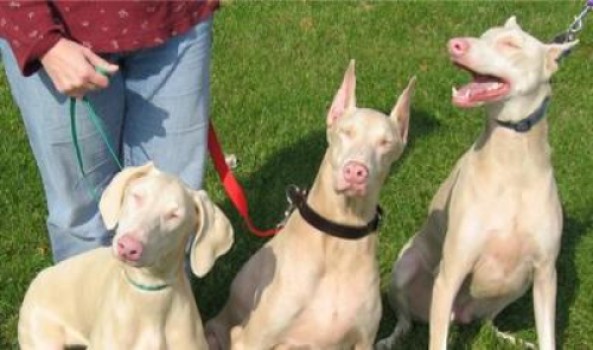
Michigan State University researchers have identified a genetic mutation in Doberman pinschers that causes albinism in the breed, a discovery that has eluded veterinarians and breeders worldwide up until now.

Michigan State University photo

Michigan State University photo

Paige Winkler, a doctoral student at the College of Veterinary Medicine, says that the researchers found a gene mutation that results in a missing protein responsible for the pigmentation of cells.

Albino Dobermans possess a pink nose, white or very light colored coats, and pale irises in the eyes.  These characteristics are similar to human albinos who have light skin, eye discoloration and often experience visual problems.

Like human albinos, the albino Dobermans are sensitive to light and have an increased risk of skin tumors.

Winkler says that this discovery will help Doberman breeders in the future where breeding lines carrying the defective gene can be identified.

Source:  Michigan State University media statement

Golden Retrievers Bring Joy, Healing to Boston

The Golden Retriever comfort dogs are returning to Boston, one year on…great story!

See last year’s story in this blog post:  Luther and Ruthie go to Boston

If a pit bull could talk

Pit bull poster

DoggyMom.com and Canine Catering do not support breed specific legislation in any form!

The facts about pit bulls

The facts about pit bullsSource:  National Geographic

Image

Wordless Wednesday, part 23

German Shepherd in Snow

Your dog may have a permanent headache

Through selective breeding, toy breeds including the Griffon Bruxellois, Cavalier King Charles Spaniels, Chihuahuas and their crosses may have to live with a permanent headache and other maladies.

A Griffon Bruxellois Photo by © Vincent / Fotolia

A Griffon Bruxellois
Photo by © Vincent / Fotolia

Research published in the journal PloS One by researchers at the University of Surrey has identified the specific effect Chiari malformation has on the shape of a dog’s skull and brain.

Researchers took brain, skull and vertebrae measurements of 155 Griffon Bruxellois and compared dogs affected by the condition, with normal Griffons. They discovered that Griffons with the disease had taller foreheads and that it had also caused the shape of the brain to change, with severely affected animals having their cerebellum pushed underneath the main part of the brain.

The taller forehead makes some toy breeds look like a doll, making them more attractive to people looking to purchase a dog.

Although it can be asymptomatic, in many dogs Chiari malformation can cause headaches, problems with walking or even paralysis.

Lead author, Dr Clare Rusbridge says: “Chiari malformation can be described as trying to fit a big foot into a small shoe. It can be very painful, causing headaches and pressure on the brain and can result in fluid filled cavities in the spinal cord. Our latest discoveries will be significant in driving this research forward and hopefully allow us to identify which genes may be associated with the condition. Our next steps will be to apply our technique to other breeds with Chiari malformation and investigate more sophisticated ways of screening, so that risk of disease can be detected more easily, at an earlier age and with a single MRI scan.”

The research team wants to work with responsible breeders to use scanning technology so they can remove the condition from the breeding population.

Source:  AlphaGalileo press release

No correlation between breed and aggression

Researchers from the University of Bristol’s School of Veterinary Sciences have investigated the occurrence of dog aggression towards people with a survey of UK dog owners.

The 4,000 responses revealed:

  • aggression towards unfamiliar people was reported more commonly by owners than aggression to family members
  • 7 per cent of owners responded that their dog barked, lunged, growled or actually bit when people came to the house
  • 5 per cent of owners said that these things happened when out on walks
  • 3 per cent of owners reported aggression towards family members

Dog bearing teeth

The study highlighted that the majority of dogs showing aggression do so in just one type of situation. This indicates that the tendency to categorise dogs as either generally ‘safe’ or ‘vicious’ is a misconception, and that most dogs show aggression as a learnt response to particular situations.  (A lot of trainers working in animal shelters probably already knew this.)

The research also highlighted that although general characteristics, such as breed type, are significant risk factors across large populations they explain only a small amount of the overall difference between aggressive and non-aggressive dogs.   Therefore, it is not appropriate to evaluate the risk of aggressive behaviour in an individual dog using characteristics such as breed type.

That’s another black mark for supporters of breed specific legislation!

The results of this research have been published in the journal of Applied Animal Behaviour Science.

Source:  University of Bristol media release

Gotta Golden in the Lower 48?

golden-retrievers-fighting-cancer The Morris Animal Foundation is recruiting dogs for its Golden Retriever Lifetime Study.  3,000 Goldens will be followed for life to gather insights that could help prevent and treat cancer in Goldens and all other dog breeds.  In the USA, the Foundation estimates that more than 60 percent of Golden Retrievers die from cancer.

Participants will receive periodic questionnaires about their dog to complete and also be reimbursed $75 towards annual exam costs (owners must agree to bear the remaining costs of participation).  Dogs must be purebreds, with verifiable three-generation pedigree.  Any Golden under the age of two is eligible.

More information can be found in this brochure.

If your Golden resides in the lower 48 states, this may be his/her chance to contribute to the science behind canine health and longevity.

Short dog syndrome

You’ve probably heard about Short Man Syndrome.  (In fact, many of us (including me) have experienced it firsthand!)

Did you know that there is growing evidence of Short Dog Syndrome?

Researchers at the University of Sydney have published their research into this topic in the online journal PLoS One.  Professor Paul McGreevy is the lead author of the study and says, “the shorter the dogs the less controllable their behaviour is for their owners.”

Dachshunds and other short breed dogs may be more difficult to train and control

Dachshunds and other short breed dogs may be more difficult to control

The study used owners’ reports on the behaviour of over 8,000 dogs from across 80 breeds and related them to the shape of 960 dogs of those breeds, revealing strong relationships between height, bodyweight, skull proportions (relative width and length) and behaviour.

33 out of 36 undesirable behaviours were associated with height, bodyweight and skull shape

As a breed’s average height decreased, the likelihood of behaviors such as mounting humans or objects (humping), owner-directed aggression, begging for food and attention-seeking increased.

“The only behavioral trait associated with increasing height was ‘trainability’. When average bodyweight decreased, excitability and hyperactivity increased,” said Professor McGreevy.

The researchers admit that there is an aspect here of nature vs nurture.  If aggressive and ‘bad’ behaviours were present in larger dogs, the results could be more dangerous.  Poor behaviour in small dogs is likely to be tolerated more.  Over time, breeding has resulted in the patterns observed by the research team.

Source:  University of Sydney media release