Category Archives: dog care

Massage for dogs with neurological conditions

I love working with special needs dogs of all kinds.  Last month, I had the privilege of working with two very special puppies at Best Friends Animal Sanctuary – Kit and Caboodle.

These puppies, Siberian Husky crosses, are brother and sister and were abandoned at the age of 8 weeks in Missouri.  They found their way to Utah to be cared for and rehabilitated.  Their kennel is lined with layers of pillows and blankets because both dogs struggle to stand up, although they are getting stronger every day thanks to caregivers and volunteers who work with them on a regular basis.  They even have purpose-built mobility carts to help them!

These kids are approaching their first birthday and have puppy levels of energy and are interested in all that is going on around them; the veterinary team has managed their conditions through medications for nausea and nerve pain….

During my session, we filmed a number of videos with two of the volunteers observing what I was doing with the dogs – so they could replicate some of my actions.

With both dogs, I was interested in calming their central nervous system, relaxation, and lots and lots of stretching since their limbs are working very hard.  Despite their neurological status, both dogs had trigger points just like ‘normal’ dogs do.

I am very grateful for the staff who organized my work schedule so I could offer my skills to 10 dogs at the sanctuary.

And I watch with interest on the progress reports about my neurological babies.

Kathleen Crisley, specialist in dog massage, rehabilitation and nutrition/food therapy, The Balanced Dog, Christchurch, New Zealand

Pet obesity

October 12th is National Pet Obesity Awareness Day in the USA.  Pet obesity is a ‘first world’ problem; I often see dogs in my practice that are overweight or obese.

This handy obesity chart gives you an idea of how to score your dog’s (and cat’s) body condition:

Layout 1

A vet check is always advisable before starting your dog on a weight loss programme.  In my experience, weight loss isn’t just about dietary changes.  Massage and stretching combined with exercise can help your dog feel  better and move more freely – meaning more calories are burned to assist with any reduction in food intake.

Kathleen Crisley, specialist in dog massage, rehabilitation and nutrition/food therapy, The Balanced Dog, Christchurch, New Zealand

Common signs of pain in dogs

How do I know my dog is in pain?

(It’s a question I get fairly frequently)….

Here’s a list of things to look out for:

  • Decreased social interaction
  • Anxious expression
  • Submissive behavior
  • Refusal to move
  • Whimpering
  • Howling
  • Growling
  • Guarding behavior
  • Aggression, biting
  • Decreased appetite
  • Self-mutilation
  • Changes in posture

If you think your dog is in pain, then a visit to your vet is the first priority.  Once we have a working diagnosis, then consider what complementary therapies can do to manage your dog’s quality of life – often with reduced or no drugs.

Kathleen Crisley, specialist in dog massage, rehabilitation and nutrition/food therapy, The Balanced Dog, Christchurch, New Zealand

Owners of seriously ill pets at risk of stress, anxiety and depressive symptoms

Owners of seriously or terminally ill pets are more likely to suffer with stress and symptoms of depression and anxiety, as well as poorer quality of life, compared with owners of healthy animals, finds a study published by Veterinary Record.

old dog

Caring for a sick or dying pet can be a serious emotional burden. Credit: © tuaindeed / Fotolia

This ‘caregiver burden’ may also lead to increased veterinarian stress, say the authors.

Research on human caregiving describes ‘caregiver burden’ as a response to problems and challenges encountered while providing informal care for a sick family member. But little is known about the impact of caregiver burden on owners of animals with chronic or terminal diseases – and the veterinarians who care for them.

So a team of researchers, led by Mary Beth Spitznagel at Kent State University in Ohio, set out to assess caregiver burden and psychosocial function in 238 owners of a dog or cat.

They compared 119 owners of an animal diagnosed with a chronic or terminal disease with 119 healthy controls blindly matched for owner age and sex and animal species.

Symptoms of stress, anxiety and depression were measured using recognised scales, and quality of life was assessed by questionnaire. Owners’ demographic information was also recorded.

Results showed greater burden, stress and clinically meaningful symptoms of depression and anxiety, as well as poorer quality of life, in owners of animals with chronic or terminal disease. Higher burden was also related to poorer psychosocial functioning.

The authors outline some study limitations which could have introduced bias, but they say their findings “may help veterinarians understand and more effectively handle client distress in the context of managing the challenges of sick companion animal caregiving.”

And they suggest that future research is needed to better understand risks for caregiver burden in the client, how this might be reduced, and how it impacts veterinarian wellbeing.

In a linked commentary, Katherine Goldberg calls for improved training for veterinarians around provision of long term care for serious illness. This includes tailoring treatment plans to client preferences, recognising when clients are distressed, and partnering with mental health professionals to provide support.

“This inaugural exploration of caregiver burden within a veterinary setting is the first step in assessing the impact of veterinary caregiving on clients, as well as the impact of client emotional distress on veterinarian wellbeing,” writes Goldberg. “It is my hope that with continued dialogue, we will continue to build the literature in these essential areas.”

Source:  BMJ press release

Willa – Our Sweet Girl

Willa is a special dog.

An American Pit Bull x Boxer, Willa has breast cancer which has likely spread. She’s on medication, but with time being precious, it’s important to focus on quality of life.   Willa is a popular sleepover dog at Best Friends Animal Sanctuary – every precious sleepover adds to Willa’s quality of life and enrichment.  She really enjoys getting out of kennels, getting cuddles and having a good, deep sleep.

IMG_1818[1]

Willa loves rides in the car

IMG_1810[1]

A special tag for a special girl

I really enjoyed staying with Willa and seeing her sweet nature in person.  Let’s hope she gets a home soon.

Kathleen Crisley, specialist in dog massage, rehabilitation and nutrition/food therapy, The Balanced Dog, Christchurch, New Zealand

Massage in the sanctuary environment

I have taken myself on study leave to Best Friends Animal Sanctuary in Kanab, Utah and today, they lined up 10 dogs for me to work with.  It was a jam-packed day.

First on the list was return customer, Google.  A Blue Heeler x Australian Cattle dog cross, I massaged Google two years ago during my last visit (see Re-visiting Old Friends).  Google has long-standing neck issues thanks to being kept on a chain early in his life.  He receives chiropractic adjustments every two months.  Google has been at Dogtown for 7 years; he’s now 10.  Google prefers to be adopted into a home where he will be the only-dog (and possibly the reason why it is taking him so long to find a home).

Massage definitely has a role to play in animal sheltering.  Keeping a dog comfortable in the kennel environment, particularly when they have physical challenges, is essential so the dog puts his/her best paw forward when prospective adopters come visiting.

Massage therapists look for the ‘soft eyes’ of a relaxed client.  Here’s a selfie to show you what I mean.

Good boy, Google!

Google at Dogtown

Kathleen Crisley, specialist in dog massage, rehabilitation and nutrition/food therapy, The Balanced Dog, Christchurch, New Zealand

My Dog is My Home

One of the best parts of the day is when I return to my home after a long day’s work and Izzy is there to greet me.  I think most dog owners/parents feel that way.

Now imagine that you are homeless and you have a dog (or two).  Access to a homeless shelter and other social services is out of reach because you refuse to give up your dogs.

That’s the plight of many homeless Americans and the charity My Dog is My Home is working to help them by facilitating co-sheltering projects that allow both humans and pets to be supported.

The project did a series of YouTube videos to highlight the experience of human-animal homelessness.  Here’s one of the videos:  Spirit’s story alongside his dogs, Kyya and Miniaga, in Los Angeles.

Kathleen Crisley, specialist in dog massage, rehabilitation and nutrition/food therapy, The Balanced Dog, Christchurch, New Zealand

Fish oil supplements – beware!

I regularly see posts on Facebook about supplementing dogs with fish oils.  I meet new clients fairly regularly who feel they are doing the right thing by feeding fish oil supplements to their dogs as a source of Omega 3 and for anti-inflammatory support.

However, most owners seem unaware of the studies that most commercial fish oil supplements in New Zealand are oxidised – meaning that the levels of polyunsaturated fatty acids is dramatically lower than claimed on the label.  I’m not in favour of ingesting rancid oils!

In fact, this 2015 study found that only 8% of the supplements tested in the New Zealand market met the levels expected by international recommendations.  And higher-priced supplements and those with brand name labels were no indicators of better quality.

Another study based on supplements available in Canada showed that 50% of the supplements tested were oxidised.

In keeping with my philosophy of food as a source of wellness, I’ve moved away from the concept of fish oil supplementation using commercial supplements and instead choose real-life salmon and sardines as a source of fish oils.

If I was a dog, I’d choose a few sardines over a fish oil capsule any day!

tinned sardines

Kathleen Crisley, specialist in dog massage, rehabilitation and nutrition/food therapy, The Balanced Dog, Christchurch, New Zealand

A perspective on time, a precious resource

Time is a precious resource.  We only have so much time in our day – you don’t get any more or any less than anyone else.

I have often said that one of the most important things we have to give our dogs is our time.  Time for play, time for love, time for care…That said, since I often work with sick or elderly dogs in my massage practice, I am also very mindful of how time can get away on us.

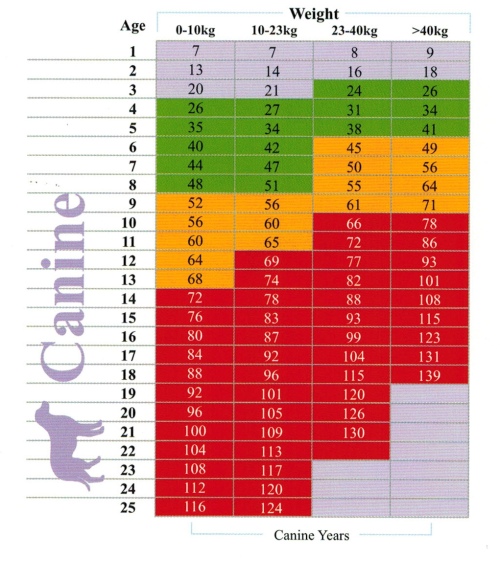
Our dogs live at a different time scale than we do.  There are many illustrations of the this  – here’s just one:

dog age chart

With our dogs aging at a faster rate than we do,  we don’t always understand the impact of a delay.

For example:

I meet many dog owners who come to see me because they have a fear of putting their dog on medications such as those that are used for arthritis.  Let me be clear on this – although I practice natural therapies – I am not against using traditional medications like non-steroidal anti-inflammatory drugs (NSAIDs).  Actually, quite the opposite.

Many dogs benefit from pain relief just like we humans do.

One of the better ways to assess the levels of pain in a dog is to give it a short course of NSAIDs and simply watch for changes in the dog’s behaviour and levels of activity.   If the dog improves, this is often the best indicator we have about the dog’s level of discomfort.

If pain is managed, then we can do even more hands-on work like acupressure, stretching, acupuncture and massage and this often means dosages of the ‘hard drugs’ can be reduced without sacrificing pain management.

In this example, the owner is hesitating to make a decision on using medication – even with the idea that we go into the arrangement knowing the medications will be used for only a short period – perhaps 2-3 weeks.

The dog weighs 25 kg and is 10 years old.

I start working with the dog and suggest a number of times that I believe the dog is in pain or at a minimum – uncomfortable.

The owner takes 2 months to make a decision before agreeing to try some pain relief.

In human years, since the dog is aging at a rate of 6 years to 1 human year at this life stage… 

The owner has waited the equivalent of one human year to make a decision!

 I will ask– if this was your grandma/grandpa/father/mother –  would you allow them to live like this without pain relief?

The answer has always been ‘no.’

We have a duty to care for our dogs which involves acting in their best interests.  They can’t tell us in words how much pain they are in, it’s up to us to figure it out.  And in deciding what to do, we must always be mindful of how precious time is.

Kathleen Crisley, specialist in dog massage, rehabilitation and nutrition/food therapy, The Balanced Dog, Christchurch, New Zealand

Sun Seekers

IMG_1552

Izzy the greyhound rests in the late winter sun after a day of teaching a massage workshop for other greyhound owners

Our dogs are warm-blooded mammals, just like we are.  It’s no wonder that so many dogs love sitting in the sun and will move as the sun moves.

Based on the meridian theory of Traditional Chinese Medicine, it makes sense to me that the sun’s warmth will gently warm acupoints, stimulating blood and qi flow and releasing endorphins which make the dog feel better.

Dogs also produce Vitamin D in their skin, it’s a bit like humans only harder because the sun’s rays have to penetrate through their fur.  Dogs aren’t as efficient in converting 7-Dehydrocholesterol, which is the precursor to vitamin D.

If there’s a wound on the dog, sunlight will help to dry it out.  Sunlight is also a natural anti-bacterial (which is why our mothers and grandmothers swore by the need to hang towels and sheets in the sunlight to brighten and freshen them.)  Sunlight can help kill excess yeast which is particularly useful for dogs that fight skin problems relating to yeast.

Even though a dog can sit inside during winter to enjoy the warmth of the sun, windows will filter out some of the sun’s rays which we probably want to have in terms of penetrating through the fur to help with Vitamin D production.  That’s why in winter, I like to exercise Izzy on sunny days without her coat so she receives the full effect of the sun.

Thin coated dogs (like Izzy) have to be protected from UV radiation during summer and the warmer months.  White-coated dogs and those with thin skin over the muzzle or under the arms also need to be protected from sun damage.

But that’s not much of a worry right now, during the depths of the southern hemisphere winter.

Kathleen Crisley, specialist in dog massage, rehabilitation and nutrition/food therapy, The Balanced Dog, Christchurch, New Zealand