Category Archives: dog care

Brain training for old dogs (touchscreens for dogs!)

Spoiling old dogs in their twilight years by retiring them to the sofa and forgiving them their stubbornness or disobedience, doesn’t do our four-legged friends any good. Regular brain training and lifelong learning create positive emotions and can slow down mental deterioration in old age. Physical limitations, however, often do not allow the same sort of training as used in young dogs.

In a new study, a team of researchers led by cognitive biologists from Vetmeduni Vienna propose computer interaction as a practical alternative. In the training lab, old dogs responded positively to cognitive training using educational touchscreen games. The aim now is to get the interactive “dog sudoku” ready for home use.

Touchscreen for dogs

Playing computer games might be the perfect “brain Training” for old dogs Credit: Messerli Research Institute/Vetmeduni Vienna

Lifelong learning is not just good for people, it is also good for dogs. Dogs are capable of learning even in old age, and constant brain training and mental problem-solving create positive emotions and slow the natural pace of mental deterioration. Unlike puppies or young dogs, however, old dogs are almost never trained or challenged mentally. Senior dogs are usually perfectly integrated into our lives and we often forgive them any disobedience or stubbornness. In addition, due to their increasing physical limitations, we usually spare old dogs the sort of training we might expect from young animals.

Cognitive biologists from the Messerli Research Institute at Vetmeduni Vienna propose computer games as an efficient alternative. Simple mental tasks on the computer, combined with a reward system, can replace physically demanding training and still keep the animals mentally fit even in old age. First, however, the method must be taken out of the laboratory and transferred to the living room.

Tablet games like “sudoku” for old dogs

At obedience school or in private, puppies and young dogs are socialised and challenged using a variety of training methods to help them integrate smoothly into our daily lives. As the dogs get older, however, we increasingly – and unconsciously – reduce the level of regular training and challenges. “Yet this restricts the opportunities to create positive mental experiences for the animals, which remain capable of learning even in old age,” explains first author Lisa Wallis. “As is the case with people, dopamine production in dogs also falls in old age, leading to a decline in memory and motivational drive. But this natural mental deterioration can be countered with the specific training of cognitive skills.”

Under laboratory conditions, the training works using computer-based brain-teasers. It does take some preparation to get the dogs used to the touchscreen, but once the animals have got the trick they turn into avid computer gamers. “Touchscreen interaction is usually analysed in young dogs. But we could show that old dogs also respond positively to this cognitive training method,” says senior author Ludwig Huber. “Above all, the prospect of a reward is an important factor to motivate the animals to do something new or challenging.”

Mentally fit four-legged “gamers” – laboratory solution to be made available to the general public

Using simple tasks that can be solved through touchscreen interaction, followed by a reward, even old dogs remain willing to learn. “The positive feeling created by solving a mental challenge is comparable to the feeling that older people have when they learn something new, doing something they enjoy. Regular brain training shakes not only us, but also dogs out of their apathy in old age, increasing motivation and engagement and thus maximising learning opportunities”, says Huber.

It is still not clear whether dogs slowly forget the things they once learned because of reduced powers of recollection or due to a lack of training in old age. The fact is, however, that lifelong learning with the touchscreen can help counteract this development. The research team hopes that this study will not only motivate technicians and software developers, but also interested dog owners, to consider future cooperation. “Our scientific approach could result in an exciting citizen science project to increase the understanding of the importance of lifelong learning in animals,” says Wallis.
Source:  University of Veterinary Medicine, Vienna

Do Unto Animals – book review

When Tracey Stewart’s book was launched in 2015, it was to great fanfare and lots of reviews.  It has taken me a while to get this book to the top of my reading pile.

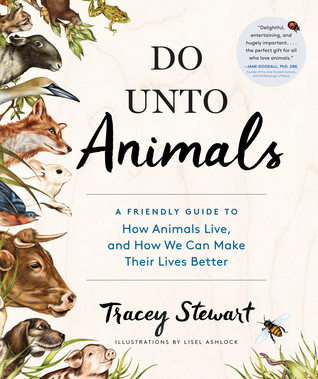
Do Unto AnimalsThe theme of the book is ‘how to give back’ to animals of all types.  The first 70 or so pages are about domestic dogs and cats and the remaining 110+ pages are about other creatures including wildlife and farm animals.
To be honest, I think Stewart could have cut the chapters about dogs and cats and focused solely on the ‘other’ creatures.  The advice given for dogs and cats is pretty basic and not particularly well thought out because the information is so brief.  For example, she has included two pages about dog massage with 6 ‘moves’ and the usual warnings about ‘not to be substituted for veterinary care.’

The book comes into its own, however, when the other animals become the focus of the text.  For American audiences, the chapters about backyard wildlife and the roles of each of the ‘pests’ is enlightening. In the farm animals section, she covers pigs, cows, goats, sheep, horses, chickens, turkeys, ducks and geese.  And for each type of animal, she includes a hard hitting ‘what makes a pig (cow, goat, sheep, horse, chicken, turkey, duck or goose) unhappy.’

These pages constitute a simple ‘list of shame’ when it comes to factory farming and the realities of individual consumer choices for meat, dairy, and even feather down garments.

The best part of the book, in my opinion, are the illustrations by Lisel Ashlock.  In full color, these adorn every page of the book and are a reason why this book should be owned and shared in print version (not electronic).

My overall grade:  A-

Tracey Stewart has a veterinary technician qualification although her first career was in design.  She is the wife of comedian and talk show host Jon Stewart.  Both are committed to animal welfare, with a large animal family of their own on their New Jersey farm property; part of the proceeds of each book sold go to support Farm Sanctuary.

Kathleen Crisley, specialist in dog massage, rehabilitation and nutrition/food therapy, The Balanced Dog, Christchurch, New Zealand

Finances and financial sacrifices

When you make a commitment to a dog, you make it for life – or at least you should (although from many of the listings I see in Facebook groups and on Trade Me, it is clear that others don’t believe in the lifetime commitment).  With that lifetime commitment comes a fairly significant financial commitment.

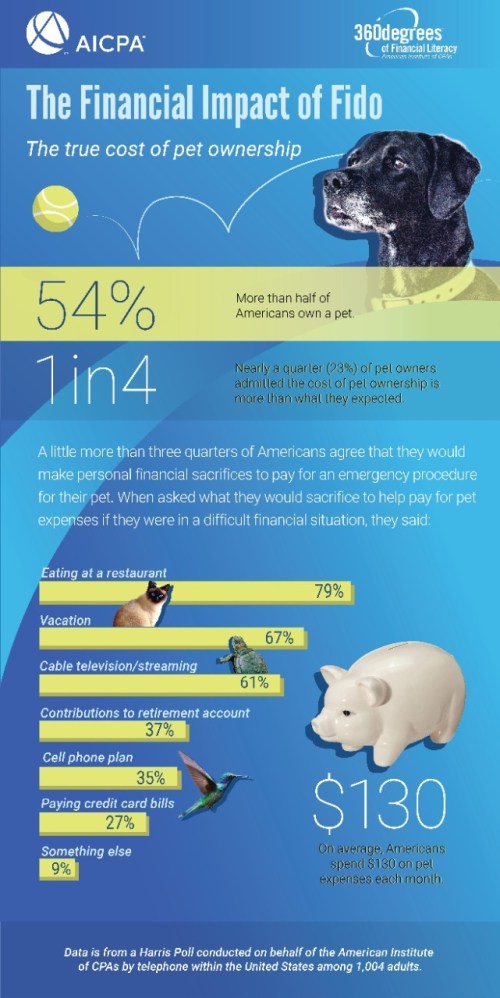
That’s why I applaud the recent survey undertaken by the American Institute of Certified Professional Accountants (AICPA) concerning the cost of pet ownership.  Although this survey was done in the USA, I would expect the findings to be broadly transferable to New Zealand – certainly the recommendations are!

The overall findings were:

  • On average, American pet owners spend $1,560 per year on their pets
  • One-in-four say their pets cost more than they expected
  • More than 3-in-4 Americans would make financial sacrifices for their pets

And the survey even asked how these pet owners would make financial sacrifices, if they had to, to fund emergency pet care expenses which is illustrated in the graphic below:

The Financial Impact of Fido by the American Institute of CPAs

To help Americans fully understand the financial commitment that comes with bringing a pet into their home, the AICPA’s National CPA Financial Literacy Commission has the following tips:

  • Be honest with yourself financially – If you are struggling to pay off your student loans and have credit debt piling up, does it really make financial sense to get a pet?  Pets are great but they are meant to help relieve stress, not add to it due to financial difficulties.
  • Do your research – Though the cost of routine care may be predictable, it varies widely from animal to animal, and even from breed to breed, across the full spectrum of family pets. Know ahead of time the probable cost of care that will come with your companion.
  • Make a budget: “pre-pet” & “post-pet” — Include all related expenses, i.e. food, treats, leash, crates – including tank for fish, lizards, etc.—toys, vet visits, grooming and other services such as boarding and day care. If your pet will require a habitat powered by electricity, be sure to factor in the impact it will have on your utilities bill.
  • Be prepared – If you’re worried about unforeseen costs, use an emergency savings calculator to help you regularly set aside funds, or consider getting pet insurance.
  • Buy in Bulk – Items such as food, treats and preventive medicine can be purchased in bulk, reducing the overall cost per unit.

Kathleen Crisley, specialist in dog massage, rehabilitation and nutrition/food therapy, The Balanced Dog, Christchurch, New Zealand

Two french bulldogs and a pug

Today, I gave Aki, Haru, and Yuki their Christmas presents – relaxation massages paid for by their Dad.  I was booked up last week when he rang and couldn’t fit in 3 hours of massage before the holiday – luckily everyone was happy to wait.

All I knew was that I was going to meet “two french bulldogs and a pug.”  I was not disappointed; all three were charming.  Yuki is the oldest, and will be 8 years old in March; Aki is 5; Haru will be 2 in February.

Pug

Yuki the Pug

French Bulldog

Haru the French Bulldog

French Bulldog

Aki the French Bulldog

Massages for your dog make a wonderful gift; relaxation massage distributes the oils of the coat to support skin health, allows your dog to chill out and be the center of attention, and I report back on any lumps and bumps I find to ensure you have discussed these with your vet.

Kathleen Crisley, specialist in dog massage, rehabilitation and nutrition/food therapy, The Balanced Dog, Christchurch, New Zealand

Risk of chocolate poisoning in dogs peaks at Christmas, warn experts

Christmas dog

Christmas dog, photo courtesy of the University of Liverpool

Pet owners are being urged to be vigilant this Christmas, as University of Liverpool researchers warn of a “significant peak” in the risk of chocolate poisoning in dogs over the festive period.

Most people know that chocolate can be poisonous to dogs but may not know why. The toxic ingredient is a caffeine-like stimulant called theobromine that can lead to an upset stomach, a racing heartbeat, dehydration, seizures and in the most severe cases death.

In a new study published in the Vet Record, researchers from the University’s Small Animal Veterinary Surveillance Network (SAVSNET) have used electronic health records from UK veterinary practices to analyse cases of chocolate ingestion in dogs.

The findings reveal significant seasonal peaks of chocolate ingestion cases across the year, most notably at Christmas and to a lesser extent at Easter –  as chocolate becomes more accessible within the home.

In most cases the amount of chocolate consumed was quite small, with common festive culprits including selection boxes, chocolate cake, liqueurs, chocolate Santas and advent calendars.

Veterinary researcher Dr P-J Noble who led the study commented: “Dogs love a chocolate treat and at Christmas there are plenty about. Sadly dogs can’t eat chocolate safely so many of them end up making an unplanned visit to the vet, which can disrupt the celebrations.

“People should keep festive chocolates away from pets. If chocolate is consumed, owners should talk to their vet as soon as possible, and ideally be prepared to quantify the amount and type of chocolate consumed. Information on the chocolate packaging may help the vet take the best action. While many cases of chocolate-eating are not at toxic levels, where they are, it is better to see the vet quickly.”

The research, which analysed 386 cases of chocolate ingestion in dogs from 229 UK veterinary practices between 2013 and 2017, also revealed some differences in the seasonal pattern of UK cases compared to other countries. Peaks in similar cases around Valentine’s Day and Halloween that have previously been reported in the USA and Germany were not found in the UK, which the researchers suggest could be due to different festival priorities.

The study also found that chocolate ingestion was significantly less common in older dogs and that no specific breed is more at risk than others.

Dr Noble added: “Big data is allowing us to perform wide scale studies of issues like chocolate exposure. This will help us to understand the influence of age, breed, season and geography on a wide range of different problems.”

Christmas stress and dogs

It’s that time of year again –  Christmas (followed closely by New Year).  And if the traffic is anything to go by (and I am a mobile practitioner, so I’m on the road fairly often), holiday preparations are in full swing.  The schools have let out for summer, and the shopping intensity is increasing.  So, too, are the rates of pre-Christmas stress.

Holiday plans, parties, travel, new guests coming to stay, and presents and food to buy and prepare should be happy things, but a lot of  people get stressed by them, too.

Have you ever thought about the impact of Christmas on your dog?

Feliz Naughty Dog

Our dogs also suffer stress.   With the changes in routine and surroundings that Christmas brings, we shouldn’t be surprised if our dogs get stressed.

Some will become destructive, such as unwrapping presents under the tree or chewing on ornaments/lights.  (These are also a health hazard, of course.)   Others may show their stress through lip-licking and yawning, backing away, going off their food, pacing, tucking their tail under, etc.

It’s important to know the signs of a stressed dog and to do something to lower your dog’s anxiety.

Ensure your dog has a safe space at home – like a crate or a bedroom – where they can retreat when they have had enough.

Play calming music, spray the room with calming mixtures of essential oils, Bach flower remedies, or Adaptil.

And do your very best to keep your dog on a regular routine.  Meal times and walks are things that your dog has come to count on at certain times of the day. Don’t mess about with these ‘certains’ in their life – it helps to keep stress in check.

Kathleen Crisley, specialist in dog massage, rehabilitation and nutrition/food therapy, The Balanced Dog, Christchurch, New Zealand

A dog’s life in families with children

Note from DoggyMom:

This research reinforces my advice to families with young children and dogs:  understand your dog’s non-verbal and verbal cues so you can pick up when they are stressed, going over threshold, and need time away from the children.

I have several clients on my books currently who are expecting their first child in 2018; this is a subject that we discuss on a regular basis.


Millions of families know how rewarding and enjoyable dog ownership can be – but now a new study has for the first time examined the quality of life for a pet dog owned by a family with children.

happy dog

Photo courtesy of University of Lincoln

There is now extensive scientific research showing the many benefits that pet dogs bring to families, including improved family functioning and wellbeing for those with children with neuro-developmental disorders such as Autism Spectrum Disorder (ASD) and ADHD. For all children, dogs can provide valuable companionship, encourage exercise and family activities, and teach them about responsibilities.

Until now, little attention has been paid to how living with children affects quality of life for pet dogs (those not trained as assistance dogs). Funded by Dogs Trust – the UK’s largest dog welfare charity – a team of animal behaviour and welfare specialists from the University of Lincoln’s School of Life Sciences are examining this question.

Published in the scientific journal PLOS ONE, their latest research involved interviewing parents who own a dog – half with typically developing children and half with children with Autism or ADHD, with all children aged between four and 10 years old.

The research revealed that the child-dog relationship has a number of beneficial aspects for the dog, including a sense of routine, more time for fun and play, and companionship.

Dr Sophie Hall, a Research Fellow specialising in human-animal interactions at the University of Lincoln’s School of Life Sciences, said: “Our study involved 36 dog-owning families, who all highlighted some key benefits that their pet dogs receive from living with young children.

“For example children provide close companionship for pets as well as imposing a sense of predictable and consistent routine in the home, in terms of feed and walk times, which we know is extremely important for a dog’s wellbeing. Of course, children also play regularly with their pet dogs and activities such as throwing a ball and doing assault courses represent really valuable opportunities for exercise and positive mental stimulation.

“The study also highlighted some potentially negative impacts on the pet, which it is important for parents to be aware of when bringing a dog into a home with children.”

The negative impact could be brought on by children having tantrums, with parents observing their dogs running away, shaking or hiding on some of these occasions. Parents also observed a change in their dog’s behaviour if it became ‘over stimulated’ – such as barking, becoming agitated, or seeking a place to escape – when their children were very noisy.

Other events that could cause potential distress for dogs in homes with children could include rough play or accidents such as collisions with toys or pulling the dog’s tail.

The study suggests that in a home with small children, it is important for dogs to have a ‘safe haven’ to escape to if needed, and for parents to understand both the obvious and more subtle signs of distress in their pets and to teach their family about these signs. For example, pet dogs often have wide eyes or lick their lips when they are mildly stressed.

Dr Hall added: “The positive and negative aspects of the child-dog relationship were similar in families with typically developing children and in those with children with a neuro-developmental disorder.

“As such, providing they are aware of key risk events and how to cope with these, and ensuring adequate supervision, parents should not necessarily be dissuaded from acquiring a pet dog because of their child’s developmental issues. As we know, pet dogs can really enrich family life and support child development and wellbeing.”

The results of this initial study are now being developed further by the team at the University of Lincoln with support from Dogs Trust.

The paper is freely available to view online at PLOS ONE.

Source:  University of Lincoln media release

Low stress handling and the use of food diversions

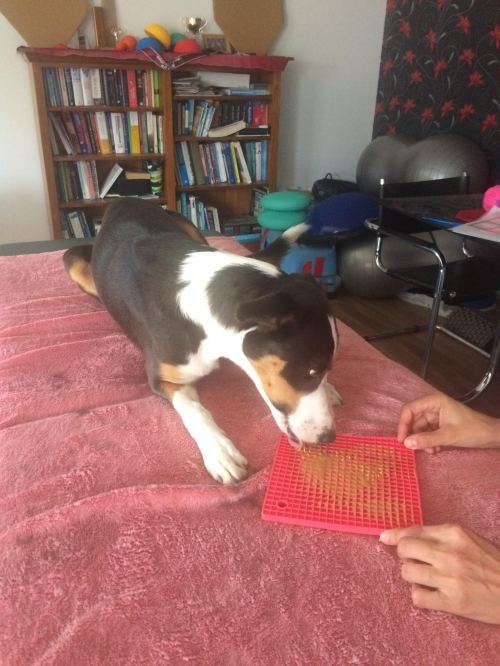
Heading dog with food diversion for dog massage

This is Bee, a young heading dog.  Yesterday, she had her third massage and, with each session, she’s getting better.

There’s nothing physically wrong with Bee; her Mum is training her for competitive agility and wants to keep her in top condition.  Since Bee is high-energy, the massage sessions are also to help her with focus and mindfulness.

During her first massage, Bee took a long time to settle.  At her second massage, I suggested that we introduce a toy and we used a braided rope tug toy.  Then I decided to try pushing some treats into the braids and we got almost instant results.  Bee became more relaxed and allowed more touch.  When I left, her Mum and I promised each other that next time, we’d use a food toy for the entire session.

So yesterday, her Mum was ready.  And how clever is she???  She purchased a silicone pot holder for only $2 from Kmart and spread it with peanut butter.  We had our best massage yet.

Low stress handling techniques are all about keeping the dog below threshold – no stress or anxiety.  Food diversion toys can help with this – and they don’t have to be fancy or expensive.

Kathleen Crisley, specialist in dog massage, rehabilitation and nutrition/food therapy, The Balanced Dog, Christchurch, New Zealand

Seeing is believing

As the saying goes, “seeing is believing” and I have found that this holds true when educating people about the value of dog massage and complementary therapies.  My profession is not well known (yet) and so it’s important to me to help spread the word in a positive and enjoyable way.

Yesterday, I had a massage tent at the ASB Summer Starter, an annual fun run and walk where dogs are encouraged to participate.  This was my first year supporting the event (I tried last year but no one responded to my enquiry – so that’s progress!).

When people see how their dog responds to massage, even at a busy outdoor event like this one, it helps to open their eyes about complementary therapies.  Fit dogs can still have trigger points and knots, just like humans.  There was even a tripod on my table yesterday – healthy and happy – but a body that will need support going forward as the dog ages.

And I hate to think that people take exclusively the physio approach to their dog’s health – that is waiting until they are hurting or injured before seeking treatment. (Physiotherapy NZ’s definition of physio is ‘to help restore movement and function to anyone affected by an injury, disability or health condition’).

So yesterday was about showing people a taste of what massage and other therapies can do for their healthy dog.

Seeing is Believing.

Kathleen Crisley, specialist in dog massage, rehabilitation and nutrition/food therapy, The Balanced Dog, Christchurch, New Zealand

Hand-me-down

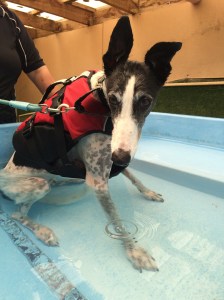
Today I took Izzy swimming.  For only her third time, I think she did very well:

Looking at Izzy’s flotation vest, the Float Doggy made by D-Fa, you’d think I bought it for her, but in fact it’s a hand-me-down – and a testament to the quality of the item.

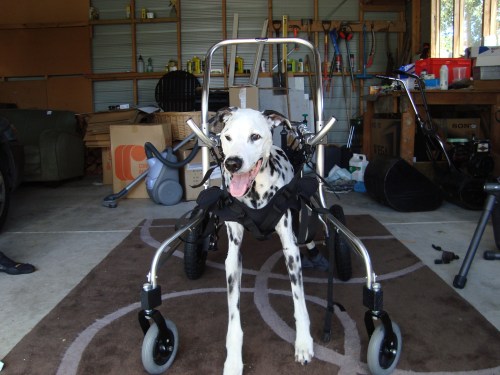
The D-Fa vest was purchased by a client for Ollie, who within the span of days became a quadriplegic in 2010.  Swimming was part of his long-term care program (I won’t say rehab, since he never re-gained the use of his legs and on autopsy it was found that he had a brain tumor).

Ollie in chair.jpg

When Ollie died in September 2011, Ollie’s owner passed his life vest onto me for Daisy.  By then, Daisy was also swimming at the Dog Swim Spa on a fortnightly basis.

Daisy-in-her-D-Fa

Daisy wearing her Float Doggy flotation vest

Daisy passed away in July 2014 and so that vest saw a lot of use from September 2011 to July 2014.

And it came out of storage this year to support Izzy.

I wash out the vest after each use with liquid laundry detergent and cold water; chlorine from the pool can damage fibers of most garments.

Otherwise, that’s all I’ve done to maintain it.

I’d say that’s pretty well made!

Izzy in her D-Fa

Izzy wearing the same Float Doggy, 22 November 2017

Kathleen Crisley, specialist in dog massage, rehabilitation and nutrition/food therapy, The Balanced Dog, Christchurch, New Zealand