Vera does her morning yoga (photo by Jenny Hamilton)
I remember watching a yoga video years ago where the instructor described the act of stretching as ‘making space in the joints.’
As a canine massage therapist, I think stretching is essential. It lengthens muscles in a controlled and safe way to ensure good range of motion in the limbs and it helps to maintain blood flow to essential soft tissues.
As our dogs age, or when they are injured, then often need help with stretching (the same is true of people). That’s where professional massage comes in – someone to help warm and stretch the muscles, tendons and ligaments.
Owners can also learn to stretch their dogs; it’s something I include in special massage workshops for greyhound owners. I’ve found that greyhounds, with their sleek builds and racing instinct, often tighten up when in a pet home or when they don’t get regular off-lead exercise.
Kathleen Crisley, specialist in dog massage, rehabilitation and nutrition/food therapy, The Balanced Dog, Christchurch, New Zealand
Some people find it hard to believe that a dog professional like myself has never raised a dog from a puppy. That’s because my family raised me with the idea that you adopt, rather than buy, a dog. And by default that has steered me into a life with re-homed dogs – both mixed breeds and purebreds – who have entered my life at different ages.
My first dog came from a shelter; my second came from a supermarket ‘free to a good home’ ad; my third was a private adoption facilitated by a local rescue group (but she had never lived in their shelter); my fourth was a word-of-mouth adoption of Daisy, a purebred Pointer, who had bounced back to her breeder through no fault of her own. And now, I have Izzy who is a retired racing greyhound.
It’s a myth that ‘rescue’ dogs are all mixed breeds; many pure bred dogs also find themselves in need of re-homing. Responsible breeders will take back a dog for any reason during the lifetime of the dog. So, for example, in cases of divorce or an owner’s death, these dogs come up for adoption – and that’s only a couple of examples. There are also breed specific rescue groups who are passionate supporters of a breed and work to re-home dogs who have fallen on bad times.
What my life of adopting dogs has taught me is patience. It’s great to go out and buy the dog a bed, food and toys and envisage a perfect life together. And it will be good- but there are usually teething problems.
For example, when I adopted Izzy , she was suffering from re-homing stress. She was overwhelmed by her surroundings in my home – it was totally foreign territory. She was off her food and made herself a bed on a blanket by the front door. She remained there for almost 2 weeks (only moving to eat or drink or go out for walks) until she got her confidence to explore more of the house.
It took her 2 months to venture confidently into my bedroom (where large windows looking out onto the garden seemed to overwhelm her). She did not get on my bed for almost 4 months.
We had a few toileting incidents but that was also because she was getting used to new food and was already stressed from her change of circumstances. Whose tummy wouldn’t cause them problems?
But we got there and that takes patience. When I do home-checking for Greyhounds as Pets, I get an idea about how well the family is prepared to be patient with their new dog.
A prospective owner with a very strict timeline for getting their dog settled is unlikely to be successful – the dog doesn’t know about the timeline.
The best advice I can give is – be patient. If anything, give your new dog some space. Let them decide when they are comfortable in trying new things and don’t overwhelm them with affection too soon.
It’s worth the wait.
Kathleen Crisley, specialist in dog massage, rehabilitation and nutrition/food therapy, The Balanced Dog, Christchurch, New Zealand
I see a lot of dogs in my massage practice who have bad breath and/or other noticeable signs of dental disease. Ask most veterinarians and they’ll tell you that they do a lot of ‘dentals’ during the course of any given week. If your dog requires teeth to be extracted because of infection, cracking, or gum disease, your healthcare bill will quickly increase.
The first line of defense in keeping your dog’s teeth healthy is a good diet of wholesome ingredients. That includes chews and bones. Raw diets excel in this because they use bones as a staple part of the diet but I have also seen dogs with excellent teeth who are fed commercial dog foods – typically supplemented with fresh ingredients – and with bones and chews a regular part of the regime.
Some owners feed a combination of raw and commercial diets; I personally like this balanced approach and it is what I feed my own dog.
But, and here’s the but…bones and chews don’t solve the dental disease problem for a good number of dogs. Why?
Some dogs just aren’t naturally strong chewers; they aren’t motivated by chewing for very long – even on a fresh and meaty bone
Dogs who have been rescued or adopted may already have already experienced damage to their teeth or suffered early in life because of a poor diet or starvation
I believe that some dogs, like people, have a mouth chemistry that pre-disposes them to tartar build-up. Dogs are individuals and we simply can’t rule out that nature deals the bad-teeth card to some dogs
Dogs who have been born with defects such as cleft palates usually have something wrong with their teeth from the outset; bones and chews may be difficult for these dogs
So what’s the next step?
My view is definitely teeth-brushing. We train our children to do this daily. Why would it be any different for a domesticated dog?
[And, with hand on heart, most vets will choose teeth brushing over a special ‘dental diet’ any day.] The issue here is having the patience and persistence to brush teeth effectively. Unfortunately, a lot of owners simply give up because of their dog’s protests and vets then become conditioned to ‘water down’ the advice by saying ‘try it a couple of days per week..’ and ‘feed a dental diet.’
I brush my dog’s teeth daily. Izzy is a retired racing greyhound, a breed known for their bad teeth. By the time Izzy was adopted at age 5 1/2, her teeth were noticeably unstable and worn down from what must have been chewing on the bars of a kennel or some other surface equally as unforgiving. She had teeth extracted as part of her adoption medical visit.
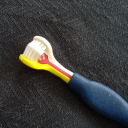
I like this very straightforward video from The Whole Dog Journal on the subject of teeth brushing. The only oversight is that the video doesn’t cover the triple-headed toothbrush design which I prefer. My concern with the long-handled toothbrushes is that it is easy to poke a dog in the mouth with them, particularly if they are fussing with you over getting their teeth brushed in the first place…
A triple-headed dog toothbrush – my choice!
There are other natural solutions to dental care which include the use of homeopathics and herbs. All of these are my choice before a dental diet. Why?
Well here’s the ingredient list off the label of a well-known prescription diet product. Does it sound healthy/wholesome to you?
It’s been particularly busy the last few days. I had expected it to be busy – just not this busy.
The planned part of the weekend was my company re-branding. At long last, my business is now The Balanced Dog Ltd – a practice focused on professional dog massage and natural care.
When I started in business in 2007, it was as a maker of preservative-free dog treats and cakes and so the company name of Canine Catering suited…but by 2010, my dog massage practice was growing and it is this aspect of natural dog care that has become my passion.
The new name also reflects my interests in Traditional Chinese Medicine and nutrition. It’s all about balance and health.
But what I didn’t expect this weekend was my first truly viral post on Facebook. A client of mine shared this cartoon with me and it all took off from there:
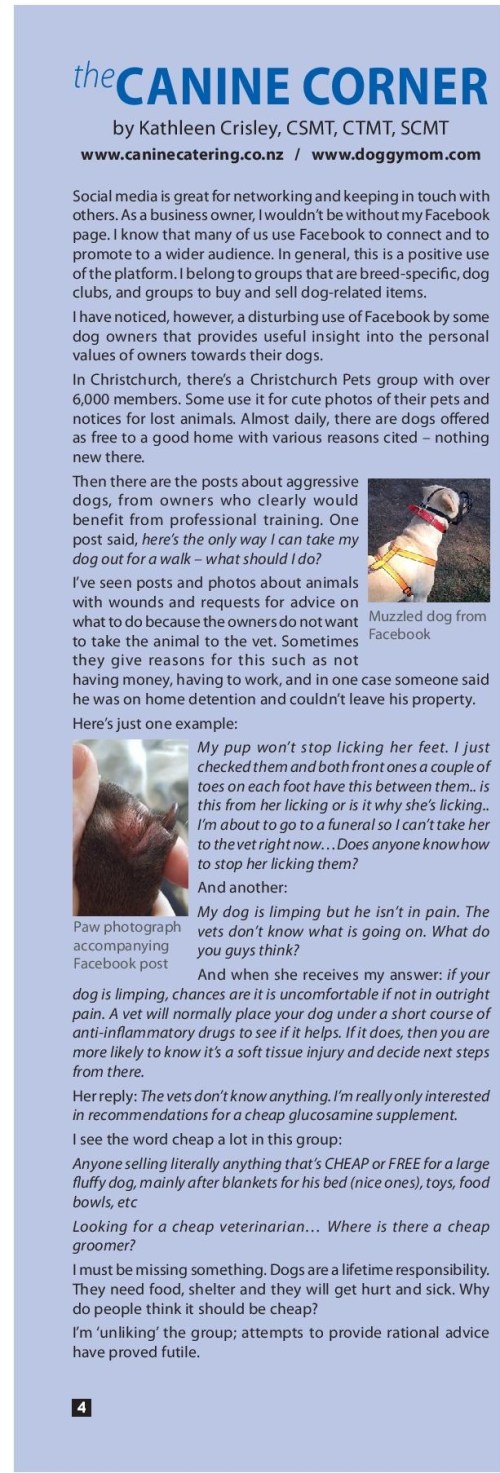
You see, last month my column about this subject was published in NZ Dog World magazine. I’m increasingly concerned about how people are taking to Facebook for medical diagnosis (instead of seeking professional veterinary care).
It’s okay to seek advice from peers when your dog has a known condition. Support groups for all types of disorders exist on social media; I’ve used them myself.
And I guess a lot of people agree with me – I’ve tripled the number of Facebook likes on my page and have had over 1.5 million views. Not bad for an independent canine massage practitioner from little old New Zealand…
Thanks for reading my blog; I’ve been writing it for five years now and I still enjoy it and the connections I have made with some dedicated dog parents.
Kathleen Crisley, specialist in dog massage, rehabilitation and nutrition/food therapy, The Balanced Dog, Christchurch, New Zealand
Oh…and here’s my column about “Dr Facebook” if you’re interested:
This winter, when you are home sick with the cold or flu cuddling with your dog or cat may feel like just what the doctor ordered.
A Vanderbilt infectious disease expert, while stopping short of actually prescribing in-home “pet therapy” for colds or flu, says that if having your companion by your side makes you feel better, go right ahead. Pets won’t catch or spread human viruses.
“The pet is a comfort, not a hazard,” said William Schaffner, M.D., professor of Preventive Medicine at Vanderbilt University Medical Center. Even somebody who pets the dog or cat after you is unlikely to catch your virus that way, and “you can’t get a cold or the flu from your dog or cat,” Schaffner said.
While pets are pretty much off the hook, Schaffner says the true hazard in catching a virus comes from fellow two-legged creatures.
“Flu is transmitted person-to-person through close personal contact. If you get within my breathing zone, within three feet, I can transfer the influenza virus to you. I breathe it out, you breathe it in, and you can be infected,” Schaffner said.
Colds and flu can also be transmitted by hand—handshaking extroverts take note—or via some surfaces, such as when a sick person touches a doorknob, for example, and somebody else touches the same surface, and then touches his or her face.
“People should wash their hands often and use hand sanitizer,” Schaffner said. “Also, when flu is rampant in the community, greet friends with an elbow bump rather than a handshake.”
People and their pets have this in common: the best way to avoid getting sick is to be immunized—with pets it’s their vaccinations, and with people it’s a flu shot.
I came across an article recently which was a sort of a “Vets Tell You What They Really Think” piece. It listed 50 things that the veterinarian would love to say, but can’t, because it would be either too forward or too unprofessional (or both).
One of these really stood out for me:
“Here’s a pet peeve: owners who don’t want to pay for diagnostic tests but then cop an attitude because you don’t know what’s wrong with the animal. Since you wouldn’t let me do the blood work or X-rays, how the heck do you expect me to know?”—A vet in South Carolina.
I’m in total agreement with this vet. If we don’t have a diagnosis how are we able to help?
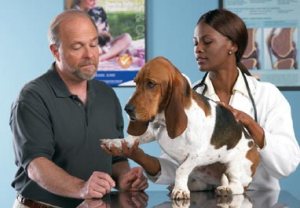
Believe it or not, I get contacted fairly regularly from people who want me to come and work on their dog because they don’t want to pay for x-rays or other tests. In such cases, I tell them politely that I need a diagnosis to be able to confidently work with their animal. The risk is too high that, for example, if the dog has spinal injury I can make it worse rather than better.
Costs for veterinary care can be high, but you pay for the skills and the tools that are available to a veterinarian. The vet is your dog’s equivalent of the Family Doctor/General Practitioner and sometimes the Emergency Room Doctor combined. Your dog needs them!
There are times I’ve been caught. Such as the case where the owners said x-rays had been taken and we worked for quite a few weeks on the dog only to suffer setbacks. The owners were getting frustrated. I suggested other things within my scope of practice and I recommended they go back to the vet.
That’s when I found out that the owner had only allowed the vet to take a single x-ray to save money. The x-ray didn’t reveal anything in the lower spine and so the vet assumed a partial tear of the cruciate based solely on symptoms. And that’s the diagnosis I was working with, too.
When the owners returned to the vet, they were persuaded to do more scans and that’s when the problem (and a totally different diagnosis) was determined.
In the end, these owners probably spent more money than they saved. And their dog walked around with an injury that was even more difficult to address.
My advice to owners is to only bring a dog into your life when you are confident that you can pay for their care (and that’s means more than just vaccinations, food and flea treatments). And if you have concerns about your ability to pay for injuries and illness – get pet insurance. Some policies even cover costs of complementary care such as dog massage when these treatments are recommended by your vet.
I know that some owners like the idea of setting aside money regularly; my concern is that you would have to be setting fairly large amounts aside regularly for a bank balance with compounding interest to reach into the thousands. And that’s what some of my clients face when surgeries and special procedures are needed.
Your vet is an essential part of your health care team. We all need a solid diagnosis to help your dog feel better.
Kathleen Crisley, specialist in dog massage, rehabilitation and nutrition/food therapy, The Balanced Dog, Christchurch, New Zealand
I personally can’t stand the taste of liver, but it is a different story for Izzy and the dogs I see in my practice.
Liver, an organ meat, is found in the ‘offal’ section of supermarkets. It’s very much worth buying some liver for your dog to be fed two-three times per week and this can be done easily with a commercial food diet by boiling the liver and adding the liver and the water over the food. A third of a cup of the meat is sufficient per serving. (I don’t like feeding raw foods combined with cooked/commercial foods – because the digestive enzymes needed for raw vs cooked are different.) If feeding a raw diet, it’s okay to feed raw liver.
I also make my own liver treats which I use as a reward for dogs in my massage practice.
Liver is nutrient-rich. It’s a source of protein, Vitamin A, Vitamin B12, Phosphorus, Potassium, Iron, and Co-enzyme Q10. It’s a good antioxidant and, for performance dogs, it’s a super food.
It’s possible to feed too much of a good thing and this is also the case with liver. If a dog is fed too much liver, it can develop a condition known as hypervitaminosis A; this is an overdose of vitamin A.
Symptoms of a vitamin A overdose can include bone deformity, bone spurs on the dog’s legs or spine that cause him to limp, digestive upsets, muscle weakness, stiffness and sometimes weight loss.
If feeding a commercial diet, I think liver is one of the easiest ‘toppers’ you can introduce that will bring some fresh ingredients into your dog’s diet.
Kathleen Crisley, specialist in dog massage, rehabilitation and nutrition/food therapy, The Balanced Dog Ltd, Christchurch, New Zealand
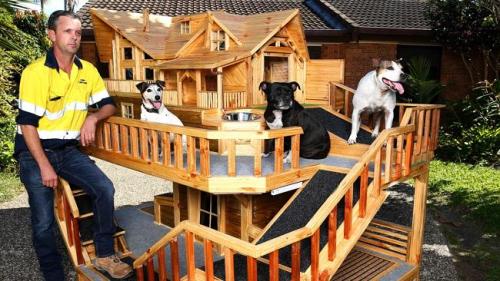
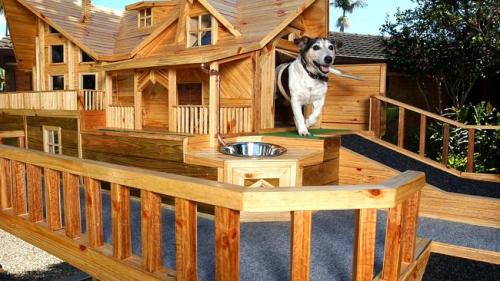
Australian man, Sean Longhurst, put in hundreds of hours over two months to build his dogs a dog house.
It is very much luxury accommodation with multiple stories, ramps, insulation, sensors lights and automatic-fill water bowls.
Photo by the Gold Coast Bulletin
Dog Assa shows off the house (photo by Gold Coast Bulletin)
When interviewed earlier this year, Mr Longhurst said the project has given him a new appreciation for dog house construction and he intends to go into business making dog houses that are replicas of their owner’s homes.
Kathleen Crisley, specialist in dog massage, rehabilitation and nutrition/food therapy, Canine Catering Ltd, Christchurch, New Zealand
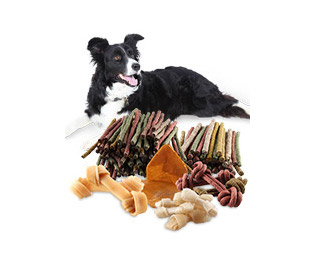
New Zealanders love a bargain and a current special on one of the ‘limited day deal’ sites lists “100% Natural” dog treats, 184 of them in total, for $19.99.
Take a look at that photo. I see artificial colours in the munchy sticks and raw hides that are known to cause choking problems and intestinal blockages. And, there is no country of origin labeling, either. So who knows where they have come from and what methods have gone into preparing them.
But, if they can afford to sell so many treats for this price, a savvy dog parent should be asking where they have come from.
Readers who follow my column in NZ Dog World know that I have a problem with linking responsible dog owners with anything ‘cheap.’ A bargain is only a bargain when you get quality and integrity for a good price and you should know where your dog’s food is coming from.
Kathleen Crisley, specialist in dog massage, rehabilitation and nutrition/food therapy, Canine Catering Ltd, Christchurch, New Zealand
It’s been a hot day. Izzy and I are both feeling the heat.
I’ve kept the shades drawn today to help keep out the strong sunshine and Izzy is enjoying her fan.
Izzy does her best to chill out in front of the fan
A bit later I will probably turn on the air conditioning to cool the house down for sleeping…and we’ll go for a short walk after the sun sets.
The lawn was mowed yesterday and so Izzy’s paddling pool isn’t filled right now – but luckily the forecast is for the weather to be cooler and more comfortable tomorrow.
We are both looking forward to that.
Kathleen Crisley, specialist in dog massage, rehabilitation and nutrition/food therapy, Canine Catering Ltd, Christchurch, New Zealand