Category Archives: dog care

All dogs matter


All dogs matter

I often get asked ‘what type of dog benefits most from massage and laser?’

People think that a certain breed or size of dog has the most problems.  While it is true that some breeds have a higher likelihood of problems due to genetics – obesity or hip dysplasia in Labradors, for example – the reality is that all dogs benefit from touch therapies.  That’s purebreds and mixed breeds, toy dogs, medium and large dogs and extra-large dogs.

People also think that you only massage a dog once they are elderly and showing signs of discomfort.  While of course you should seek help in these instances, you can keep your dog more flexible in the joints and with good blood flow to the muscles by instituting a regular wellness program that includes massage.

And by regular, I only see some of my clients six- or eight-weekly, because we have their dog responding well to their treatments.  They move more freely and comfortably now and only need a ‘top up’ to keep in good shape.

So the other message I have in this post is that your dog’s massage therapy doesn’t have to break your budget.  If you get your dog into a regular massage program, you can easily plan for this expense and accommodate it.   This is so much better than trying to fund the ‘ambulance at the bottom of the cliff’ approach.

I practice on a mobile basis, and so with lower overheads (no clinic to rent, heat and insure), I pass on these savings to my customers.

Kathleen Crisley, specialist in dog massage, rehabilitation and nutrition/food therapy, The Balanced Dog, Christchurch, New Zealand


Teefs

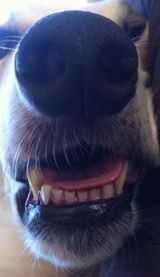
Greyhounds, it seems, like to sleep with their mouths open.   And their owners like to take photos of their hounds showing off their ‘teefs’ – photos that are shared on Facebook groups involving greyhounds (I follow several)…

Greyhound front teeth by Elizabeth Anne Dodd

A sleeping greyhound shows off their front teefs (Photo by Elizabeth Anne Dodd)

So I’ve used these photos as an inspiration.  How much do you know about your dog’s teeth?

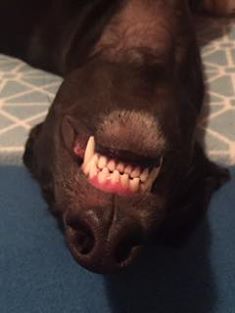
greyhound front teeth upside down by Gill Vernon

An upside down sleeping Greyhound, again showing off the front teefs (Photo by Gill Vernon)

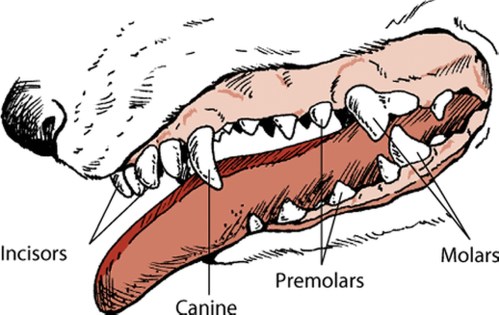
Let’s look at a diagram of an adult dog’s teeth:


Adult dog teeth diagram

An adult dog’s teeth (diagram courtesy of the Merck Vet Manual)

The dog has 6 incisors on the upper and lower jaws that are used for grasping.

Of the famous “canine teeth” there are only 2 each on the upper and lower jaws.  Their main function is tearing.

There are 8 premolars on the upper and lower jaw and their main function is grinding.  There are 4 molars in the upper jaw and 6 on the lower jaw.  These teeth also have a grinding function.

The best way to keep your dog’s teeth healthy is to feed a nutritious diet.

I am a big support of regular teeth brushing, too. (see my blog post on Brushing your dog’s teeth)

Kathleen Crisley, specialist in dog massage, rehabilitation and nutrition/food therapy, The Balanced Dog, Christchurch, New Zealand
 

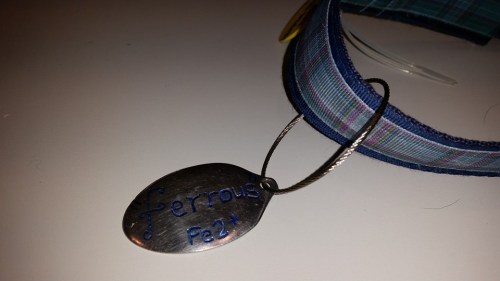
Homemade dog tag

I think every dog should have a name tag attached to its collar.  It’s useful for people to know your dog’s name, particularly if it gets lost.

And I also love recycling or re-using items for another purpose when I can.  It’s a case of waste not, want not. (see,  for example, my blog on how I re-used a pill bottle for my dog’s emergency kit)

So, when this homemade dog tag came across my Facebook feed, I wanted to share it.

It’s made from an old teaspoon that has been flattened, with the handle cut off.  I’d never have thought of that!

Home made dog tag from a teaspoon

Homemade dog tag by Rhys Agnew, Canterbury, New Zealand

Kathleen Crisley, specialist in dog massage, rehabilitation and nutrition/food therapy, The Balanced Dog, Christchurch, New Zealand
Eyesight in the older dog

The eyesight in our dogs changes with age.

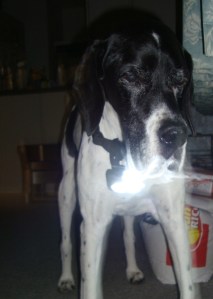
English Pointer with Puplight

Researchers based at the Nestlé Purina Research Center in Missouri have discovered that our dogs become more near-sighted as they age.  Their results were published in the journal PLoS One.

This investigation used an instrument called an autorefractor to measure the dogs’ eyesight in indirect and direct lighting conditions. The study involved nine Beagles ranging in age from 1 to 14 years.   Before entering the study, the dogs were examined to confirm that none of them had cataracts.

Measurements were taken on three different days of the week for a period of six weeks.

The researchers found a remarkable difference between the younger and older dogs.  The older dogs had a much-reduced ability to see at longer distances (far-sightedness) compared to the younger dogs.  Younger dogs were also able to make larger accommodation changes from indirect light to direct light conditions, indicating a more flexible lens.

Humans are the opposite in terms of length of sight.  As we age it can become more difficult to read and see things at shorter distances whereas our ability to see at distances is often not affected (although some older people do have difficulties adjusting to night and low-light conditions, just as the dogs in this study did).

So if your dog is getting older and you notice that they can’t pick up on your body language and signals, there’s a physical reason for it.

Through my own experience working with older dogs, I recommend using a light that helps your senior dog adjust to low-lighting conditions.  See my post on the PupLight, for example.

Kathleen Crisley, specialist in dog massage, rehabilitation and nutrition/food therapy, The Balanced Dog, Christchurch, New Zealand
 

A tip for changing back to Standard Time

On Saturday evening in New Zealand, we’ll be changing clocks back to Standard Time.  This is often a difficult day for dogs, because suddenly they haven’t been fed at their ‘normal’ time.

An hour is a long time to wait in dog time!

Clock

So, for the next few nights, feed your dog 10 to 15 minutes later than the previous evening.  You’ll transition them to their new feeding in Standard Time with less trauma.

Kathleen Crisley, specialist in dog massage, rehabilitation and nutrition/food therapy, The Balanced Dog, Christchurch, New Zealand
Crate training

I like crate training, particularly because it helps ‘future proof’ your dog.

If your dog needs surgery or rest from an injury at any time, having them used to comfortably resting in a crate saves a lot of time and stress (for both dog and owner).

If you need to travel with your dog, whether for a holiday or for relocating, crate training helps you manage your dog’s comfort as well as your own (e.g. limits the risks of accidents in hotel rooms that will charge you an additional cleaning fee).

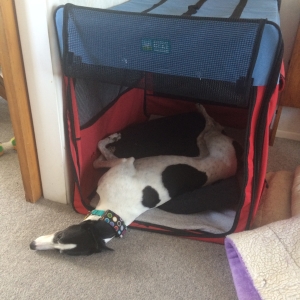
Greyhound in crate

Izzy, mostly in her crate, but enjoying a summer breeze coming from the back door. Izzy’s crate is her safe place (the way it should be)

Crate training can be particularly useful for re-homed dogs because dogs will seek out a place that is safe (den-like if you are thinking of wolves).  Giving a re-homed dog a place they can retire to – and not be bothered – is useful for getting them accustomed to life in a domestic home.  It’s also a useful boundary for children to learn.  If the dog is in its crate, then leave it alone.

Unfortunately, over the last 10 or so years, as crate training became more normalised as a concept, it also has been abused.  Owners who are not consistent with their training or not taking the time to truly get their new puppy or dog settled in their home (taking on a dog is a lifetime responsibility, but initially you have to put in the time to get your dog set up for success  for life), have begun using crates as a cage.  A place to go when the owners are out at work (all day, in most cases) or when the dog has mis-behaved and the owner has had enough.

That’s the wrong use of a crate.  There were even stories of dogs locked in their crates during the Christchurch earthquake of 2011 – the dogs were up to their necks in liquefaction by the time they were saved.  That’s not a heartening story if you ask me.  That’s a story of an irresponsible dog owner.

There are many resources to help owners learn crate training.  The Humane Society of the United States, for example, has this useful video:

Kathleen Crisley, specialist in dog massage, rehabilitation and nutrition/food therapy, The Balanced Dog, Christchurch, New Zealand
Prepared for dew claw and nail injuries

Izzy is a greyhound, a breed that seems predisposed to a lot of dew claw injuries.  Her last one occurred in February, when running after another dog’s tennis ball at the dog park.

I am now better prepared for nail injuries – with the easy addition of some cornflour (corn starch for those of you in the Northern Hemisphere) in my first aid kit.

You don’t need a fancy styptic pencil in your first aid kit to stop the bleeding of a nail injury; this good old fashioned powder will do the job.  I’ve placed mine in a recycled prescription pill bottle.

Corn flour for dew claw injuries

If a nail injury occurs, you want to stop the bleeding which can be profuse.  Apply pressure and this powder to stem the bleeding.  Once stopped, then you can clean the wound properly with water and antiseptic and wrap the paw to keep it  clean.  Changing the bandage every day, re-applying antiseptic, is important.

Some nail injuries are worse than others; some will heal without veterinary help.  In our last case, the quick was fully exposed (ouch!) and despite my efforts to keep it clean and dry, it became red/irritated and infected. (This is why you have to change the bandage every day and check for signs of infection).

A short course of antibiotics prescribed by our vet took care of the job.

I’m much more confident now that I have my container of cornflour in our first aid kit.

Kathleen Crisley, specialist in dog massage, rehabilitation and nutrition/food therapy, The Balanced Dog, Christchurch, New Zealand


Functional furniture for dog owners

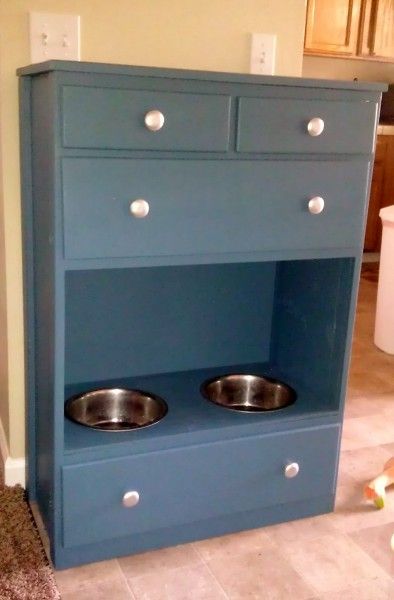
Here’s a design I saved from online a while back.  If you have a small apartment or house, this is a great idea.  There’s functional storage for your dog’s coats and other gear (or perhaps other things for yourself) and then some of the drawers have been removed to become a raised feeder.

I wish I was better at DIY!

Raised dog bowls in chest of drawers

Kathleen Crisley, specialist in dog massage, rehabilitation and nutrition/food therapy, The Balanced Dog, Christchurch, New Zealand
Sleeping patterns of dogs

This infographic, with information sources referenced at the bottom, shows some interesting facts about our dogs and their patterns of sleep.

Let Sleeping Dogs Lie Infographic

Homeopathics, in pack order

The Telegraph has reported this week that Queen Elizabeth II feeds her dogs in ‘order of seniority’  and that the dogs consume a range of herbal and homeopathic remedies.

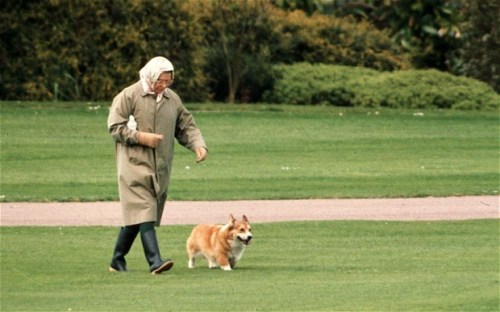
Queen with Corgi

The Queen of England couldn’t be more Establishment and yet – there she is – open-minded enough to recognise that herbals and homeopathics may help keep her Corgis in good health, for longer.

I respect her for that.

It’s long been reported and known that the Queen is an animal-lover.  Dr Mugford, an animal psychologist who has worked with the Queen’s dogs says “The Queen has definite views about how dogs should be cared for: she doesn’t tolerate unkindness, and I remember she took a very dim view of President Lyndon B Johnson picking his dogs up by their ears.”

Queen Elizabeth has made the decision fairly recently not to replace her Corgis when they pass away, which has been a long-standing tradition in her household.  This is surely a sign that the Queen is feeling the pressures of time and old age.  She doesn’t want to bring dogs into the household when it’s highly likely they will out-live her.

Kathleen Crisley, specialist in dog massage, rehabilitation and nutrition/food therapy, The Balanced Dog, Christchurch, New Zealand