Category Archives: dog care

Medical marijuana for dogs?

A bill in the legislature of the State of Nevada was introduced this week that would legalize the use of marijuana in the treatment of animals.

The bill is sponsored by Democrat Tick Segerblom.  It would let owners obtain the drug for their animals if a veterinarian confirmed it “may mitigate the symptoms or effects” of a chronic or debilitating medical condition.

The same bill has provisions for the use of medical marijuana by people.

Companion Cannabis, a product as seen in a medical marijuana dispensary in Los Angeles (Photo by Damian Dovarganes, Associated Press)

Companion Cannabis, a product as seen in a medical marijuana dispensary in Los Angeles (Photo by Damian Dovarganes, Associated Press)

There isn’t a lot of research about the use of marijuana in animals, although there are stories of owners using it to alleviate illness symptoms in their pets – usually as a last resort when traditional therapies haven’t helped.

Physiologically speaking, dogs have a high concentration of THC receptors in their brains (THC is an active ingredient in marijuana).  As a consequence, dogs are more susceptible to marijuana and this can lead to a toxic dose.  There is evidence that in states such as Colorado, which has already legalized marijuana use, more dogs are being admitted for treatment because of marijuana toxicity after they’ve eaten their owner’s supply.

The American Veterinary Medical Association, not surprisingly, does not have an official stance on the use of medical marijuana.  Since research into the topic isn’t ‘evidence based,’ the Association merely suggests that vets make treatment decisions based on sound clinical judgment that stay in compliance with the law.

The Association says that even in states where medical marijuana is legal, it is still a Class I narcotic under federal law which means vets are not legally allowed to prescribe it; meaning that in essence the Association is saying that vets shouldn’t prescribe marijuana unless federal law is changed and they are satisfied that there is a clinical reason for doing so.

Kathleen Crisley, specialist in dog massage, rehabilitation and nutrition/food therapy, Canine Catering Ltd, Christchurch, New Zealand

Winning at Crufts after a broken paw

This year’s Crufts competition was overshadowed by claims of poisoning and unethical conduct amongst competitors.  Unfortunately, this means some of the better, good-news stories have not been given the air time they normally would.

Take Kamba, for example.  A Rhodesian Ridgeback, Kamba had a piece of floating bone in his paw which was diagnosed last year after x-rays.  Kamba hadn’t been using his leg as expected and so his owner looked into the cause.

Kim Hodge and her Rhodesian Ridgeback, Kamba

Kim Hodge and her Rhodesian Ridgeback, Kamba

After the diagnosis, she pursued rehabilitation which included physical rehab and hydrotherapy which occurred from September 2014 with increasing frequency in the weeks leading up to the Crufts show.

Kamba won first prize in both the Post Graduate Class and Reserve Dog Challenge Certificate for his breed at the four-day event.  He beat more than 100 other dogs.

“Kamba loves meeting other dogs and really seems to enjoy doing shows, so it was great to see how the crowd and the judges reacted to him too. Usually, top prizes tend to go to the more seasoned dogs so it was really lovely that Kamba impressed them.”

Source:  Derby Telegraph

Kathleen Crisley, specialist in dog massage, rehabilitation and nutrition/food therapy, Canine Catering Ltd, Christchurch, New Zealand

Teddy’s journey ends

This is a blog post I didn’t think I would be writing for some years.  Unfortunately, some things are just not meant to be.

Teddy, the Beagle who so bravely came back from a front leg amputation last year, passed away on Saturday.  He was only 8 years old – gone too soon.

TeddyTeddy 10_9_14

Cancer took Teddy’s life away very quickly.  For the last 8 weeks or so, Jill had been saying things like ‘he’s not himself’ ‘he’s tired today’ or ‘he hasn’t been right since we changed his medication.’

We discussed diet, a different mixture of supplements, different medications, and different acupressure sequences…

Some days he seemed like his old self, others not.  Sometimes his liver function tests came back as abnormal, then re-tests would show an improvement after changing his core food.

But late last week, things turned quickly.

Teddy vomited up his breakfast on Tuesday and then stopped eating and drinking.  Another blood test showed highly escalated liver enzymes and Teddy was in trouble.  He was booked initially for an ultrasound on Monday but then he had to go to the vet on Friday for fluids and stayed overnight.  The ultrasound was moved up to Saturday.

And the ultrasound specialist had terrible news.  His report reads “These findings are consistent with metastatic neoplasia (likely sarcoma, adenocarcinoma, or carcinoma).  There is hepatic and splenic involvement (with likely metastases to lymph nodes and lungs).  Unfortunately Teddy’s prognosis is grave.”

Jill took a distressed Teddy home and her regular vet came to give him his final injection.  As Jill said, there was no choice.

When I saw Jill yesterday, she just said that in writing Teddy’s last story, she wanted his story to matter.

I’ve thought really hard about this.  I think everything about Teddy mattered.  He was a Beagle that was just a little too large to win in the show ring (despite winning best baby puppy several times).  Early on, Jill discovered that Teddy was born with bilateral hip dysplasia and she set about keeping him happy and healthy (I came into the picture in 2010 after an unsuccessful attempt at hydrotherapy, because Teddy also had neck problems that were aggravated by swimming).

When I lost Daisy last July, it was Teddy who would come and sit beside me in sympathy.

And then last August’s horrible accident and the amputation which was going to affect Teddy’s mobility as he aged.  And he came through it like a trooper.  When I adopted Izzy (my greyhound), I took her for a visit and a 3-legged Teddy was zooming after her as if nothing had changed.

So, what do Teddy’s last days tell us?

I think they tell us that no matter how well we take care of our dogs, and with our best intentions for seeing them to old age, we really have very little influence when the end comes.  We do our best.  And we have to make the right decisions for our dogs in the face of critical or terminal illness.

I’m glad that Teddy came through his amputation so well and that he and Jill had months together that they wouldn’t have had if she had decided to end his life then.  And I’m glad Teddy didn’t suffer for days and days like people suffering from terminal cancer do.

Teddy is one of those special clients that I will carry in my heart for the remainder of my days.  He was My Favourite Beagle.  Everything about him matters.

Kathleen Crisley, specialist in dog massage, rehabilitation and nutrition/food therapy, The Balanced Dog Ltd, Christchurch, New Zealand

Behind the scenes in canine blood donation

Animals, including dogs, may need blood donations at critical points in their lives.

The University of Veterinary Medicine, Vienna has operated a blood bank for dogs for more than a decade. 

Reasons for a blood transfusion among dogs (and cats) are usually serious accidents, large operations, certain types of cancer, cases of intoxication with rodent poison, serious infectious diseases such as the tick-borne babesiosis, and blood illnesses including haemolytic or inherited bleeding disorders such as haemophilia.

At the University of Veterinary Medicine, Vienna dog owners can bring their animals to donate blood regularly or as needed. Blood donations two to four times a year per dog is the maximum. About 15 minutes are required for a donation. Dogs must have a minimum weight of 25 kilograms and usually donate about 450 millilitres of blood at each session.

Photo by Felizitas Steindl / Vetmeduni Vienna

Photo by Felizitas Steindl / Vetmeduni Vienna

Animal blood, as well as human blood, is divided into various groups based on different surface proteins found on the red blood cells. More than twelve different blood type systems have been described for dogs, although in practice dogs are only tested for DEA 1.1 positive or DEA 1.1 negative.

Dogs can be registered as blood donors at the Clinical Unit of Internal Medicine Small Animals of the Vetmeduni Vienna. The donors receive a donor card and undergo a thorough examination before each donation. This mandatory health check includes a complete blood count, a test for blood parasites, and a check-up for viral infections.

“Donating blood does not harm the animals. The donated amount can be quickly regenerated by the animal’s organism,” says  specialist for small animal internal medicine and blood bank coordinator Nicole Luckschander-Zeller. “We pay special attention to making sure that donor animals feel good during donation. That’s why, after every donation, we give the animals a little snack.”

Dog blood is not only used as a whole. Individual blood components, such as plasma or erythrocyte concentrates, are stored and used when needed.

Source:  Vetmeduni Vienna media release


Special needs pets can make great companions

(Photo: Sara C. Tobias/The Advocate)

Pickles, a Pug with no eyes (Photo: Sara C. Tobias/The Advocate)

In this story (link below), the Newark Advocate talks about the adoption of pets with special needs and why their owners wouldn’t think twice about doing it again.

Meet, for example, Pickles.  Pickles’ eyes were surgically removed for health reasons but she still enjoys life!

Special needs pets can make great companions.

Kathleen Crisley, specialist in dog massage, rehabilitation and nutrition/food therapy, Canine Catering Ltd, Christchurch, New Zealand


A smartphone for you and your dog

Motorola has unveiled the Scout 5000, a smartphone for dogs

Smartphone for dogs

The device, which is WiFi and Bluetooth enabled, will monitor a dog’s health, track their location with GPS and allow owners, when they are not home, to speak to their dogs using 3G.   A microphone will allow the dog to be heard, too.

There is also a built-in camera so owners can check on what their dogs are up to.

Scout 5000

Motorola says the Scout 5000 will be available in the USA in June and carry a $199 price tag; a version for small dogs will be $91.  The device will come with a year of 3G service, after which owners will need to purchase a data plan.

Technology has, again, gone to the dogs!

Kathleen Crisley, specialist in dog massage, rehabilitation and nutrition/food therapy, Canine Catering Ltd, Christchurch, New Zealand

Dogs in strollers: real men do it!

I’m so happy to be able to share these photos.

Kenny is a Blue Heeler/Bull Terrier cross.  Now 12, he’s survived a car accident when a puppy and then a stroke in 2011.

Not surprisingly, Kenny has a few mobility issues.  His back gets sore and his left side is weaker.   He gets regular massage and laser treatments from me which help to keep him more comfortable and mobile.

Like many other senior dogs with a few aches and pains, Kenny still wants to join his family when they go out.  Sometimes he makes it into his favourite park but then struggles on the way back to the car.

The solution, when Kenny gets tired, is to put him in a stroller.

Kenny with dad, Jason (photo by Elesha Ennis)

Kenny with dad, Jason (photo by Elesha Ennis)

Many men seem reluctant to be seen walking their dog in a stroller.  I say “Real men are happy to show that they care and love their dog”.  All credit to Jason, Kenny’s dogfather.

Dogs with mobility issues can live full and active lives with a little help.  Kenny is far better off getting the mental stimulation of family outings than he is being left at home.  Senior dog care requires management techniques; strollers and carts can play their part.

It's a long way back to the car...thanks Dad!  (Photo courtesy of Elesha Ennis)

It’s a long way back to the car…thanks Dad! (Photo courtesy of Elesha Ennis)

Kathleen Crisley, specialist in dog massage, rehabilitation and nutrition/food therapy, Canine Catering Ltd, Christchurch, New Zealand


Snow Doggies

For those of us who have been sweltering in the heat this southern hemisphere summer, check out these snow dogs!

Nikitaland's avatarNikitaland

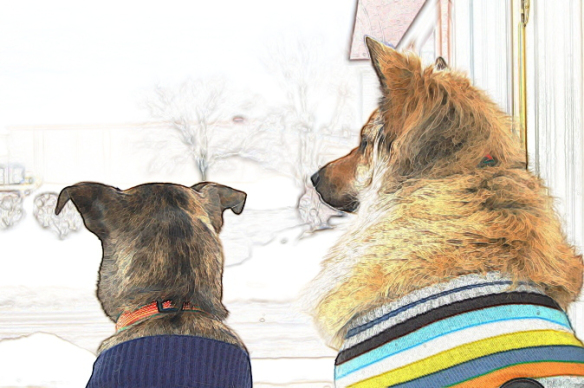
I love our dogs! There is nothing that I would not do for them. I will never get tired of seeing them sit in the front door together, side by side, watching the cars, deer (aka “Big Doggies”), an occasional kitty, and the police cars that patrol the area.

BELLA AND NIKITA BY FRONT DOOR

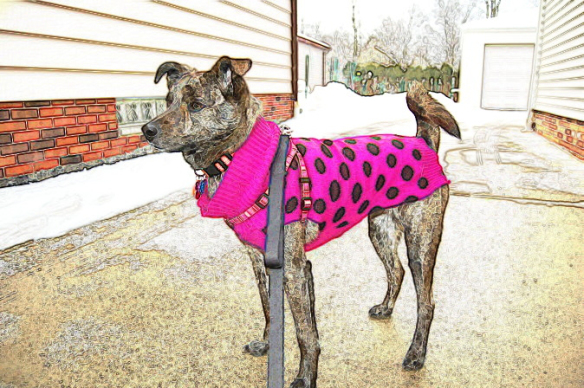
This is Bella’s other new sweater! She looks like a little lady bug in her new pink sweater with black polka dots! I used a neat photo effect on this photo called colored pencil. I love how it brought out Bella’s coloring and defined the bricks on the house.

BELLAS NEW SWEATER2

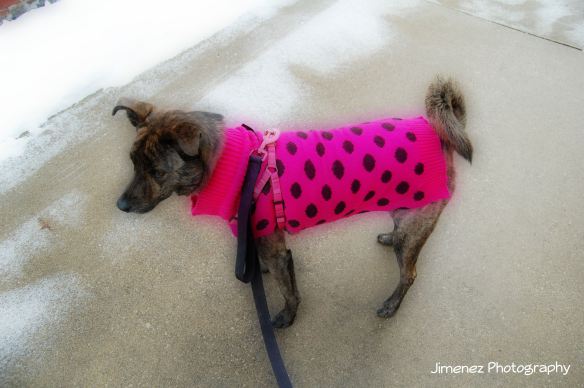
Bella loves her new sweaters because she is now nice and warm and her butt is now covered well too!

BELLA PINK SWEATER

What is the funnest thing to do when it snows? Build Snow Doggies! Here is my rendition of Nikita and Bella as Snow Doggies! I can’t even tell you how…

View original post 77 more words

Lost Dogs – Is your dog at risk?

I really like the checklist in this item. Sometimes, without thinking, we put our dogs at risk. Losing a dog would be one of the most heartbreaking things that any of us experience – let’s re-think our habits before it is too late.

Kathleen Crisley, specialist in dog massage, rehabilitation and nutrition/food therapy, Canine Catering Ltd, Christchurch, New Zealand

Mel's avatarNo Dog About It Blog

IMG_6838I’m often brought to tears by stories of lost dogs that have been found.

Just this past weekend, a ten-year-old dog was found after being lost and out on her own for several days in frigid temps. As I read her owner’s teary and thankful response to all those who helped her get her dog back, I wept.

I remember the powerful waves of emotion that swept over me when I finally had Cupcake back in my arms again – relief, gratitude, and extreme happiness. Even though it has been three years since Cupcake went missing, I have never forgotten those twelve days she was gone. I have only to read another lost dog story or see another missing dog posting, to feel all the fear, worry and sadness all over again.

Losing a dog (no matter how long) changes you. It makes you more cautious, and more attentive. It also makes you less likely…

View original post 491 more words

Sarah’s Something Special Day

This is a great idea for multi-dog households. Every fur baby needs one on one time!

Tales From the Woof Pack's avatarAdventures at Run A Muck Ranch

Recently, we instituted mandatory Something Special Days.   Once a week, each dog is to be separated from The Hoard for 100% attention.  No cell phone, no distractions, just 100% attention focused on one dog.

Today was Sarah’s Something Special Day.

As an added bonus, she had both Crabby and me there to share it with her.

Does this look like a happy girl to you?

DSC_4719

View original post