Category Archives: dog care

Racing dogs wear leggings to prevent injuries

Sled dogs are appearing this season wearing a spandex legging that extends from ankle to shoulder, according to a new article in the Anchorage Daily News.

The leggings protect against “chicken leg” which is a problem when snow builds up on the back of the leg and balls up, eventually pulling the fur out, leaving raw spots that are prone to infection.

Dogs competing in the Yukon Quest International Sled Dog Race are amongst the first wearing the new invention, which has received praise from the head veterinarian in the competition.

Isn’t it great to see new products coming on the market that help dogs?

Dog breath is no laughing matter

We’ve all heard the jokes and comments about dog breath.  Things like “I owned a dog named Halle, he had such bad breath we called him Halle tosis”

However, dog breath is no laughing matter.  Bad breath is one of the common symptoms of gingivits and periodontal disease.  February is National Pet Dental Health Month in the USA.  Take this time to learn a bit more about your dog’s dental health.

Plaque consists of saliva, bacteria, and food particles.  Dental experts say that plaque is 80% bacteria and when it isn’t removed, it will harden into dental calculus – commonly known as tartar.  Tartar is clearly recognizable as a brown hard coating on your dog’s teeth.

The earliest form of periodontal disease is gingivitis.   A reddening or swelling along the gum line in your dog is a sign of gingivitis.  The gums may also bleed when touched.  Gingivitis is reversible if you clean your dog’s teeth.

If gingivitis gets into the cavity around a tooth, the problem literally deepens.  Gums may recede and expose the bone which can also become infected.  This is full-blown periodontal disease and it can be stopped with a proper dental cleaning but in many cases there is still lasting damage.

As periodontal disease progresses, your dog is at risk of systemic infections where bacteria and associated toxins spread throughout the bloodstream.  Researchers believe there is a connection between dental disease and liver, kidney, lungs and heart problems.

Signs of gingivitis and periodontal disease may include:

  • Bad Breath
  • Regular drooling
  • Difficulty with chewing or eating
  • Vomiting
  • Red or swollen gums which may bleed
  • Tartar on the teeth
  • Receding gums
  • Loose or missing teeth

Many dog owners swear by the ‘bone a day’ rule – that chewing something hard will clean their dog’s teeth.  However, more veterinarians recommend teeth brushing now than ever before and they will check your dog’s teeth at their annual check-up.

Dog toothpastes are available in flavours like chicken, beef, malt and vanilla and most dogs will rapidly get accustomed to having their teeth brushed.  It can be a game and the toothpaste is the reward.

Weight gain and obesity are not only human conditions

We live in modern times, and in western societies such as ours, obesity and weight gain are consistent problems.  And not just for people.

36 million pets in the United States are obese, according to the Association for Pet Obesity Prevention.  In dog population terms, that’s 55% of the dog population.  The Association does a pet obesity survey each year, timed with National Pet Obesity Prevention Day (in October), where it asks pet owners to fill out a survey about their pet’s size, breed and eating habits.

Veterinarian Ernie Ward is a co-founder of the Association and he says that the focus on reward-based training has helped to contribute to the obesity problem.  Simply put, owners are not adjusting their dog’s daily intake of food at mealtime to compensate for treats being given as a reward.

And once a dog is fully trained, the rewards seem to keep coming for sometimes very basic tasks.  Like pooping, for example.

(Ask yourself:  once your child is potty-trained, do you keep praising him/her each time they use the toilet? – even into their teenage and adult years?)

And I’ve found that delivering the news to a client that their dog could lose some weight can often be a reason for not being asked to return for another massage treatment.  According to a recent article in The Boston Globe, I’m not alone.  Vets that deliver the news that a pet is overweight may find that the owner becomes defensive or, worse, takes their business elsewhere!

However, when I am dealing with a dog with arthritis or other mobility disorder, I am looking for ways to relieve their pain.  If they are carrying around extra weight, their sore joints and muscles are pulling double-duty.  I remember a client with a Pug, for example, who was easily twice its normal body weight.  Sure, the dog had arthritis, but it was so fat that it didn’t want to exercise and so weight loss was going to be a challenge and something the owner had to a) recognise and b) act on.

The Globe article also discusses the wide range of calorie content amongst commercial dog foods.    People may change their dog’s food, but continue feeding the same number of cups per day.  Weight gain is insidious and many people don’t recognise that their dog has put on weight until a vet or someone else points it out to them.

I do nutritional assessments for this reason.  I ask questions about the dog’s lifestyle, exercise habits and eating.  And I can run caloric calculations based on the dog food label to give advice on how much to feed.

There are many health professionals including your vet that have your dog’s best interest at heart.  Don’t be afraid to ask if they think your dog is overweight and be humble enough to make changes.

P.S.  When I take Daisy to her acupuncture treatments, my vet asks me to weigh her prior to each consultation.  This keeps me very disciplined to ensure that Daisy remains in her ideal weight range.

Some full-service pet shops and veterinary practices are happy for you to drop in to use their scales.  Why not make it a habit of walking your dog to these places for a weigh-in?  It’s a new routine that will keep you focused on your dog’s weight in a more positive way.

More about spinal cord injury

This video, courtesy of the University of California San Francisco,  shows the gait effects of  spinal cord injury and a very good close up of the proprioception test that is used by vets.   (See my previous blog about prioprioception here.)

The alpha roll myth

When scientists studied captive wolves (and I’m talking about research that dates back to the 1960s), they observed fighting for dominance within the group and extrapolated that information as relevant to domesticated dog behaviour.  Unfortunately, by studying captive wolves, the scientists were observing an artificial pack – wolves that were placed together in very unnatural circumstances.

Over the years and ‘informed’ by this research, the theory of being the Alpha Dog developed.  The alpha dog is the top dog of the pack, the dog who eats first (as an example).

Trainers who picked up on the alpha dog theory taught their clients to ‘alpha roll’ their dog.  That is when you force your dog to roll over on its back to signal your dominance.

It is true that wolves roll over as a submissive behaviour, but nothing in the record suggests that wolves force other wolves to roll over.   Wolves will roll over on their backs as a submissive gesture – they do it willingly and not by force.

This YouTube video shows a wolf rolling over as a sign of submission:

There are many trainers today who are adopting reward-based techniques, but others still adhere to a rigid interpretation of dominance theory including alpha rolls.  I’m saddened to say that when I first adopted Daisy eight years ago, I went to a local dog training club in Christchurch where the teacher believed in alpha rolls.  When Daisy didn’t go ‘down’ on my command, he took both of her legs on the right side and flipped her over.  I can still remember the frightened look in her eyes and I was almost in tears myself over the incident.

My advice is to stay away from any dog trainer that doesn’t use reward based techniques.  Make sure any trainer you use doesn’t have outdated ideas of what is true canine behaviour.

Resolve to be a great dog owner this year

There are lots of jokes that circulate at this time of year about a dog’s resolutions for the new year (e.g., kitty-box crunchies are not junk food, etc.).  But what about your resolutions for your role as a Doggy Mom or Doggy Dad?

Here are my suggestions for new year resolutions:

1.  Resolve to feed your dog the highest quality dog food you can afford.  Not sure what to feed or even if you are feeding the right amount?  That’s where a nutritional assessment comes in.  People like me are trained in reading the labels of your existing dog food and with some information about your dog’s condition and lifestyle, we can tell you a lot about whether you are feeding the right amount and make un-biased suggestions about your core dog food.

In my case, I’m not affiliated with any veterinary practice or brand of dog food (many professionals take their nutrition training from a programme offered by dog food manufacturer – ask about this when selecting a provider for nutritional advice!)

2.  Exercise more – for your dog and yourself!  Exercise is important mental and physical stimulation for both you and your dog.  Discover new walks, link up with walking partners and doggy buddies for more variety, and manage your exercise according to the temperatures of the day (your dog doesn’t have the heat regulation system that you do in the summer; and their paw pads can be irritated by road salt and ice during the winter).

3.  Groom your dog – regularly.   If you don’t know what to do, then take your dog to a professional groomer and get advice on maintenance that you can do at home.  It breaks my heart to hear about veterinary nurses and groomers that have to work on severely matted dogs because their owner has neglected their grooming responsibilities.

4.  Make time for your dog.  I signed off last month’s newsletter to my Canine Catering customers saying “remember that the best thing you give your dog this holiday season is your time.”  It goes for the rest of the year, too.  Your dog is a social animal and needs your love and attention throughout the year.

5.  Keep a watchful eye on your dog’s health, ensuring they are not overweight (or underweight) and that they receive regular veterinary care.  (For a dog to be accepted into my dog massage and rehabilitation practice, the owner must certify for me that their dog is under regular veterinary care.)

6.  Have fun together – play time is essential.  Dog walks are not the only stimulation for your dog.  Choose an activity that suits both you your dog.  It could be agility or obedience training, rally-o, fetch, cross-country skiing, hiking/tramping, or the use of interactive dog toys.

I wish you and your dog a wonderful 2012.  Contact me through this blog or my website for information on any topic I cover in this blog.

Happy New Year for Arizona dog

As we start a new year, great news out of Montana.

According to the Salt Lake Tribune, Buddy has been missing near Butte since November 28th.  He has been reunited with Phil Nichols, his owner, this week.

Read more here.

Canine PTSD: Dogs Suffer Like Soldiers

The notion of canine post-traumatic stress disorder (PTSD) is still somewhat new, although those of us living in the Christchurch region of Canterbury (New Zealand) have witnessed first-hand how dogs cope with extraordinary stress caused by our ongoing earthquakes.

I have one dog in my massage therapy practice who is undergoing treatment for post-earthquake stress.   She shows signs of self-mutilation (excessive licking) and her owner reports that she is a happy dog when taken on trips away from home but she shows worry and anxiety when she returns.  She’s getting better, though, through love, attention, and massage therapy to work on acupressure points that help with the stress response.   It’s all about desensitization and it takes time.

Earlier this month, the New York Times published this article:  After Duty, Dogs Suffer Like Soldiers.  In this article, you’ll read that there is a specialist military veterinary hospital called the Daniel E. Holland Military Working Dog Hospital at Lackland Air Force Base in Texas.  There’s even a chart being used to show the acupressure points of the dog!   The hospital was named after Lieutenant Colonel Daniel Holland, who died in 2006 when a roadside bomb exploded in Iraq.

Some military dogs are being retired from service and re-homed:  For War Dogs, Life with PTSD Requires Patient Owners talks about one adoptive family’s approach to caring for their dog, Buck.

Before Cesar and Victoria

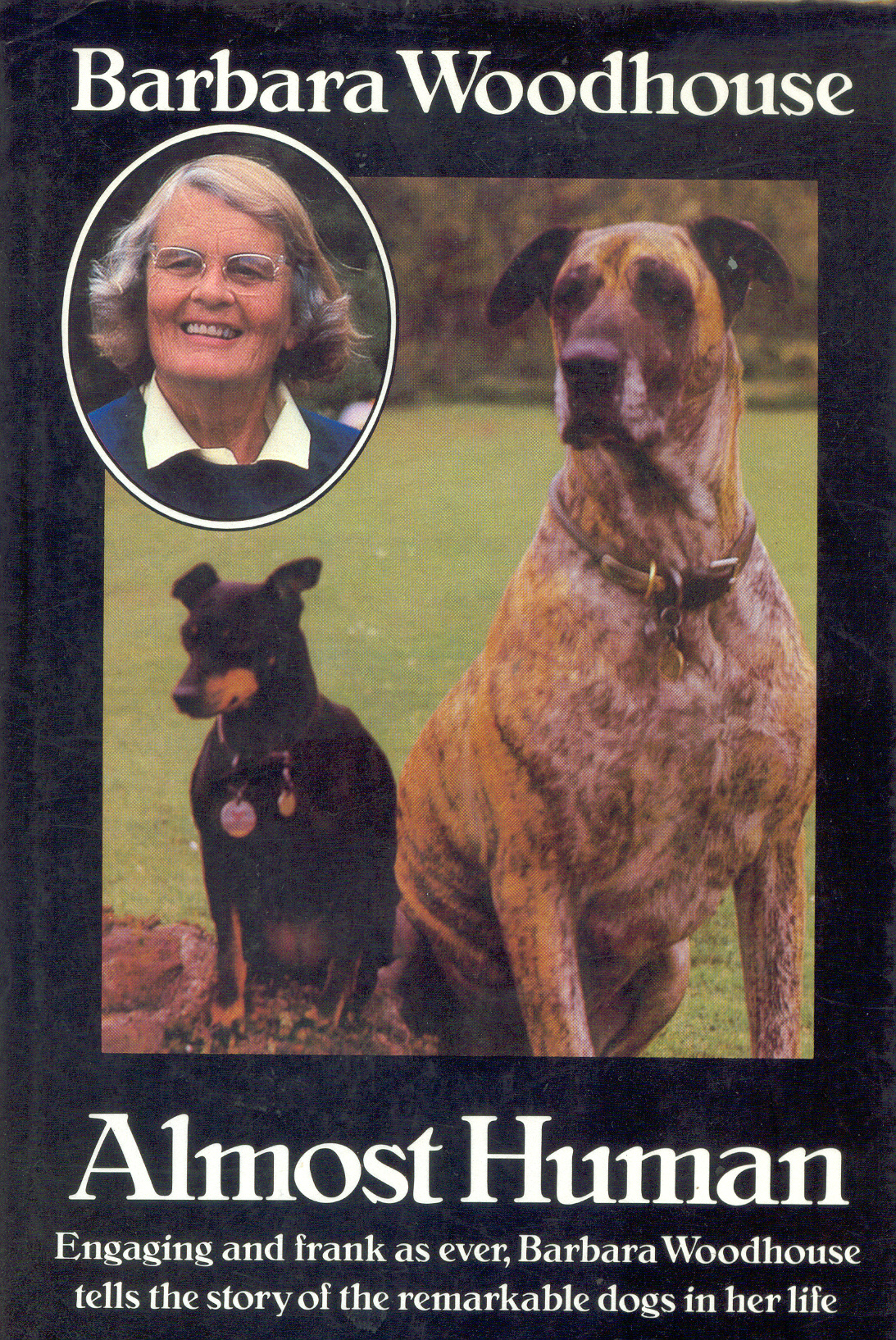
Before Cesar Millan and Victoria Stilwell, there was Barbara Woodhouse.  I have just finished reading one of Barbara’s books, Almost Human.  It made me realise that today’s craze of celebrity ‘dog experts’ isn’t new; we are just repeating a more modern version of what has gone before.


Barbara’s Great Danes, Juno and Junia,  appeared in many British television and films, acting alongside famous actors such as Sir Alec Guinness, Clark Gable and Roger Moore.

In Almost Human, Barbara writes:  My Danes were treated in exactly the same way as our children, and in so doing I learnt an awful lot about how much dogs like to be included in everything the family does…By the end of their lives I am sure they knew at least 250 words and their meaning.

Almost Human was published in 1976 and is a memoir about all her Danes: Jean, Jyntee, Juno and Junia.  There are chapters about owning and caring for a Great Dane.

Her other books included No Bad Dogs, Talking to Animals, Dog Training My Way, and A-Z of Dogs and Puppies.  In the 1980s, Barbara hosted a UK television programme called Training Dogs the Woodhouse Way.  Mrs Woodhouse even recorded an LP (the precursor to DVDs!) entitled Training Dogs Her Way.

Barbara suffered a fatal stroke in July 1988, she was 78.

Exercise for small dogs

Sometimes people forget that small dogs have different needs for their care and exercise than larger breed dogs.  Here’s some tips on how to keep your small breed dog happy and active.

  • Walking

Walking is ‘tops’ on my list for exercise for all dogs.  There are added health benefits for the dog owner, too. I recommend twice per day walks.  You need to be careful about the length of walk for small dogs because they may not be able to go as far as you can.

  • Swimming

I’m a big supporter for hydrotherapy for dogs, particularly as they age or have rehabilitation needs.  But, swimming is excellent general exercise for your small breed dog.  Check out hydrotherapy facilities in your area for information on ‘casual’ swims (therapist supervision not required).  In Christchurch, we have an excellent facility for this:  Dog Swim Spa.

  • Ball games – playing fetch

Small dogs can get quite a bit of exercise in by playing with toys and their owners.  This is great inside exercise during the winter months – provided you have a long hallway or room for your dog to play in.

  • Using the stairs

If your house has stairs or you can take your dog to work with you, using the stairs can be excellent exercise for your small breed dog.    Some breeds, such as dachshunds, should not be encouraged to do lots of stair climbing because their long spine makes them vulnerable to stress and strain injuries including slipped discs.    Be mindful of just how much effort a small dog may need to climb a stair designed for full-grown humans.  Aging dogs with arthritis should avoid stair climbing as a major source of exercise – there are better options as described above.