Category Archives: dog care

A city good for dogs is great for humans

I went to a talk earlier this week by Stephen Jenkinson, who is visiting New Zealand from the UK.  Stephen works as a consultant in the UK, with clients including kennel clubs and other agencies.  His area of interest is how public authorities can help reduce conflict over dogs and dog ownership by providing adequate facilities and opportunities for dog owners to do the right thing.

This type of urban planning helps to make dog ownership easy.  For example, you don’t have to drive across town to find an off-leash dog park because there will be dog exercise areas that are within walking distance. (This helps to reduce traffic, greenhouse gas emissions, and conflict when dog owners take their dog off-lead in a ‘normal’ park or reserve.)    Areas in larger recreational parks may be designated for use by dogs and their owners, thus keeping other tracks free for other users who do not want to play or engage with dogs.  And there is a growing body of knowledge around design of dog-friendly accommodation such as apartments and condominiums.

Stephen feels that there is opportunity for the rebuild of Christchurch to do better for dogs, their owners, and all non-dog people.   Sadly, no one from the Christchurch City Council, CERA, or Gerry Brownlee’s office participated in Mr Jenkinson’s public talk on Monday evening.  That signals a lack of senior level buy-in and support for the concepts.

I’ll be doing more research on this topic over the coming weeks and months, but if you’d like to get a flavour for what Mr Jenkinson talked about, you can listen to him speak with Kim Hill on Radio NZ National.

Consultant Stephen Jenkinson with his Border Collie

Money saving tips for dog owners

Salaries and wages aren’t growing as fast as the cost of living and so it is always wise to look for ways to cut your costs.  This includes the costs of dog ownership.

Here are my tips for reducing the overall cost of caring for your dog:

  • Buy quality toys and rotate them – instead of buying toys that are the cheapest you can find (there have been reports of cheap imported toys containing lead paint, for example) – buy quality.  Every few weeks, rotate the toys available to your dog.  A deep toy basket will help you with this chore!
  • Learn to bathe and groom your dog at home, and then cut down on the trips to the professional groomer.  You’ll still want that professional look – but it will lengthen the time between visits and save you money.
  • Buy locally.  Look for locally made shampoos, toys,  food and treats.  These are likely to be less expensive than imported brands (the cost of petrol is a good indication of rising transport costs associated with imports).  The added benefit is you are returning business to people in your area.
  • Buy secondhand goods.  Sites like Trade Me are full of useful products that are up for sale.  You can buy dog kennels, crates, blankets, coats, shampoos, and grooming tools.  In some cases, small businesses (like mine) place products on the site at competitive prices to retail.
  • Buy with your friends.  If you have a small dog, you probably don’t want to buy the largest size bag of food but typically it is the largest bag with the best price.  Why not buy a re-useable storage container and split the cost of a large bag with another dog owning friend?  You both win!
  • Watch out for your dog’s dental health.   Feed bones and chews regularly and introduce teeth brushing for added benefits.  Preventing dental problems will save you money and your dog pain in the longer term.
  • Look out for alternative places to buy your pet supplies.  I have found MyVet online in New Zealand for things like flea and worming treatment.  Much better prices than at the vet or in the pet store.
  • Keep up with your regular veterinary visits.  Regular veterinary checks are essential to picking up on health problems early.  Preventive healthcare is an investment, not a cost.

Please feel free to post your cost-saving ideas by submitting comments to this blog.

What’s proprioception?

Proprioception is the awareness of how your body, particularly your limbs, are oriented and how your body moves.  A type of self-awareness.  And your dog has it too!

When your dog next goes to the vet for an exam, watch how the vet will support the dog’s body and lift the hind paw, placing it on its toes or more of an upside down position.  Then watch your dog replace its paw to its normal position.  Your vet is looking for how quickly your dog does this and a dog with normal proprioception will replace its paw almost immediately.  Dogs with a neurological deficit will take longer.  Sometimes this isn’t a problem, and sometimes it is a sign that something is going wrong.  It depends on what other symptoms your dog has.

Other symptoms of a proprioceptive deficit include a wearing of the toe nails in an abnormal pattern (I see this a lot in my massage practice) or a strange posture when your dog goes to sleep (paws or legs in an abnormal position).

There are exercises that you can do to enhance your dog’s proprioception.  This includes walking over sticks or ladders as seen in this YouTube video:

Kathleen Crisley, Fear-Free certified professional and specialist in dog massage, rehabilitation and nutrition/food therapy, The Balanced Dog, Christchurch, New Zealand

In memoriam

On Monday, we lost a great dog by the name of Olliver (yes – that’s the correct spelling). A Dalmatian, Ollie had great spirit, which showed through even more when he lost the ability to walk in July 2010.  The veterinary profession have been stymied as to the reason for Ollie’s sudden loss of function and his owner has generously offered Ollie’s body for study at Massey University.

With the love and constant care of his owner, Ollie was engaged and alert until his sudden crash on Monday with internal bleeding.  I miss him.   Working with Ollie three times per week over the last year, we connected in a way I haven’t had the privilege of doing with any other dog.  Rest well, Ollie, my special boy.   I will take you with me for the rest of my days.


The Rainbow Bridge

Just this side of Heaven is a place called Rainbow Bridge.  When an animal dies that has been especially close to someone here, that pet goes to Rainbow Bridge.  There are meadows and hills for all of our special friends so they can run and play together.  There is plenty of food and water and sunshine, and our friends are warm and comfortable.  All the animals who had been ill and old are restored to health and vigour:  those who were hurt or maimed are made whole and strong again, just as we remember them in our dreams of days gone by.

The animals are happy and content, except for one small thing:  they miss someone very special to them who had to be left behind.  They all run and play together, but the day comes when one suddnely stops and looks into the distance.  The eyes are intent, the eager body quivers.  Suddenly he begins to break away from the group, flying over the green grass, his legs carrying him faster and faster.  You have been spotted and when you and your special friend finally meet you cling together in joyous reunion, never to be parted again.  The happy kisses rain upon your face, your hands again caress his beloved head and you look once more into the trusting eyes of your pet, so long gone from your life but never absent from your heart.

Then you pass over the Rainbow Bridge together…

Kathleen Crisley, specialist in dog massage, rehabilitation and nutrition/food therapy, The Balanced Dog, Christchurch, New Zealand

Minding the lumps and bumps

This week, I had the pleasure of working with a dog whose owner is very attentive and diligent.  She was the first owner in a long time to provide me with her dog’s ‘lump and bump’ chart.

Many dogs, particularly as they get older, develop lumps and bumps under the skin.  Noticing when a new lump appears, and getting your vet’s opinion about it, are very important.  Many lumps are not sinister and require no attention because they are benign.    Others aren’t.

Whenever I take on a new dog/client for massage and rehab therapy, I start keeping records of the dog’s muscle condition, problems areas, and lumps/bumps.   Since I see dogs on regular basis (the length between visits varies according to the dog’s condition), I can sometimes pick up changes that their owner misses.  This is yet another benefit of massage therapy!

But, for the most part, an owner should be familiar with their dog’s condition.  Through regular grooming, you will notice where your dog has lumps and bumps and know which ones have already been tested by your vet for ‘nasty’ cells.  So start with an outline of your dog’s body and record where they are.

Refer back to your chart periodically when you are bathing and grooming your dog.  If you find something that wasn’t there before, record its size and location on your chart and take your chart with you to the vet.

If you are local to the Canterbury area, we also discuss lump and bump charts and how to compile them in my dog massage workshops for owners.

Kathleen Crisley, Fear-Free certified professional and specialist in dog massage, rehabilitation and nutrition/food therapy, The Balanced Dog, Christchurch, New Zealand

CSI – dog style?

Pooprints, based in Tennessee (USA), is offering DNA testing of a different kind.  It is not about testing your mixed breed dog to find out their lineage, it’s about DNA testing of dog poo!

The number of subdivisions, condominium-style accommodation developments, and apartment complexes is on the rise in the US.  This is a result of a ‘downsizing’ of accommodation because of the economic recession as well as growth in population centres where work is available, but cost of living and commuting times are also an issue.  In these types of developments, there are dog owners living alongside non-dog owners.  And poop is  a problem.

(For my New Zealand readers, read my Last Word column in the March 2011 issue of NZ Dog World magazine.  In that column, I discussed the looming liability of infill housing, population growth,  and the growing problem of dog owners who do not clean up after their dog.)

The company’s service is rather straightforward.  First, a residential community decides to start a dog DNA testing programme.  Usually, this test is mandatory as part of signing up to live there. A mouth swab is taken of your dog and sent for  DNA testing and the results are entered into that site’s database.

Then, a site manager is probably responsible for poop patrol in your community.  They take samples of poop that has not been cleaned up and send the samples for DNA testing (because epithelial cells in the wall of the intestine are excreted every time a dog defecates).   The site manager will be given a report about the dog/owner match in order for followup to occur.

Communities will have rules about the number of infringements required for that person to be fined, or worse, kicked out of their residence.

It may sound ‘over the top’ but it is a symptom of how strongly some people feel about poop that is not cleaned up.

CNN covered the story of one residential development in New Hampshire that has signed up to use the Pooprints system.  Read about it here.

Sea burials for your pet

New England Burials at Sea offers a special service for pet burials at sea along the US coastline from Maine to Miami.

The most common service is for scattering of cremation ash, although the company also offers organic cotton shrouds for full body burials by enquiry.

The company was founded by Brad White, a self-confessed dog lover and owner of Schipperkes who understands that pets are part of the family.

Ceremonies start at $95.0o.  A poem is usually read after the ashes are scattered, followed by flowers or wreaths that are placed on the water.  Owners can email a photo of their pet to Captain Brad before their charter so a photo of their pet is included on the sea burial certificate.   The burial certificate records the date, time, and latitude and longitude (location) where the ashes were scattered.  Many charters are unattended by the pet’s family, but in one case Captain Brad says that over 40 people attended a pet farewell ceremony on his boat.

Read more about the pet burial service here.

A quick Google search shows that there are several other firms offering pet burials at sea.  They are:

San Diego Burial at Sea

Newport Landing Burial at Sea (Los Angeles area)

A Burial at Sea Maritime Funeral Services (Rhode Island)

Amazing Gracie’s Pet Burials at Sea (San Diego area)

The Saving Lives campaign

The Royal NZ Society for the Prevention of Cruelty to Animals (RNZSPCA) has embraced the philosophy that ‘every life is precious’ and its Saving Lives campaign has a number of platforms to ensure that the lives of animals are saved and that they enjoy a quality of life.

When implemented, each of the platforms is aimed at supporting the goal of saving lives.  The platforms are:

  1.  Our Animals  – Every Life is Precious
  2. Pet retention
  3. Rehabilitation
  4. Desexing
  5. Maximising adoptions
  6. Rescue groups
  7. Foster homes and other volunteers
  8. Saving the strays
  9. Community involvement
  10. Can do!

The Hokitika SPCA has made headlines for achieving a no-kill shelter status, a direction that the RNZSPCA not only endorses, but says that it wants to see replicated throughout the country .  Read all about it in this article in the Greymouth Star.

PETNet – new pet food incident tracking system

This week the US Food & Drug Administration and the Partnership for Food Protection launched a new web-based system to enable real-time information sharing about pet food incidents.

‘Incidents’ are those occasions that appear to be related to defects in pet foods or illnesses brought on because of the consumption of pet foods.  The concept is that federal, state and local authorities that are responsible for regulation of the pet food industry and the tracking of outbreaks of disease in companion animals will register information on the voluntary system.  If they suspect a trend or suspicious connection with pet foods, they’ll register their information on the PETNet system.

In 2007, there was the huge recall of pet foods contaminated with melamine and when the events were debriefed, it showed that veterinarians were picking up on a trend but had no readily available platform to share their concerns.  Regulatory authorities were slow to react.  Through the internet, email systems and professional networks, veterinarians were able to get the word out that there was a problem with pet foods, but not in as quickly as they would have if there was a platform such as PETNet.

The Partnership for Food Protection was established in 2008 by the FDA bringing together federal, state, local, territorial and tribal representatives with expertise in food, feed, epidemiology, laboratory, animal health, environment and public health.

This is a list of PETNet project members.

Source:  US Food & Drug Administration media statement, 1 August 2011

Dogs and grief

Dogs are emotional creatures and they often form strong bonds to their owners, extended family, and other dogs in the household.  This, of course, is one of the many benefits of having a dog (or more) as members of your pack.   Because of these emotional connections, dogs also experience grief when a loved companion dies.

Symptoms of grief can include lethargy, loss of appetite and weight loss.  With the grief comes a depression of the immune system, possibly leaving your dog vulnerable to problems like kennel cough (even if they are vaccinated).  Being aware of these symptoms is important and when a loss is experienced, extra care and attention are needed to help the dog manage their grief.  Things like extra outings to new parks can help stimulate brain activity and keep the dog happy.   Ensuring the dog has a solid routine they can rely on is also very comforting.   I have even been called in to give grieving dogs a relaxation massage to provide them extra stimulation and help them feel better.

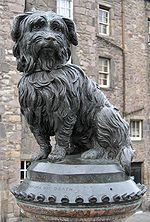
One of the most ‘celebrated’ cases of a dog’s loyalty to its dead master is the story of Greyfriars Bobby.  Bobby was a Skye Terrier owned by John Gray, who worked in Edinburgh, Scotland as a night watchman.    In February 1858, John Gray died from tuberculosis and his body was buried in the Greyfriars Kirkyard.  According to legend, for the next 14 years, Bobby spent most of his time at the grave mourning his master.  In 1872, following Bobby’s death, a statue of the dog by William Brodie was erected outside of the gates of the Kirkyard with funds from a local patron.

The Greyfriars Bobby statue located in Edinburgh, Scotland

For more recent stories about dogs who have grieved for their owners, read The phenomenon of grieving dogs.