Category Archives: dog care

Collars risk causing neck injuries in dogs, study shows

A study led by a canine scientist at Nottingham Trent University looked at the potential impact of pulling on the lead and the related pressure on the neck, using a variety of of collar-types and styles.

Young Woman Walks Her Dog In California Park

The collars and a slip lead were tested on a canine cylinder neck model with a pressure sensor.

A range of forces were applied to the lead representing different interactions—a firm pull (40 Newtons) strong pull (70N) and a jerk (141N) – with the contact area of the collar and the pressure on the neck being recorded.

The study, which also involved the University of Nottingham, found that with all the collar types and styles tested—even those that were padded or had a wide fitting—the pressure exerted on the model neck would be sufficient to risk injury to the dog.

No single collar tested provided a pressure considered low enough to reduce the risk of injury when pulling on the lead, they found.

Lead jerks on the collar may occur when dogs on extendable leads abruptly come to a stop, when a dog lunges on a lead, or is ‘corrected’ by the handler.

The researchers argue that as all collar types will pose some risk, dogs should be trained to walk on a loose lead without pulling, or walked using a harness which applies no pressure to the neck.

“All types of dog collar have the potential to cause harm when the dog pulls on the lead,” said Dr. Anne Carter, a researcher in Nottingham Trent University’s School of Animal, Rural and Environmental Sciences.

She said: “While collars provide a means to identify a dog or demonstrate ownership, they are also frequently used as a connection between handler and dog and to facilitate control, restraint or movement.

“Even the ‘best’ type of collar is putting too much pressure on the dog’s neck if they pull on the lead and this is risking injury. We suggest that collars should be used to display ID tags and dogs should be walked on a harness or loose lead that avoids any pressure on the neck.

“It is not recommended that collars be used as a means of control for any dogs that may pull on the lead.”

Study co-author Dr. Amanda Roshier, from the School of Veterinary Medicine and Science, University of Nottingham, said: “Using sophisticated engineering tools, we simulated collar pressures that dogs may be exposed to on the lead and how this varies with different collar models, and the force exerted by a handler. Our tests aimed to give practical insight into how the choice of collar and its use impacts the welfare of dogs.”

Rachel Casey, Director for Canine Behaviour and Research at Dogs Trust, said: “It’s a common problem for owners that their dog pulls on the lead, when excited to get out on a walk. The findings of this research highlight the extent to which all collars exert pressure on the sensitive tissues of dogs’ necks when there is tension on the lead. It is for this reason that we recommend that owners attach a lead to a well fitted harness—particularly if their dog is likely to pull on the lead during a walk or if they use a long line during walks.

“Walks are also made more pleasurable for pet and owner if dogs are taught to walk calmly on a loose lead. Taking a bit of time to teach your dog that he or she can get to the park without pulling, will save a lifetime of pulled arms as well as avoiding possible injury to your dog. We have a range of resources available online on how to teach your dog to walk on a loose lead using a reward-based approach.”

The study was undertaken at the Wolfson Labs, in the Faculty of Engineering with support from bioengineer Professor Donal McNally, also of the University of Nottingham.

The research is reported in the journal Vet Record.

Source:  Nottingham Trent University

Beyond Izzy’s pram (managing dogs through to old age) Part 9 – medications

Today, I’m talking about medications and their role in your dog’s care.  Medications are the 7th rung of our ladder…

Arthritis management diagram - the ladder

Medications are prescribed by your veterinarian after they have examined your dog and are confident on the match between the medication and your dog’s conditions.  For dogs with multiple health problems, it’s incredibly important to use the same veterinarian or to declare all medications you are using with every vet to ensure there are no adverse drug interactions.

As with healthcare for people, we now have more drugs than ever to support and treat health conditions in our dogs. Although we have been talking a lot in this series about arthritis, aging dogs often develop other health conditions.  These include things like urinary incontinence and kidney disease, as examples.

My English Pointer, Daisy, took Propalin syrup for many years because of urinary incontinence (she would leak urine, usually while asleep).  Thanks to the liquid form of the medication, I was able to gradually get her to the lowest effective dose – and that’s something I really liked because I didn’t want her to be over-medicated.

Words of advice #1:  Always ask if your dog’s medication comes in a liquid form.  Many pet parents struggle to give their dog a pill, whereas liquid is often easier to put over food or down the throat.  And, as noted above, with a liquid medication you have greater ability to adjust dosages than with pill formats.

Medications have a huge role to play in the management of arthritis, an inflammatory disease that causes pain and discomfort.  The most common group of drugs used to help patients with arthritis are the non-steroidal anti-inflammatory drugs (NSAIDs).  These include:

  • Rimadyl
  • Carprieve
  • Metacam
  • Previcox
  • Trocoxil
  • Pentosan Polysulfate

Other pain medications which are not in the NSAID class include:

  • Gabapentin
  • Codeine
  • Fentanyl
  • Ketamine
  • Amantadine
  • Paracetemol

It is fairly common for me to meet dog parents who are concerned about giving their dogs medications because they’ve heard that they can have side effects.  That concern is valid to a point, but not to the point that you allow your animal to live with enduring pain.  Pain is an animal welfare issue.

In addition, I have never met a person who said that they would withhold arthritis medication from their aging mother, father or grandparents because they were worried about side effects.  If it’s good enough for your human loved ones, this approach is also good enough for your dog.

Words of advice #2:  Adopt a trial approach to pain medication.  I’m not talking about ‘free samples’ here – I’m talking about a medication trial that lasts a few weeks to see what effects they have on your dog and to help you get accustomed to the idea of giving them medication.  Many veterinarians will endorse this approach.  After a consultation, your vet will prescribe several weeks worth of pain medication.  Your job is to follow the dosage instructions and to watch your dog’s behavior…

By the end of many pain medication trials,  it is common for me to hear that the dog is bouncing around again, walking for longer distances, eating more robustly, etc.  That tells us how much pain they have been in and justifies prolonged usage of the medication.

Remember, arthritis is a degenerative disease.  It’s not going away – and so neither is the pain.

During New Zealand’s Covid-19 lockdown, a woman contacted me about her dog who, she said, prior to lockdown had been reluctant to walk on an intermittent basis. But since she was home more and walking him regularly, she had noticed that some days he wouldn’t walk at all and on others, he’d want to head for home a lot sooner than planned.

She described his behavior to me and, since I was unable to work with clients at the time, I suggested she talk to her vet about a pain management trial.  Vets were classified as essential services during the lockdown.

She took my advice and when I followed up with her, she told me that her dog was a puppy again.  He’s going for x-rays now because in post-lockdown, the vet is able to admit the dog for x-rays.  The images will tell us the extent of his suspected/likely arthritis.  And we’ll use massage, laser and exercise to manage him along with the medication.    (Remember, we can go up and down our ladder)


Izzy the greyhound in her pram

In closing, I’ll bring this post back to Izzy.  She has corns and arthritis and, based on our experience with NSAIDs after surgeries, they weren’t an option for her for longer term pain management.  Her stomach doesn’t tolerate them.  Our vet suggested gabapentin, which she takes twice each day.

The pain management is part of her daily regime which includes, of course, rides in her pram when she is too tired or sore to continue walking.  We review Izzy’s health and degree of lameness on a regular basis with our vet before getting a refill of her gabapentin.

Over time, medication needs can change.  If one medication doesn’t work, there is usually something else that the vet can prescribe for your dog.


Got questions about this post?  Please feel free to post a message or contact me through my practice, The Balanced Dog.

Kathleen Crisley, Fear-Free certified professional and specialist in dog massage, rehabilitation and nutrition/food therapy, The Balanced Dog, Christchurch, New Zealand

In a world with Covid-19, an in-home pet service offers peace of mind

Balanced Dog Facebook banner

If Covid-19 has taught us anything, it is that your home is where your heart is…where your dog is… and where you are in control.  You control who comes in and who doesn’t, and you also have complete control over cleaning of surfaces and airing of rooms.

For this reason, I think more than ever, the pet services that can offer an in-home service offer true value.

Each in-home service should provide you (the customer) with a comprehensive Covid-19 safety plan which has details about their equipment cleaning, personal hygiene and contact tracing procedures.  Since in-home services are 1:1, it means that you and your dog are kept at a distance (literally) from the service’s other customers and this reduces your risk of exposure.

For distancing purposes, you can also set up your home in a configuration that works for you and your dog – while still keeping your social distance from your groomer/therapist/trainer.  Again, this is a win for you and also a win for your visiting professional.  Distance = safety.

And when your service provider has left your home, you know exactly what areas of your home to clean; I recommend using a main room that has easy access to your front or back entrance door.  This means that your visiting professional doesn’t need to walk through other rooms – further restricting the areas you will want to clean when they have finished.

I know that some pet services can’t be provided in-home.  But many can.   We live in uncertain times.  Control of your surroundings can keep you and your family safe.

Kathleen Crisley, Fear-Free certified professional and specialist in dog massage, rehabilitation and nutrition/food therapy, The Balanced Dog, Christchurch, New Zealand


Beyond Izzy’s pram (managing dogs through to old age) Part 8 – adding complementary therapies

This is the post I’ve been wanting to write – the 6th rung on our ladder is complementary therapies – my specialty!

At the outset, I need to say that you will find some professionals/websites who believe that you need your vet’s permission to use complementary therapies.  That is not correct.

While you should always make your vet (and any other member of your healthcare team) aware of what treatments you are using with your dog, you are your dog’s guardian.  The decisions you make about your dog’s healthcare are up to you – provided of course that what you are doing for your dog meets accepted ethical standards and is within the law.

(Read further to navigate the interface between traditional veterinary care and complementary care….)

Arthritis management diagram

In my experience, the reasons why dog parents are interested in complementary therapies varies.

  • I meet people who have a mistrust of medications (which will be the subject of Part 9 in my series) and they want to lower their dog’s dependency on them
  • Others have used complementary therapies successfully for their own healthcare and seek to do the same with their pet
  • Some just want to ensure that they have done everything they can for their dog and feel that they have reached the maximum benefits with traditional veterinary care alone
  • And others see complementary therapies as a cheaper option than traditional veterinary care and seek it instead of going to the vet.  (There’s a difference between complementary and alternative!  I will not take clients into my practice who cannot provide records to show that their animal has been under the care of a qualified veterinarian.)

Key Point 1:  If you meet a complementary therapist who speaks badly about veterinary care, or actively encourages you not to go to the vet, then my advice is simple: walk away.


As a pet parent, I have used various complementary therapies with my dogs over the years.  These have included:

  • acupuncture
  • acupressure
  • massage
  • laser therapy
  • supplements
  • hydrotherapy
  • TCM food therapy
  • homeopathy
  • flower essences
  • herbal medicine
  • medicinal mushrooms
  • crystals
  • animal communication

It’s important to understand the modality of the therapy and what it aims to achieve.  Every practitioner should be able to give you a clear understanding of what they do with your dog and whether their therapy is a match for your dog’s situation.

Key Point 2:  Ask the practitioner about their qualifications and commitment to further study.  Have they attended specific training in their modality?

Be cautious of claims such as  “I mentored with…”  Mentoring is not structured training with examination, case studies, or a standard that the student must meet to become qualified.

While online study is useful for continuing professional development (and I use this mode myself), I am wary of ‘core’ qualifications which are achieved online exclusively.  A professional tutor or trainer should have been able to communicate with the student and seen their work firsthand and you just can’t get this quality of instruction through videos alone.  Moreover, if a practitioner is prepared to pay money to travel to achieve their qualifications, it gives you added assurance that they were prepared to invest in their career.

Key Point 3:  Look for other signs of professionalism like professional affiliations and, if the modality is regulated where you live, are they compliant?

Professional associations exist to support their professions with continuing education requirements, peer support, group insurance policies for liability/indemnity and networking.  In the dog care field, there are developments happening all the time.  Modalities need to adjust as new information comes to hand.  So if your practitioner isn’t connected to any associations, you have to ask why…

Key Point 4:   Ask your vet for recommendations, but ask questions about why they recommend a practice, too.

Many veterinarians are not familiar with complementary therapies or understand the range of what is available in your area so their ability to refer may be limited.  You should do your own research about what’s available and cross-check it with your vet’s recommendations/referrals.  Also, with more practices taking a corporate approach (the days of the independent vet practice are numbered if not gone altogether in many areas), they also enter into preferred supplier agreements which have a financial motive behind their referral.

Key Point 5:  Look for a robust intake process to any complementary practice.

A practitioner should take time to understand your dog’s health status and your concerns.  Satisfy yourself that these are in-depth questions and that the practitioner is not simply ticking boxes.  Every dog is different and so the approach for complementary therapy should be suited to each individual dog.

Key Point 6:  Treatment shouldn’t happen behind closed doors – you should be there!

As your dog’s guardian, you should be present when anyone is working with your dog.   Not only should you witness what the treatment entails, but also your dog’s reaction to it.   As a Fear-Free certified professional, my approach relies on watching the dog’s non-verbal communication and reactions and going at their speed.  A session should not just be about ‘get this done in 30 minutes.’

Key Point 7:  Understand the costs

Just as with veterinary care, complementary care incurs costs.  Make sure you budget for your dog’s care – from buying supplements to more hands-on therapies.  In this, I would say that while drug-based solutions can often kick in rapidly, the effects of some complementary therapies – such as supplements and homeopathics – take a bit of time to build in the dog’s system.  Factor in the time it takes to see results when you are budgeting.

And finally, if you aren’t seeing results with a complementary therapy within a reasonable amount of time, then stop and re-evaluate.  Remember that we can go up and down our ladder and that our dogs are aging at a faster rate than we do.


Got questions about this post?  Please feel free to post a message or contact me through my practice, The Balanced Dog.

Kathleen Crisley, Fear-Free certified professional and specialist in dog massage, rehabilitation and nutrition/food therapy, The Balanced Dog, Christchurch, New Zealand

Beyond Izzy’s pram (managing dogs through to old age) Part 7 – making adjustments to your home

Thanks to Covid-19, a lot of us are spending a lot more time at home.  This is the perfect time to assess your home and to address the adjustments you should make for an aging dog.

Arthritis management diagram with 5 rungs

Think of the older people you’ve had in your life.  Perhaps Grandma or Grandpa.

Older people may not be able to handle steps as well as they used to, and because they are not as agile on their feet with reduced reflexes, they are more susceptible to slips, trips and falls when navigating obstacles.

The same is true for dogs.

Polished wood, tiles, and linoleum are all slippery surfaces.  You don’t want your dog to lose its footing ever – it only takes one slip to cause an injury.  Non-slip rugs and floor coverings can work wonders to protect your dog before an accident happens.

Stairs and steps are always dangerous surfaces for dogs – even a healthy dog can have an accident on these surfaces.  If you do not have a workaround for your dog using steps (such as going in and out of another door), add non-slip treads in rubber or carpet tiles to the stairs and supervise your dog when going up and down whenever possible.  A harness helps greatly with this.

One of the areas I feel is overlooked when making home adjustments is the possible loss of your dog’s eyesight and the need for better lighting.  Eyesight, particularly during nighttime, can diminish in older dogs.

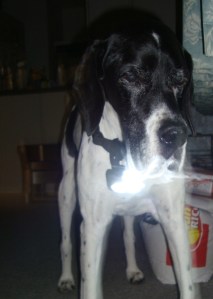
I had personal experience of this with my English Pointer, Daisy.  I noticed that she was becoming reluctant to go outside at night (where we had 2 steps leading down to our walk and yard).  When I’d flip on the light, she was happy again.  I was concerned not just that she could slip/trip on the steps, but also that she may not be able to navigate our garden and could bump into a bush, damage her eyes, etc.English Pointer with Puplight  I could have installed several floodlights to light up the section (but somehow, I didn’t think this was an economical option and one that may also not please the neighbors).

While not a home adjustment per se, I chose a PupLight – a lighted dog collar that I could clip on before sending her out in the dark.  Although marketed as a safety feature for walking dogs at night, the PupLight was ideal in lighting her way ahead of her.

Here’s an example of why I chose the ladder for my diagram on managing older dogs. 

Remember that I said we can go up and down the management steps as we need to?

Well, I had clients with an elderly Golden Retriever.  They initially made adjustments to their home which worked well for a few months.  But then their dog’s mobility got worse.  They were living in a modern two-storey townhouse and all the bedrooms were upstairs with a winding staircase which had a landing halfway up.

Their solution?  Time for another home adjustment.  Only this time they moved their own queen-sized bed into the lounge downstairs and placed their mattress directly onto the floor to reduce its height.

Their elderly Golden Retriever could still sleep with them in bed and navigate ‘jumping’ into bed with them safely!

Got questions about this post?  Please feel free to post a message or contact me through my practice, The Balanced Dog.

Kathleen Crisley, Fear-Free certified professional and specialist in dog massage, rehabilitation and nutrition/food therapy, The Balanced Dog, Christchurch, New Zealand

Dogs can experience hearing loss

Just like humans, dogs are sometimes born with impaired hearing or experience hearing loss as a result of disease, inflammation, aging or exposure to noise. Dog owners and K-9 handlers ought to keep this in mind when adopting or caring for dogs, and when bringing them into noisy environments, says Dr. Kari Foss, a veterinary neurologist and professor of veterinary clinical medicine at the University of Illinois at Urbana-Champaign.

hearing loss dog

This puppy does not respond to audible cues unless it can see the person giving them. The puppy’s assessment includes Brainstem Auditory Evoked Response testing, which independently evaluates hearing in each ear. The painless procedure can be done on dogs when they are awake, sedated or anesthetized. Photo by L. Brian Stauffer

In a new report in the journal Topics in Companion Animal Medicine, Foss and her colleagues describe cases of hearing loss in three working dogs: a gun dog, a sniffer dog and a police dog. One of the three had permanent hearing loss, one responded to treatment and the third did not return to the facility where it was originally diagnosed for follow-up care.

The case studies demonstrate that those who work with police or hunting dogs “should be aware of a dog’s proximity to gunfire and potentially consider hearing protection,” Foss said. Several types of hearing protection for dogs are available commercially.

Just as in humans, loud noises can harm the delicate structures of a dog’s middle and inner ear.

“Most commonly, noise-induced hearing loss results from damage to the hair cells in the cochlea that vibrate in response to sound waves,” Foss said. “However, extreme noise may also damage the eardrum and the small bones within the inner ear, called the ossicles.”

Pet owners or dog handlers tend to notice when an animal stops responding to sounds or commands. However, it is easy to miss the signs, especially in dogs with one or more canine companions, Foss said.

“In puppies with congenital deafness, signs may not be noticed until the puppy is removed from the litter,” she said.

Signs of hearing loss in dogs include failing to respond when called, sleeping through sounds that normally would rouse them, startling at loud noises that previously didn’t bother them, barking excessively or making unusual vocal sounds, Foss said. Dogs with deafness in one ear might respond to commands but could have difficulty locating the source of a sound.

Owners think their pet is experiencing hearing loss should have the animal assessed by a veterinarian, Foss said. Hearing loss that stems from ear infections, inflammation or polyps in the middle ear can be treated and, in many cases, resolved.

Hearing-impaired or deaf dogs may miss clues about potential threats in their surroundings, Foss said.

The Online Dog Trivia Quiz

Dog Trivia Challenge for Facebook

We’re supporting our customers with dog-themed entertainment during the country’s Covid-19 shutdown.

Join us at 4 pm on Sunday, 5th April (NZ time) for our dog trivia challenge – think of it as a pub quiz without the pub! (you supply the drinks and snacks at your place)

Upon registration, we’ll send you a link to join the quiz using Zoom.  You don’t need a Zoom account to participate.  Simply follow the Zoom link that is emailed to you and you will be prompted to download and install Zoom when you click the join link in the email.  It’s always wise to try this before the quiz starts.

The purpose of this quiz is to have fun.  Write down your answers to each question and we’ll email the answers out after the quiz has finished so you can check and share your score.

We’ll draw one name at random from everyone who registers and that person will receive a prize pack of our dog treats worth $30 – we’ll ensure delivery after the lockdown is over!

***Only New Zealand residents qualify to win the prize pack but we would welcome participation from our overseas followers***

Book your place on the quiz here


Kathleen Crisley, Fear-Free certified professional and specialist in dog massage, rehabilitation and nutrition/food therapy, The Balanced Dog, Christchurch, New Zealand

Warmth works wonders

Spot with wheat bag

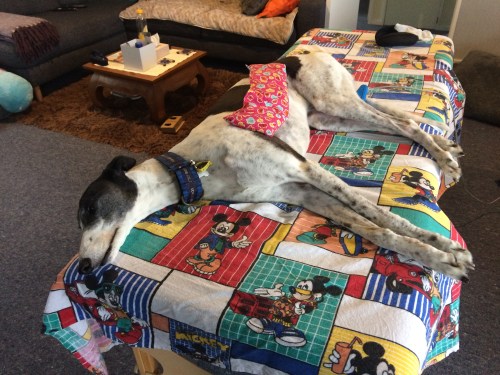
This is Spot, an ex-racing greyhound who is a regular client for massage and laser therapy.  Today as part of his session I used a wheat bag (warmed in the microwave) to help warm the muscles in his hind legs; by initially warming the muscles, I was able to massage Spot more deeply in these congested areas  without causing discomfort.

Why do we use a hot pack/warm compress/hot water bottle/wheat bag?

Warmth stimulates blood vessels to dilate to help blood flow to an area which is why it is quite helpful for people and animals who have arthritis.

Warmth also helps muscles to relax and, on a chilly morning like today, warmth is generally comforting (which is why in the above photo the bag is resting on Spot’s side.  I had finished using the wheat bag on his hind legs but left it on his rib cage because he was enjoying the weight and warmth of the bag).

Warmth should never be used in the acute phase of an injury, when there is swelling, redness or pain because warmth will exacerbate the inflammation.

Kathleen Crisley, Fear-Free certified professional and specialist in dog massage, rehabilitation and nutrition/food therapy, The Balanced Dog, Christchurch, New Zealand
Beyond Izzy’s pram (managing dogs through to old age) Part 6 – modifying exercise

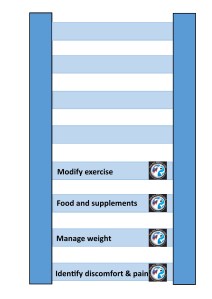
The 4th rung of our ladder is about modifying exercise. This particular aspect is easy to explain, but many owners find it a challenge to put into practice because they build a routine of dog walking or perhaps ball chasing as their dog’s sole form of exercise.

And as I discussed in Part One of this series, our dog’s age often creeps up on us because they are aging faster than we are.

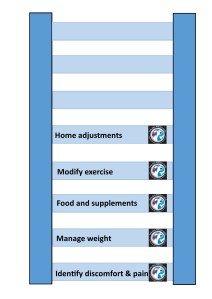
Arthritis management diagram with 4 rungs

An older dog needs age-appropriate exercise based on their physical ability.  A dog that walked for 10 kms when it was aged four may not be able to cope at aged eight, nine, ten, or more (every dog is different).

But, our dogs love us and so many will continue walking to the point of collapse which is what happened here in 2016 to a 12-year old Huntaway.   In this case, the dog was taken on a steep hill track with, no doubt, the best of intentions. She walked until she could walk no farther, collapsing and spending the night in the freezing cold until she could be rescued.

The duration of a walk is just as important as its intensity.  A walk in soft sand at the beach or hill walks are much more intense that an amble around your neighborhood on flat ground.

I often ask clients to monitor the amount of exercise their dog is getting by recording both the amount of time they spend out and also distance walked.   (A Fitbit or other fitness tracking device can be used for this).  Because I practice in-home, I usually get a good understanding of the local area where the dog is often taken for its walks.

Just because your dog wants to chase the ball, or run, or walk for hours, doesn’t mean he/she should.  It’s our responsibility to moderate their exercise – even if that means that we can no longer run with the dog that has run with us for years.

Replacing high impact exercise with brain games – foraging for kibble in the yard, as an example – presents an aging dog with the chance to weight shift and walk at a pace that suits them and on familiar ground.  If they get tired, they can rest easily.

Sometimes, it’s as easy as alternating a day with a longer walk, and then maybe only short toilet walks – or no walk – the following day.

In Izzy’s case, we are dealing primarily with corns in her right front paw that are aggravating arthritis in her carpus (wrist).  There have been days when she tells me (by refusing to go out the front door), that she doesn’t want to walk.   We often get in our morning walk with no issues.  But her afternoon walk can be variable.  There are days where we have no issues.  On some days, though, she will start out with a happy gait and no lameness and then she’ll start to slow up, sometimes I’ll notice a small trip or scraping of the nails or she will be walking with her head held low – a sign she is tiring.

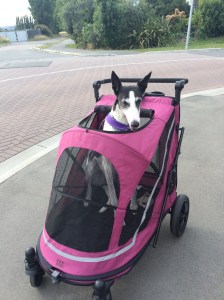
That’s when we use her pram so she can continue with sights and smells, but with no walking.  The ultimate in modified exercise!

Izzy greyhound in pram stroller

The biggest hurdle I often face is owners who just don’t seem willing or able to modify their daily routines to accommodate their dog’s changing needs.  It’s part of our lifetime responsibility.  Be flexible.  Be resilient.  Be kind.

If your feet were hurting, you’d want to slow down – wouldn’t you?

Got questions about this post?  Please feel free to post a message or contact me through my practice, The Balanced Dog.

Kathleen Crisley, Fear-Free certified professional and specialist in dog massage, rehabilitation and nutrition/food therapy, The Balanced Dog, Christchurch, New Zealand
Beyond Izzy’s pram (managing dogs through to old age) Part 5 – Supplements

The third rung of our ladder is Food & Supplements.  As promised, this post is dedicated exclusively to supplements (I discussed Food in part 4).  Brace yourself – this is another long post and I am not promising to cover the range of supplements available, either.  These are some that I have personal experience with and I will explain my rationale for using them so you understand my principles for supplement use.

Arthritis management diagram 3rd rung

Supplements are a huge industry in both human and animal care and they earn a lot of money for the manufacturers that sell them.  And for the most part, the industry is unregulated which means that, while we can buy them easily, there aren’t standards of manufacture and they can reach the shelves with little if any study as to their effectiveness.

That said, for many generations people had to rely on non-drug solutions to healthcare before there was such a thing as a pharmaceutical industry.  And the structure of clinical trials is a modern medicine concept.  I keep an open mind about natural remedies – and doing one’s homework is the best way to make good choices. (I have also found that the same people who claim that research paid for by manufacturers is dubious also endorse prescription dog foods that are also backed up by self-funded industry research – go figure!)

If you remember nothing else from this post, please remember these 4 key points:

  1. Supplements are not drugs.  You aren’t going to see an effect after a single dosage and most need time to build up in the system.  For this reason, they are solutions for the longer term and not a solution for a dog that is severely lame or in pain.
  2. Supplement for a reason.   This is explained  in more detail later.
  3. Implement one change at a time.  I see a lot of dog parents who are in crisis mode.  Their dog has had a fall, surgery or has experienced lameness and they throw everything but the kitchen sink at them at once.  How do you know what is working and what isn’t?
  4. Tell your vet what supplements you are using so they are on your dog’s medical records.  If your vet is going to prescribe medication, they should know everything your dog is eating and taking as supplements to be sure there are no adverse interactions.  If your vet doesn’t agree with you about using a supplement but on other grounds than ‘doing harm’, it’s still your choice as your dog’s guardian about whether or not to continue using them.
Let’s get the CBD thing out of the way first

CBD (cannabidiol) has only begun to be tested on animals.  But it is in lots of products and supplements – at last year’s Global Pet Expo and other trade shows – it was CBD that was all the rage.  A huge market with lots of money changing hands seemed to spring up overnight.

In New Zealand, “tetrahydrocannabinols, the chemicals in hemp which include THC, cannabidiol (CBD), and related compounds, and any preparation or plant containing them, are classed by the Ministry of Health as controlled drugs under the Misuse of Drugs Act 1975. Under the ACVM Act, controlled drugs and anything containing them must only be given to or fed to animals after registration under the ACVM Act. When products are registered, MPI applies strict controls and conditions of sale and use.”  (Source:  Ministry of Primary Industries)

My natural health colleagues in the USA have expressed concern about CBD products and how they may interact with other medications that pets may be taking (compounded by the fact that many pet parents are reluctant to disclose to their vet that they are using a CBD product).  And others are concerned not so much by the CBD ingredient itself but because of the quality of the carriers and flavourings used in the CBD products.

I know there are CBD products being given to dogs in NZ on the quiet – clients have asked me about products they’ve seen in local health shops and ‘green expos’ and a rumour that some pet parents are making it themselves.

I’m taking a wait-and-see approach to CBD.  And I’m following the research with interest!

So earlier I said that we should supplement for a reason.  I knew Izzy was an ex-racer who would have experienced a lot of stress on her joints during her professional career.  So I started her almost immediately after adoption (around age 6) on glucosamine and chondroitin.  These were to support her cartilage matrix and she continues on them to this day.  My choice to start supplementation was based on her history and my assumption (rightly) that she would likely develop arthritis.

Glucosamine and chondroitin through studies have shown a chondroprotective effect.  Chondroprotectives are “specific compounds or chemicals that delay progressive joint space narrowing characteristic of arthritis and improve the biomechanics of articular joints by protecting chondrocytes.” 

I started Daisy on glucosamine and chondroitin at the magic age of 7 (that imaginary line that, when crossed, helps us generally to define dogs as being senior).  She also remained on them until she passed 3 weeks after her 14th birthday.

When I said that supplements weren’t drugs, it also means that you need to maintain the dosage for them to remain effective.  And if you stop or run out, then you can expect to have to re-start a program of loading to build them back up in the body again.

Another example of supplementing for a reason is when a dog has arthritis – and many dogs develop this condition (between 60% and 80% of dogs to be exact – according to different studies).      Arthritis causes inflammation in the joints.  Controlling the inflammation helps to control the pain.

Izzy also takes deer velvet and has done since she turned 7.   (I started Daisy on deer velvet very late in her life, as the product was new to me then back in 2013/14). There’s a great literature review out of Australia that talks about the different properties of deer velvet, for example.  In the words of Dr W Jean Dodds of Hemopet/Nutriscan, deer velvet “helps alleviate arthritic symptoms by rebuilding cartilage, improving joint fluid, increasing tissue and cellular healing times, and improving circulation.”  So I started Izzy on this when she was that much older, it seemed a good adjunct to her glucosamine and chondroitin particularly for the circulation effects and the growth factors that would help with any micro-tears in soft tissues.

Green lipped mussel extract is somewhat unique to New Zealand and the omega-3 polyunsaturated fatty acids have been shown in studies to have an anti-inflammatory effect.  When Daisy’s lumbosacral disease was first confirmed via x-ray in 2011, she started on a high quality green-lipped mussel concentrate.  Izzy, with arthritis in her wrists and toes, has been taking green-lipped mussel since 2018, when she dislocated her toe.  The NSAIDs disagreed with her and so I felt that with her advancing arthritis in the toes, she needed consistent anti-inflammatory support.

I also use turmeric in Izzy’s food – she’s 11 now and I’ve been consistently using turmeric for about three months because it’s got anti-inflammatory effects and she seems to tolerate it on her stomach whereas we know from the times she has needed NSAIDs after surgeries that her stomach doesn’t cope.  I’m using a combination of dried turmeric powder and fresh turmeric when I cook for her and I have noticed an improvement in her mobility in conjunction with our regime for managing her corns.  (Her hydrotherapist noticed her enhanced mobility, too.)

With each of the supplements I’ve mentioned above, they were instituted one at a time and for a reason.   If I choose to stop a supplement to try something else, I will stop the first supplement for about 3 weeks before starting the new one.  That’s because I want to make one change at a time.

You may have noticed that I haven’t mentioned supplement brands in this post.  That’s because my local market in New Zealand has different products than those of my readers elsewhere.  And while I have preferred products, I also aim to understand the client’s budget and recommend the highest quality product that they can afford.

And as you’ve reached the bottom of this post, you may also realize that I spend a significant portion of my household budget on Izzy’s care.  Supplements are just one aspect of her care and for a 75 day supply of her green lipped mussel, for example, I spend close to NZ$100.

Got questions about this post?  Please feel free to post a message or contact me through my practice, The Balanced Dog.

Kathleen Crisley, Fear-Free certified professional and specialist in dog massage, rehabilitation and nutrition/food therapy, The Balanced Dog, Christchurch, New Zealand