Category Archives: dog care

Beyond Izzy’s pram (managing dogs through to old age) Part 2

According to statistics, one in every five dogs is affected by arthritis, or more specifically osteoarthritis.  It’s a disease that is progressive and is associated with a number of factors which result in degeneration of the joints.

In my opinion, the stats are probably a lot higher.  More than one in five.  And that’s because too many dog parents see the symptoms of arthritis but classify it as ‘normal slowing down with age’ and they don’t seek professional help until much later – if at all.   Arthritis can develop in young dogs – I’ve seen it in dogs between the ages of 1 and 2 –  but the odds certainly increase with age.  If a dog reaches the age of 7, then they have a 65% chance of developing arthritis.

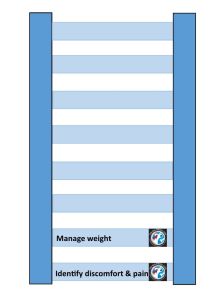
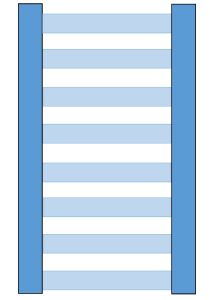
So in this post, I want to introduce you to the ladder concept for managing dogs with arthritis.  There are various rungs to the ladder and we’re going to cover each one.  Each rung is a step up in terms of effort (and potentially cost) and, just like in real life, you can go up and down the ladder based on circumstances which can include progression of the disease.

Ladder diagram

The first rung is about identifying pain and discomfort in your dog.   Many owners expect their dog to whimper or cry out as the primary indicator that they are uncomfortable.  But that just isn’t true.  By the time a dog vocalises, chances are they have been experiencing discomfort for some time and have become very painful.

There are degrees of difference between discomfort and pain

Discomfort is tolerable.  People describing discomfort use words like lingering, annoying, or aching.

Pain is much more than discomfort.  Pain is intense.  It changes the way you do things or enjoy your day.  When people describe pain they choose words like burning, sharp, or shooting.

Discomfort tells us something is wrong and often helps us manage before the situation becomes painful.

Our dogs are non-verbal communicators.  We have to become experts at their non-verbal communication by being keen observers.

In late 2017, for example, I noticed a behavioural change in Izzy.  Over the course of about 10 days, it seemed that almost every time I looked over at her, she was licking her left carpus (wrist).  And so I took her to the vet and asked for x-rays.  These confirmed ”very minor arthritic changes” – so minor that we agreed a regular rubdown with an animal liniment would likely be sufficient rather than requiring pain medication.  Izzy was experiencing discomfort and not pain.

Changes can be subtle.  My intake questionnaire for new clients is many pages long and I ask questions about mobility and behaviour as well as personally observing the dog’s gait.  A reluctance to get out of bed in the morning may not be a sign of laziness, for example.  It could be that the dog is stiff after resting all night.

Other signs can include:

  • difficulty getting comfortable in bed
  • withdrawal from normal activities
  • snapping when touched
  • pressure sores on the elbows or other joints
  • lameness or changes in gait
  • scuffing of toe nails
  • pacing

The list goes on…

When we see someone every day (and this includes our pets), we often don’t pick up on small changes.  This is a main reason why asking for a professional’s assessment is a good thing to do.  They come into your situation with a fresh set of eyes.

Got questions about this post?  Please feel free to post a message or contact me through my practice, The Balanced Dog.

Kathleen Crisley, Fear-Free certified professional and specialist in dog massage, rehabilitation and nutrition/food therapy, The Balanced Dog, Christchurch, New Zealand
Beyond Izzy’s pram (managing dogs through to old age) Part 1

I promised a series on dog aging and care to explain that Izzy’s care started long before we introduced her pram (stroller).   Welcome to Part 1

For this series, I’ll be drawing on my experience as a dog parent with an aging dog as well as my 10+ years of professional experience in canine massage and rehabilitation.

Whenever I am asked about how I chose my profession, I explain that I had a muse.  Her name was Daisy.  An English Pointer who was neglected by her first family, Daisy entered my life at the age of 4 and left it at the age of 14 years and 3 weeks.

Daisy the English Pointer

Daisy, a sweet-natured and intelligent English Pointer, had many health problems over the course of her life. But we managed to get her to the age of 14+ which for a large-breed dog is a good life.


Izzy the greyhound

Izzy is my current canine companion. As I write this column in January 2020, she will be turning 11 in a few weeks. As an ex-racing greyhound, you can expect that Izzy’s body has seen some wear and tear and I will cover that in future posts.


For this introduction, let’s talk about time and age.  My mother, who passed away last year, used to say that, “no one I know is getting any  younger.”  The same is true of our dogs.  Aging is a fact of life.  It’s not a disease, it’s a life condition.

Most dog parents understand that their dogs don’t live as long as we do.  And you’ve probably seen charts like these before – but let’s review how a dog ages.  Smaller dogs tend to live longer, giant breed dogs have the shortest life expectancy.

I’ve included two charts because some of my readers go by weight in pounds, and others like my local clientele in New Zealand use kilograms.  Both charts have been derived by the work of Dr. Fred L. Metzger of Metzger Animal Hospital in State College, PA.

How old is your dog in poundsHow old is your dog in kgsSo I expect most of you have gone to find your dog’s human age on the chart.  That’s good; it’s how I start a conversation with one of my clients about their dog’s life status.

A more powerful use of these charts, however, is to consider time.  Because we age in our time, we tend to lose track of time in terms of our dog’s health.

Let’s say that we have a large breed dog who is 11 years old and he’s recently been to the vet for medication for the first time and the family has asked me to work with him because he’s reluctant to walk and doesn’t want to get into the car.

When we chat, the family tells me he has  probably been slowing down for ‘about a year.’  Today he is the equivalent of a 72 year-old man.  But his symptoms started when he was 10 and the human age of approximately 66.  So his family, although they clearly love him, waited 6 years to get professional help.

If your child was limping, would you wait 6 years to take them to the doctor? (I hope most of you say no.)

What I’d like each of you to do now is record your dog’s birthday and human year equivalent on your phone, wall calendar or diary – whatever you use.  If your dog was adopted and you don’t know their exact birth date, you can use their Gotcha Day instead.  Now, check out the chart and see how many human years will go by before their next birthday.

In the example above, it’s 6 years.

12 months/6  = 2 months

So if you were my client, I may ask you to enter a reminder message every two months in your diary and I’d give you a simple checklist of questions to review.  Just one tool that I use with some clients to help them understand their dog’s aging process and need to remain vigilant for signs of change.

Got questions about this post?  Please feel free to post a message or contact me through my practice, The Balanced Dog.

Kathleen Crisley, Fear-Free certified professional and specialist in dog massage, rehabilitation and nutrition/food therapy, The Balanced Dog, Christchurch, New Zealand


Jess has a massage (and I’m interviewed for a podcast)

Jess of Dogs of New Brighton

Jess, a Beardie x Huntaway, is the canine inspiration behind the Dogs of New Brighton podcast. Here she is on my massage table for the first time.

Earlier last month, I was asked to visit with Michele Hollis and Jess who live in New Brighton (east Christchurch).   Together they produce the Dogs of New Brighton podcast.

After I spent an hour with Jess for a relaxation massage, Michele and I sat down for an interview.

Listen to Part 1:  In the first 20 minute segment of our interview, Michele asks me questions about Jess’ session, her reactions during the massage, and my qualifications and background.

Listen to Part 2:  In the second 20 minute segment,  Michele and I have a free-ranging discussion on a number of topics.  I explain in more detail about the use of Fear Free techniques in canine massage and why I use a massage table; I also explain the legal standing of physical therapy on animals in New Zealand and the use of the terms ‘physio’ and ‘physiotherapy’.  Michele asks me questions about the liver dog treats I feed in my practice, our treats and cakes that are made here in Christchurch at The Balanced Dog and I explain our free Birthday Club, too.  I also talk about what I feed my greyhound, Izzy, and we finish our chat about Christchurch and whether it is a dog-friendly city including a discussion of irresponsible dog owners, community standards, and the need to pick up poo.

Jess of the Dogs of New Brighton

Listen to Jess snoring after her massage in Part 1 of my interview with Michele of the Dogs of New Brighton

Kathleen Crisley, Fear-Free certified professional and specialist in dog massage, rehabilitation and nutrition/food therapy, The Balanced Dog, Christchurch, New Zealand


Does training method matter?: Evidence for the negative impact of aversive-based methods on companion dog welfare

Your dog may be the apple of your eye, but let’s be honest: she is an animal, with her own instincts and idiosyncrasies, and there are going to be times when she makes you want to tear your hair out.

Much you want to, however, new research suggests that you should never yell at or otherwise punish a mischievous mutt.

No Yelloing

Photo ref: smrm1977/iStock

According to a new study uploaded to pre-print server bioRxiv, aversive training such as positive punishment and negative reinforcement can have long-term negative effects on your dog’s mental state.

“Our results show that companion dogs trained using aversive-based methods experienced poorer welfare as compared to companion dogs trained using reward-based methods, at both the short- and the long-term level,” the researchers write in their paper.

“Specifically, dogs attending schools using aversive-based methods displayed more stress-related behaviours and body postures during training, higher elevations in cortisol levels after training, and were more ‘pessimistic’ in a cognitive bias task.”

This sort of research has been conducted before, and found that aversive training has negative effects, but it’s primarily been on police and laboratory dogs. In addition, the aversive training tends to be shock collar training, which is only one of several tools used.

So, led by biologist Ana Catarina Vieira de Castro of the Universidade do Porto in Portugal, the international team of researchers conducted their new study on companion dogs.

The animals were recruited from a number of training schools in Porto – 42 dogs from three schools that use reward-based training like food treats or play, and 50 dogs from four schools that use aversive-based training, such as yelling, physically manipulating the dog, or leash-jerking.

Each dog was filmed during the first 15 minutes of three training sessions, and saliva samples were taken to assess stress levels from training – three from each dog relaxing at home to establish baseline levels of stress hormone cortisol, and three from each dog after training.

The researchers also analysed the dogs’ behaviour during training to look for stress behaviours, such as yawning, lip-licking, paw-raising and yelping.

Unsurprisingly, the dogs in the aversive training classes showed elevated stress behaviours, particularly yawning and lip-licking. Their saliva also had significantly increased levels of cortisol compared to when they were relaxing at home.

By contrast, the positive reinforcement dogs were pretty chill – far fewer stress behaviours, and much more normal cortisol levels.

The next step was to assess the longer term effects of this stress. A month after the dogs were assessed at training, 79 of them were then trained to associate a bowl on one side of a room with a sausage snack. If the bowl was on that side, it always held a delicious treat; if located on the other side, the bowl never had the treat. (All bowls were rubbed with sausage to ensure the smell didn’t give the game away.)

Then, the researchers moved the bowls around the room to ambiguous locations to see how quickly the dogs would approach in search of the treat. Higher speed was interpreted to mean the dog was anticipating a mouthful of deliciousness, whereas a slower speed meant the dog was more pessimistic about the bowl’s contents.

Sure enough, the more aversive training a dog had received, the more slowly it approached the bowl. Interestingly, dogs from the reward-based training group actually learnt the bowl location task faster than the aversive-training dogs.

This suggests that reward-based training may actually be more effective, although the researchers suggest this may be because the dogs already understand treat-based training methods. It’s possible that the other group would learn more quickly were an aversive method applied – more research needs to be done to determine this.

Overall, though, the results seem to imply that aversive training doesn’t necessarily have an edge over reward training, and that reward training is much better for your dog’s happiness.

“Critically,” the researchers said, “our study points to the fact that the welfare of companion dogs trained with aversive-based methods appears to be at risk.”

The full paper is available on bioRxiv ahead of peer review.

Source:  Sciencealert

Come on, Jacinda, Ban the Boom

Successive governments, including the current Labour Government led by Prime Minister Jacinda Ardern, have refused to heed the growing calls from animal lovers to ban the private sales of fireworks.

That’s a real shame.  Let’s face it, a lot has been said about the Prime Minister because she chose to become a mother while acting as PM.

Here’s Zoe, one of Izzy’s friends, all rugged up for Guy Fawkes.  She’s in a thundershirt, with ear muffs, and music and still nervous and anxious.  There are lots of similar photos and videos of stressed out animals on Facebook this week.

Zoe for Guy Fawkes

Now I wonder if Jacinda would like it if one of these stressed out dogs was her baby, Neve Te Aroha Ardern Gayford?  Not a nice thought, is it?  I wouldn’t wish it on the Prime Minister’s baby.  Maybe she and her Government shouldn’t wish it on ours.

Maybe what will get action from this government is to remind them that all fireworks are single use and disposable.  Just like the plastic bags that they and their coalition partners banned earlier this year.  These fireworks are filling up our landfills, too.   What’s the deal, Green Party?

I’m not going to apologise if this post is a lot more ‘in your face’ than most of my posts.  I’m entirely sick of the inaction.  Are you?

Kathleen Crisley, Fear-Free certified professional and specialist in dog massage, rehabilitation and nutrition/food therapy, The Balanced Dog, Christchurch, New Zealand


Control the flies without chemicals

Spring has sprung around New Zealand and that means open doors and windows to let the fresh air in.

It also means that some people reach for cans of fly spray or, worse, those automatic dispensers that regularly dose your house with chemicals.  (Not to mention the regular ‘hiss’ of the spray which can be very upsetting to some dogs and that our dogs can smell things we can’t – remember that I only use Fear Free practices).

I’m no fan of chemicals.

A few years ago, a client of mine showed me their temporary fly screen door which they install every year.  It’s quite easy, really.  It comes with tacks and double-sided velcro and strong magnets which close the panels after you walk through it.  Dogs easily learn to walk through the screen, too, which means the panels close behind them as they go in/out (Izzy and her friends that visit have had no problems negotiating the door).

I put my fly screen up about a week ago and it’s made a huge difference.  Here are a couple of photos to show you what it looks like:

The temporary fly screens are available in major hardware stores and through Trade Me at very reasonable prices.

And for windows, good old fashion net curtains help to reduce the entry of flies into your home, too.

So much better than chemicals!

Kathleen Crisley, Fear-Free certified professional and specialist in dog massage, rehabilitation and nutrition/food therapy, The Balanced Dog, Christchurch, New Zealand

World Animal Day and an anniversary

Today, 4 October 2019 is World Animal Day.  It is also the 10th anniversary of the launch of my canine massage practice – the first certified canine massage practitioner in the City of Christchurch.

To mark this important day, here’s a short video of current client, Pepper.  Pepper is a Border Collie cross who was rescued from a roadside in the South Island.  He’s had some discomfort in his neck and hindquarters which is resolving nicely using massage, acupressure and laser therapy.

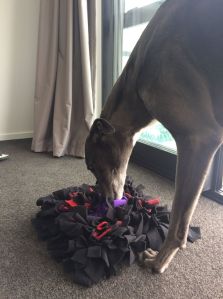
Pepper needs to be active – both physically and mentally – and this toy helps him to do that.

And in a blast from the past, here’s a link to the local coverage of the company launch.

Kathleen Crisley, Fear-Free certified professional and specialist in dog massage, rehabilitation and nutrition/food therapy, The Balanced Dog, Christchurch, New Zealand


Pet owners who fail to walk their dogs daily face $2,700 fine in this Australian territory

Dog owners could be fined up to $2,700 (AU$4,000) if they don’t walk their pets at least once a day under new legislation recognizing animals as sentient beings in the Australian Capital Territory.

Dog owners walk their pets

Dog owners walk their pets (file photo).


The Animal Welfare Legislation Amendment Bill, which became law on Thursday, imposes a range of strict penalties in a bid to improve animal welfare.
Owners can face heavy on-the-spot fines if they fail to provide basics like shelter, food and water. People who confine dogs for 24 hours must also allow them to move freely for the next two hours or face prosecution.
The territory is the first jurisdiction in Australia to recognize animal sentience.
“Modern animal welfare is about considering how an animal is coping both mentally and physically with the conditions in which it lives,” ACT City Service Minister Chris Steel, who secured the bill, said in a media release.
Source:  CNN

A new twist on couples massage

This year, I signed on to become a sponsor of the inaugural 4 Paws Marathon in Christchurch.  This event is the brainchild of a sports medicine doctor who loves to run with his dogs – but found that while his dogs could train with him, they weren’t allowed to join in on race day.

Yesterday was race day.

And I was set up at the finish line working alongside Rachel, a friend and colleague who is a human massage therapist at Bodyworks Massage Therapy.

IMG_4134

The massage tent at the 4 Paws Marathon

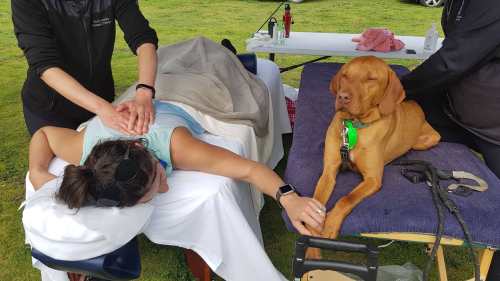
We decided to promote our joint sponsorship with the couples massage theme:  human + dog.   By working together,  not only did our services keep ‘in theme’ of the event, but we also showed the mutual respect we have for one another in our respective fields.

Rachel is qualified to massage humans; I’m qualified to massage canines.  Since canine massage is a relatively new field in New Zealand, I appreciated the opportunity to showcase the benefits of the modality in front of the runners and other sponsors at the event.

Here are just a few photos from the day:

Hand holding at the massage tentIMG_4159IMG_4189IMG_4158

We look forward to sponsoring again next year!

Kathleen Crisley, Fear-Free certified professional and specialist in dog massage, rehabilitation and nutrition/food therapy, The Balanced Dog, Christchurch, New Zealand

That spot on Izzy’s muzzle

At a social walk yesterday, quite a few of our friends noticed the purple stitches in Izzy’s muzzle.  She had a lump removed a little over a week ago (her stitches come out on Monday).

Everyone needs to understand that lumps cannot be diagnosed by the naked eye.  Without a biopsy, you can never be sure about the type of cells that are growing there.

In Izzy’s case, the spot on her nose opened up and bled like crazy and, by the following morning, had totally disappeared again.  Bleeding concerns me – hence the reason we went off to the vet.

Izzy's nose

The testing has come back and it’s good news.  The spot was a hemangioma, a benign growth that is related to sun damage.

With the spring and summer on their way, I’ve made a promise to both of us that I will be much more diligent in applying sunscreen to her muzzle each and every day.

Kathleen Crisley, Fear-Free certified professional and specialist in dog massage, rehabilitation and nutrition/food therapy, The Balanced Dog, Christchurch, New Zealand