Category Archives: dog ownership

The sale of Ellenco to Southern Cross – a positive for pet owners

Southern Cross Benefits Ltd announced this week that it has purchased Ellenco Pet Insurance.  Although some may lament the loss of a ‘mom and pop’ operation that has operated for 22 years, I think the ownership transfer is a good thing for New Zealand dog (and other pet) owners.  Why?

  • Only 8% of dog owners in NZ currently have pet insurance (according to the NZ Companion Animal Council’s Companion Animals in NZ survey, July 2011)
  • The Southern Cross Healthcare Group, of which Southern Cross Benefits Limited is one company,  is the largest healthcare insurance provider in NZ
  • Ellenco’s owners could not afford to put up the $3 million bond required by new legislation and its previous bond of only $500,000 was a potential risk to policy holders
  • In my opinion, Southern Cross is a trusted brand in NZ and should encourage more pet owners to seriously consider the purchase of insurance
  • Southern Cross has acknowledged that surveys of its clients have shown that there is interest in pet insurance – so an audience that hasn’t been reached so far by  insurance providers is aware of the benefits of pet insurance –  but hasn’t had the confidence yet to buy a policy
  • Southern Cross Benefits Limited has an A+ (Strong) financial strength rating from Standard & Poor’s, is a Registered Financial Service Provider, and is a member of the Insurance & Savings Ombudsman’s Disputes Resolution Scheme

Insurance, like other business markets, matures over time.  This is a huge step for NZ in its recognition of the importance of pets and the associated costs of their healthcare.

Another big step in the pet insurance market here was when The Warehouse started offering Petplan insurance, furthering the marketing of pet insurance generally through a very popular retail outlet.

In the words of Ian MacPherson, CEO of Southern Cross Healthcare Group, “Pet insurance is a natural extension for Southern Cross. Many New Zealanders count their pets as part of the family. However, currently very few owners have pet insurance, meaning they are exposed to what can be very high bills should their pet be affected by an unexpected illness or injury.”

It is important to note that the policies of all pet insurance providers in NZ have coverage of some sort for complementary therapies.  Read my pet insurance fact sheet for more details.

Footnote:  Credit must be given to the founders of Ellenco, Rodger Cox and Jenny Ellenbroek.  Ellenco was the first firm to offer pet insurance in New Zealand, others have followed.  Many policy holders have benefited from the coverage of their company’s policies.  Alas, time has caught up with the small Christchurch-based operation.

The Insurance (Prudential Supervision) Act 2010 required insurers to put up higher bonds and the small firm could not afford this change.  Policy holders are lucky that the owners negotiated with Southern Cross for the purchase of the firm’s policies.  Until operations are transferred to Hamilton in 2013, there will be no change to Ellenco’s policy provisions.

Kathleen Crisley, specialist in dog massage, rehabilitation and nutrition/food therapy, The Balanced Dog, Christchurch, New Zealand

Dogs run amok?

Dogs run amok | Canterbury News | Local News in Canterbury.

This article was published in the Monday 27th February 2012 edition of the News Advertiser.  I wrote to the reporter, Anna Turner, today because the article encourages you to “Have your say” at the end but only encourages submissions from those who have had problems with dogs (not cyclists) on the shared path.

I wrote:

Dear Ms Turner,

For the record, the pathway from Northlands Shopping Centre to Mona Vale is not a cycleway – it is a shared corridor for use by cyclists, pedestrians and dog walkers.  As a shared space, it is essential that all users are polite, respectful and allow safe passage to other users.  It is unfortunately true that some dog walkers do not have their dogs under effective control (which can be on lead or off lead, if the dog is suitably trained).  To encourage responsible dog ownership, I favour a system where the offending dog owner is required to attend dog training (rather than a spot fine).  This would be a similar system to when drink drivers are required to attend alcohol education.

The pathway also needs a monitored speed limit for cyclists and a requirement for them to ring a bell or sound a horn when they are approaching pedestrians/dog walkers from behind.  You cannot hear a cyclist coming up behind you and they speed around you frightening both you and your dog (even a dog under effective control will respond if they are suddenly scared or threatened).  The cyclists using this pathway often use it as a speedway to get them from Point A to Point B and show little regard for anyone on foot (regardless of whether they have a dog or not).

And what can we learn from these types of conflicts?  The need for better urban design.  The proposed Otakaro green space along the Avon River presents us with an excellent opportunity to design an open green space for cyclists and dog owners plus other walkers who want to be dog-free in a seamless design.  There are examples from overseas about such design.  Sadly, when an overseas expert on dog-friendly design visited the city last year, not a single community board or city council representative attended his public talk. 

Your newspaper would serve our community better by investigating issues more thoroughly and reporting them in a balanced way rather than going for the inflammatory headline.  Please contact me if you’d like more information about urban design, responsible dog ownership and other issues facing dog owners.

I then got this reply from Ms Turner:

Hi Kathleen,

 If you read the story it says several times that this is a shared cycleway/walkway. You’ll also see that Mr Talbot acknowledges that some cyclists should monitor their behaviour as well.

And then I wrote back to say:

Hello Anna,

First impressions count.  The headline on the front page is “Dogs run amok” and the headline on page 3 is “Dogs running rampant on narrow cycleway”  (not narrow shared path)

My point is that you should encourage submissions about cyclists as well as dogs and take some time to investigate the issues of better urban planning so that all users can peacefully co-exist .

And her final reply said:

I’ll pass on your comments to the subeditors who write the headlines, I have no part in that.

Thanks for your input

Is this a case of buck passing?  It sounds like it to me.  How do we get our journalists to be more receptive to issues facing urban dog owners – that we need to encourage responsible ownership but at the same time provide facilities for them?

Are speeding cyclists not newsworthy?


A letter to my dog

A letter to my dog is the website collecting stories for photographer Robin Layton’s book project.  Dog owners from across the United States are encouraged to write a letter to their dog, include a photo, and upload both to the site.

This year, Layton will select some of the submissions and visit the dogs and their owners for professional photographs – and the letters and photos will go into his book.    A contribution from the proceeds of the book will be donated to the Humane Society of the United States.

What I like about the site is that people can include the breed of their dog as part of their submission (and there’s a category for mixed breeds, too!).  If you’re partial to the Dalmatian, for example, you can click on the Dalmatian link and read all the stories submitted by Dalmatian owners.

What I really like about the site is that it is a great pick-me-up after a long day.   It’s  dedicated to the bond between dog and owner and gives owners a chance to express their great love for their dog.  Excellent reading!

Some excerpts:

Full of jokes and hugs, you always know how to make me laugh, even in my darkest depression.

The way you look at me, it makes me feel as if I am every thing good in the world, because that is what you see in me.

I am so happy to have you and I hope you live a lot more years.

How could we have known when we walked into the animal control (the pound) the special connection and impact you would have on our lives.

I adopted you 9 years ago, and I still have vivid memories of that day when I came to pick you up.

This might seem a little odd because you can’t read, so I’ll explain it to you over a beer and a few treats very soon.

You instantly won my heart and even managed to win over my mom.

This slideshow requires JavaScript.

Stevenson Companion Animal Life-Care Center

In the United States alone, it is estimated that 500,000 animals are surrendered to shelters each year because their owners have passed away without leaving instructions or plans for their care.

The Stevenson Companion Animal Life-Care Center is based at Texas A&M University.  Entirely privately funded, the Center operates with the support of endowments and private gifts.  Animals that are enrolled with the Center come to live there when their owners are no longer able to care for them.  It’s a rest home of sorts for pets whose owners want their animals to live out the remainder of their lives in a social atmosphere with quality veterinary care.

This YouTube video gives you an introduction to the Center:

The Center opened in 1993 and is named after Mrs Madlin Stevenson who donated 50% of the start up funds for the facility.  The Luse Foundation donated the other half.

This video provides a tour of the facility:

Admittedly, not everyone will be able to send their dog for care at the Stevenson Center.  Enrollments are based on the owner’s age at the time of enrollment and may either be paid in advance or through a bequest in the will.  This is the current chart of fees for a dog (or cat or bird) in US dollars.

Age Minimum Endowment by Bequest Minimum Amount for Paid-up Endowment
30 – 39 $100,000 $10,000
40 – 49 $85,000 $20,000
50 – 59 $70,000 $30,000
60 – 69 $60,000 $40,000
70+ $50,000 $50,000

Want to know more?  Visit the Stevenson Companion Animal Life-Care Center’s website.

The alpha roll myth

When scientists studied captive wolves (and I’m talking about research that dates back to the 1960s), they observed fighting for dominance within the group and extrapolated that information as relevant to domesticated dog behaviour.  Unfortunately, by studying captive wolves, the scientists were observing an artificial pack – wolves that were placed together in very unnatural circumstances.

Over the years and ‘informed’ by this research, the theory of being the Alpha Dog developed.  The alpha dog is the top dog of the pack, the dog who eats first (as an example).

Trainers who picked up on the alpha dog theory taught their clients to ‘alpha roll’ their dog.  That is when you force your dog to roll over on its back to signal your dominance.

It is true that wolves roll over as a submissive behaviour, but nothing in the record suggests that wolves force other wolves to roll over.   Wolves will roll over on their backs as a submissive gesture – they do it willingly and not by force.

This YouTube video shows a wolf rolling over as a sign of submission:

There are many trainers today who are adopting reward-based techniques, but others still adhere to a rigid interpretation of dominance theory including alpha rolls.  I’m saddened to say that when I first adopted Daisy eight years ago, I went to a local dog training club in Christchurch where the teacher believed in alpha rolls.  When Daisy didn’t go ‘down’ on my command, he took both of her legs on the right side and flipped her over.  I can still remember the frightened look in her eyes and I was almost in tears myself over the incident.

My advice is to stay away from any dog trainer that doesn’t use reward based techniques.  Make sure any trainer you use doesn’t have outdated ideas of what is true canine behaviour.

Resolve to be a great dog owner this year

There are lots of jokes that circulate at this time of year about a dog’s resolutions for the new year (e.g., kitty-box crunchies are not junk food, etc.).  But what about your resolutions for your role as a Doggy Mom or Doggy Dad?

Here are my suggestions for new year resolutions:

1.  Resolve to feed your dog the highest quality dog food you can afford.  Not sure what to feed or even if you are feeding the right amount?  That’s where a nutritional assessment comes in.  People like me are trained in reading the labels of your existing dog food and with some information about your dog’s condition and lifestyle, we can tell you a lot about whether you are feeding the right amount and make un-biased suggestions about your core dog food.

In my case, I’m not affiliated with any veterinary practice or brand of dog food (many professionals take their nutrition training from a programme offered by dog food manufacturer – ask about this when selecting a provider for nutritional advice!)

2.  Exercise more – for your dog and yourself!  Exercise is important mental and physical stimulation for both you and your dog.  Discover new walks, link up with walking partners and doggy buddies for more variety, and manage your exercise according to the temperatures of the day (your dog doesn’t have the heat regulation system that you do in the summer; and their paw pads can be irritated by road salt and ice during the winter).

3.  Groom your dog – regularly.   If you don’t know what to do, then take your dog to a professional groomer and get advice on maintenance that you can do at home.  It breaks my heart to hear about veterinary nurses and groomers that have to work on severely matted dogs because their owner has neglected their grooming responsibilities.

4.  Make time for your dog.  I signed off last month’s newsletter to my Canine Catering customers saying “remember that the best thing you give your dog this holiday season is your time.”  It goes for the rest of the year, too.  Your dog is a social animal and needs your love and attention throughout the year.

5.  Keep a watchful eye on your dog’s health, ensuring they are not overweight (or underweight) and that they receive regular veterinary care.  (For a dog to be accepted into my dog massage and rehabilitation practice, the owner must certify for me that their dog is under regular veterinary care.)

6.  Have fun together – play time is essential.  Dog walks are not the only stimulation for your dog.  Choose an activity that suits both you your dog.  It could be agility or obedience training, rally-o, fetch, cross-country skiing, hiking/tramping, or the use of interactive dog toys.

I wish you and your dog a wonderful 2012.  Contact me through this blog or my website for information on any topic I cover in this blog.

Happy New Year for Arizona dog

As we start a new year, great news out of Montana.

According to the Salt Lake Tribune, Buddy has been missing near Butte since November 28th.  He has been reunited with Phil Nichols, his owner, this week.

Read more here.

Before Cesar and Victoria

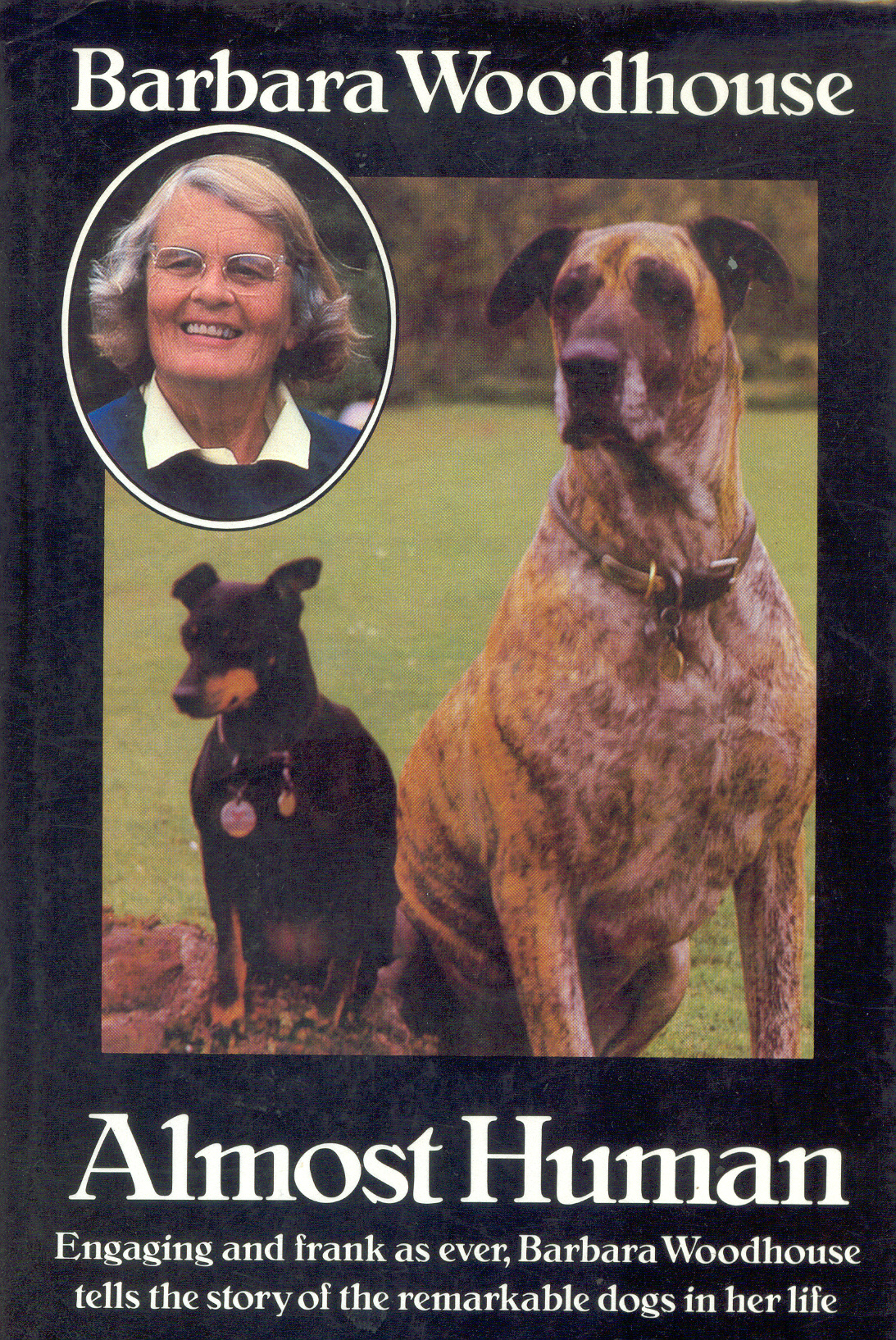
Before Cesar Millan and Victoria Stilwell, there was Barbara Woodhouse.  I have just finished reading one of Barbara’s books, Almost Human.  It made me realise that today’s craze of celebrity ‘dog experts’ isn’t new; we are just repeating a more modern version of what has gone before.


Barbara’s Great Danes, Juno and Junia,  appeared in many British television and films, acting alongside famous actors such as Sir Alec Guinness, Clark Gable and Roger Moore.

In Almost Human, Barbara writes:  My Danes were treated in exactly the same way as our children, and in so doing I learnt an awful lot about how much dogs like to be included in everything the family does…By the end of their lives I am sure they knew at least 250 words and their meaning.

Almost Human was published in 1976 and is a memoir about all her Danes: Jean, Jyntee, Juno and Junia.  There are chapters about owning and caring for a Great Dane.

Her other books included No Bad Dogs, Talking to Animals, Dog Training My Way, and A-Z of Dogs and Puppies.  In the 1980s, Barbara hosted a UK television programme called Training Dogs the Woodhouse Way.  Mrs Woodhouse even recorded an LP (the precursor to DVDs!) entitled Training Dogs Her Way.

Barbara suffered a fatal stroke in July 1988, she was 78.

North America’s most pet-friendly airlines

As most of you know, I’m a big supporter of traveling with your dog when on holiday/vacation and I encourage you to support pet-friendly shops and accommodation providers in your area.

Petfinder.com recently released its findings for 2011’s most pet-friendly airlines.  This year, the site extended its coverage to Canada so it is now ranking airlines that service North America.

Petfinder reviewed airlines in the following categories:

  • what airline is most pet-friendly overall

Winner:  Pet Airways – a dedicated airline for transporting pets

  • offers the best amenities for pets and their parents

Winner:  JetBlue – for the 2nd year in a row.  JetBlue provides travelers with a pet carrier baggage tag, a travel “petiquette” guide, 300 TrueBlue points each way, and a comprehensive e-booklet with pet-friendly hotels, restaurants, parks and animal hospitals in some of JetBlue’s major cities.

  • best in offering transport to a variety of pets

Winner:   Frontier Airlines because they allow dogs, cats, rabbits, guinea pigs, hamsters and small birds in the cabin

  • best for flying multiple pets in the cabin

Winner:  Frontier Airlines, which allows up to 10 pet containers on each flight. Only one pet container is allowed per person, but the limit per flight means that multiple friends/relatives can travel with animals so the entire family arrives at its destination together

  • best service for large sized pets

Winner:  Pet Airways, the maximum height for a pet carried by the airline is 34 inches.  This allows for large sized breeds like Newfoundlands and Great Danes to fly.

All pet-friendly airlines which made the ranking were required to have zero pet deaths in the past reported year according to official government reports.

Signs of anxiety in your dog

Earlier this week, I took a call from a dog owner interested in what dog massage could do to assist her dog in managing its anxiety.   As we talked, I could see that the dog was manifesting some of the typical signs of anxiety.  These include:

  • excessive panting
  • restlessness
  • a change to elimination habits
  • self-mutilation, often leading to problems such as lick granuloma
  • depression
  • change in personality, sometimes leading to aggression when the dog is highly stressed
  • trembling
  • reduction in coat condition, and general signs of being unwell

Our dogs often show similar symptoms to us when major stress is an issue; however they can’t talk about it like we can.   It is up to us as dog owners to pick up on the changes in our dogs and be open minded to figure out the causes.

Luckily, this owner knows what started the problem and so we are already halfway there to designing a treatment regime for her dog.

Massage therapy is useful for dogs suffering from anxiety because I can help calm the nervous system, giving the dog a ‘time out.’  I will also show dog owners useful acupressure points to assist with calming and we will work together on a regime that helps the dog to overcome its fears.  Anxiety problems rarely develop overnight, and so it takes a bit of time to help the dog recover.

For acute conditions of stress and anxiety, I’ve previously reviewed D.A.P.  Read that item here.