Category Archives: Dogs

Animal Welfare Act Review workshop

An invitation is extended to all interested parties who would like to take part in a forum to share ideas in the review of the Animal Welfare Act planned for later this year (2012).

It is proposed that this open forum will allow each organisation to bring their ideas for improvements to the Act to share and explore as a collective so that their thoughts may be reinforced and enhanced with additional  views.  In this informal setting much can be achieved and uniformity will result.  Bring your ideas and your ideals and emerge with a stronger resolve.

Date: Friday 3rd August 2012

Time: Commences at 11am, concludes around 4pm (with lunch in the middle!)

Venue: Auckland SPCA Education Centre, (Harrison Room), 50 Westney Road, Mangere, Auckland

If you wish to attend the Animal Welfare Act Review workshop please confirm your attendance no later than Thursday 26th July 2012 by emailing Michelle Clay, Secretary of the NZ Companion Animal Council at michelle.clay@xtra.co.nz

Yorkie waits for 2 days for his truck driver owner to return

Truckies from all over the USA routinely travel with a canine sidekick.  In the case of Michael Siau, an Arkansas-based trucker, he almost lost his sidekick, Rambo this week.

A Yorkie, little Rambo decided to get out of the truck in Missouri at a rest stop and Siau didn’t notice until he was hundreds of miles away.

This story ends happily, however, with the two united with the help of a local animal shelter.  Read the entire Associated Press story here.

Dog dreaming

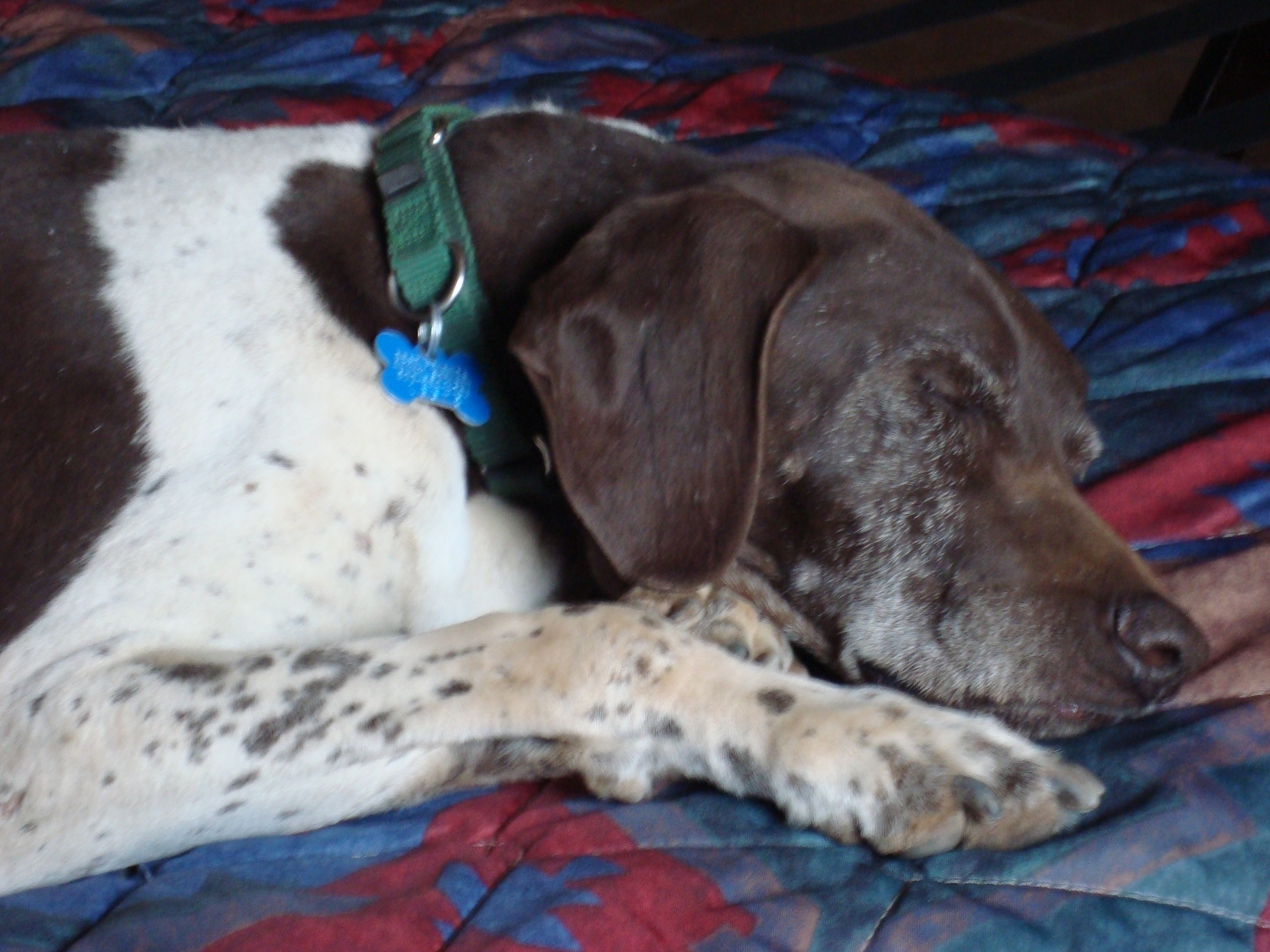
We’ve all seen our dogs deeply asleep, with paws and legs twitching.  There have even been times when my dog puts her head up while sleeping and howls like a wolf.  (She usually wakes herself up, too).

Do our dogs dream?

All evidence points to an answer of ‘yes’.

Researchers know, for example, that the EEGs (electroencephalograms) of sleeping dogs show brain wave activity similar to humans during sleep.  There is a period of sleep known as REM sleep (REM means rapid eye movement) when breathing becomes irregular and the eyes twitch.  Sound familiar?

When humans have been wakened during REM sleep, they report that they have been dreaming and so there is no reason to think that our dogs aren’t dreaming. 

Matthew Wilson, Associate Professor of Brain and Cognitive Sciences at the Massachusetts Institute of Technology says that animals have complex dreams and are able to retain and recall long sequences of events while they are asleep. 

His work involved rats and monitoring their brain wave activity when they were asleep and awake.  He also tracked the effect of sleep on learning of repetitive tasks.

Professor Wilson has said of his work “dreams are the ultimate off-line experience. This work demonstrates that animals are capable of re-evaluating their experiences when they are not in the midst of them.”

By the way, dogs, cats and rabbits are crepuscular which means that they naturally tend to be more active at dawn and at dusk.  Humans are diurnal which means they are most active during the day (which explains why night shifts are so hard on people).  Dogs seem to adjust their own sleep habits to match those of their owners.

Caring for Nunavik’s sled dogs

Andréanne Cléroux, a veterinary student at the University of Montreal International Veterinary Group, is conducting a project to design and deliver a first aid guide for dogs in northern Quebec.

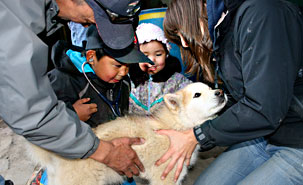
A family with their dog in Nunavik. (Credit: Sylvie Ricard)

“The problem relates mainly to animal health care, immunization, and dog population control,” Cléroux explains. “We wanted to create a guide that would provide basic tools for pet owners so they can provide care to their animal while waiting to contact the remote veterinary consultation service to get advice from a veterinarian at the CHUV (University of Montreal Veterinary Hospital).” 

Cléroux spent time developing the guide before travelling to northern Quebec to work on the draft with residents.  One of the challenges has been to develop a product that was good for those unfamiliar with dog care and still make it useful to mushers, who tend to know more about their dogs.

Cléroux has also created a first aid kit that includes all the necessary material to provide the care described in the manual and delivered it to several villages, with a goal to make it more widely available to all 14 communities in Nunavik.

Source:  University of Montreal press release


Things I must remember as a dog

  • When in the car, I will not insist on having the window rolled down when it’s raining.
  • We do not have a doorbell.  I will not bark each time I hear one on the television.
  • The sofa is not a face towel.  Neither are mum’s and dad’s laps.
  • My head does not belong in the refrigerator.
  • I will not bite the officer’s hand when he reaches in for dad’s drivers license.
  • I will not use ‘roll around in the dirt’ as an option after just getting a bath.
  • The cat is not a squeaky toy so when I play with him and he makes that noise, it’s usually not a good thing.

US stamps in honour of working dogs

The US Postal Service has a set of four stamps honouring service dogs.

The Dogs at Work set shows a guide dog assisting a blind woman, a tracking dog that is following a scent, a therapy dog visiting with an elderly woman and a search and rescue dog standing in a field.

In releasing the stamps for sale, the USPS said “Dogs have become more than just best friends — they’ve also become our coworkers. From guide dogs to therapy dogs to search and rescue dogs, these stamps from the U.S. Postal Service® honor the enduring partnership between dogs and people.”

“Currently, some 10,000 guide dogs in the U.S. and Canada serve as an extra set of eyes for people who are blind. Therapy dogs, chosen for their friendly dispositions, bring comfort and joy to the elderly and the ill. Dogs that work with police and military personnel are trained to detect drugs, guns, and explosives. Search and rescue dogs speed up search efforts, increasing the odds of survival for disaster victims.

Artist John M. Thompson created original paintings for the stamps, which were designed by art director Howard E. Paine. The Dogs At Work stamps are being issued at a 65-cent denomination, which is the price for single-piece retail First-Class Mail weighing more than one ounce and up to and including two ounces.”


Doggy quote of the month for June

“Until one has loved an animal, a part of one’s soul remains unawakened”

– Anatole France

Community, officials at odds over free-roaming dog

Blue the dog doesn’t have a home. And he apparently doesn’t want one. But the blue-eyed Australian cattle dog has $1,800 in savings, a Facebook page and an air-conditioned dog house.

He also has a lawyer, who is working to get him an exemption from local leash laws so he can continue his free-wheeling lifestyle in southern New Mexico’s lakeside community of Elephant Butte, where he was abandoned as a puppy a decade ago.

Read the full story in The Daily Times.

A Dog’s Soul

Every dog must have a soul, somewhere deep inside

Where all his hurts and grievances are buried with his pride.

Where he decides the good and bad, the wrong way from the right,

And where his judgment carefully is hidden from our sight.

A dog must have a secret place, where every thought abides,

A sort of close acquaintance that he trusts in and confides.

And when accused unjustly for himself.   He cannot speak,

Rebuked.  He finds within his soul, the comfort he must seek.

He’ll love, tho’ he is unloved, and he’ll serve tho’ badly used,

And one kind word will wipe away the times he’s been abused.

Altho’ his heart may break in two, his love will still be whole,

Because God gave to every dog an understanding Soul!

–  Author Unknown

Canine heartworm disease

In my recent visit to the Best Friends Animal Society sanctuary, I fell in love with a little dog that I would have loved to adopt.   I learned that she had heartworm disease and was scheduled to undergo further treatment.

I’m not familiar with this disease because I live in New Zealand, where the disease doesn’t exist (and so our authorities would not allow her into the country, which was news I was not prepared to hear).  Here’s some information on the condition:

Heartworm disease is widespread in the United States but particularly prevalent in the southern states around the Gulf of Mexico (including Texas, where my little dog was picked up).  

Mosquitoes help to transmit the infection.  The mosquito ingests microfilariae that circulate in the blood of an infected animal and then these microfilariae develop inside the mosquito.  When the mosquito bites another dog, the larvae are transferred to the new host and travel through the connective tissues into veins and then travel to the heart where they attach themselves in the arteries and pulmonary blood vessels to feed off the nutrient-rich blood.

Within 3-4 months, the heartworms begin reproducing, releasing microfilariae into the bloodstream, where again they can be picked up by mosquitoes to infect other dogs or re-infect the same dog that is bitten again.

Heartworms can grow up to a foot in length and damage the blood vessels as well as inhibiting the flow of blood.   Many dogs with heartworm will not show symptoms but in more serious cases the dogs may have a mild, persistent cough, be reluctant to exercise, show fatigue after only moderate exercise, or have reduced appetite and weight loss.  Dogs can die from the effects of a severe heartworm infestation.

There is a drug that can be injected into a dog for treatment of heartworm, but administration of drugs to prevent heartworm is essential in all dogs.  Dogs are tested for an antigen to confirm presence of heartworms. 

Dogs that are treated for heartworm are injected with a special drug under close veterinary supervision.  Dogs must be kept quiet because as the worms die off, their bodies can become lodged in the lungs causing pulmonary embolism.  This condition can also kill the dog.   Treatment for heartworm is not a full-proof process and comes with risks.

Heartworm disease can affect animals other than dogs.  It has been found in coyotes, wolves, cats, foxes and ferrets – but is the dog that is considered the definitive and ideal host.

Dog owners in the US should ensure that they are giving their dog an approved heartworm prevention drug. 

You can learn more about canine heartworm disease by visiting the American Heartworm Society website.

A canine heart showing severe heartworm infestation