Category Archives: Dogs

Click to give – and it’s free!

One of the greatest things about the internet is the ways it can be used to support charitable organisations, including those involved in animal welfare.

I like the Click to Give website.  Advertisers support the site with proceeds of ‘clicks’ going directly to the nominated charity.  This site supports the ASPCA for animals in need (and 5 other non-animal charitable organisations).

There is a simple registration process to become a user of the site and you are allowed to click only once each day.  You can keep a tally of your reward points and collect these to earn reward gifts or donate points back to the charities for more support.  For example, 400 points can be redeemed to vaccinate a homeless dog or cat.

You can also sign up to get a daily email reminder to ensure you click every day.

I hope you will sign up for the site by following this link:

A city good for dogs is great for humans

I went to a talk earlier this week by Stephen Jenkinson, who is visiting New Zealand from the UK.  Stephen works as a consultant in the UK, with clients including kennel clubs and other agencies.  His area of interest is how public authorities can help reduce conflict over dogs and dog ownership by providing adequate facilities and opportunities for dog owners to do the right thing.

This type of urban planning helps to make dog ownership easy.  For example, you don’t have to drive across town to find an off-leash dog park because there will be dog exercise areas that are within walking distance. (This helps to reduce traffic, greenhouse gas emissions, and conflict when dog owners take their dog off-lead in a ‘normal’ park or reserve.)    Areas in larger recreational parks may be designated for use by dogs and their owners, thus keeping other tracks free for other users who do not want to play or engage with dogs.  And there is a growing body of knowledge around design of dog-friendly accommodation such as apartments and condominiums.

Stephen feels that there is opportunity for the rebuild of Christchurch to do better for dogs, their owners, and all non-dog people.   Sadly, no one from the Christchurch City Council, CERA, or Gerry Brownlee’s office participated in Mr Jenkinson’s public talk on Monday evening.  That signals a lack of senior level buy-in and support for the concepts.

I’ll be doing more research on this topic over the coming weeks and months, but if you’d like to get a flavour for what Mr Jenkinson talked about, you can listen to him speak with Kim Hill on Radio NZ National.

Consultant Stephen Jenkinson with his Border Collie

Money saving tips for dog owners

Salaries and wages aren’t growing as fast as the cost of living and so it is always wise to look for ways to cut your costs.  This includes the costs of dog ownership.

Here are my tips for reducing the overall cost of caring for your dog:

  • Buy quality toys and rotate them – instead of buying toys that are the cheapest you can find (there have been reports of cheap imported toys containing lead paint, for example) – buy quality.  Every few weeks, rotate the toys available to your dog.  A deep toy basket will help you with this chore!
  • Learn to bathe and groom your dog at home, and then cut down on the trips to the professional groomer.  You’ll still want that professional look – but it will lengthen the time between visits and save you money.
  • Buy locally.  Look for locally made shampoos, toys,  food and treats.  These are likely to be less expensive than imported brands (the cost of petrol is a good indication of rising transport costs associated with imports).  The added benefit is you are returning business to people in your area.
  • Buy secondhand goods.  Sites like Trade Me are full of useful products that are up for sale.  You can buy dog kennels, crates, blankets, coats, shampoos, and grooming tools.  In some cases, small businesses (like mine) place products on the site at competitive prices to retail.
  • Buy with your friends.  If you have a small dog, you probably don’t want to buy the largest size bag of food but typically it is the largest bag with the best price.  Why not buy a re-useable storage container and split the cost of a large bag with another dog owning friend?  You both win!
  • Watch out for your dog’s dental health.   Feed bones and chews regularly and introduce teeth brushing for added benefits.  Preventing dental problems will save you money and your dog pain in the longer term.
  • Look out for alternative places to buy your pet supplies.  I have found MyVet online in New Zealand for things like flea and worming treatment.  Much better prices than at the vet or in the pet store.
  • Keep up with your regular veterinary visits.  Regular veterinary checks are essential to picking up on health problems early.  Preventive healthcare is an investment, not a cost.

Please feel free to post your cost-saving ideas by submitting comments to this blog.

Jesse’s helpful dog tricks

It’s been a rough week.  I’m in need of laughter and the immune support and tension relief that it brings.  So, I hope you enjoy this YouTube video of Jesse performing amazing dog tricks that help around the house.

What’s proprioception?

Proprioception is the awareness of how your body, particularly your limbs, are oriented and how your body moves.  A type of self-awareness.  And your dog has it too!

When your dog next goes to the vet for an exam, watch how the vet will support the dog’s body and lift the hind paw, placing it on its toes or more of an upside down position.  Then watch your dog replace its paw to its normal position.  Your vet is looking for how quickly your dog does this and a dog with normal proprioception will replace its paw almost immediately.  Dogs with a neurological deficit will take longer.  Sometimes this isn’t a problem, and sometimes it is a sign that something is going wrong.  It depends on what other symptoms your dog has.

Other symptoms of a proprioceptive deficit include a wearing of the toe nails in an abnormal pattern (I see this a lot in my massage practice) or a strange posture when your dog goes to sleep (paws or legs in an abnormal position).

There are exercises that you can do to enhance your dog’s proprioception.  This includes walking over sticks or ladders as seen in this YouTube video:

Kathleen Crisley, Fear-Free certified professional and specialist in dog massage, rehabilitation and nutrition/food therapy, The Balanced Dog, Christchurch, New Zealand

In memoriam

On Monday, we lost a great dog by the name of Olliver (yes – that’s the correct spelling). A Dalmatian, Ollie had great spirit, which showed through even more when he lost the ability to walk in July 2010.  The veterinary profession have been stymied as to the reason for Ollie’s sudden loss of function and his owner has generously offered Ollie’s body for study at Massey University.

With the love and constant care of his owner, Ollie was engaged and alert until his sudden crash on Monday with internal bleeding.  I miss him.   Working with Ollie three times per week over the last year, we connected in a way I haven’t had the privilege of doing with any other dog.  Rest well, Ollie, my special boy.   I will take you with me for the rest of my days.


The Rainbow Bridge

Just this side of Heaven is a place called Rainbow Bridge.  When an animal dies that has been especially close to someone here, that pet goes to Rainbow Bridge.  There are meadows and hills for all of our special friends so they can run and play together.  There is plenty of food and water and sunshine, and our friends are warm and comfortable.  All the animals who had been ill and old are restored to health and vigour:  those who were hurt or maimed are made whole and strong again, just as we remember them in our dreams of days gone by.

The animals are happy and content, except for one small thing:  they miss someone very special to them who had to be left behind.  They all run and play together, but the day comes when one suddnely stops and looks into the distance.  The eyes are intent, the eager body quivers.  Suddenly he begins to break away from the group, flying over the green grass, his legs carrying him faster and faster.  You have been spotted and when you and your special friend finally meet you cling together in joyous reunion, never to be parted again.  The happy kisses rain upon your face, your hands again caress his beloved head and you look once more into the trusting eyes of your pet, so long gone from your life but never absent from your heart.

Then you pass over the Rainbow Bridge together…

Kathleen Crisley, specialist in dog massage, rehabilitation and nutrition/food therapy, The Balanced Dog, Christchurch, New Zealand

Lions Hearing Dogs of Australia

Coming up next month in my column in NZ Dog World and on this blog will be information on Hearing Dogs in New Zealand.  However, I was in Australia last week on business and picked up some useful information about Lions Hearing Dogs in that country.

98% of the hearing dogs in Australia are ex-shelter dogs.  As their name suggests, these dogs alert a hearing impaired owner to important sounds like the fire alarm.  It takes approximately $30,000 to train a single hearing dog.

Access to public places for these assistance dogs is guaranteed by law with penalties of up to $50,000 can be applied if someone refuses access to a hearing dog and its owner.

The organisation has trained over 500 dogs since 1982 and has a very useful website.

Be glad you’re not a dog owner in Jiangmen, China

The City of Jiangmen, China originally banned keeping of all dogs  effective from July 26, 2011.  Nine days later, after public pressure, the ban was lifted but only concerning ownership of dogs.   Dogs are still banned from all public places – which doesn’t bode well for the ongoing socialisation of dogs and puppies in that region, nor the efforts of owners to keep them stimulated and exercised.

This is a sad outcome for dogs and dog owners alike.  City officials say that the move was prompted by escalating rates of dog bites and attacks.  (For example, 4,000 dog-related complaints in the first six months 0f 2011.)

So, be glad you’re not a dog owner in Jiangmen, China.  Or a dog for that matter.

Read more about the ban in this UPI article.

Two cats one dog magazine – read it online for free!

Two cats one dog is the vet magazine for pet lovers and you can read it online for absolutely FREE!

Simply go to this introductory page to register and then you are ready to read issues of the magazine online.

I’m featured in the current issue (Spring 2011) as part of a comprehensive article on pet physiotherapy.   There’s a case study of one of my regular clients, Teddy, a young Beagle with hip dysplasia.  The article starts on page 17;  here’s a link to get you to the right page.

They say the best things in life are free – so get reading today!

Kathleen Crisley, Fear-Free certified professional and specialist in dog massage, rehabilitation and nutrition/food therapy, The Balanced Dog, Christchurch, New Zealand

Dogs as workers – not such a bad idea according to NZ researcher

“Some people think that is cruel to use dogs as workers,” says Dr William “Deak” Helton, “but what these people don’t seem to understand is that from the dog’s perspective it is actually crueller if they are not allowed to work.”  Dr Helton, who is based at the Department of Psychology at the University of Canterbury in Christchurch, New Zealand, is describing for me his experience with working dogs in Alaska.  I wrote about his research in my Canine Corner column this month (NZ Dog World), and here’s some more information about Deak and his research.

This slideshow requires JavaScript.

(Photos copyright Eve Welch, University of Canterbury)

Deak has been studying dogs for over 12 years and, from those early days growing up in Alaska, he observed that sledding and racing dogs wanted to pull immediately when they were placed in harness.  Many people don’t realise, when watching coverage of competitions like the Iditarod, that a large metal snow anchor is used to keep the sled in place as the dogs are secured in their harnesses.  A handler that forgets to do this will quickly find his/her sled taken out for an unguided run!

Deak has a keen interest in seeing working dogs reach top performance.  He described one of his research projects, looking for a way to help screen dogs being considered for a working career:A recent study we did was one in which we measured dogs’ right and left ear temperatures and their ability (based on owners’ reports) to pay attention. The tympanic membrane’s (ear drum’s) temperature is highly correlated with the temperature of the brain on the same side. So differences between the ear’s temperatures may tell you if the dog is more strongly cerebrally lateralized than another. Dogs (like people) have two cerebral hemispheres, one right and one left. Most people are aware that they have a dominate hemisphere (are lateralized). Dogs also differ in their degree of lateralization (how strong one side is compared to the other). Neuroscientists have hypothesized that being strongly lateralized (having a dominate cerebral hemisphere) is actually helpful to the animal in coordinating its behaviour. Imagine having two brain hemispheres both trying to tell your body what to do, without having one as the “leader,” the system may be prone to confusion. Hence, dogs with stronger cerebral lateralization may be better able to pay attention. The less lateralized dogs may be more prone to conflicting cues (distraction). Difference in right and left ear temperature may be an objective measure of cerebral lateralization.

One area where dogs show promise is in the field of medical diagnostics, says Deak.  He goes into some detail about the role of the dog, its accuracy in detecting rates of disease, and his opinion that dogs would be used more widely than they currently are:

There have now been several studies showing that dogs can be used to detect various medical conditions, for example, cancers. When you compare detection capability across tests/technologies you have to look at both the correct detection rate and the false alarm rate of the different tests.

Dogs have been trained to detect the presence of breast cancer by smelling the patient’s exhaled breath. The principle is essentially the same as breath analysis to detect alcohol consumption. The patient breathes into a tube that traps the chemicals exhaled in their breath. The dog then is presented with these breath samples and has been trained to signal when one of them has cancer related chemical compounds (it might not be that the dog is smelling cancer per se, but some related chemical excreted by the body as a reaction to cancer). McCulloch and colleagues (2006) have trained dogs to do this task (detect breast cancer via breath samples), and the dogs after training demonstrated a correct detection rate around 88.0% and a false alarm rate around 2.3%. This is not perfect, but for comparative purposes, in the medical literature, mammography screening by professional radiologists for breast cancer typically has a correct detection rate around 86.6% and a false alarm rate around 3.2% (Banks et al., 2004).

A higher correct detection rate and lower false alarm rate means an overall better detector.

The dog definitely looks promising. Keep in mind mammography is also considered by many to be uncomfortable and some people are concerned that the procedure itself may have side effects. This may put off people from doing the test. The key with cancer is probably early detection. If people are afraid of the test, they aren’t going to do it until they feel so bad they have to and by that time it might be too late. Dog detection (since the dog doesn’t have to even be in contact with the patient) is generally non-invasive.

For detecting intestinal cancer the difference in screening may be between a stool sample and having a colonoscopy. The latter is much more uncomfortable than the former. Considering the preliminary evidence and the long track-record of dogs being used in other detection contexts (explosives, narcotics, invasive pests, etc.), I think the lack of using dogs in medical diagnostic work is mysterious. While dogs will not be a perfect system, people have to realize there are no tests that are perfect. Dogs (or other biological detectors) could be used in conjunction with other tests. There are companies trying to figure out what the dogs are detecting so that they can make technological tests for detecting cancer based on the dog’s ability to detect it, but that is not helping anyone now.

Dogs can probably do the job and if the track record in other contexts is informative (for example, explosives) then dogs will probably be able to do the job better than technology for the foreseeable future.  Of course we should develop other technologies, but if we want to save lives now, dogs could be used more in this context.

The Editor of Canine Ergonomics:  The Science of Working Dogs, a compilation of research from disciplines ranging from biology and veterinary medicine, to psychology and forensic medicine, Deak says “For me, this book filled a gap when you consider how extensive dogs are employed.”  The book, published in 2009 has had great reviews.
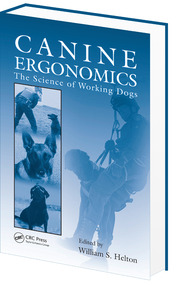
The cover of Deak's book

Deak describes his research as the field of engineering psychology, more popularly known as ergonomics.  His work in the field of human factors psychology has earned him the 2011 Earl Alluisi Award for Early Career Achievement by the American Psychological Association (APA).