Category Archives: research

Clinical trials to help beat cancer

Raelene Wouda’s passion for improving cancer treatment starts with our four-legged friends.

Dog cancer photo
Wouda, Kansas State University assistant professor of clinical sciences, is conducting clinical trials to treat cancers in dogs, cats and other companion animals.

When pet owners bring their dogs, cats, horses and other animals to the College of Veterinary Medicine’s Veterinary Health Center for treatment, Wouda and the Oncology Service can offer groundbreaking new treatments often at a lower cost to pet owners.

Wouda also is able to study important topics, such as improved diagnostic testing, monitoring approaches and innovative treatment options, including anti-cancer vaccines, t-cell transfer, combination chemotherapy and nanoparticle drug formulations. She has recently published her research in Veterinary Comparative Oncology and the Journal of the American Veterinary Medical Association.

“Although surgery, radiation therapy, chemotherapy and, more recently, immunotherapy have improved patient outcomes, many cancers still do not have a long-term cure,” said Wouda, a clinical veterinary oncologist. “These clinical trials are a crucial step.”

But Wouda’s research benefits humans, too. Many cancers in animals — especially dogs — are similar to those in humans, which means that the diagnosis, monitoring, treatment and response to treatment are also similar.

“Any research that we do in our patients has the potential to provide important information for how the disease can be better diagnosed, monitored and treated in human patients,” Wouda said. “That’s what I would like to do with our research. I would like to continue to improve outcomes for our veterinary patients and, by extension, help human cancer patients.”

Companion animals offer several research advantages. Wouda’s clinical trial program focuses primarily on dogs because of the similarities between their cancers and human cancers, such as osteosarcoma, melanoma, lung cancer and urogenital cancers. Osteosarcoma, for example, is both clinically and genetically almost identical in dogs and human pediatric patients.

Dogs also live with us and are exposed to the same environmental factors. Additionally, because dogs age faster than humans — one dog year is equivalent to seven human years — their diseases progress faster, which is a practical advantage for rapidly evaluating a new treatment’s efficacy and clinical benefit, Wouda said.

“We get clinical answers more quickly in dogs,” Wouda said. “The benefit of a particular therapy becomes evident in dogs more rapidly compared to people, and because of this we can preserve research and development finances, but more importantly, we save valuable time and resources.”

Animal clinical trials are structured similarly to human clinical trials and are tightly regulated and overseen. Wouda works with Mary Lynn Higginbotham, associate professor of clinical sciences, their graduate students and oncology technicians as well as the Veterinary Health Center’s referring veterinarians to conduct these clinical trials. They also collaborate with human medical researchers to discuss how the research can best be applied in the field of human oncology.

“For many pet owners, cancer is a terminal diagnosis for their beloved family member,” Wouda said. “These studies provide owners an opportunity to trial a cutting-edge therapy for their pets at a reasonable price. Moreover, owners participating in these clinical trials take comfort and are pleased to know that they are helping to achieve better treatments and outcomes for pets that may be diagnosed with cancer in the future.”

Source:  Kansas State University
Dogs were domesticated not once, but twice

The question, ‘Where do domestic dogs come from?’, has vexed scholars for a very long time. Some argue that humans first domesticated wolves in Europe, while others claim this happened in Central Asia or China. A new paper, published in Science, suggests that all these claims may be right. Supported by funding from the European Research Council and the Natural Environment Research Council, a large international team of scientists compared genetic data with existing archaeological evidence and show that man’s best friend may have emerged independently from two separate (possibly now extinct) wolf populations that lived on opposite sides of the Eurasian continent.

Domestication photo

Man’s best friend. Dogs were domesticated not once, but twice… in different parts of the world. Credit: © lenaivanova2311 / Fotolia

This means that dogs may have been domesticated not once, as widely believed, but twice.

A major international research project on dog domestication, led by the University of Oxford, has reconstructed the evolutionary history of dogs by first sequencing the genome (at Trinity College Dublin) of a 4,800-year old medium-sized dog from bone excavated at the Neolithic Passage Tomb of Newgrange, Ireland. The team (including French researchers based in Lyon and at the National Museum of Natural History in Paris) also obtained mitochondrial DNA from 59 ancient dogs living between 14,000 to 3,000 years ago and then compared them with the genetic signatures of more than 2,500 previously studied modern dogs.

The results of their analyses demonstrate a genetic separation between modern dog populations currently living in East Asia and Europe. Curiously, this population split seems to have taken place after the earliest archaeological evidence for dogs in Europe. The new genetic evidence also shows a population turnover in Europe that appears to have mostly replaced the earliest domestic dog population there, which supports the evidence that there was a later arrival of dogs from elsewhere. Lastly, a review of the archaeological record shows that early dogs appear in both the East and West more than 12,000 years ago, but in Central Asia no earlier than 8,000 years ago.

Combined, these new findings suggest that dogs were first domesticated from geographically separated wolf populations on opposite sides of the Eurasian continent. At some point after their domestication, the eastern dogs dispersed with migrating humans into Europe where they mixed with and mostly replaced the earliest European dogs. Most dogs today are a mixture of both Eastern and Western dogs — one reason why previous genetic studies have been difficult to interpret.

The international project (which is combining ancient and modern genetic data with detailed morphological and archaeological research) is currently analysing thousands of ancient dogs and wolves to test this new perspective, and to establish the timing and location of the origins of our oldest pet.

Senior author and Director of Palaeo-BARN (the Wellcome Trust Palaeogenomics & Bio-Archaeology Research Network) at Oxford University, Professor Greger Larson, said: ‘Animal domestication is a rare thing and a lot of evidence is required to overturn the assumption that it happened just once in any species. Our ancient DNA evidence, combined with the archaeological record of early dogs, suggests that we need to reconsider the number of times dogs were domesticated independently. Maybe the reason there hasn’t yet been a consensus about where dogs were domesticated is because everyone has been a little bit right.’

Lead author Dr Laurent Frantz, from the Palaeo-BARN, commented: ‘Reconstructing the past from modern DNA is a bit like looking into the history books: you never know whether crucial parts have been erased. Ancient DNA, on the other hand, is like a time machine, and allows us to observe the past directly.’

Senior author Professor Dan Bradley, from Trinity College Dublin, commented: ‘The Newgrange dog bone had the best preserved ancient DNA we have ever encountered, giving us prehistoric genome of rare high quality. It is not just a postcard from the past, rather a full package special delivery.’

Professor Keith Dobney, co-author and co-director of the dog domestication project from Liverpool University’s Department of Archaeology, Classics and Egyptology, is heartened by these first significant results. ‘With the generous collaboration of many colleagues from across the world-sharing ideas, key specimens and their own data — the genetic and archaeological evidence are now beginning to tell a new coherent story. With so much new and exciting data to come, we will finally be able to uncover the true history of man’s best friend.’

Source:  Science Daily

Does your dog understand you?

Research by a Brigham Young University psychology professor shows how dogs perceive and use human emotional cues and gestures.

Professor Ross Flom conducted two experiments where he looked at the frequency in which dogs followed a pointing gesture to locate a hidden reward. Those gestures were paired with either positive or negative behaviors from the person pointing. Positive behaviors included smiling and speaking in a pleasant tone. Negative behaviors included frowning, a furrowed brow and speaking in a harsh tone.

The main finding of the study is that dogs use human emotions in determining how quickly or how slowly they’re going to go and explore an unfamiliar location. While positive behaviors didn’t improve response time from the control group, negative behaviors, which simulated emotions closely tied to anger, delayed the response time.

The bottom line:  your dog doesn’t trust you when you’re angry.

Fossil dog represents a new species

Fossil dog

A fossil found in Maryland was identified by a University of Pennsylvania doctoral student as belonging to a new species of ancient dog. The hyena-like canine, with massive jaws capable of crushing bone, would have lived approximately 12 million years ago, at a time when massive sharks like megalodon swam in the oceans. Credit: Illustration of Cynarctus from “Dogs, Their Fossil Relatives and Evolutionary History.” Reprinted and used with permission of the publisher and Mauricio Antón, author of the illustration and copyright owner [2008]; Courtesy of University of Pennsylvania

A doctoral student at the University of Pennsylvania has identified a new species of fossil dog. The specimen, found in Maryland, would have roamed the coast of eastern North America approximately 12 million years ago, at a time when massive sharks like megalodon swam in the oceans.

The newly named species is Cynarctus wangi, named for Xiaoming Wang, curator at the Natural History Museum of Los Angeles County and a renowned expert on mammalian carnivores. This coyote-sized dog was a member of the extinct subfamily Borophaginae, commonly known as bone-crushing dogs because of their powerful jaws and broad teeth.

“In this respect they are believed to have behaved in a similar way to hyenas today,” said the study’s lead author, Steven E. Jasinski, a student in the Department of Earth and Environmental Science in Penn’s School of Arts & Sciences and acting curator of paleontology and geology at the State Museum of Pennsylvania in Harrisburg.

Fossils from terrestrial species from this region and time period are relatively rare, thus the find helps paleontologists fill in important missing pieces about what prehistoric life was like on North American’s East Coast.

“Most fossils known from this time period represent marine animals, who become fossilized more easily than animals on land,” Jasinski said. “It is quite rare we find fossils from land animals in this region during this time, but each one provides important information for what life was like then.”

Whenco-researchers Jasinski and Wallace first began their investigation of the specimen, which had been found by an amateur collector along the beach under the Choptank Formation in Maryland’s Calvert Cliffs region and was then held by the Smithsonian Institution, they presumed it was a known species of borophagine dog, a species called marylandica that was questionably referred to as Cynarctus, a fossil of which had been found in older sediment in the same area. But when they compared features of the occlusal surfaces, where the top and bottom teeth meet, of the previously known and the new specimens, they found notable differences. They concluded that the specimen represented a distinct species new to science.

“It looks like it might be a distant relative descended from the previously known borophagine,” Jasinski said.

Borophagine dogs were widespread and diverse in North America from around 30 million to about 10 million years ago. The last members went extinct around 2 millions of years ago during the late Pliocene. C. wangi represents one of the last surviving borophagines and was likely outcompeted by ancestors of some of the canines living today: wolves, coyotes and foxes.

Despite its strong jaws, the researchers believe C. wangi wouldn’t have been wholly reliant on meat to sustain itself.

“Based on its teeth, probably only about a third of its diet would have been meat,” Jasinski said. “It would have supplemented that by eating plants or insects, living more like a mini-bear than like a dog.”

“This new dog gives us useful insight into the ecosystem of eastern North America between 12 and 13 million years ago,” Jasinski said.

Source:  PennNews media release

Rare human disease found in dogs

Lung disease

A rare, severe form of pulmonary hypertension, which up until now, has only been classified as a human lung disease, has also been discovered in dogs according to a Michigan State University study. (Stock image) Credit: © Sylvie Bouchard / Fotolia

A rare, severe form of pulmonary hypertension, which up until now, has only been classified as a human lung disease, has also been discovered in dogs according to a Michigan State University study.

“Our research is the first to document the existence of pulmonary veno-occlusive disease, or PVOD, in dogs,” said Kurt Williams, the lead author of the study and an expert in respiratory pathology in MSU’s College of Veterinary Medicine. “PVOD is considered one of the most severe forms of pulmonary hypertension.”

The study is published in the journal Veterinary Pathology.

The number of pulmonary hypertension, or PH, cases reported in the United States is low, affecting 15 to 50 people per million each year. PVOD is diagnosed in only about 10 percent of PH cases where no other cause of the disease has been determined. Unfortunately, there are very few effective treatment options for PVOD and a lung transplant often becomes the best choice.

“PVOD might be more common in dogs than in people, but this has yet to be determined and needs to be looked at further,” Williams said.

Pulmonary hypertension develops because of abnormal blood vessels in the lungs, which makes it harder for the heart to push blood through and provide oxygen to the rest of the body. In cases of PVOD, the small veins in the lungs become blocked, increasing pressure in these blood vessels, and ultimately causing heart failure.

“The same process happens in canines,” Williams said. “These dogs also come in with similar symptoms as humans, yet because subtle changes in health may not be recognized as quickly in dogs, death can occur quickly once the animal is seen by a veterinarian.”

Symptoms include cough, increased rate of breathing, respiratory distress, loss of appetite and chronic fatigue. Fatal progression of the disease in humans can last up to two years.

“PVOD is a poorly understood disease not just because it’s so rare, but also because there’ve been no other animals known to have the disease,” Williams said. “Our finding changes things.”

Williams said that the discovery could be important for human medicine because the canine disease may serve as a model for human PVOD.

“It’s cases like this that help to remind us how important veterinary medicine is to medicine in general,” he said. “Our colleagues in the human medical community are becoming much more aware of the many diseases shared by our respective patients and how together we can learn from each other.”

Source:  Michigan State University media release

Will computers replace dog trainers?

North Carolina State University researchers have developed and used a customized suite of technologies that allows a computer to train a dog autonomously (without human involvement), with the computer effectively responding to the dog based on the dog’s body language.

“Our approach can be used to train dogs efficiently and effectively,” says David Roberts, an assistant professor of computer science at NC State and co-author of a paper on the work. “We use sensors in custom dog harnesses to monitor a dog’s posture, and the computer reinforces the correct behavior quickly and with near-perfect consistency.”

Dog training with computers

“Because the technology integrates fundamental principles of animal learning into a computational system, we are confident it can be applied to a wide range of canine behaviors,” says Alper Bozkurt, an assistant professor of electrical and computer engineering and co-author of the paper. “For example, it could be used to more quickly train service dogs. Ultimately, we think the technology will be used in conjunction with human-directed training.”

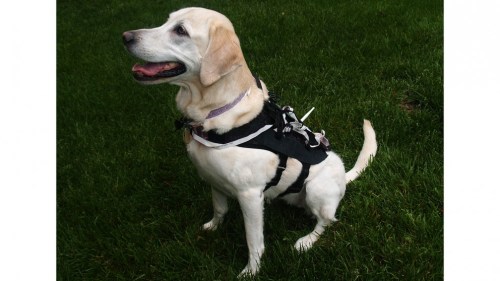
The dog harness fits comfortably onto the dog and is equipped with a variety of technologies that can monitor the dog’s posture and body language. Each harness also incorporates a computer the size of a deck of cards that transmits the sensor data wirelessly.

For the current study, the researchers wrote an algorithm that triggered a beeping sound and the release of dog treats from a nearby dispenser whenever the dog’s harness sensors detected that the dog went from standing to sitting.

The researchers had to ensure that the reinforcement was given shortly after the desired posture was exhibited, and also ensure that rewards were only given for the correct posture. This required a trade-off. If the algorithm ran long enough to ensure the correct posture with 100 percent certainty, the reinforcement was given too late to be effective for training purposes. But if the reinforcement was given immediately, there was a high rate of rewarding the wrong posture.

To address this, the researchers worked with 16 volunteers and their dogs to optimize the algorithm, finding the best possible combination of speed and accuracy. The researchers then compared the algorithm’s timing and accuracy to that of an expert human trainer.

The algorithm was highly accurate, rewarding the appropriate behavior 96 percent of the time. But the human trainer was better – with a 100 percent accuracy rate.

However, while the average response time was about the same for both algorithm and trainer, there was a lot of variation in the time of response from the trainer. The algorithm was incredibly consistent.

“That variation matters, because consistency is fundamentally important for all animal training,” Roberts says.

“This study was a proof of concept, and demonstrates that this approach works,” Bozkurt says. “Next steps include teaching dogs to perform specific behaviors on cue, and integrating computer-assisted training and human-directed training for use in various service dog applications.”

“In the long term, we’re interested in using this approach to animal-computer interaction to allow dogs to ‘use’ computers,” Roberts says. “For example, allowing an explosive detection dog to safely and clearly mark when it detects components of a bomb, or allowing diabetic alert dogs to use their physical posture and behaviors to call for help.”

Source:  North Caroline State University media release

Senior adults see benefits from dog ownership

The Centers for Disease Control and Prevention (USA) recommends that adults of all ages should engage in 150 or more minutes of moderate physical activity per week. Among adults 60 years of age or more, walking is the most common form of leisure-time physical activity because it is self-paced, low impact and does not require equipment.

Johnson and Dog - senior dogs

Rebecca Johnson and her team determined that older adults who also are pet owners benefit from the bonds they form with their canine companions. Photo by University of Missouri

Researchers at the University of Missouri have determined that older adults who also are pet owners benefit from the bonds they form with their canine companions. Dog walking is associated with lower body mass index, fewer doctor visits, more frequent exercise and an increase in social benefits for seniors.

“Our study explored the associations between dog ownership and pet bonding with walking behavior and health outcomes in older adults,” said Rebecca Johnson, a professor at the MU College of Veterinary Medicine, and the Millsap Professor of Gerontological Nursing in the Sinclair School of Nursing. “This study provides evidence for the association between dog walking and physical health using a large, nationally representative sample.”

The study analyzed 2012 data from the Health and Retirement study sponsored by the National Institute on Aging and the Social Security Administration. The study included data about human-animal interactions, physical activity, frequency of doctor visits and health outcomes of the participants.

“Our results showed that dog ownership and walking were related to increases in physical health among older adults,” said Johnson, who also serves as director of the Research Center for Human-Animal Interaction at MU. “These results can provide the basis for medical professionals to recommend pet ownership for older adults and can be translated into reduced health care expenditures for the aging population.”

Results from the study also indicated that people with higher degrees of pet bonding were more likely to walk their dogs and to spend more time walking their dogs each time than those who reported weaker bonds. Additionally, the study showed that pet walking offers a means to socialize with pet owners and others.

Retirement communities also could be encouraged to incorporate more pet-friendly policies such as including dog walking trails and dog exercise areas so that their residents could have access to the health benefits, Johnson said.

Source:  University of Missouri media release

Eyesight in the older dog

The eyesight in our dogs changes with age.

English Pointer with Puplight

Researchers based at the Nestlé Purina Research Center in Missouri have discovered that our dogs become more near-sighted as they age.  Their results were published in the journal PLoS One.

This investigation used an instrument called an autorefractor to measure the dogs’ eyesight in indirect and direct lighting conditions. The study involved nine Beagles ranging in age from 1 to 14 years.   Before entering the study, the dogs were examined to confirm that none of them had cataracts.

Measurements were taken on three different days of the week for a period of six weeks.

The researchers found a remarkable difference between the younger and older dogs.  The older dogs had a much-reduced ability to see at longer distances (far-sightedness) compared to the younger dogs.  Younger dogs were also able to make larger accommodation changes from indirect light to direct light conditions, indicating a more flexible lens.

Humans are the opposite in terms of length of sight.  As we age it can become more difficult to read and see things at shorter distances whereas our ability to see at distances is often not affected (although some older people do have difficulties adjusting to night and low-light conditions, just as the dogs in this study did).

So if your dog is getting older and you notice that they can’t pick up on your body language and signals, there’s a physical reason for it.

Through my own experience working with older dogs, I recommend using a light that helps your senior dog adjust to low-lighting conditions.  See my post on the PupLight, for example.

Kathleen Crisley, specialist in dog massage, rehabilitation and nutrition/food therapy, The Balanced Dog, Christchurch, New Zealand


Words we say to our dogs and other things

Yet more research on the human-animal bond.  This time the research was based at Barnard College’s Dog Cognition Lab.

Researchers Alexandra Horowitz and Julie Hecht asked members of the public to send them videos of playtime with their dogs.

Dog with frisbee

They received 187 videos from dog owners in 19 different countries and watched them all, looking for patterns in human behaviour and the dog’s responses.

For example, they created a list of the top 35 words owners used with their dogs:

List of words dog owners use

The research team also noticed gender differences.  Female owners touch their dogs more when at play; half of male owners didn’t touch their dogs at all.

There is a practical application for this research (although I do agree that it sounds like a fun job).  There is a growing interest in helping to train dogs as assistance dogs and understanding how humans and dog interact may help to refine training techniques.

The research has been published in the journal Animal Cognition.

Source:  Discover magazine

Cross-breeding to eradicate Chiari syndrome

In a new study published in the journal PLOS ONE, scientists from the University of Surrey, working with an experienced breeder in the Netherlands, examined how the skull and brain of toy dogs change when a Brussels Griffon with Chiari-like malformation is crossed with an Australian Terrier.  The succeeding hybrid puppy is then back crossed to a Brussels Griffon to give some of the features of the Brussels Griffon, but keeping the longer skull of the Australian Terrier.

Griffon and cross breed

Second-generation backcross and purebred Brussel Griffon Sire Photo credit: Henny van der Berg

The results from the study showed it is possible to breed a dog which had the external features of a short-nosed Brussels Griffon and reduce the risk of Chiari malformation, a debilitating condition found in toy dogs and affecting 1 in 1,280 humans.  The disease is characterised by premature fusion of skull bones forcing parts of the brain to push through the opening in the back of the skull causing fluid filled cavities to develop in the spinal cord. Chiari malformation causes headaches, problems with walking or even paralysis and has become prevalent in some toy breed dogs as a result of selective breeding.

The breeder, Henny van der Berg proposed the project idea after an accidental mating between two of her dogs.  The four-year study analysed five traits on magnetic resonance images (MRI) scans and how they changed generation by generation in the family of 29 dogs.  Using a careful selection of head shape and MRI scans over two generations, the findings revealed it was possible to breed a dog which had the external features of a Brussels Griffon, but is less susceptible to Chiari malformation.

“This is a true collaboration with breeders and researchers working together and using their expertise to improve the health of dogs,” said Dr Clare Rusbridge from the University of Surrey.

“Our study investigated how the characteristics of this disease is inherited in the family.  Such knowledge could help in tackling this debilitating disease in toy dog breeds.  We hope our research will help develop more sophisticated ways of screening and improve breeding guidelines by creating robust breeding values.”

The team at the University of Surrey is now collaborating with geneticists at the University of Montreal, and correlating the skull and brain traits visualised on magnetic resonance images with the dog genome. This information will then be translated to humans.

Source:  University of Surrey media release

My other posts about Chiari malformation include: