Category Archives: research

Kids with dogs have less anxiety

A research team at Bassett Medical Center in New York has found that kids with a dog at home experience far less clinical anxiety than do children who are dog-less.

This small study adds to the growing body of knowledge about the human-animal bond and the positive health impacts of dog ownership.

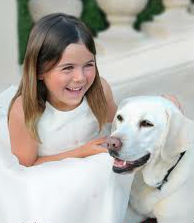
Child and dog

Read more about this study on NBC News.


Other blog posts about kids, dogs and health:

Kathleen Crisley, specialist in dog massage, rehabilitation and nutrition/food therapy, The Balanced Dog, Christchurch, New Zealand

Dogs evolved with climate change

World leaders are meeting right now in Paris to discuss climate change…but did you know that dogs evolved in part because of climate change?

A study of North American dog fossils as old as 40 million years suggests that the evolutionary path of whole groups of predators  – including dogs – can be a direct consequence of climate change.  The study has been published in the journal Nature Communications.

“It’s reinforcing the idea that predators may be as directly sensitive to climate and habitat as herbivores,” said Christine Janis, professor of ecology and evolutionary biology at Brown University, who worked with lead author Borja Figueirido, a former Brown Fulbright postdoctoral researcher who is now a professor at the Universidad de Málaga in Spain. “Although this seems logical, it hadn’t been demonstrated before.”

The climate in North America’s heartland back around 40 million years ago was warm and wooded. Dogs are native to North America. The species of the time, fossils show, were small animals that would have looked more like mongooses than any dogs alive today and were well-adapted to that habitat. Their forelimbs were not specialized for running, retaining the flexibility to grapple with whatever meal unwittingly walked by.

Early Dogs

Two early dogs, Hesperocyon, left and the later Sunkahetanka, were both ambush-style predators. As climate changes transformed their habitat, dogs evolved pursuit hunting styles and forelimb anatomy to match.
Image: Mauricio Anton

But beginning just a few million years later, the global climate began cooling considerably; the forests slowly gave way to open grasslands.

Pups of the plains

Did this transition affect the evolution of carnivores? To find out, Figueirido and the research team, including Jack Tseng of the American Museum of Natural History in New York, examined the elbows and teeth of 32 species of dogs spanning the period from ca. 40 million years ago to 2 million years ago. They saw clear patterns in those bones at the museum: At the same time that climate change was opening up the vegetation, dogs were evolving from ambushers to pursuit-pounce predators like modern coyotes or foxes — and ultimately to those dogged, follow-a-caribou-for-a-whole-day pursuers like wolves in the high latitudes.

“The elbow is a really good proxy for what carnivores are doing with their forelimbs, which tells their entire locomotion repertoire,” Janis said.

The telltale change in those elbows has to do with the structure of the base where the humerus articulates with the forearm, changing from one where the front paws could swivel (palms can be inward or down) for grabbing and wrestling prey to one with an always downward-facing structure specialized for endurance running. Modern cats still rely on ambush rather than the chase (cheetahs are the exception) and have the forelimbs to match, Janis said, but canines signed up for lengthier pursuits.

In addition, the dogs’ teeth trended toward greater durability, Figueirido’s team found, consistent perhaps with the need to chow down on prey that had been rolled around in the grit of the savannah, rather than a damp, leafy forest floor.

If predators evolved with climate change over the last 40 million years, the authors argue, then they likely will have to continue in response to the human-created climate change underway now. The new results could help predict the effects we are setting in motion.

“Now we’re looking into the future at anthropogenic changes,” Janis said.

Source:  Brown University media release

The great escape – an example of dog intelligence

Any reader of my blog knows that I enjoy following research topics, and I’ve written a number of posts about dog cognition.

This video, of a German Short Haired Pointer, shows that dogs are smart and can work things out.

She’s working on her great escape…watch her as she works it out (don’t just jump to the end)

Kathleen Crisley, specialist in dog massage, rehabilitation and nutrition/food therapy, Canine Catering Ltd, Christchurch, New Zealand

A device to help monitor guide dog health

Researchers at North Carolina State University have developed a device that allows people who are blind to monitor their guide dogs, in order to keep tabs on the health and well-being of their canine companions.

Guide dog and handler

Sean Mealin and Simba, using a traditional guide dog harness and handle. Photo credit: NC State University

“Dogs primarily communicate through their movements and posture, which makes it difficult or impossible for people who are blind to fully understand their dogs’ needs on a moment-to-moment basis,” says David Roberts, an assistant professor of computer science at NC State and co-author of a paper describing the new technology. “This challenge is particularly pronounced in guide dogs, who are bred and trained to be outwardly calm and avoid drawing attention to themselves in public.

To address this need, the researchers have developed a suite of technologies that monitor a dog’s breathing and heart rate and share the information with the dog’s handler.

“Our goal is to let guide dog handlers know when their dogs are stressed or anxious,” says Sean Mealin, a Ph.D. student at NC State and lead author of the paper. “This is important because it is widely believed that stress is a significant contributing factor to early retirement of guide dogs and other service animals. The technology may also be able to help handlers detect other health problems, such as symptoms of heat exhaustion.”

The issue is particularly important to Mealin, who is blind and works with his own guide dog, Simba.

The research team had previously developed monitoring technologies that are incorporated into a lightweight harness that can be worn by rescue or service dogs. The trick was to find a way to share that monitoring data with users who are blind – and to do so in a way that allows those users to act on the information.

So, the researchers developed a specialized handle that attaches to a guide dog’s harness.  The handle is equipped with two vibrating motors.

High tech dog harness

This guide-dog harness handle contains electronics that allow users to monitor the breathing and heart rate of their dogs. Photo credit: David Roberts

One motor is embedded in the handle by the handler’s thumb, and vibrates – or beats – in time with the dog’s heart rate. When the dog’s heart rate increases, so does the rate at which the motor beats.

The second motor is embedded in the handle near the handler’s pinky finger, and vibrates in synch with the dog’s breathing. The vibration increases and decreases in intensity, to simulate the dog breathing in and out.

“We’re refreshing the design and plan to do additional testing with guide-dog handlers,” Roberts says. “Our ultimate goal is to provide technology that can help both guide dogs and their people. That won’t be in the immediate future, but we’re optimistic that we’ll get there.”

Source:  NC State University media release

How our dogs react to faces (vs other objects)

Dogs have a specialized region in their brains for processing faces, a new study finds. PeerJ is publishing the research, which provides the first evidence for a face-selective region in the temporal cortex of dogs.

“Our findings show that dogs have an innate way to process faces in their brains, a quality that has previously only been well-documented in humans and other primates,” says Gregory Berns, a neuroscientist at Emory University and the senior author of the study.

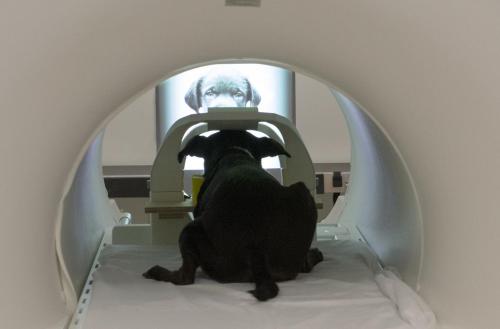
Dog in MRI machine at Emory University

The study involved dogs viewing both static images and video images on a screen while undergoing fMRI. It was a particularly challenging experiment since dogs do not normally interact with two-dimensional images, and they had to undergo training to learn to pay attention to the screen. Photo by Gregory Berns, Emory University

Having neural machinery dedicated to face processing suggests that this ability is hard-wired through cognitive evolution, Berns says, and may help explain dogs’ extreme sensitivity to human social cues.

Berns heads up the Dog Project in Emory’s Department of Psychology, which is researching evolutionary questions surrounding man’s best, and oldest, friend. The project was the first to train dogs to voluntarily enter a functional magnetic resonance imaging (fMRI) scanner and remain motionless during scanning, without restraint or sedation.

For the current study, the researchers focused on how dogs respond to faces versus everyday objects. “Dogs are obviously highly social animals,” Berns says, “so it makes sense that they would respond to faces. We wanted to know whether that response is learned or innate.”

The study involved dogs viewing both static images and video images on a screen while undergoing fMRI. It was a particularly challenging experiment since dogs do not normally interact with two-dimensional images, and they had to undergo training to learn to pay attention to the screen.

A limitation of the study was the small sample size: Only six of the eight dogs enrolled in the study were able to hold a gaze for at least 30 seconds on each of the images to meet the experimental criteria.

The results were clear, however, for the six subjects able to complete the experiment. A region in their temporal lobe responded significantly more to movies of human faces than to movies of everyday objects. This same region responded similarly to still images of human faces and dog faces, yet significantly more to both human and dog faces than to images of everyday objects.

If the dogs’ response to faces was learned – by associating a human face with food, for example – you would expect to see a response in the reward system of their brains, but that was not the case, Berns says.

The researchers have dubbed the canine face-processing region they identified the dog face area, or DFA.

One hypothesis is that distinguishing faces is important for any social creature.

Source:  EurekAlert! media statement


Professor Berns’ group at Emory University is one of the leading research teams in the field of canine cognition.  Previous blog posts about his work include:

Canine companions and the lure of inattentively pooping in public

The title of this post is unashamedly taken from an article in the journal Environmental Sociology.

Dog poop flagged for research

Photo by Matthias Gross

This article is a study, primarily focused on European nations, and the patterns of owners who do/do not clean up after their dog poops.

The author observed that people are more likely to clean up after their dog when there are people around to watch.

I’ll let you read it for yourself…

The study’s (published) conclusion is:

This exploratory study thus suggests that observing activities and strategies of defecating may provide new insight into human–animal relationships by exploring the role of droppings. An important prerequisite for successfully displaying poop and for diverting attention away from the fact that dog poop is increasingly to be seen in public is that the actors involved are skillful enough to attest to nonknowledge about the production of excrements by their best friends.

Kathleen Crisley, specialist in dog massage, rehabilitation and nutrition/food therapy, Canine Catering Ltd, Christchurch, New Zealand

Other blog posts about dog poop include:

Early contact with dogs linked to lower risk of asthma

A team of Swedish scientists have used national registries encompassing more than one million Swedish children to study the association between early life contact with dogs and subsequent development of asthma.

The new study found that children who grew up with dogs had about 15 percent lower risk of asthma than children without dogs.

Childhood asthma and dog ownership

Tove Fall is Assistant Professor in Epidemiology at the Department of Medical Sciences and the Science for Life Laboratory.
Photograph: Mikael Wallerstedt

A total of more than one million children were included in the researchers’ study linking together nine different national data sources, including two dog ownership registers not previously used for medical research. The results are being published for the first time in JAMA Pediatrics. The goal was to determine whether children exposed to animals early in life are at different risk of asthma.

‘Earlier studies have shown that growing up on a farm reduces a child’s risk of asthma by about half. We wanted to see if this relationship also was true also for children growing up with dogs in their homes. Our results confirmed the farming effect, and we also saw that children who grew up with dogs had about 15 percent less asthma than children without dogs. Because we had access to such a large and detailed data set, we could account for confounding factors such as asthma in parents, area of residence and socioeconomic status’ says Tove Fall, Assistant Professor in Epidemiology at the Department of Medical Sciences and the Science for Life Laboratory, Uppsala University. She coordinated the study together with researchers from Karolinska Institutet in Stockholm, Sweden.

In Sweden, every person carries a unique personal identity number. Every visit to a specialist physician and every prescription made are recorded in national databases, accessible to researchers after de-identification of data. Even dog ownership registration is mandatory in Sweden since 2001. These scientists studied whether having a parent registered as a dog-owner or animal farmer was associated with later diagnosis or medication for childhood asthma.

’These kind of epidemiological studies look for associations in large populations but do not provide answers on whether and how animals could protect children from developing asthma. We know that children with established allergy to cats or dogs should avoid them, but our results also indicate that children who grow up with dogs have reduced risks of asthma later in life. Thanks to the population-based design, our results are generalizable to the Swedish population, and probably also to other European populations with similar culture regarding pet ownership and farming‘ says Catarina Almqvist Malmros, senior author of the study, Paediatrician at Astrid Lindgren Children’s Hospital and Professor in Clinical epidemiology at Dept of Medical Epidemiology and Biostatistics at Karolinska Institutet, Stockholm.

Source:  Uppsala University media release

In 2012, I wrote about another study linking childhood asthma and dog ownership in Of dogs, house dust and asthma…

The companionship of dogs helps kids undergoing cancer treatment

Although survival rates for children diagnosed with cancer have increased dramatically over the past 40 years, hard evidence of proven psychosocial benefits to improve quality of life among patients and families during treatment has remained elusive.

Many hospitals have therapy dogs who visit with patients, and anecdotal evidence underscores the positive impact these programs have on children with cancer and their families.

Preliminary findings from a new, multi-center trial provides some of the first quantitative data to validate these claims.  The study, to be presented at the American Academy of Pediatrics (AAP) National Conference & Exhibition in Washington, DC, collected data on blood pressure, pulse rates and anxiety levels of children before and after a weekly visit from a therapy dog. During the visits, children pet or talk to the dog, brush its fur, view the dog’s photos, watch the dog practicing tricks or commands, and learn about dog breeds.

Photo courtesy of University of Texas Health Science Center

Photo courtesy of University of Texas Health Science Center

Preliminary findings show that blood pressure readings in the group receiving animal-assisted interventions remains more stable across all sessions than in the control group, said lead researcher Amy McCullough, Ph.D., National Director of Humane Research and Therapy for the American Humane Association. Similarly, there was a higher degree of variability in heart rate within the control group patients than with the treatment group patients.

“These findings suggest that the dog may have a calming effect on the patient,” Dr. McCullough said.

In addition to the effects on pulse and heart rate to date, preliminary results indicate the canine encounters appear to improve anxiety levels among parents. Parents in the control group report fluctuating anxiety levels with peaks and valleys; parents in the treatment group show more consistency in anxiety levels, and even a small decline in anxiety levels by the end of their participating in the study. Overall, children in both groups saw a decrease in anxiety over the course of their study enrollment. Researchers are also gauging the therapy dogs’ temperament and behavior during the visits.

“This study will be a milestone in understanding of the benefits of the vital bond shared between people and animals,” Dr. McCullough said.

Source:  American Academy of Pediatrics media release

Puppy Up to Cancer

You’ve probably heard the terms ‘man up’ or ‘woman up’ – but how about ‘puppy up’?

That’s the origin of the name for the Puppy Up to Cancer initiative founded by the 2 Million Dogs Foundation.  Through every Puppy Up walk, funds are raised to help with cancer research.

Walks are usually led by human and canine survivors of cancer and often dogs who are infirm or who can’t walk for long distances participate by riding in wagons and carts.

Dogs are often used in comparative oncology studies because their cancers have commonalities with human cancers.

I think this  is a great idea and since we have many dogs in New Zealand who also fall to cancer, fundraising in this way would be a way of contributing to the body of knowledge.

Kathleen Crisley, specialist in dog massage, rehabilitation and nutrition/food therapy, Canine Catering Ltd, Christchurch, New Zealand

Research shows why cats are more independent than dogs

Domestic cats do not generally see their owners as a focus of safety and security in the same way that dogs do, according to new research.

Relaxed cat and dog. While it is increasingly recognized that cats are more social and more capable of shared relationships than traditionally thought, this latest research shows that adult cats appear to be more autonomous -- even in their social relationships -- and not necessarily dependent on others to provide a sense of protection. Credit: © bodza2 / Fotolia

Relaxed cat and dog. While it is increasingly recognized that cats are more social and more capable of shared relationships than traditionally thought, this latest research shows that adult cats appear to be more autonomous — even in their social relationships — and not necessarily dependent on others to provide a sense of protection.
Credit: © bodza2 / Fotolia

The study by animal behaviour specialists at the University of Lincoln, UK, shows that while dogs perceive their owners as a safe base, the relationship between people and their feline friends appears to be quite different.

While it is increasingly recognised that cats are more social and more capable of shared relationships than traditionally thought, this latest research shows that adult cats appear to be more autonomous – even in their social relationships – and not necessarily dependent on others to provide a sense of protection.

The research, published in the scientific journal PLOS ONE, was led by Professor Daniel Mills, Professor of Veterinary Behavioural Medicine at the University of Lincoln’s School of Life Sciences, along with Alice Potter – who studied as a postgraduate at Lincoln and now works with the Companion Animals Science Group at the RSPCA.

Professor Mills said: “The domestic cat has recently passed the dog as the most popular companion animal in Europe, with many seeing a cat as an ideal pet for owners who work long hours. Previous research has suggested that some cats show signs of separation anxiety when left alone by their owners, in the same way that dogs do, but the results of our study show that they are in fact much more independent than canine companions. It seems that what we interpret as separation anxiety might actually be signs of frustration.”

The Lincoln researchers carefully adapted the Ainsworth Strange Situation Test (SST), which has been widely used to demonstrate that the bond between young children or pet dogs with their primary carer can be categorised as a ‘secure attachment’ – where the carer is seen as a focus of safety and security in potentially threatening (or unfamiliar) environments.

The study observed the relationships between a number of cats and their owners, placing the pets in an unfamiliar environment together with their owner, with a stranger and also on their own. In varying scenarios, it assessed three different characteristics of attachment; the amount of contact sought by the cat, the level of passive behaviour, and signs of distress caused by the absence of the owner.

“Although our cats were more vocal when the owner rather than the stranger left them with the other individual, we didn’t see any additional evidence to suggest that the bond between a cat and its owner is one of secure attachment.”

“For pet dogs, their owners often represent a specific safe haven; however it is clear that domestic cats are much more autonomous when it comes to coping with unusual situations.”

Source:  University of Lincoln media release