Category Archives: research

The critical period of socialization

Doctoral research by evolutionary biologist Kathryn Lord at the University of Massachusetts Amherst suggests that different behaviors between puppies and wolves are related to their critical period of socialization, when they have their first sensory experiences.

Lord studied responses of seven wolf pups and 43 dogs to both familiar and new smells, sounds and visual stimuli, tested them weekly, and found they did develop their senses at the same time.  Whilst puppies and wolves have a critical four-week period for socialization, the difference is in the timing.

Wolf cub

Wolf and dog pups begin walking and exploring without fear when the socialization window is open and they will retain familiarity throughout their lives with those things they contact.   After the window closes, new sights, sounds and smells will elicit a fear response.

By making observations, Ms Lord confirmed that both wolf pups and dogs develop the sense of smell at age two weeks, hearing at four weeks and vision by age six weeks on average.

The difference in timing of the socialization period is stunning.   Dogs begin the socialization period at four weeks, while wolves begin at two weeks.  This, says Lord, is the reason for different paths of development.

When wolf pups start to discover their world, they are still blind and deaf at age two weeks. “No one knew this about wolves, that when they begin exploring they’re blind and deaf and rely primarily on smell at this stage, so this is very exciting,” says Lord.

Dog pups only begin to explore and walk after all three senses, smell, hearing and sight, are functioning. Overall, “It’s quite startling how different dogs and wolves are from each other at that early age, given how close they are genetically. A litter of dog puppies at two weeks are just basically little puddles, unable to get up or walk around. But wolf pups are exploring actively, walking strongly with good coordination and starting to be able to climb up little steps and hills.”

Details of this research are published in the journal Ethology.

What’s the diff, Cliff?

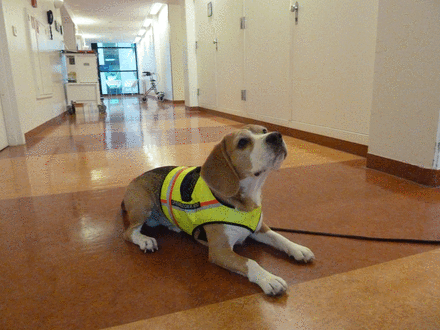
Cliff, a Beagle, is a specially trained detector dog working in two Dutch teaching hospitals.  He’s been the centre of a major study into detection of Clostridium difficile (‘C diff’ for those who are professionals in the field), an infectious bacteria that can run rampant through hospitals, rest homes and other healthcare facilities.

Detector dog on hospital ward

Symptoms range from mild diarrhoea to more severe conditions like colitis. The bacterium can be transmitted through either personal contact or the environment and the testing for the bacteria is time consuming.

The research involved 300 patients, 30 which had C diff infection.  Cliff was guided along the wards by his trainer and the trainer had no idea if the person was infected or not.  Cliff was trained to sit or lie down when C diff was detected.

The Results?  Cliff was an expert at identifying infections of C diff – with around 90% accuracy –  regardless of whether he was sniffing out stool samples or identifying infected patients in the hospital.  Cliff is only one dog, but with these results, the concept of using dogs to identify C diff infections has been proved.

This comprehensive video explains Cliff’s training and the research:

Source:  British Medical Journal

The British Medical Journal’s Shaggy Dog Story

Two Belgian researchers have published their Shaggy Dog Story in the British Medical Journal this month.

They tell of a 35-year old patient with a severe sleep disorder that made traveling on public transport a problem because she would fall asleep and miss her stop, often becoming disoriented.

Dog waking patient

She was paired with a service dog that was trained to wake her for important noises and on public transport.   This type of success story points to even more roles for service dogs.

Wake me up, Shaggy!

What’s in your dog’s plastic toy?

A research team at Texas Tech University has studied the levels of phthalates and bisphenol A (known as BPA) in dog training batons and other plastic toys.  They presented their findings at the Society of Environmental Toxicology and Chemistry conference held in California.

The research was conducted by Kimberly Wooten, a master’s student using the project as her thesis, and Phil Smith, an associate professor of terrestrial ecotoxicology.  Smith also raises and trains Labradors.

“In the process of training a lab, you do a lot of work with these plastic bumpers. I have a lot of bumpers in my garage, and they spend a lot of time in the mouths of my retrievers. Well, lots of attention has been given to chemicals in plastics lately regarding their effects on humans. Since we all care about our dogs, and we want them to be as healthy and smart and well-behaved as possible, we decided to look into this.”

BPA are used to give elasticity to plastic and vinyl and are known endocrine disruptors that mimic estrogen or act as anti-androgens and could lead to negative health effects.  In 2012, the US Government banned the use of these chemicals in baby bottles.

Training bumpers had higher levels of BPA than toys; but weathered and aged toys released more BPA than newer ones.

The research raises a number of questions, but it is hard to compare results because so few studies have been done – particularly in the area of how much of the BPA actually enters the dog’s system.

“The interaction of pet health and environmental chemicals is understudied,” Wooten said. “What may be a safe dose for one species isn’t always a good measure for another species. But the amount of BPA and phthalates we found from the bumpers would be considered on the high end of what you might find in children’s toys.”

Source:  Texas Tech University press release

Another reason to keep your dog fit and trim

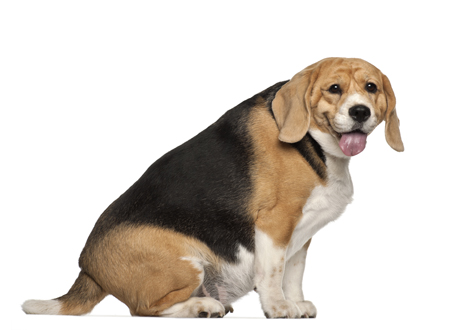
University of Liverpool researchers have found that obese dogs can experience metabolic syndrome, a condition that describes multiple health issues that occur in the body at the same time.  Obese humans suffer from the same syndrome.

The condition occurs when a number of health problems, such as increased blood glucose and increased cholesterol levels, develop together, with the potential to increase the risk of other diseases, such as cardiovascular disease and diabetes.

In a study of 35 obese dogs, 20% had metabolic syndrome.  These dogs had increased blood insulin which suggests that the pancreas is working harder than normal.  Blood adiponectin, a protein produced by fat cells that helps control sugars and fats, was also at lower levels than normal.

The metabolic abnormalities improved when the dogs successfully lost weight.

The research team admits that they have to study the impacts in more detail to understand the health implications of metabolic syndrome.

However, why wait for more studies?  If your dog is overweight we already know that their quality of life improves with weight loss.

Source: University of Liverpool media release

How your dog matches words to objects

Researchers at the University of Lincoln (UK) have published a study based on the learning patterns of a Border Collie named Gable.  They wanted to see if Gable could match words with objects based on shape, which is the learning pattern in humans of toddler age.

Credit: Sally Smith; van der Zee E, Zulch H, Mills D (2012) Word Generalization by a Dog (Canis familiaris): Is Shape Important?

Gable could identify an object by name, but over time he associated the same word with objects of similar texture or size (not shape).

The researchers concluded that where shape matters for humans, size or texture appears to be the dominating issue for a dog.

This is small study (using only one dog) but it does provide insight into the learning and development of dogs.  I’m sure there is more to come in this research field.

Source:  Word Generalization by a Dog (Canis familiaris): Is Shape Important?

Researcher calls for monitoring of diseases in dogs and cats

Professor Michael Day of the School of Veterinary Sciences in Bristol, UK,  is the lead author in an article that recommends global monitoring of diseases in dogs and cats.  While it is known that many human diseases originate in animals, only diseases in livestock are currently monitored.

Professor Day makes the case that because cats and dogs are integrated into our lives and share our households, the potential for introduction of new zoonotic diseases exists.  He says:

‘The number of small companion animals is significant.  For example there are an estimated eight to ten million dogs living in up to 31 per cent of UK homes and in the USA, 72 million dogs in 37 per cent of homes. 

In developed countries the relationship between man and dogs and cats has deepened, with these animals now closely sharing the human indoor environment.  The benefits of pet ownership on human health, well-being and development are unquestionable, but as dogs and cats have moved from the barn, to the house, to the bedroom, the potential for disease spread to humans increases.’

Any new monitoring system will require resources and funding and the political will to see it established.  At a time when the global economy is struggling, one can be skeptical about whether there is a chance of seeing this recommendation become a reality.

You can read the article in the Emerging Infections Diseases journal  here.

Source:  University of Bristol media release

Kissing your dog and the link to gum disease

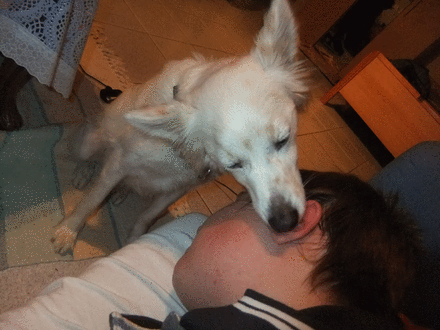
My mother was never happy when our dog got too close and  managed to lick her on the mouth.   In the Snoopy cartoons, you might remember when Lucy would run around yelling ‘Get the iodine, get the hot water.  I’ve been kissed by a dog.’ 

It turns out that there is need for caution when considering the mouth-to-mouth contact with your dog.

Researchers from Japan have tracked a microbe that is very common in dogs but rare in humans.   In dog owners, 16% of them had the microbe and it appears that they share close contact with their dogs – including kissing.

The researchers also found ten human strains of periodontitis-related bacteria in the dogs’ mouths.  And they found that low levels of contact were enough to transmit mouth bacteria either way.

In considering the research, Dr Paul Maza, of the College of Veterinary Medicine at Cornell University, told America’s Fox News:  ‘Many of the different types of bacteria in dogs and cats are the same type of bacteria as in humans. If owners practice oral hygiene on their pets, such as  brushing their teeth, a pet’s mouth can actually be even cleaner than a human mouth.’

Read the full story in the Daily Mail.

Contagious yawning in dogs

Ever been at a party or in a meeting and someone yawns – and then others (including you) do the same? Have you noticed your dog yawning when you do?

Research from Lund University in Sweden published in the journal Animal Cognition proves that dogs catch yawns from humans.  But, only dogs above the age of seven months appear to be susceptible.

The syndrome of contagious yawning is an indicator of empathy, mimicking the emotional responses of others.  You can’t really measure empathy directly.

This study involved 35 dogs in Denmark between the ages of  four and 14 months.  Given that contagious yawning may be an empathetic response, the results suggest that empathy develops slowly over the first year of a dog’s life.

The researchers tested the dogs with both an unfamiliar experimenter and their owner and found no evidence that the puppies yawned more in response to their owners.

Source:  Springer publishing

Developing methods in pain management and osteoarthritis

Researchers at Kansas State University are devoting their time to the study of improvements in pain management and the treatment of osteoarthritis in dogs.   (For more information on pain management, see my June 2012 blog)

The projects are led by James Roush, a professor of clinical sciences.

In one study, the research team determined that the maximum effective time for using hot and cold packs for pain management is 10 minutes.   The researchers studied how packing affects tissue temperature in beagles and beagle-sized dogs after surgery because hot and cold packing is a common technique for reducing swelling.   After 10 minutes, the maximum change in tissue temperature has been reached.

In another study, a special mat is being used to study lameness in dogs suffering from osteoarthritis.  When dogs step on the mat, it measures the pressure in their step and the study team can determine in which leg the lameness is worse.

“We’ve designed the study to help improve osteoarthritis treatment,” Roush said. “We will also use it to measure clinical patients when they come in for regular checkups. We can measure their recovery and a variety of other aspects: how they respond to nonsteroidal anti-inflammatories, how they respond to narcotics or how they respond to a surgical procedure that is designed to take that pressure off the joint.”

And in a third study,  Roush is collaborating with researchers to study the effectiveness of a painkiller used to treat dogs to identify potential alternatives.

“To achieve the drug’s effect, the dosage in dogs is much higher than in people,” Roush said. “It also may not be a very good analgesic in dogs. We want to see if there is an alternative that requires smaller doses and does not have not as much of a discrepancy for patients.”

Source:  Kansas State University media release