Category Archives: special dogs and awards

A turtle’s best friend

In January, during the northern hemisphere’s winter, a Newfoundland named Veda found a loggerhead turtle in distress.

Veda the Newfoundland

Veda a two year old, 120 pound female Newfoundland, owned by Leah and Brad Bares found a stranded sea turtle on Ellisville Beach in Plymouth. (photo courtesy of NE Aquarium)

Her owners phoned the New England Aquarium, who responded quickly and rescued it.  It was nursed back to health for over 5 months before it could be released to the wild again at Assateague State Park in Maryland.

If it weren’t for Veda, the turtle is unlikely to have been saved.  There’s not a lot of people on the beach in January!

Just another case of how special dogs are and how their skills can be put to good use for the benefit of humans and other animals.

Kathleen Crisley, specialist in dog massage, rehabilitation and nutrition/food therapy, The Balanced Dog, Christchurch, New Zealand

VP Nominee Senator Kaine and why I’m writing about him in a dog blog

Today Senator Tim Kaine made news by officially becoming Hillary Clinton’s running mate in the race for the US Presidency.  That’s not why I’m writing about him.

The announcement of his status as candidate for Vice-President has overshadowed something he did earlier this month.  He announced his support for the PAWS Act.

On 15th July he announced his support for new legislation to help veterans suffering from Post-Traumatic Stress Disorder (PTSD). The bill, known as the Puppies Assisting Wounded Service members (PAWS) Act, would help veterans suffering from PTSD to access innovative treatment methods to improve their quality of life.

“We owe each and every veteran a debt of gratitude for the sacrifices they made on and off of the battlefield,” Kaine said.Many come home with injuries that are unseen, such as PTSD which affects a significant percentage of veterans who have returned from the wars in Iraq and Afghanistan. A service dog can provide loyalty and emotional support to help our veterans cope with the scars they return with. I’m proud to join this bipartisan effort.”  

The PAWS Act directs the Veterans Administration to implement a five-year pilot program to provide service dogs from certified providers as well as veterinary health insurance to those veterans who: (1) served on active duty on or after September 11, 2001; and (2) were diagnosed with, and continue to suffer from, PTSD. Veterans paired with dogs would receive follow-up support service from the certified service dog provider for the rest of the dog’s life.
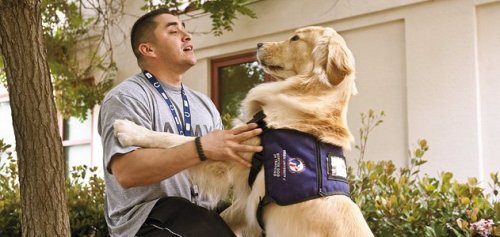
Soldier with PTSD and dog

Pictured in 2012, a soldier in the Paws for Purple Hearts program, one of four experimental programs that paired veterans afflicted by PTSD with Labrador and Golden retrievers. (Joseph Matthews, Veterans Affairs Photo)

The bill authorizes $10 million for each fiscal year from 2017 to 2022 to carry out the pilot program. Following completion of the pilot program, the Government Accountability Office would conduct a program evaluation and submit a report to Congress.

The House version of the PAWS Act, H.R. 4764, was introduced by Congressman Ron DeSantis (R-Fla.) in March 2016. The House bill currently has 97 bipartisan cosponsors and has been referred to the House Committee on Veterans’ Affairs.

I’m pleased to see the support for this Act, although I doubt even $10 million per year will go far enough.  It’s a start.   Thank you Senator Kaine for your support.

Kathleen Crisley, specialist in dog massage, rehabilitation and nutrition/food therapy, The Balanced Dog, Christchurch, New Zealand

In my book review of Reporting for Duty, I referred to these statistics concerning returning soldiers and their needs for support dogs:

  • More that 540,000 veterans of the wars in Iraq and Afghanistan have PTSD or depression (or both)
  • More than 260,000 veterans have been diagnosed with traumatic brain injuries
  • Even if all of the service dog organisations currently operating in the United States increased their annual output by a factor of 100, the mental health challenges of veterans would still not be met
  • The present policy of the Veteran’s Administration is to provide service dogs only to veterans with visual or hearing impairment or some selected mobility challenges – a small sub-set of the range of uses and support that can be given by trained dogs (Assuming the pilot program referred to in the PAWS Act proved successful – then this policy may change)

Research shows dogs de-stress families with autistic children

Owning a pet dog reduces stress and significantly improves functioning in families who have a child with Autism Spectrum Disorder (ASD), new research has shown.

The study, carried out by researchers at the University of Lincoln, UK, and funded by the US-based Human Animal Bond Research Initiative (HABRI) Foundation, also found a reduction in the number of dysfunctional interactions between parent and child among families which owned a dog.

Published in the American Journal of Veterinary Behavior, it is among the first of a number of HABRI-funded research projects which examine the effects of companion animals on human health. This project focused specifically on the effects of pet dogs on families with children with ASD.

Professor Daniel Mills, Professor of Veterinary Behavioural Medicine in the School of Life Sciences at the University of Lincoln, led the research. He said: “While there‭ ‬is‭ ‬growing‭ ‬evidence ‬that ‬animal-assisted‭ ‬therapy‭ ‬can aid in ‬the‭ ‬treatment‭ ‬of‭ children with ‬autism‭ ‬spectrum‭ ‬disorders, this study is one of the first to examine how‭ ‬pet‭ ‬dog‭ ‬ownership‭ ‬can also ‬improve‭ ‬the‭ ‬lives‭ ‬of‭ ‬those‭ ‬more widely affected‭ ‬by‭ ‬autism. Researchers have previously focused on the positive effects that assistance dogs can have on the child’s well-being and have passed over the impact they might also have on close relatives, but our results show that owning a pet dog (rather than a specifically trained assistance dog) can considerably improve the function of the whole family unit.‬‬‬‬‬‬‬‬‬‬‬‬‬‬‬‬‬‬‬‬‬‬‬‬‬‬‬‬‬‬‬‬‬‬‬‬‬‬‬‬‬‬

“We found a significant, positive‭ ‬relationship‭ ‬between‭ ‬parenting‭ ‬stress‭ ‬of‭ ‬the child‭’‬s‭ ‬main‭ ‬caregiver‭ ‬and‭ ‬their‭ ‬attachment‭ ‬to‭ ‬the‭ family dog. This highlights the importance of the bond between the carer and their dog in the benefits they‬‬‬‬‬‬‬‬‬‬‬‬‬‬‬‬‬‬‬‬‬‬‬‬‬‬‬‬‬‬‬‬‬‬‬‬‬‬‬‬‬‬‬‬‬‬‬‬‬‬‬‬‬‬‬‬‬‬‬‬‬‬‬‬‬‬‬‬‬‬‬‬‬‬‬‬‬‬‬‬‬‬‬‬‬‬‬‬‬‬‬‬‬‬‬‬‬‬‬‬‬‬‬‬‬‬‬‬‬‬‬‬‬‬‬‬‬‬‬‬‬‬‬‬‬‬‬‬‬‬‬‬‬‬‬‬‬‬‬‬‬‬‬‬‬‬‬‬‬‬‬‬ gain.”‬‬‬‬‬‬‬‬‬‬‬‬‬‬‬‬‬‬‬‬‬‬‬‬‬‬‬‬‬‬‬‬‬‬‬‬‬‬‬‬‬‬‬‬‬

The research involved families who took part in a previous study, which examined the short-term effect of a pet dog on families of a child with autism. The researchers followed up with the families two and a half years later in order to determine the longevity of the benefits of pet ownership. The study demonstrated that initial results of reduced family difficulties lasted years beyond the early stages of acquiring a dog, and that stress levels continued to experience a steady decline.

“Stress associated with parenting a child with autism continued to decrease among dog owners over time, but we did not see the same reductions in families without a dog,” added Professor Mills. “This long-term follow up study highlights the potential benefits of pet ownership in bringing long-term improvements to the lives of families living with a child with autism.”

HABRI Executive Director Steven Feldman said: “Parents of children with autism can experience increased anxiety and stress, and now we have strong scientific evidence to show that pets can have positive effects on these quality-of-life issues. Families with an autistic child should consider pet ownership as a way to improve family harmony.”

The study at Lincoln is one of a series of research projects from a major body of work carried out at the University of Lincoln’s School of Life Sciences which sheds light on the benefits that pet dogs can bring to children with ASD and their families.

Source:  University of Lincoln media release

Using therapy dogs to prepare for the Olympics

Olympic dog

The Summer Olympics in Rio are not far away and it’s a stressful time for athletes as they prepare and aim to qualify for the competition.

In the United States, the swim team is using  dogs to help manage the stress! A Havanese named Holly and a Goldendoodle named Larry are among the crew supporting the swimmers.

Read more in this New York Times article – US Swimmers Using Therapy Dogs to Relax Before Races

Kathleen Crisley, specialist in dog massage, rehabilitation and nutrition/food therapy, The Balanced Dog, Christchurch, New Zealand

How dogs can sniff out diabetes

A chemical found in our breath could provide a flag to warn of dangerously-low blood sugar levels in patients with type 1 diabetes, according to new research from the University of Cambridge. The finding, published in the journal Diabetes Care, could explain why some dogs can be trained to spot the warning signs in patients.

Claire Pesterfield, a paediatric diabetes specialist nurse at Addenbrooke’s Hospital, Cambridge University Hospitals NHS Foundation Trust has type 1 diabetes, which requires insulin injections to manage blood sugar levels. She also has a golden Labrador dog that has been trained by the charity Medical Detection Dogs to detect when her blood sugar levels are falling to potentially dangerous levels.

“Low blood sugar is an everyday threat to me and if it falls too low – which it can do quickly – it can be very dangerous,” says Claire. “Magic is incredible – he’s not just a wonderful companion, but he’s my ‘nose’ to warn me if I’m at risk of a hypo. If he smells a hypo coming, he’ll jump up and put his paws on my shoulders to let me know.”

Hypoglycaemia – low blood sugar – can cause problems such as shakiness, disorientation and fatigue; if the patient does not receive a sugar boost in time, it can cause seizures and lead to unconsciousness. In some people with diabetes, these episodes can occur suddenly with little warning.

Given the reports of dogs alerting owners to blood glucose changes, researchers at the Wellcome Trust-MRC Institute of Metabolic Science, University of Cambridge, believed that certain naturally-occurring chemicals in exhaled breath might change when glucose levels were low. In a preliminary study to test this hypothesis, the scientists gradually lowered blood sugar levels under controlled conditions in 8 women, all around their forties, and all with type 1 diabetes. They then used mass spectrometry – which look for chemical signatures – to detect the presence of these chemicals.

The researchers found that levels of the chemical isoprene rose significantly at hypoglycaemia – in some cases almost doubling. They believe that dogs may be sensitive to the presence of isoprene, and suggest that it may be possible to develop new detectors that can identify elevated levels of isoprene in patients at risk.

“Isoprene is one of the commonest natural chemicals that we find in human breath, but we know surprisingly little about where it comes from,” says Dr Mark Evans, Honorary Consultant Physician at Addenbrooke’s Hospital, University of Cambridge. “We suspect it’s a by-product of the production of cholesterol, but it isn’t clear why levels of the chemical rise when patients get very low blood sugar.

“Humans aren’t sensitive to the presence of isoprene, but dogs with their incredible sense of smell, find it easy to identify and can be trained to alert their owners about dangerously low blood sugar levels. It provides a ‘scent’ that could help us develop new tests for detecting hypoglycaemia and reducing the risk of potentially life-threatening complications for patients living with diabetes. It’s our vision that a new breath test could at least partly – but ideally completely – replace the current finger-prick test, which is inconvenient and painful for patients, and relatively expensive to administer.”

The research was funded by the National Institute for Health Research (NIHR) Cambridge Biomedical Research Centre with support from the Cambridge NIHR Wellcome Trust Clinical Research Facility.

Source:  University of Cambridge media release

Cancer sniffing dogs

I write frequently about special dogs and assistance dogs. But this post isn’t about research – it’s about real-life stories where common pet dogs have detected cancer in their owner.

For example, I have a client in my massage practice who said that her dog was acting differently towards her.  We initially attributed this to stress in the home – since they had recently moved house with all of the associated angst. And then came a diagnosis of bladder cancer and she’s now in the middle of aggressive treatment for it.. On reflection, I believe her dog, who is a sensitive boy, picked up on the scent of her cancer but he didn’t know how to tell her.

And then this week, I read about Banjo who lives in North Carolina with his owner, Tim Buckner.  Banjo acted strangely to a wart on his Tim’s arm…and when Tim went to get it checked by a dermatologist, he was diagnosed with melanoma.

We know that dogs have extremely sensitive noses.  And I include here the PBS NewsHour item about dogs and how they can detect cancer.  This piece opens with yet another dog owner telling the tale of how her dog detected her cancer.

Dogs continue to show us unique ways they can help us and our quality of life.  You may have saved your pet, but your pet could also save you.

Kathleen Crisley, specialist in dog massage, rehabilitation and nutrition/food therapy, The Balanced Dog, Christchurch, New Zealand

Comfort in Orlando

Comfort dog in Orlando

Melissa Soto with Susie, a comfort dog, on Tuesday near a memorial site for the victims of the mass shooting in Orlando, Fla. Credit John Taggart/European Pressphoto Agency

The Golden Retriever comfort dogs which served so honorably after the Boston Marathon bombing and the Sandy Hook school shooting have been called into action again.

This New York Times article covers brilliantly what these dogs and their handlers do by sharing unconditional love and comfort.

My only wish is that there weren’t so many occasions when the dogs are needed…

Kathleen Crisley, specialist in dog massage, rehabilitation and nutrition/food therapy, The Balanced Dog, Christchurch, New Zealand

Reporting for Duty – book review

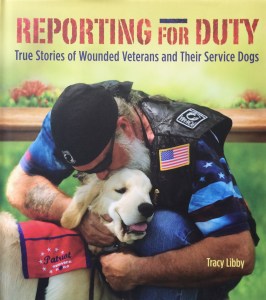
I have just finished reading Reporting for Duty, a coffee table book written by Tracy Libby.  This book is presented well, with small vignettes interspersed with text, photos, and profiles of 15 veterans and their assistance dogs.

Reporting for duty by Tracy Libby

The book’s first chapter explains  PTSD (post traumatic stress disorder, a term that didn’t come into use until after the Vietnam War), TBI (traumatic brain injury), and MST (military sexual trauma) – pretty gut-wrenching content.

The chapters that follow include coverage of therapy dogs in history, prison puppy programs and combat and operational stress-control dogs.  The final chapter is about how dogs read us, with references to the various research findings about canine cognition and the human-animal bond (a favourite subject of mine).

There are many photographs in this book, which are lovingly presented.  It provides a good selection of case studies – veterans and their dogs – with veterans from different wars and each requiring different levels of assistance and support.

But it is the book’s Foreward that will remain with me for some time.  Written by Karen D Jeffries (retired Commander in the US Navy, and co-founder of Veterans Moving Forward, Inc – a charity which will benefit from some of the proceeds of sales), the Foreward contains some sobering statistics and facts:

  • The US Veteran’s Administration is unable to meet the needs of the disabled veteran population
  • More that 540,000 veterans of the wars in Iraq and Afghanistan have PTSD or depression (or both)
  • More than 260,000 veterans have been diagnosed with traumatic brain injuries
  • Even if all of the service dog organisations currently operating in the United States increased their annual output by a factor of 100, the mental health challenges of veterans would still not be met
  • The present policy of the Veteran’s Administration is to provide service dogs only to veterans with visual or hearing impairment or some selected mobility challenges – a small sub-set of the range of uses and support that can be given by trained dogs

This is a book that is best enjoyed in hard copy – flick through the photos and thank heaven for the people who volunteer, fund raise, and train assistance dogs.

My copy of the Reporting for Duty was provided free-of-charge by the book’s publisher.  I will cherish it as part of my dog book collection.

Kathleen Crisley, specialist in dog massage, rehabilitation and nutrition/food therapy, The Balanced Dog, Christchurch, New Zealand


A special yearbook photo

Yearbooks are a tradition.  They provide the chance to capture a moment in time which is usually a milestone in a young person’s education.

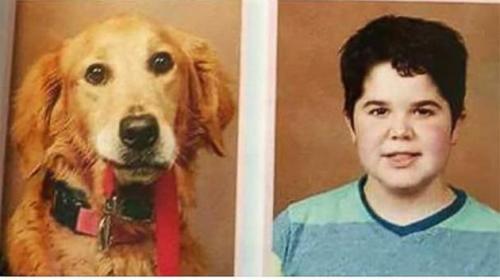
In West Monroe, Louisiana, a special yearbook photo was taken this year, of Presley who is Seph Ware’s service dog.

yearbook

Presley and Seph Ware are featured side by side in the class yearbook at Good Hope Middle School. (Holtzclaw Photography)

Seph, age 14, has Duchenne Muscular Dystrophy which is  a progressive genetic muscle disorder that causes a loss of muscle function.  Presley’s job is to help help him with daily activities at school like picking things up off the floor, opening and closing doors and turning the lights on and off.

The Good Hope Middle School felt it was only right to have Presley featured in the yearbook since she has been at school every day.

Special dog!

Source:  ABC 13

The little pit bull who survived a fire

Firefighter William Linder was washing his car last year when he smelled smoke.  A neighbor’s shed was on fire and when he entered, he found a little pit bull puppy cowering in the corner.

Jake

He revived the puppy with mouth-to-snoot resuscitation and the puppy was admitted to a veterinary hospital with burns over 75% over his body.

The puppy endured six weeks of antibiotics and morphine to survive his injuries.  His owners abandoned him because they couldn’t pay for his care.  So Linder, who works in Hanahan, South Carolina, adopted him.

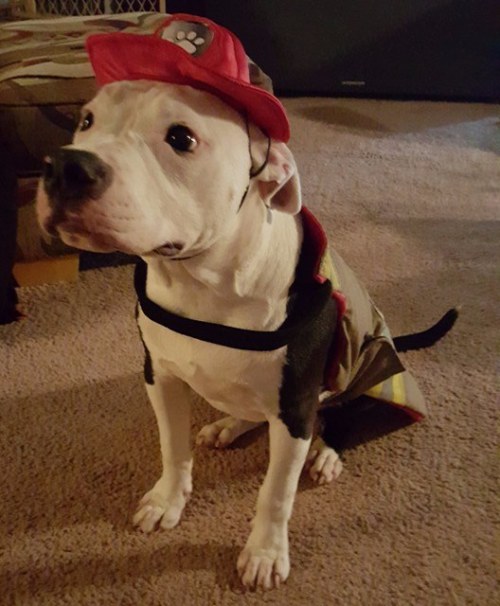
Jake as firefighter

Although Jake has bald spots from the burns where fur will never grow, he’s become a station mascot and Linder takes him to elementary schools to teach fire prevention.

Another pit bull showing the world that, just like other dogs, they only want be loved.

Kathleen Crisley, specialist in dog massage, rehabilitation and nutrition/food therapy, The Balanced Dog, Christchurch, New Zealand