Dry Dog, Wet Dog

Serenah Hodson is an Australian pet photographer.  She’s just done a series entitled Dry Dog Wet Dog.  She says,

‘Dry Dog Wet dog came about with washing my own dogs. Their personalities change when they know it’s bath time. So I decided to create a series of the different looks and not only personalities but the difference in look from groomed to wet. We get such great texture on the dog when the hair is wet. Some dogs look completely different when wet and this was the joy I wanted to capture.’

Here’s a few of Serenah’s photos and  you can follow her on Facebook to see more of her work.

Garfunkel-Dry-Dog-Wet-Dog Casper-Dry-Dog-Wet-Dog Bones-Dry-Dog-Wet-Dog Henri-Dry-Dog-Wet-Dog

Kathleen Crisley, specialist in dog massage, rehabilitation and nutrition/food therapy, Canine Catering Ltd, Christchurch, New Zealand

The basics of animal behavior

Nikolaas Tinbergen, who lived from 1907-1988, was a scientist who developed four basic questions that would explain animal behavior; he ultimately won the Nobel Prize for his work.

If you get involved in animal advocacy or rescue work, it helps to have some understanding of animal behavior.   The ‘4 Questions’ help us to understand why an animal is exhibiting a behavior.  Some published resources call these Questions ‘the Four Whys…’ (although the questions aren’t always phrased as a why)

1.  What is the function of the trait, or why does it exist?

2.  What is the phylogeny, or evolutionary history, of the trait?

3.  What is the cause of the trait?  Regardless of history or function, there is likely to be a physical basis for the behavior.

4.  How did the trait develop?  This is where you consider how the animal interacted with its environment and surroundings over time.

Barking dog

So, as a simple example – let’s consider barking.  Barking exists as a form of communication that augments physical body language.  So that’s the function question answered.

As far as evolution is concerned, it is probable that early dogs had different vocal sounds which developed into the barking we know today in the wide range of dog breeds.

The cause of barking is the passing of air through vocal chords – much like in humans.

And how the trait developed…well this is connected to domestication and how dogs could communicate with the canine and human members of their pack.  Animal trainers learn to distinguish the different types of barking and help to pass this knowledge onto their clients.

Most dog owners can also understand the differences in their dog’s barking.

Kathleen Crisley, specialist in dog massage, rehabilitation and nutrition/food therapy, Canine Catering Ltd, Christchurch, New Zealand

What do dogs dream about?

This is a funny compilation of videos – when your dog is asleep, what do you think they are dreaming about?

But on a more serious note, researchers have looked at brain activity when dogs are asleep.  All the evidence points to the fact that dogs do dream.  Read my post on Dog Dreaming.

Kathleen Crisley, specialist in dog massage, rehabilitation and nutrition/food therapy, Canine Catering Ltd, Christchurch, New Zealand

Buffy the Three-Legged Pit Bull

Picture by Gracia Lam

Picture by Gracia Lam

Read Buffy’s Story Here (courtesy of The Boston Globe Magazine)

Kathleen Crisley, specialist in dog massage, rehabilitation and nutrition/food therapy, Canine Catering Ltd, Christchurch, New Zealand

14 Dogs Who Made Poor Life Choices

A bit of humor for the weekend…

Thunder Dog – book review

Thunder Dog

Thunder Dog tells the story of Michael Hingson and Roselle, his guide dog.  Michael was working in the World Trade Center’s North Tower on the 78th floor on the morning of September 11, 2001.  The book gets its title from the fact that Roselle was very afraid of thunder and, during the wee hours of September 11th, there had been a thunder storm which woke both dog and handler – with handler providing emotional support.

The book starts with a chapter ‘Goodbye to a Hero’ in which Hingson tells us that Roselle died on June 26, 2011.  This is not entirely surprising – virtually all of the dogs who had involvement in 9/11 have since passed away.  It is, sadly, to be expected.

This book is written in a conversational style, as if Hingson was giving an interview (he did, many in fact, after the 9/11 attacks – television presenter Larry King writes the Foreward to the book).  It makes for very easy reading.

Interspersed with chapters detailing the long walk down from the 78th floor as dog and handler evacuated, Hingson tells us more about his life.  He wasn’t born blind, for example.  He was a premature baby and back when he was born, babies were put into incubators with a very high oxygen environment (it wasn’t until later when many babies ended up surviving, but blind, that doctors became aware of the cause).  Roselle was not Hingson’s first guide dog, either.  And Hingson’s parents encouraged him to explore his world; he even rode a bicycle around his neighborhood without assistance – learning to navigate by echolocation.

But the horrors of that day, and the strong bond between man and dog are what this book is really about.  How Hingson had to rely on Roselle more than ever, whilst remaining calm for her so she could do her job.  And how Roselle offered terrified people emotional support on a day like no other.  Hingson’s recollections of short conversations with firefighters who were climbing up the tower to fight the fire and assist in rescue are most poignant.

Roselle’s legacy lives on in the Roselle’s Dream Foundation which has since been established by Mr Hingson to honor her memory.  Throughout the book, Hingson emphasizes that being blind did not stop him from having a normal life and so the Foundation does its best to support scholarships to enable blind people to live their lives to the fullest.  The Foundation also exists to educate the sighted about blindness.

A book well worth reading.  It spent time on the New York Times Bestseller list.

Kathleen Crisley, specialist in dog massage, rehabilitation and nutrition/food therapy, Canine Catering Ltd, Christchurch, New Zealand

Dogs and taxes

It is the 15th of April – Tax Day in the United States.  The deadline that comes around all too quickly, a date when every US resident must file a federal tax return with the Internal Revenue Service.  Most states also have state tax returns that must be filed today, too.

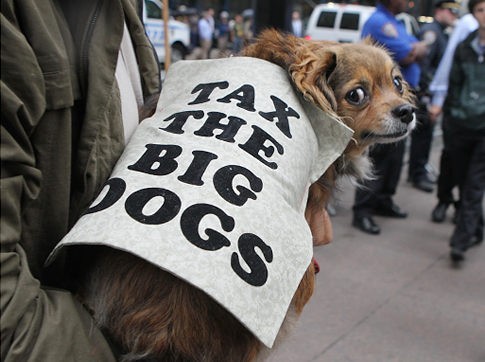
Tax the big dogs

Have you ever considered what your dog and taxes have to do with each other?

Unfortunately, unlike human dependents, our dogs are not tax-deductible.  So, please don’t try this on your tax return.

In New York state, however, officials and animal rights advocates have filed a state bill that would give anyone who adopts a pet from a New York animal shelter a tax credit of $100, or $300 for up to three animals per year.

The bill is sponsored by Kevin Parker, a state senator from Brooklyn, and would cover all domesticated animals offered for adoption.  City Councilwoman Julis­sa Ferreras, from Queens, introduced a resolution backing the bill, which would make New York the first state to grant such a credit.   In New York State alone, shelters can care for up to 8 million dogs and cats each year; about 3 million are euthanized because there is no one to adopt them.


In terms of deductions, as I said earlier – don’t attempt to deduct your dog as a dependent.  It will only cause you tax troubles.

But, there are some dog-related expenses that are deductible:

1.  If you need a guide dog because you are visually impaired or for hearing assistance, you can deduct the costs of buying, training and caring (food, grooming, veterinary care) for your guide dog as a medical expense.  The same holds true for dogs trained to help you with any other diagnosed physical or mental condition.

2.  If you use a dog in your business, such as for security purposes, the cost of keeping the dog healthy – as with a guide dog – can be considered a legitimate business expense that is deductible.

3.  If you have to move house, pet relocation costs are also deductible as part of your overall moving expenses.

4.  Some people earn money from their dog-related hobbies – things like competing in dog shows, for example.  If those hobbies result in an income, you have to declare it.  But, the expenses you incur for pursuing your hobby are also deductible – provided that total of these expenses exceed 2 percent of your adjusted gross income before deductions.

5.  If you volunteer for a pet-related charity, and the charity is a registered 501(c)(3) adoption center, you can deduct mileage you incur for working on behalf of the shelter.  If you foster a dog and costs like food are not fully reimbursed – these are deductible too.  It helps if the organisation you are working for provides you with a letter acknowledging your volunteer work on their behalf.

6.  Some owners set up pet trusts to protect and care for their pet after they pass away.  Trusts have tax advantages in terms of tax deductions.  But, it is important to have a lawyer who understands your local estate planning laws to help you with the set up of your trust.

Really, with any tax-related matter it is best to seek professional advice and remember to keep good records!

Kathleen Crisley, specialist in dog massage, rehabilitation and nutrition/food therapy, Canine Catering Ltd, Christchurch, New Zealand

Sources:  New York Post, Bankrate


One out of every three cars in the drive thru…

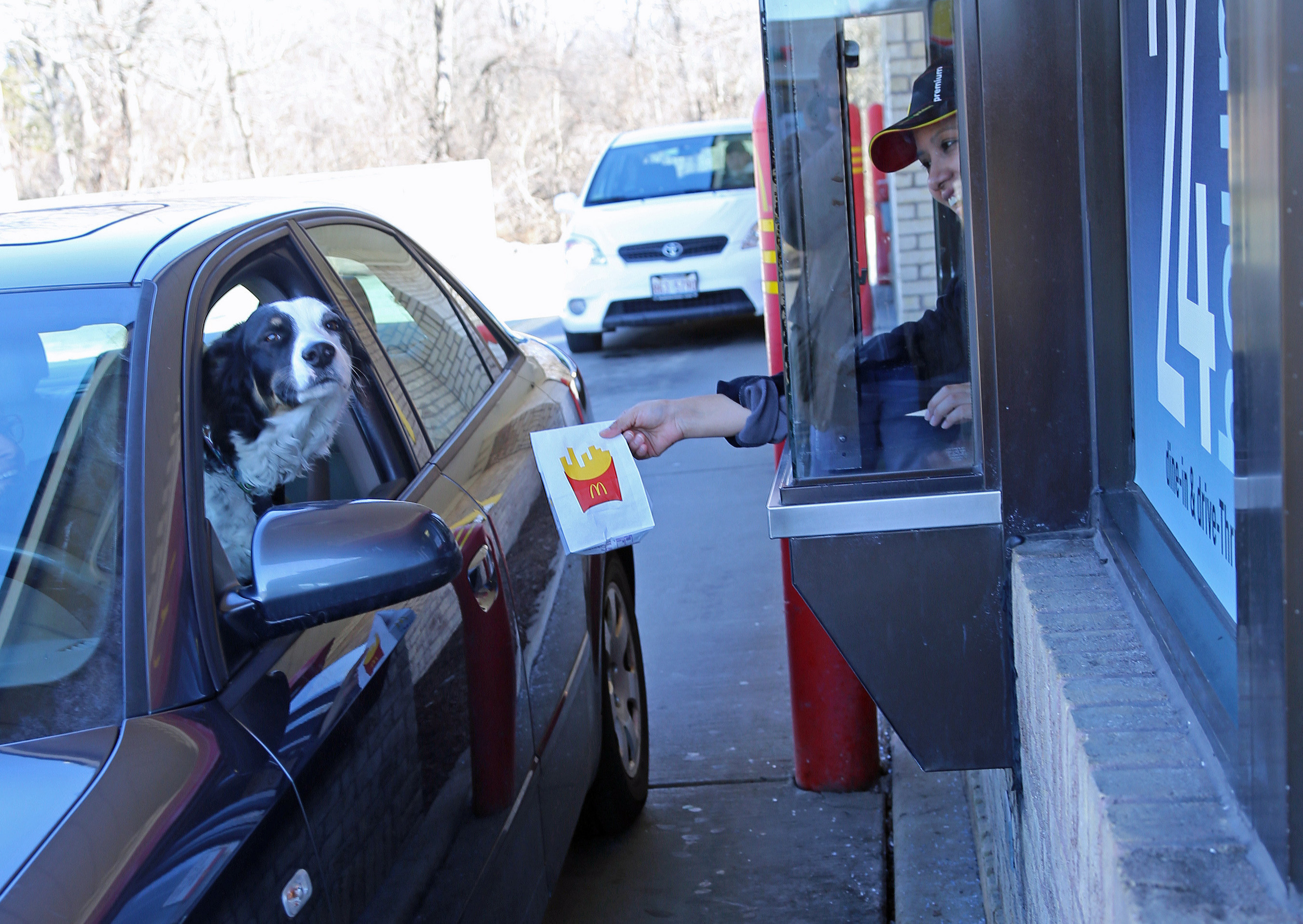
Courtesy of Reyes, Maggie (Photographer). March 2015

Courtesy of Reyes, Maggie (Photographer). March 2015

A survey by market research firm Relevation Research, based in Illinois, has shown that 1 out of every 6 US households buys fast food for a dog during at least some of their drive-thru or take-out window visits.  At this rate, over 1,000,000,000 visits annually are catering to a dog.

One third of dog owners  drive through with their dog in the car; four-fifths of those actually claim to order something specifically for the dog.  McDonald’s is visited most often for the dog followed by Burger King and Wendy’s.  Starbucks is patronized less despite offering Puppy Whip/Puppuccino.

Nan Martin, principal at Relevation Research, advises that QSRs (known as quick service restaurants in the ‘biz’) should team up with dog food/treat manufacturers to design dog-safe offerings at their establishments.

In Christchurch, McDonald’s outlets usually stock dog treats at their drive-thru windows.  If your dog rides in the back seat, the window attendant doesn’t always notice and so you have to ask for dog treats.  And the only surviving Starbucks outlet (thanks to our earthquakes) doesn’t offer a drive-thru, let alone Puppuccinos.

(I’m a big fan of Starbucks coffee and so – please – open a drive-thru branch here and please stock it with Puppuccinos.  Izzy and I would be frequent customers.)

Kathleen Crisley, specialist in dog massage, rehabilitation and nutrition/food therapy, Canine Catering Ltd, Christchurch, New Zealand

Source:  PR Newswire media release


Shaggy Muses – book review

Shaggy muses

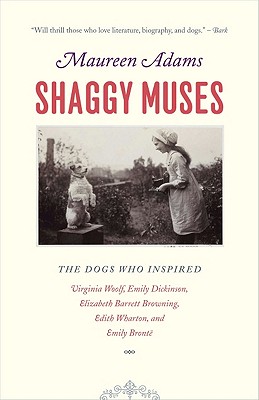
Shaggy Muses by Maureen Adams offers a new twist in understanding the writing and lives of five famous women authors.

This book is about the dogs who inspired Virginia Woolf, Emily Dickinson, Elizabeth Barrett Browning, Edith Wharton and Emily Brontë.

In this book, you will understand the role that Flush a golden Cocker Spaniel, who kept Elizabeth Barrett Browning company, had on her life and writing.  Her life was isolated and frequented by ill health.  That is, of course, until Robert Browning enters the scene. When Elizabeth marries Robert in a secret ceremony and leaves her family home without her father’s permission, she makes sure Flush goes too.

Virginia Woolf also had a Cocker Spaniel, named Pinka.

Emily Dickinson found solace with Carlo, a Newfoundland.  Edith Wharton’s comparatively long life was filled with the companionship of a series of Pekingese.

I was, however, unprepared for the story of Emily Brontë and her Mastiff, Keeper.  One day, after finding Keeper resting on a bed inside the house, Emily beats the dog bloody with her bare hands.  The author relates the story in terms of ‘typical’ domestic violence behavior and the apparent struggle of wills between Keeper and Emily.  Keeper, in truly dog style, remained loyal to her until the end, accepting her ministrations to his swollen face and eyes.  (I’m afraid, however, that this story has put me off reading any more of Brontë‘s work, most likely for life).

If you like literature and dogs, this book is for you.  I liked the historical context as the author relates the stories of each woman in chronological order.  It puts into perspective the influences on each woman’s life and also how society was changing (Virginia Woolf, for example, had a notable lesbian love affair with fellow author Vita Sackville-West).

Kathleen Crisley, specialist in dog massage, rehabilitation and nutrition/food therapy, Canine Catering Ltd, Christchurch, New Zealand


Wordless Wednesday, part 54

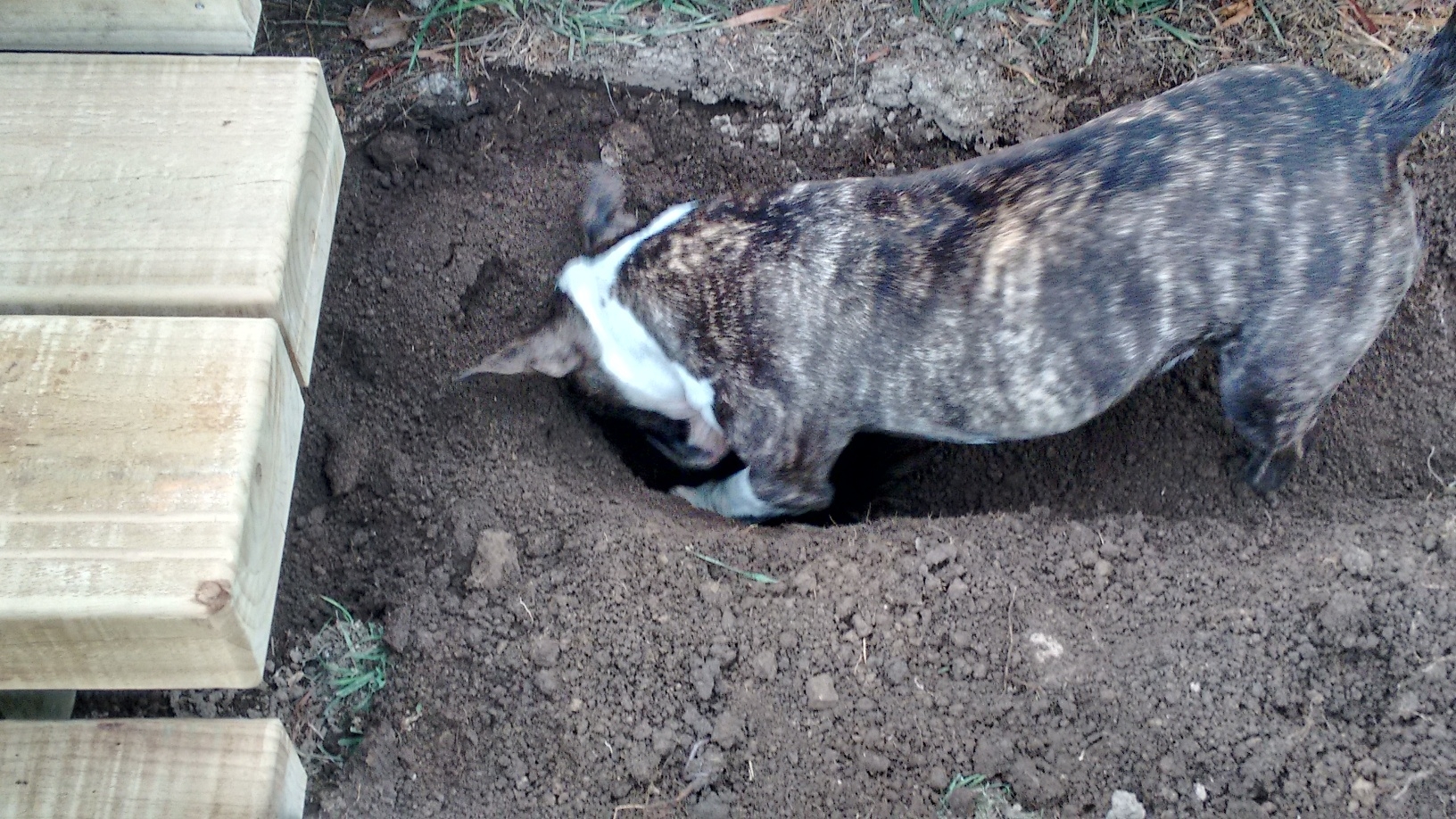
Tilly helps her Mum do the gardening  Photo by Denise Balloch

Tilly, an English Bull Terrier, helps her Mum do the gardening (Photo by Denise Balloch)