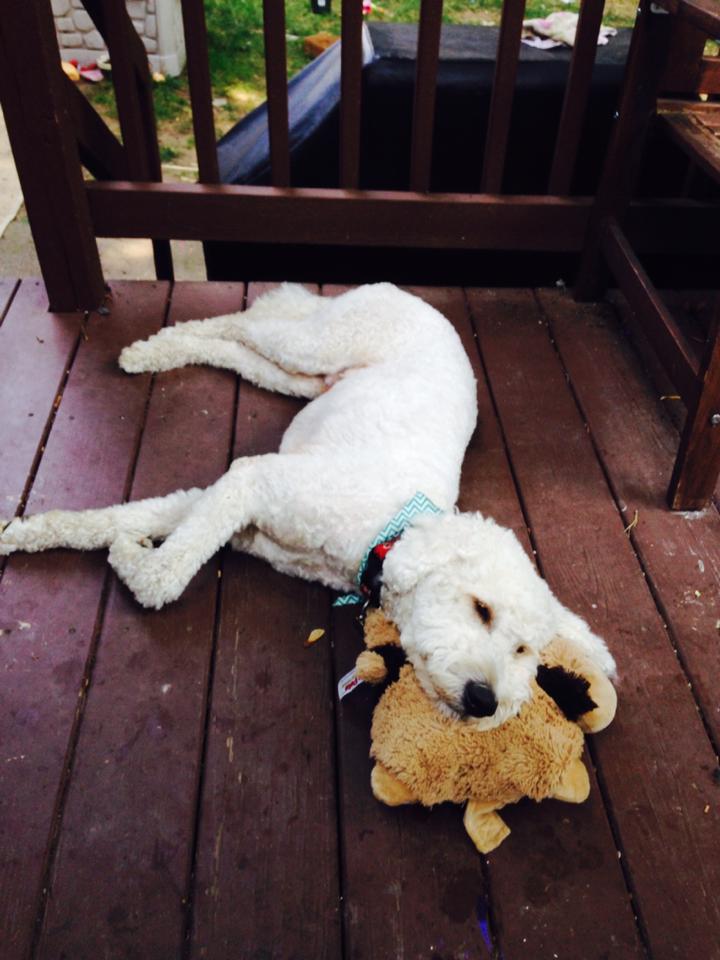
Photo courtesy of Karen Eckstein Han


Photo courtesy of Karen Eckstein Han

With Daisy’s passing, it is probably not surprising that I reached for a book on grief and – more specifically – a book about grief over the loss of a pet.
I purchased this book in 2013, but when I started to read it then, it didn’t feel right. Although aging, Daisy was still in good health and I felt like I was somehow ‘jumping the gun.’ The book went to the bottom of my ‘to read’ pile until last week when I found myself at loose ends in my empty house.
One of the biggest things about loss of a pet is, although deep down we know that our dog has a short lifespan, there is nothing that can prepare you for the emotional tidal wave that comes on the day of your dog’s death. So, having a book to turn to for guidance is useful.
This book is written in simple terms, with some historic references to cultures and how they view death, dying and the role of pets. It discusses the decision we face when euthanizing a sick pet, how to deal with children’s grief, understanding the need to care for yourself when grieving, and deciding when it is right to take steps that allow you to move on.
Since Kowalski is a clergyman, he has used his background to prepare a section on readings and poems that can be used in a memorial service for a lost pet.
I’m glad I had this book handy for when I had to suddenly face the loss of Daisy and, based on my experience, I would recommend to all my readers to have a book about pet grief in your ‘tool box’ for when you have to face the sad occasion of saying goodbye.
Kathleen Crisley, specialist in dog massage, rehabilitation and nutrition/food therapy, Canine Catering Ltd, Christchurch, New Zealand
Posted in dog books, dogs and mourning
Tagged Daisy, Gary Kowalski, grief, grieving, loss of a pet, pet grief, pet loss
New data from Dognition shows that female dogs tend to be more flexible navigators than males. This is the opposite of trends in humans, and gives us important insight into how dogs see the world.
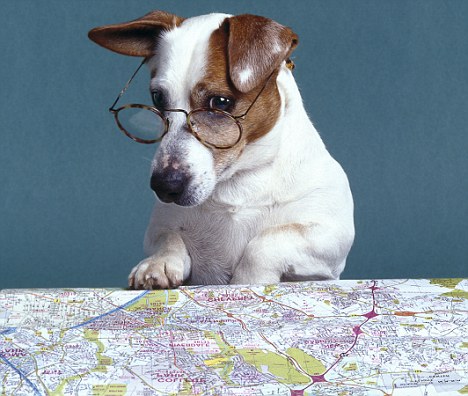
In the navigation game, part of the monthly Dognition subscription, owners hid food inside two bowls, and taught their dog that the treat was always on one side, for example always on the left. Then the owner brought their dog around to the opposite side and recorded which bowl their dog chose.
Female dogs were more likely to use an allocentric, or a landmark based strategy. They used objects in the room to figure out which bowl to choose. For instance, in the beginning, perhaps the bowl with the treats was near a door, or a lamp. When the females were brought around to the opposite side, they still looked for those landmarks, which means no matter which way they were oriented, they would always go back to the bowl they learned was ‘correct’ in the beginning.
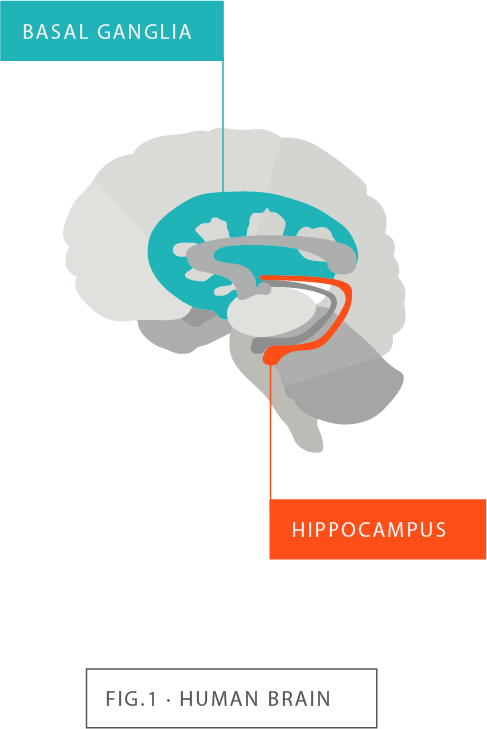
In people, this is called forming a mental map, or using a ‘bird’s eye’ view. Using allocentric navigation means the dogs were mostly relying on their hippocampus, a part of the brain that mediates spatial awareness and memory. This strategy is particularly effective in large and unfamiliar environments, and is the more flexible of the two strategies. Not surprisingly, humans who rely on environmental navigation are good at reading maps.
Male dogs were more likely to be egocentric navigators. They learned the association by thinking ‘the treat is on my right’. When owners brought the dogs around to the opposite side, these dogs chose the bowl on their right, which was the opposite bowl that they had chosen before. By using this strategy, the dogs were mostly relying on their basal ganglia, a part of the brain that mediates motor skills.
Before there were maps or navigational instruments, Pacific islanders used egocentric navigation for long sea voyages. They used the position of the stars in relation to themselves, (e.g. to get to this island, the Milky Way should be on my right). People who rely on egocentric navigation tend to make good cinematographers – they have a special talent for allowing others to see the world as they do.
The results are exactly the opposite as in humans, where men are usually allocentric navigators and women are egocentric navigators. Perhaps male dogs just need to get better at asking for directions.
Source: Dognition news
Posted in research
Tagged allocentric navigation, Dognition, dogs, egocentric navigation, female dogs, male dogs, map reading, navigation, navigators
This is a new video produced by the American Chemical Society. It explains why dogs sniff bottoms and what information they can detect from the smells.
“and she looked deep into my eyes
and she said ‘you have always been the center of my universe
I have loved you always’
I pressed my head into hers and assured her that I was here
as I had always been here
and she looked deep into my heart
and she asked me ‘How much do you love me?’
and I stroked her face, soothingly, and closed her eyes as I replied
“With all my heart…’
and then, she looked deep into my soul
and she asked me
‘Do you love me enough to let me go?’
and I held her close and replied softly…
yes…”
– Unknown
It is with a very heavy heart that I announce the passing of my beloved Daisy on the 26th of July. As any dog lover will know, one of the hardest things about having a dog in your life is knowing that they do not live as long as we do and many of us will face the decision to let them pass in peace and without pain.
Daisy was 14 years, 17 days old. Although slowing down, she always showed in an interest in twice-daily walks until about a month ago, when one afternoon she looked up at me to say “I’ve been to the toilet, now I just want to go home and rest.” We have had more days like that – sporadically – until about the last week when once daily walks were enough for her. After her last acupuncture treatment on Wednesday afternoon, she was very happy and energetic – walking longer and at a quicker pace than the last few weeks.
That was to be our last walk together.
One of the things that is an owner’s responsibility and duty is to manage quality of life. In Daisy’s case, she had the look in her eye that many people describe – it told me “I’ve had enough.”
As part of my grieving process, and in tribute to my dear Daisy, here are a few photos of her life. We were together for 10 years and 7 months – and I wish I had them to do all over again.
Kathleen Crisley, specialist in dog massage, rehabilitation and nutrition/food therapy, Canine Catering Ltd, Christchurch, New Zealand

This is one of the first photos I took of Daisy, shortly after adopting her

Daisy ‘upgraded’ to a red collar and I love this photo because it gave a better perspective to her size and conformation

In 2004, Daisy allowed me to dress her in a Boston Red Sox sweatshirt to celebrate their World Series win

In April 2008, Daisy helped to pose in the garden to show off some new landscaping

In April 2008, we celebrated Daisy’s 8th birthday a wee bit in advance as part of launching Canine Catering

In February 2011, following our big earthquake, Daisy revealed that she was suffering from arthritis in her hips and spine. Swimming became a fortnightly activity from then on

Daisy loved food and treats; here she enjoys a Busy Bone whilst visiting with her Uncle Guy in 2012

On her 13th birthday, I took Daisy for an off-lead walk at The Groynes as a special treat

We celebrated our 10th anniversary together by taking a trip to Ruby Bay. Daisy was so happy during our 5 days there.

My last photos of Daisy were taken on July 12th as part of a photo shoot for the business
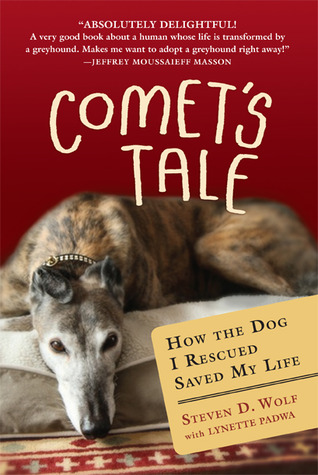 This book will make you want to go out and adopt a Greyhound! Mr Wolf tells the story of Comet, a Greyhound who comes into his life as his health and well-being are seriously under threat.
The author never had any experience with Greyhounds until he is drawn to a charitable group promoting Greyhound adoption at his local supermarket.
A Greyhound who suffered abuse at the track, Comet is withdrawn around most people but decides that Mr Wolf (affectionately called “Wolfie” by his wife) is for her. She literally sits down next to him and lets him know – take me home.
As Steven’s health deteriorates, he lives on pain killers and can barely walk or do simple household tasks. This is when he decides that Comet has all of the qualities of a service dog and only needs training. He looks for trainers to assist him and all scoff at the suggestion that a Greyhound could be a service dog. So, he trains her himself.
I particularly liked the stories of Comet as she learns to pull Steven’s wheelchair through the airport. Aided by the photo on the cover of the book (the only photo in this book, which perhaps is its only shortcoming), you can understand when Steven describes Comet’s doe eyes and the looks she would give him to communicate her very articulate thoughts!
I recommend this book for summer reading (if you are currently in the Northern Hemisphere) or curl up with it in front of the fire for winter entertainment (if you are in the Southern Hemisphere).
Happy reading!
Kathleen Crisley, specialist in dog massage, rehabilitation and nutrition/food therapy, Canine Catering Ltd, Christchurch, New Zealand
More than 140 years ago, Charles Darwin noticed something peculiar about domesticated mammals. Compared to their wild ancestors, domestic species are more tame, and they also tend to display a suite of other characteristic features, including floppier ears, patches of white fur, and more juvenile faces with smaller jaws. Since Darwin’s observations, the explanation for this pattern has proved elusive, but now, in a Perspectives article published in the journal GENETICS, a new hypothesis has been proposed that could explain why breeding for tameness causes changes in such diverse traits.

Helios, an approximately 3-year-old cattle dog/greyhound mix with Lucky Dog Animal Rescue. Photo courtesy Lucky Dog Animal Rescue
The underlying link between these features could be the group of embryonic stem cells called the neural crest, suggests the research team.
“Because Darwin made his observations just as the science of genetics was beginning, the domestication syndrome is one of the oldest problems in the field. So it was tremendously exciting when we realized that the neural crest hypothesis neatly ties together this hodge-podge of traits,” says Adam Wilkins, from the Humboldt University of Berlin – one of the study’s authors.
Neural crest cells are formed near the developing spinal cord of early vertebrate embryos. As the embryo matures, the cells migrate to different parts of the body and give rise to many tissue types. These tissues include pigment cells and parts of the skull, jaws, teeth, and ears—as well as the adrenal glands, which are the center of the “fight-or-flight” response. Neural crest cells also indirectly affect brain development.
In the hypothesis proposed by Wilkins and co-authors Richard Wrangham of Harvard University and Tecumseh Fitch of the University of Vienna, domesticated mammals may show impaired development or migration of neural crest cells compared to their wild ancestors.
“When humans bred these animals for tameness, they may have inadvertently selected those with mild neural crest deficits, resulting in smaller or slow-maturing adrenal glands,” Wilkins says. “So, these animals were less fearful.”
The authors also suggest that the reduced forebrain size of most domestic mammals could be an indirect effect of neural crest changes, because a chemical signal sent by these cells is critical for proper brain development.
The hypothesis will require testing, which will be able to be done once genetic mapping of domesticated species like the dog, fox and rat are completed.
Full journal article details: The “Domestication Syndrome” in Mammals: A Unified Explanation Based on Neural Crest Cell Behavior and Genetics
Adam S. Wilkins, Richard W. Wrangham, and W. Tecumseh Fitch. GENETICS July 2014, 197:795-808, doi: 10.1534/genetics.114.165423
http://www.genetics.org/content/197/3/795.full
Source: Genetics Society of America media release





 DoggyMom.com