New dog, old tricks? Untrained stray dogs can understand human cues

If you have a dog, hopefully you’re lucky enough to know that they are highly attuned to their owners and can readily understand a wide range of commands and gestures. But are these abilities innate or are they exclusively learned through training?

To find out, a new study in Frontiers in Psychology investigated whether untrained stray dogs could understand human pointing gestures.

Dogs and gestures research

A new study shows that untrained stray dogs respond to gestures from people, suggesting that understanding between humans and dogs transcends training. Image: Shutterstock

The study revealed that about 80% of participating dogs successfully followed pointing gestures to a specific location despite having never received prior training. The results suggest that dogs can understand complex gestures by simply watching humans and this could have implications in reducing conflict between stray dogs and humans.

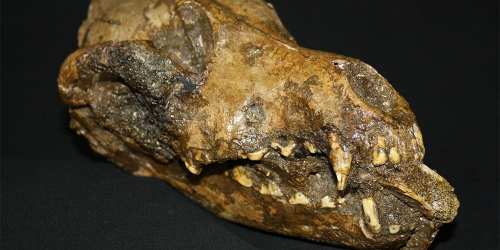
Dogs were domesticated 10,000–15,000 years ago, likely making them the oldest domesticated animals on the planet. Humans then bred dogs with the most desirable and useful traits so that they could function as companions and workers, leading to domesticated dogs that are highly receptive to human commands and gestures.

However, it was not clear whether dogs understand us through training alone, or whether this was innate. Can dogs interpret a signal, such as a gesture, without specific training, or even without having met the signaling person previously? One way to find out is to see whether untrained, stray dogs can interpret and react to human gestures.

Stray dogs are a common feature in cities around the world and particularly in many developing countries. While they may observe and occasionally interact with people, such dogs have never been trained, and are behaviorally “wild”. Conflicts between stray dogs and humans are a problem and understanding how humans shape stray dog behavior may help alleviate this.

To investigate, Dr. Anindita Bhadra of the Indian Institute of Science Education and Research Kolkata, India, and colleagues studied stray dogs across several Indian cities. The researchers approached solitary stray dogs and placed two covered bowls on the ground near them. A researcher then pointed to one of the two bowls, either momentarily or repeatedly, and recorded whether the dog approached the indicated bowl. They also recorded the perceived emotional state of the dogs during the experiment.

Approximately half of the dogs did not approach either bowl. However, the researchers noticed that these dogs were anxious and may have had bad experiences with humans before. The dogs who approached the bowls were noted as friendlier and less anxious, and approximately 80% correctly followed the pointing signals to one of the bowls, regardless of whether the pointing was momentary or repeated. This suggests that the dogs could indeed decipher complex gestures.

“We thought it was quite amazing that the dogs could follow a gesture as abstract as momentary pointing,” explained Bhadra. “This means that they closely observe the human, whom they are meeting for the first time, and they use their understanding of humans to make a decision. This shows their intelligence and adaptability.”

The results suggest that dogs may have an innate ability to understand certain human gestures which transcends training. However, it should be noted that the shyer, more anxious animals tended not to participate, so future studies are needed to determine more precisely how an individual dog’s personality affects their ability to understand human cues.

Overall, dogs may be more perceptive than we realize. “We need to understand that dogs are intelligent animals that can co-exist with us,” said Bhadra “They are quite capable of understanding our body language and we need to give them their space. A little empathy and respect for another species can reduce a lot of conflict.”

Original article:  Free-Ranging Dogs Are Capable of Utilizing Complex Human Pointing Cues

Source:  Frontiers Science News

WSU study aims to prevent adverse drug reactions in dogs

If not identified before surgery, a rare genetic mutation could result in your dog being exposed to dangerously high levels of anesthetic agents.

Scientists at Washington State University’s College of Veterinary Medicine initially discovered the mutation in greyhounds and more recently in other common dog breeds.

The research group, a member of the Program in Individualized Medicine (PrIMe), published its findings in Scientific Reports.

Researchers on genetic mutation anesthetic study

Researchers Stephanie Martinez and Michael Court pose with their dogs Otis (left), Seamus (center), and Matilda (right). Matilda is a carrier of a mutation found by Martinez and Court, which results in less of the enzyme used to break down many popular anesthetics.

For years, veterinarians have known that some greyhounds struggle to break down certain drugs, which results in potentially life-threatening and prolonged recovery periods following anesthesia. The previously unknown genetic mutation that the WSU researchers uncovered in greyhounds causes less of CYP2B11, the enzyme that breaks down these drugs, to be made.

Not surprisingly, the mutation was also found in several other dog breeds that are closely related to the greyhound including borzoi, Italian greyhound, whippet, and Scottish deerhound.

However, when the research team extended their survey to more than 60 other breeds, using donated samples from the WSU Veterinary Teaching Hospital DNA Bank, they were surprised by what they found.

According to the study, funded by the American Kennel Club’s Canine Health Foundation, some popular dog breeds, including golden retrievers and Labrador retrievers, may also struggle to break down the commonly used anesthetics, midazolam, ketamine, and propofol.

“We started with a condition we thought was specific to greyhounds and affected a relatively small number of dogs,” said Stephanie Martinez, postdoctoral research associate and lead author on the study. “It now appears that there could be a lot more dogs affected by this mutation—dogs from breeds that we wouldn’t have expected.”

The study found about one in 50 golden retrievers and one in 300 Labrador retrievers may have low amounts of CYP2B11. According to the American Kennel Club, Labrador retrievers are the most popular breed of dog in the U.S., closely followed by golden retrievers, ranked third.

Even mixed-breed dogs were not spared; although the prevalence was much lower at only one in 3,000 dogs.

“While the mutation is not that common in most breeds—outside of greyhounds and other related breeds—because some of these other breeds are so popular, a relatively large number of dogs in this country could be affected.” Martinez said.

Michael Court, the study principal investigator and veterinary anesthesiologist who began studying slow anesthetic drug breakdown in greyhounds over 20 years ago, said, “Although we have developed special anesthesia protocols that work very safely in greyhounds—the nagging question was—should we be using these same protocols in other dog breeds?”

Court and Martinez are now moving forward to create a simple cheek swab test that could be used by dog owners and their veterinarians to detect the mutation and determine an individual dog’s sensitivity to the problematic anesthetic drugs.

“We also suspect that dogs with the mutation may have trouble breaking down drugs—other than those used in anesthesia.” Court said. “The challenge now is to provide accurate advice to veterinarians on what drugs and drug dosages should be used in affected patients.”

The research team is currently seeking volunteer golden retrievers and greyhounds to participate in a one‑day study at the WSU Veterinary Teaching Hospital to continue their study of drug breakdown in these dog breeds.

Those who are interested in having their golden retriever or greyhound participate in the study can contact courtlab@vetmed.wsu.edu for more information.

Source:  Washington State University media release

Beyond the pram

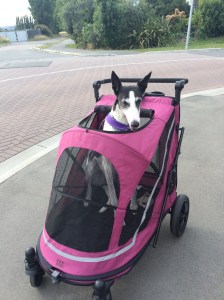
Izzy, my greyhound, has begun to use a pram (stroller) on some walks.  She’s got a combination of corns and arthritis; she’ll be 11 in just a few weeks.

The pram is only a recent development, however.   We have been on a journey together to manage her aging for the last few years.

So, based on all the questions I get when people see us in our neighborhood, I’m planning a series of posts about Izzy, arthritis, aging, and senior dog care which will draw on my personal experience both with Izzy, and my beloved English Pointer Daisy who preceded her in my life.  (plus of course my professional experience as a canine massage and rehab practitioner).

Stay tuned for more posts and be sure to let me know if you have specific issues you’d like me to cover.

Kathleen Crisley, Fear-Free certified professional and specialist in dog massage, rehabilitation and nutrition/food therapy, The Balanced Dog, Christchurch, New Zealand

IMG_4689[1]

Doga class

I’ve been busy over the last couple of weeks promoting my new doga class.

Greyhound doga

After years of trying, I have found a yoga studio that is willing to give doga (yoga with your dog) a try.  And it’s a bit of a joint venture – with me responsible for the dog aspects of the class, such as writing the class registration rules, and with my partner, MoveWell, handling the professional yoga instruction.

Last Saturday was our first class and it went without a hitch.   We’re starting with greyhounds because they are easy going dogs and will enable us to fine tune the operation of the class.  The intention is that we will offer an all-breeds class after that, paying particular attention to the sociability of the dogs, interaction and parent responsibility.

Dogs enjoy the relaxing music of yoga and the positive energy.  A few bursts of play in the studio (by the dogs) happened, too.

Doga will offer an all-weather, all-seasons option for dog parents wanting to spend quality time with their dogs while getting exercise.  We aim to offer information sessions after the classes with guest speakers on human and dog health topics, too.

So finding our feet (or should I say paws?) with this initial run of 4 classes and looking forward to our larger classes.

Namaste!

Kathleen Crisley, Fear-Free certified professional and specialist in dog massage, rehabilitation and nutrition/food therapy, The Balanced Dog, Christchurch, New Zealand
Turning the page for Spot boosts literacy in young students

Reading in the presence of a pooch may be the page-turning motivation young children need, suggests a UBC researcher.

Golden retriever Abby listens

Golden retriever Abby listens while Annie Letheman (right) reads to her sister Ruby and researcher Camille Rousseau (middle) observes.

Camille Rousseau, a doctoral student in UBC Okanagan’s School of Education, recently completed a study examining the behaviour of 17 children from Grades 1 to 3, while reading with and without a dog. The study was conducted with Christine Tardif-Williams, a professor at Brock University’s department of child and youth studies.

“Our study focused on whether a child would be motivated to continue reading longer and persevere through moderately challenging passages when they are accompanied by a dog,” explains Rousseau.

Participants were recruited based on their ability to read independently. Prior to the study, each child was tested to determine their reading range and to ensure they would be assigned appropriate story excerpts. The researchers then choose stories slightly beyond the child’s reading level.

During the study’s sessions, participants would read aloud to either an observer, the dog handler and their pet or without the dog. After finishing their first page, they would be offered the option of a second reading task or finishing the session.

“The findings showed that children spent significantly more time reading and showed more persistence when a dog—regardless of breed or age—was in the room as opposed to when they read without them,” says Rousseau. “In addition, the children reported feeling more interested and more competent.”

With the recent rise in popularity of therapy dog reading programs in schools, libraries and community organizations, Rousseau says their research could help to develop ‘gold-standard’ canine-assisted intervention strategies for struggling young readers.

“There have been studies that looked at the impact of therapy dogs on enhancing students’ reading abilities, but this was the first study that carefully selected and assigned challenging reading to children,” she says.

Some studies and programs have children choose their own book, and while the reading experience would still be positive, Rousseau adds it’s the educational experience of persevering through a moderate challenge that offers a potentially greater sense of achievement.

She hopes the study increases organizations’ understanding of how children’s reading could be enhanced by furry friends.

Rousseau is continuing her research on how canine-assisted therapy can influence students in other educational contexts through UBC’s therapy dog program—Building Academic Retention through K9’s (BARK).

The study was published in Anthrozoös, a multidisciplinary journal focusing on the interactions of people and animals.

Source:  University of British Columbia media release

Jess has a massage (and I’m interviewed for a podcast)

Jess of Dogs of New Brighton

Jess, a Beardie x Huntaway, is the canine inspiration behind the Dogs of New Brighton podcast. Here she is on my massage table for the first time.

Earlier last month, I was asked to visit with Michele Hollis and Jess who live in New Brighton (east Christchurch).   Together they produce the Dogs of New Brighton podcast.

After I spent an hour with Jess for a relaxation massage, Michele and I sat down for an interview.

Listen to Part 1:  In the first 20 minute segment of our interview, Michele asks me questions about Jess’ session, her reactions during the massage, and my qualifications and background.

Listen to Part 2:  In the second 20 minute segment,  Michele and I have a free-ranging discussion on a number of topics.  I explain in more detail about the use of Fear Free techniques in canine massage and why I use a massage table; I also explain the legal standing of physical therapy on animals in New Zealand and the use of the terms ‘physio’ and ‘physiotherapy’.  Michele asks me questions about the liver dog treats I feed in my practice, our treats and cakes that are made here in Christchurch at The Balanced Dog and I explain our free Birthday Club, too.  I also talk about what I feed my greyhound, Izzy, and we finish our chat about Christchurch and whether it is a dog-friendly city including a discussion of irresponsible dog owners, community standards, and the need to pick up poo.

Jess of the Dogs of New Brighton

Listen to Jess snoring after her massage in Part 1 of my interview with Michele of the Dogs of New Brighton

Kathleen Crisley, Fear-Free certified professional and specialist in dog massage, rehabilitation and nutrition/food therapy, The Balanced Dog, Christchurch, New Zealand


Doggy quote of the month for January 2020

“Dogs don’t age like people.   We peak at twenty-five, then hit a slow, gradual decline into oblivion.  Dogs mature fast, then plateau and stay there for a long while.  Then, in the last quarter of their lives, they show steady signs of aging – arthritis, deafness, graying, slowing down.”

– Steve Duno, author of Last Dog on the Hill

Izzy the greyhound

Izzy, a greyhound, is the Poster Dog of The Balanced Dog. In 2020, she will be turning 11. Thanks for reading my blog and we look forward to bringing you more doggy news in the year to come.

Study Suggests Early-Life Exposure to Dogs May Lessen Risk of Developing Schizophrenia

Ever since humans domesticated the dog, the faithful, obedient and protective animal has provided its owner with companionship and emotional well-being. Now, a study from Johns Hopkins Medicine suggests that being around “man’s best friend” from an early age may have a health benefit as well — lessening the chance of developing schizophrenia as an adult.

And while Fido may help prevent that condition, the jury is still out on whether or not there’s any link, positive or negative, between being raised with Fluffy the cat and later developing either schizophrenia or bipolar disorder.

800 Toddler with Dog_Public Domain via Wikimedia Commons

A recent study by Johns Hopkins Medicine researchers suggests that exposure to pet dogs before the age of 13 may lessen the chance of developing schizophrenia later in life. Credit: Public domain via Wikimedia Commons


“Serious psychiatric disorders have been associated with alterations in the immune system linked to environmental exposures in early life, and since household pets are often among the first things with which children have close contact, it was logical for us to explore the possibilities of a connection between the two,” says Robert Yolken, M.D., chair of the Stanley Division of Pediatric Neurovirology and professor of neurovirology in pediatrics at the Johns Hopkins Children’s Center, and lead author of a research paper recently posted online in the journal PLOS One.

In the study, Yolken and colleagues at Sheppard Pratt Health System in Baltimore investigated the relationship between exposure to a household pet cat or dog during the first 12 years of life and a later diagnosis of schizophrenia or bipolar disorder. For schizophrenia, the researchers were surprised to see a statistically significant decrease in the risk of a person developing the disorder if exposed to a dog early in life. Across the entire age range studied, there was no significant link between dogs and bipolar disorder, or between cats and either psychiatric disorder.

The researchers caution that more studies are needed to confirm these findings, to search for the factors behind any strongly supported links, and to more precisely define the actual risks of developing psychiatric disorders from exposing infants and children under age 13 to pet cats and dogs.

According to the American Pet Products Association’s most recent National Pet Owners Survey, there are 94 million pet cats and 90 million pet dogs in the United States. Previous studies have identified early life exposures to pet cats and dogs as environmental factors that may alter the immune system through various means, including allergic responses, contact with zoonotic (animal) bacteria and viruses, changes in a home’s microbiome, and pet-induced stress reduction effects on human brain chemistry.

Some investigators, Yolken notes, suspect that this “immune modulation” may alter the risk of developing psychiatric disorders to which a person is genetically or otherwise predisposed.

In their current study, Yolken and colleagues looked at a population of 1,371 men and women between the ages of 18 and 65 that consisted of 396 people with schizophrenia, 381 with bipolar disorder and 594 controls. Information documented about each person included age, gender, race/ethnicity, place of birth and highest level of parental education (as a measure of socioeconomic status). Patients with schizophrenia and bipolar disorder were recruited from inpatient, day hospital and rehabilitation programs of Sheppard Pratt Health System. Control group members were recruited from the Baltimore area and were screened to rule out any current or past psychiatric disorders.

All study participants were asked if they had a household pet cat or dog or both during their first 12 years of life. Those who reported that a pet cat or dog was in their house when they were born were considered to be exposed to that animal since birth.

The relationship between the age of first household pet exposure and psychiatric diagnosis was defined using a statistical model that produces a hazard ratio — a measure over time of how often specific events (in this case, exposure to a household pet and development of a psychiatric disorder) happen in a study group compared to their frequency in a control group. A hazard ratio of 1 suggests no difference between groups, while a ratio greater than 1 indicates an increased likelihood of developing schizophrenia or bipolar disorder. Likewise, a ratio less than 1 shows a decreased chance.

Analyses were conducted for four age ranges: birth to 3, 4 to 5, 6 to 8 and 9 to 12.

Surprisingly, Yolken says, the findings suggests that people who are exposed to a pet dog before their 13th birthday are significantly less likely — as much as 24% — to be diagnosed later with schizophrenia.

“The largest apparent protective effect was found for children who had a household pet dog at birth or were first exposed after birth but before age 3,” he says.

Yolken adds that if it is assumed that the hazard ratio is an accurate reflection of relative risk, then some 840,000 cases of schizophrenia (24% of the 3.5 million people diagnosed with the disorder in the United States) might be prevented by pet dog exposure or other factors associated with pet dog exposure.

“There are several plausible explanations for this possible ‘protective’ effect from contact with dogs — perhaps something in the canine microbiome that gets passed to humans and bolsters the immune system against or subdues a genetic predisposition to schizophrenia,” Yolken says.

For bipolar disorder, the study results suggest there is no risk association, either positive or negative, with being around dogs as an infant or young child.

Overall for all ages examined, early exposure to pet cats was neutral as the study could not link felines with either an increased or decreased risk of developing schizophrenia or bipolar disorder.

“However, we did find a slightly increased risk of developing both disorders for those who were first in contact with cats between the ages of 9 and 12,” Yolken says. “This indicates that the time of exposure may be critical to whether or not it alters the risk.”

One example of a suspected pet-borne trigger for schizophrenia is the disease toxoplasmosis, a condition in which cats are the primary hosts of a parasite transmitted to humans via the animals’ feces. Pregnant women have been advised for years not to change cat litter boxes to eliminate the risk of the illness passing through the placenta to their fetuses and causing a miscarriage, stillbirth, or potentially, psychiatric disorders in a child born with the infection.

In a 2003 review paper, Yolken and colleague E. Fuller Torrey, M.D., associate director of research at the Stanley Medical Research Institute in Bethesda, Maryland, provided evidence from multiple epidemiological studies conducted since 1953 that showed there also is a statistical connection between a person exposed to the parasite that causes toxoplasmosis and an increased risk of developing schizophrenia. The researchers found that a large number of people in those studies who were diagnosed with serious psychiatric disorders, including schizophrenia, also had high levels of antibodies to the toxoplasmosis parasite.

Because of this finding and others like it, most research has focused on investigating a potential link between early exposure to cats and psychiatric disorder development. Yolken says the most recent study is among the first to consider contact with dogs as well.

“A better understanding of the mechanisms underlying the associations between pet exposure and psychiatric disorders would allow us to develop appropriate prevention and treatment strategies,” Yolken says.

Source:  John Hopkins Newsroom

Warmth and gratefulness at Christmas

I began my business over 10 years ago because I believed in the need for in-home care for dogs.  Gifts at Christmas from clients are always a surprise because I feel like I’m just doing my job.  But all are appreciated.

In this post, I share some of the gifts given to me this Christmas – and the thought that has gone into them is obvious:

Kathleen Crisley, Fear-Free certified professional and specialist in dog massage, rehabilitation and nutrition/food therapy, The Balanced Dog, Christchurch, New Zealand
Greetings

Gretel is a red Staffordshire Bull Terrier who receives regular massage and laser therapy.  Yesterday, her Mum took this video to show me how excited she gets when I arrive.

Gretel is a tight bundle of energy and enthusiasm and her Mum has been training her to pass her Canine Good Citizen test.

She’s a joy to work with.  If I had a tail, I would wag it when I arrive, too.

Kathleen Crisley, Fear-Free certified professional and specialist in dog massage, rehabilitation and nutrition/food therapy, The Balanced Dog, Christchurch, New Zealand