Obituary: Fidele of Bruges


Fidele of Bruges

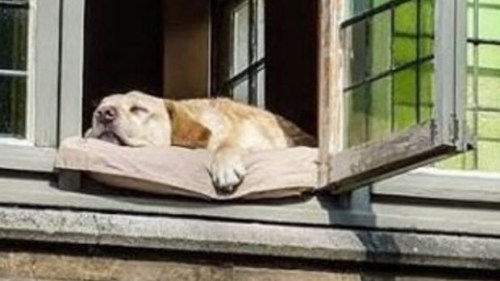
Fidele, the Golden Labrador who lived at the Bed and Breakfast Coté Canal and made a small appearance in the film In Bruges, passed away in early February at the age of 12.

His owner, Caroline Van Langeraert, has said that Fidele became an icon, with tourist boats along the canals stopping so tourists could take photos of him in his regular resting space at the window of the bed and breakfast.  He is irreplaceable.

Many tourists will have photos and videos of Fidele in his spot at the window, as seen here in YouTube.

It is always sad to see our dog friends leave; particularly so when they share our businesses and our customers know them well.  (Apparently, one US tourist asked to book into the bed and breakfast specifically because she had heard about Fidele.)


Kathleen Crisley, specialist in dog massage, rehabilitation and nutrition/food therapy, The Balanced Dog, Christchurch, New Zealand


Cross-breeding to eradicate Chiari syndrome

In a new study published in the journal PLOS ONE, scientists from the University of Surrey, working with an experienced breeder in the Netherlands, examined how the skull and brain of toy dogs change when a Brussels Griffon with Chiari-like malformation is crossed with an Australian Terrier.  The succeeding hybrid puppy is then back crossed to a Brussels Griffon to give some of the features of the Brussels Griffon, but keeping the longer skull of the Australian Terrier.

Griffon and cross breed

Second-generation backcross and purebred Brussel Griffon Sire Photo credit: Henny van der Berg

The results from the study showed it is possible to breed a dog which had the external features of a short-nosed Brussels Griffon and reduce the risk of Chiari malformation, a debilitating condition found in toy dogs and affecting 1 in 1,280 humans.  The disease is characterised by premature fusion of skull bones forcing parts of the brain to push through the opening in the back of the skull causing fluid filled cavities to develop in the spinal cord. Chiari malformation causes headaches, problems with walking or even paralysis and has become prevalent in some toy breed dogs as a result of selective breeding.

The breeder, Henny van der Berg proposed the project idea after an accidental mating between two of her dogs.  The four-year study analysed five traits on magnetic resonance images (MRI) scans and how they changed generation by generation in the family of 29 dogs.  Using a careful selection of head shape and MRI scans over two generations, the findings revealed it was possible to breed a dog which had the external features of a Brussels Griffon, but is less susceptible to Chiari malformation.

“This is a true collaboration with breeders and researchers working together and using their expertise to improve the health of dogs,” said Dr Clare Rusbridge from the University of Surrey.

“Our study investigated how the characteristics of this disease is inherited in the family.  Such knowledge could help in tackling this debilitating disease in toy dog breeds.  We hope our research will help develop more sophisticated ways of screening and improve breeding guidelines by creating robust breeding values.”

The team at the University of Surrey is now collaborating with geneticists at the University of Montreal, and correlating the skull and brain traits visualised on magnetic resonance images with the dog genome. This information will then be translated to humans.

Source:  University of Surrey media release

My other posts about Chiari malformation include:

New Florida law protects dog rescuers

Republican Governor Rick Scott has signed House Bill 131 into law.  This law will allow people to break into locked vehicles to rescue animals or people who are “in imminent danger of suffering harm.”

Dog in car

In Florida, children and pets have regularly suffered by being left in overheated cars.  Many have died.

Rightfully so, there are guidelines for the law to apply.

  1.  You must check that the vehicle is locked.
  2. After doing so, call 911 or law enforcement before entering the vehicle or immediately after rescuing the child or pet.
  3. Use no more force than is necessary to break in — and remain with the person or animal until first-responders arrive.

All of these guidelines seem very reasonable to me.

Well done to the State of Florida!

Kathleen Crisley, specialist in dog massage, rehabilitation and nutrition/food therapy, The Balanced Dog, Christchurch, New Zealand

Homeless youth with pets

Homeless youth can benefit from owning pets but not without a few challenges, according to a new study from the University of Guelph.

Led by researchers from the Ontario Veterinary College (OVC), the team found that homeless youth with pets are less likely to engage in potentially harmful behaviour, more likely to open up to veterinarians about their personal challenges and generally less depressed.
Homeless youth

(Photo courtesy Community Veterinary Outreach)

However, the team found that pets can make it difficult for their owners to obtain social services.

The study was published today in the journal Anthrozoӧs. 

Its findings mirror what researchers had been hearing anecdotally, said Prof. Jason Coe, Population Medicine.

“Those homeless youth with pets don’t want to risk incarceration or anything that would prevent them from being with their pets, so they are less likely to abuse alcohol or use hard drugs,” said Coe. He studies the human-animal bond and communication in veterinary care.

“We also found those without pets are three times more likely to be depressed, though we have not yet determined if this is directly relatable to having a pet.”

Among major challenges, he said, “Many shelters do not allow pets, so these youth may be limited in where they can sleep.”

Many youth are very open to discussing their struggles and issues with veterinarians, said lead author Michelle Lem, an OVC graduate.

She is the founder and director of Community Veterinary Outreach (CVO), a volunteer group providing mobile veterinary services to homeless people in Toronto, Hamilton, Kitchener-Waterloo, Guelph and Ottawa.

“We’re able to collaborate with public health and social workers as they attempt to reach these marginalized people, essentially using the human-animal bond and veterinary care as a gateway to provide accessible social support and healthcare,” Lem said.

“So many of these youth have lost trust in people, and the animal gives them unconditional love. They will do anything for their pets, which means they are less likely to commit potentially harmful acts, but also face more challenges with accessing housing, healthcare or addiction treatment services.”

Prof. Bill O’Grady, Sociology and Anthropology, studies youth homelessness and helped design the study.

Calling for pet-friendly shelters, he said “many homeless youth are prohibited from using services offered by the shelter system because they have pets, particularly dogs. There is an opportunity here to use this information when we’re developing services and plans for young people.”

Source:  University of Guelph media release

Doggy quote of the month for April

‘The dog is man’s best friend.

He has a tail on one end.

Up in front he has teeth.

And four legs underneath.’

– Ogden Nash, American poet

Izzy at Groynes


A tip for changing back to Standard Time

On Saturday evening in New Zealand, we’ll be changing clocks back to Standard Time.  This is often a difficult day for dogs, because suddenly they haven’t been fed at their ‘normal’ time.

An hour is a long time to wait in dog time!

Clock

So, for the next few nights, feed your dog 10 to 15 minutes later than the previous evening.  You’ll transition them to their new feeding in Standard Time with less trauma.

Kathleen Crisley, specialist in dog massage, rehabilitation and nutrition/food therapy, The Balanced Dog, Christchurch, New Zealand

Can puppies fix boredom?

SoulPancake and Puppy Chow teamed up to share the #PowerofPuppies at a preschool, retirement home, and a gym to transform an otherwise ordinary day. For every video view, Puppy Chow by Purina will donate one pound of Puppy Chow Natural to Rescue Bank® (up to 500,000 pounds or until April 23, 2016).

Shelter animals need all the support we can give them – every day across America, shelters  need to dish up thousands of meals.

Thank you!

Izzy & Lenore – book review

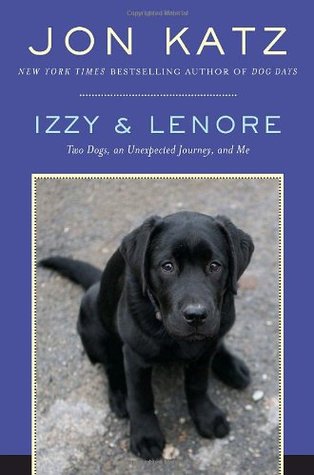
Izzy and Lenore by Jon Katz

Over this Easter weekend, I have finished reading Izzy & Lenore, another great dog book by Jon Katz.

Although Katz’s earlier books talk about his life establishing Bedlam Farm in upstate New York,  and his menagerie of animals, this book gives us some depth into who Jon Katz is as a person, and he’s honest about his own battle with depression.

Izzy is a Border Collie that is rescued by Katz and he’s intelligent, with the seeming ability to connect to people in all circumstances.  This dog seems to have an infinite amount of compassion, despite being abandoned by his previous owners.  Katz and Izzy become trained as hospice volunteers and so throughout the book, there are tales of hospice cases that the two become involved in.  If you have ever had a loved one experience a terminal illness, dealt with the effects of old age and infirmity, these stories will resonate with you.

Lenore is a congenial Labrador puppy who joins the pack.

In this book, Katz faces his own battle with depression and he explains some of the dark secrets that he and his sister share.

I recommend this book, as I have all the others I have read by Jon Katz.  I wish I had his talent for storytelling and – perhaps best of all – unlike previous stories of Bedlam Farm, no dogs die during the course of this story.

Kathleen Crisley, specialist in dog massage, rehabilitation and nutrition/food therapy, The Balanced Dog, Christchurch, New Zealand


Reading to dogs

Reading to dogs programs, more formally known as animal-assisted reading programs, are on the rise.

In this Boston Globe article, it is reported that one volunteer organisation – Dog B.O.N.E.S. (Dog Building Opportunities for Nurturing and Support) – has certified more than 200 Reading Partner teams.  And that’s working in the state of Massachusetts alone.

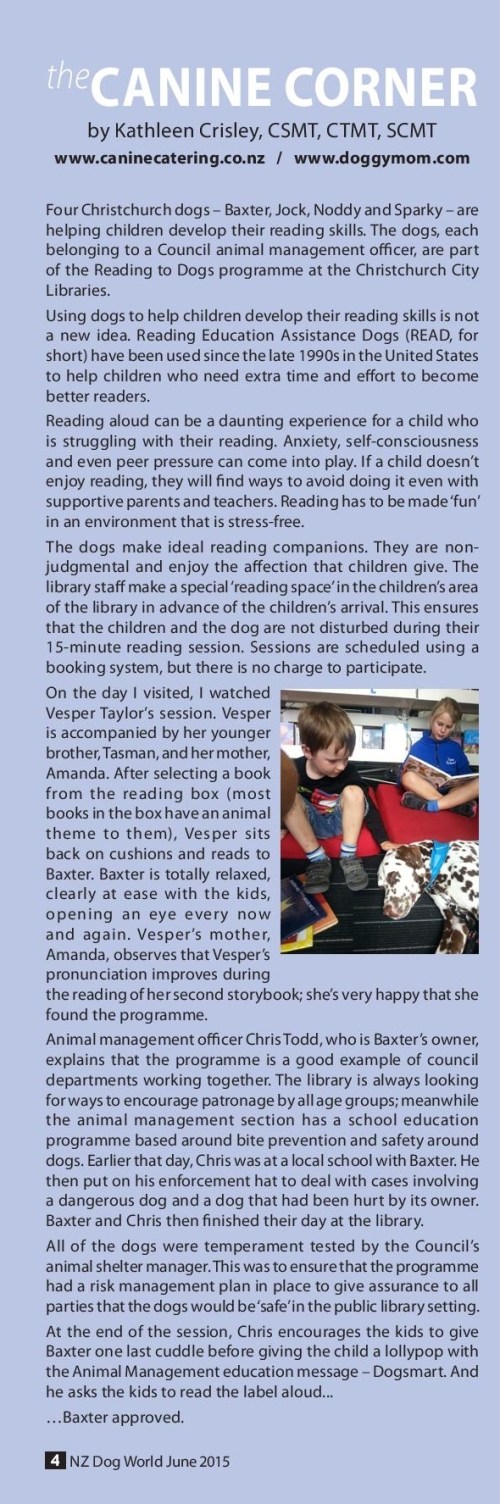
In Christchurch, we have a Reading to Dogs program which I wrote about in my column in NZ Dog World magazine (see below).

The big difference is that the Council was so worried about risk that it only accepted temperament testing by the Council’s shelter manager on the pet dogs of the animal control officers before allowing the program to proceed.  Since we have testing such as the Canine Good Citizen test, sponsored by the NZ Kennel Club, I think it’s a shame that volunteers are not resourcing this program.

This would allow the animal control officers to work in enforcement areas that are so badly needed and always under-resourced.

Reading to Dogs

See also Can your dog R.E.A.D?

Kathleen Crisley, specialist in dog massage, rehabilitation and nutrition/food therapy, The Balanced Dog, Christchurch, New Zealand

Whizz, a remarkable Newfoundland

Whizz

Photo: © PDSA / SWNS.com

A black and white Newfoundland and marine rescue dog, Whizz, has been awarded the PDSA Order of Merit.  This is the animal equivalent of the Victoria Cross and recognises animals that display outstanding devotion to their owner or wider society, above and beyond normal companionship.

His trainer told The Telegraph that he trained Whizz as a rescuer when the dog was only one year old. “I am bursting with pride for Whizz.”

“He was a dog in a million and I am truly heartbroken that he isn’t here to receive his medal. Whizz loved working and had an extraordinary talent. Not only was he strong and gentle – he was also so emotionally intuitive. This made him the perfect rescue and therapy dog and a beloved companion to the hundreds of sick children and adults he met along the way.”

During his rescue career, Whizz saved many people including two little girls who had floated out to sea on an inflatable raft and then got into trouble.  He also was a regular at Newfoundland Water Rescue Days, a fundraising event where people would enter the water and then be ‘saved’ by the rescue Newfoundlands.

Whizz also visited the sick and injured in hospital as a therapy dog.