People who have autism are often misunderstood. So are Pit Bulls. These two make a great pair.
Kathleen Crisley, specialist in dog massage, rehabilitation and nutrition/food therapy, The Balanced Dog, Christchurch, New Zealand

People who have autism are often misunderstood. So are Pit Bulls. These two make a great pair.
Kathleen Crisley, specialist in dog massage, rehabilitation and nutrition/food therapy, The Balanced Dog, Christchurch, New Zealand
Posted in dog breeds, special dogs and awards, Uncategorized
Tagged autism, Best Friends, Best Friends Animal Society, Pit Bull
Izzy is a greyhound, a breed that seems predisposed to a lot of dew claw injuries. Her last one occurred in February, when running after another dog’s tennis ball at the dog park.
I am now better prepared for nail injuries – with the easy addition of some cornflour (corn starch for those of you in the Northern Hemisphere) in my first aid kit.
You don’t need a fancy styptic pencil in your first aid kit to stop the bleeding of a nail injury; this good old fashioned powder will do the job. I’ve placed mine in a recycled prescription pill bottle.

If a nail injury occurs, you want to stop the bleeding which can be profuse. Apply pressure and this powder to stem the bleeding. Once stopped, then you can clean the wound properly with water and antiseptic and wrap the paw to keep it clean. Changing the bandage every day, re-applying antiseptic, is important.
Some nail injuries are worse than others; some will heal without veterinary help. In our last case, the quick was fully exposed (ouch!) and despite my efforts to keep it clean and dry, it became red/irritated and infected. (This is why you have to change the bandage every day and check for signs of infection).
A short course of antibiotics prescribed by our vet took care of the job.
I’m much more confident now that I have my container of cornflour in our first aid kit.
Kathleen Crisley, specialist in dog massage, rehabilitation and nutrition/food therapy, The Balanced Dog, Christchurch, New Zealand
Posted in dog care, Dogs, Uncategorized
Tagged corn starch, cornflour, dew claw injuries, first aid kit, nail injuries
A very clever ad, dog-themed, for St Patrick’s Day.
Kathleen Crisley, specialist in dog massage, rehabilitation and nutrition/food therapy, The Balanced Dog, Christchurch, New Zealand
Here’s a design I saved from online a while back. If you have a small apartment or house, this is a great idea. There’s functional storage for your dog’s coats and other gear (or perhaps other things for yourself) and then some of the drawers have been removed to become a raised feeder.
I wish I was better at DIY!
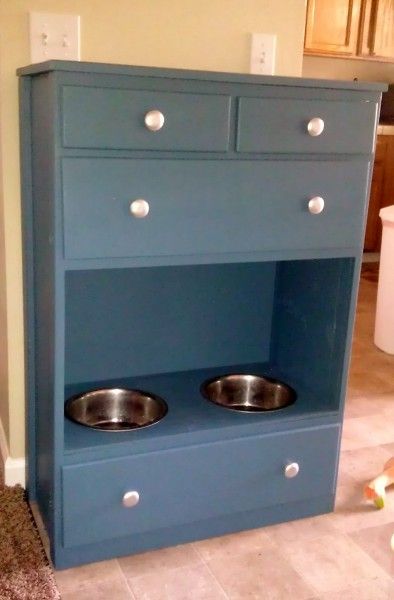
Kathleen Crisley, specialist in dog massage, rehabilitation and nutrition/food therapy, The Balanced Dog, Christchurch, New Zealand
Posted in dog care, Dogs, products for dog lovers
Tagged chest of drawers, DIY, drawers, functional furniture, raised bowls
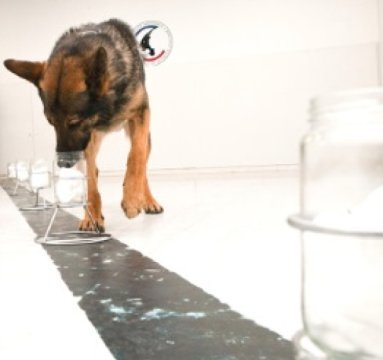
Cisko, one of the police dogs, during a scent detection test. The dog sniffs the reference scent and then smells a series of five jars containing human scents, one of which corresponds to the reference. If the dog recognizes the reference scent it lies down in front of the relevant jar; if the dog does not find a match, then it does not stop or lie down. Credit: © DGPN – SICOP
This technique consists in using a specially-trained dog to compare a human scent collected from an object found at a crime scene with scents from several people, including that of a suspect or victim. As the results of these tests are of critical importance for investigators, they need to be obtained through viable and reproducible methods. However, there are no internationally recognized norms for the training of these dogs or for their inclusion in investigations—hence the occasional reluctance to treat their evidence as proof. By analyzing results collected since 2003 at the Division of the Technical and Scientific Police (DTSP, Ecully), researchers from the Centre de recherche en neurosciences de Lyon have succeeded in demonstrating the viability of the technique used.
During basic training, the German and Belgian shepherd police dogs must learn to make the link between two scents from the same individual through the completion of increasingly complex tasks. By the end of this training, the dogs are able to carry out identification exercises during which they sniff a reference human scent and then compare it with five different human odors, one of which is the reference scent. When a dog matches the scent in the jar to the reference one (which it shows by lying down in front of the correct jar) it is rewarded with a treat or a game. The human odors may consist of traces collected from an object that someone has touched or of a scent collected directly from a person.
The analysis of the data obtained with the 13 DTSP dogs since 2003 shows that after they have learned the task’s principles, 24 months of regular training is necessary for stable and optimal performances. At the end of the first twelve months, the dogs no longer made any recognition errors, i.e., they did not confuse the scent of one person with that of another. Furthermore, their olfactory sensitivity increased significantly over the training period: on average, after two years, the dogs managed to recognize two scents from the same person in 85% of cases. The remaining 15% of cases in which no match was obtained, were mostly the result of poor scent sampling rather than poor recognition.
The researchers also found that German shepherds were better than Belgian shepherds.
At the end of their basic training, the dogs are able to participate in criminal cases and receive continuing training throughout their lives. In practice, each identification test is carried out by at least two dogs. Additionally, each dog performs at least two tests with the same panel of scents: the collected scent is presented either as a sample to be sniffed at the start of the task, or in one of the jars that the dog sniffs successively. Between 2003 and 2016, odorology was used in 522 cases at the SDPTS and helped to resolve 162 cases.
In these criminal cases, the sampled scents were only a few hours or days old. The researchers now want to study how the dogs perform on older scents. Scent samples can in fact be stored in scent libraries over several years.
Posted in Dogs, research, special dogs and awards
Tagged Belgian Shepherd, dog training, german shepherd, odorology, odors, scents


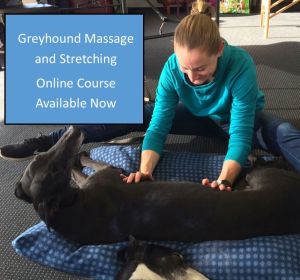
Koko is one dog who zones out during massage. And it doesn’t take long – like 5 seconds…
Kathleen Crisley, specialist in dog massage, rehabilitation and nutrition/food therapy, The Balanced Dog, Christchurch, New Zealand
I’ve been to the supermarket today and, although I don’t have human babies, I purchased something from the baby aisle:
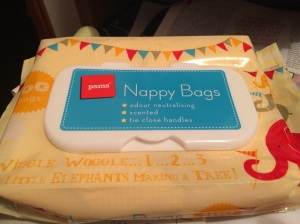
I consider this purchase a badge of honour. Nappy bags (diaper bags for those of you who live in the USA/Canada) are an excellent tool for picking up dog poo. I just got 100 bags for only $2.15 (a much better price than purchasing special doggy doo bags from the pet store).
Sadly, I think I am in the minority when it comes to dog owners. Or, at least that’s the way I feel. Today, I took Izzy for a walk in a local park after going to the supermarket and I counted 4 piles of poo that owners had not picked up.
One of them was in a field used for cricket on the weekends.
It’s a sign that we have too many irresponsible dog owners in Christchurch. And in today’s paper – Mike Yardley – a local commentator, agrees. He laments the pitiful rate of enforcement by our Council and calls upon members of the public to name and shame.
If you see a dog owner blithely pretend their animal hasn’t just crapped all over the footpath – have a crack at them. Shame them into behaviour change, because the council probably won’t police it.
That’s fine – to a point. When you feel safe to do so. But we also need greater enforcement so people take dog-owning responsibilities seriously. And we shouldn’t let the Council, which uses our taxes (rates and dog registration fees) to fund its activities, off the hook when it comes to its responsibility.
Kathleen Crisley, specialist in dog massage, rehabilitation and nutrition/food therapy, The Balanced Dog, Christchurch, New Zealand
Posted in dog ownership, Dogs
Tagged bylaw, Christchurch, dog control, dog poo, Mike Yardley
Research led by investigators in veterinary and human medicine has identified genetic pathways that exacerbate severity of canine compulsive disorder in Doberman Pinschers, a discovery that could lead to better therapies for obsessive compulsive disorder (OCD) in people. The discovery appears in the International Journal of Applied Research in Veterinary Medicine.
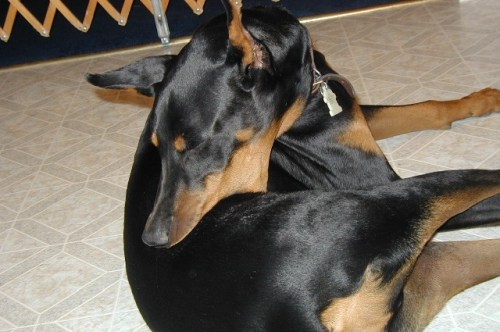
A Doberman pinscher flank sucking, an example of canine compulsive behavior
“Dogs naturally suffer complex diseases, including mental disorders that are similar to those in humans. Among those is canine compulsive disorder (CCD), the counterpart to human obsessive compulsive disorder (OCD),” says the study’s first and corresponding author Nicholas Dodman, BVMS, DACVA, DACVB, professor in clinical sciences and section head and program director of animal behavior at Cummings School of Veterinary Medicine at Tufts University.
OCD is one of the world’s most common neuropsychiatric disorders, affecting an estimated 1 to 3 percent of people and listed by the World Health Organization as among the 20 most disabling diseases. OCD is often characterized by distressing thoughts and time-consuming, repetitive behaviors, while canine compulsions may include repetitive tail chasing, excessive grooming and flank and blanket sucking. Current OCD therapies are not as effective as they could be; medicinal treatment benefits only about half of all human patients.
No previously recorded study in humans or dogs has addressed the factors that drive severity in OCD and CCD.
“Genomic research on human neuropsychiatric disorders can be challenging due to the genetic heterogeneity of disease in humans,” says neurologist Edward Ginns, MD, PhD, professor of psychiatry, neurology, pediatrics and clinical pathology, and director, program in medical genetics at the University of Massachusetts Medical School and a co-author on the new study. “Canine compulsive disorder shares behavioral hallmarks, pharmacological responsiveness, and brain structural homology with human OCD, and thus is expected to be an important animal model.”
The research team compared whole genome sequencing of 70 Doberman pinschers to search for inherited factors that exacerbate CCD. Researchers identified two loci on chromosomes that were strongly correlated with severe CCD, as well as a third locus that showed evidence of association.
The locus most strongly associated with severe CCD was found on chromosome 34 – a region containing three serotonin receptor genes.
“This is particularly significant because drugs that work on the serotonin system are the mainstay treatment for OCD in humans, which demonstrates further correlation between the human and animal models,” says Dodman.
The second locus significantly correlated with severe CCD was on chromosome 11, the same chromosome that contains a gene thought to increase the risk of schizophrenia in humans. This discovery, along with suggestive evidence found on chromosome 16 linking CCD to stress tolerance, may also be relevant to the pathophysiology of OCD, according to the study authors. “Comparative genomics is a particularly attractive approach to reveal the molecular underpinnings of disease in inbred animals with the hope of gaining new insights into these diseases in dogs and humans,” says Ginns.
“If the canine construct is fully accepted by other OCD researchers, this spontaneously-occurring model of the condition in humans, right down to the biological pathways involved, could help point the way to novel and more effective treatments for such a debilitating condition,” Dodman says.
Source: Tufts Now media release
“In times of joy, all of us wished we possessed a tail we could wag.”
– W.H. Auden, poet
This infographic, with information sources referenced at the bottom, shows some interesting facts about our dogs and their patterns of sleep.







 DoggyMom.com