Tag Archives: animals

Black dog syndrome

A common challenge in the adoption business is finding homes for black dogs.  For many years, shelter workers worldwide have reported that black dogs (and cats) are less likely to be adopted than others and more likely to be euthanized.

It’s a case of judging a book by its cover – or is it?

In films, if there is an evil or menacing guard dog, it’s usually black or dark coloured (e.g. Rottweiler, Doberman).  Black cats are notoriously associated with the devil or witches, as well.

However, research published in early 2012 suggested that the issue isn’t colour – it’s breed.  And no one appears to be gathering statistics on the adoption of black dogs vs other dogs.  Plus there’s the fact that the Labrador (including black Labs) is routinely the top of the list when it comes to popular breeds.  This means that someone isn’t afraid of black dogs!

Practically speaking, however, it is usually more difficult to photograph a black dog.  Many shelters find that they can’t do a black dog justice in the photos that are mounted on the internet on shelter web pages and Facebook sites.   Rescue organisations are encouraged to place additional overhead lighting in the kennels of black dogs to make them more appealing to visitors.  Another suggestion is to take a black dog  for a run or brisk walk before photographing him/her – thus photographing them when they are panting which is more likely to look like a smile in their photograph.

Patricia McConnell has commented on Black Dog Syndrome (fact or fiction) on her website.

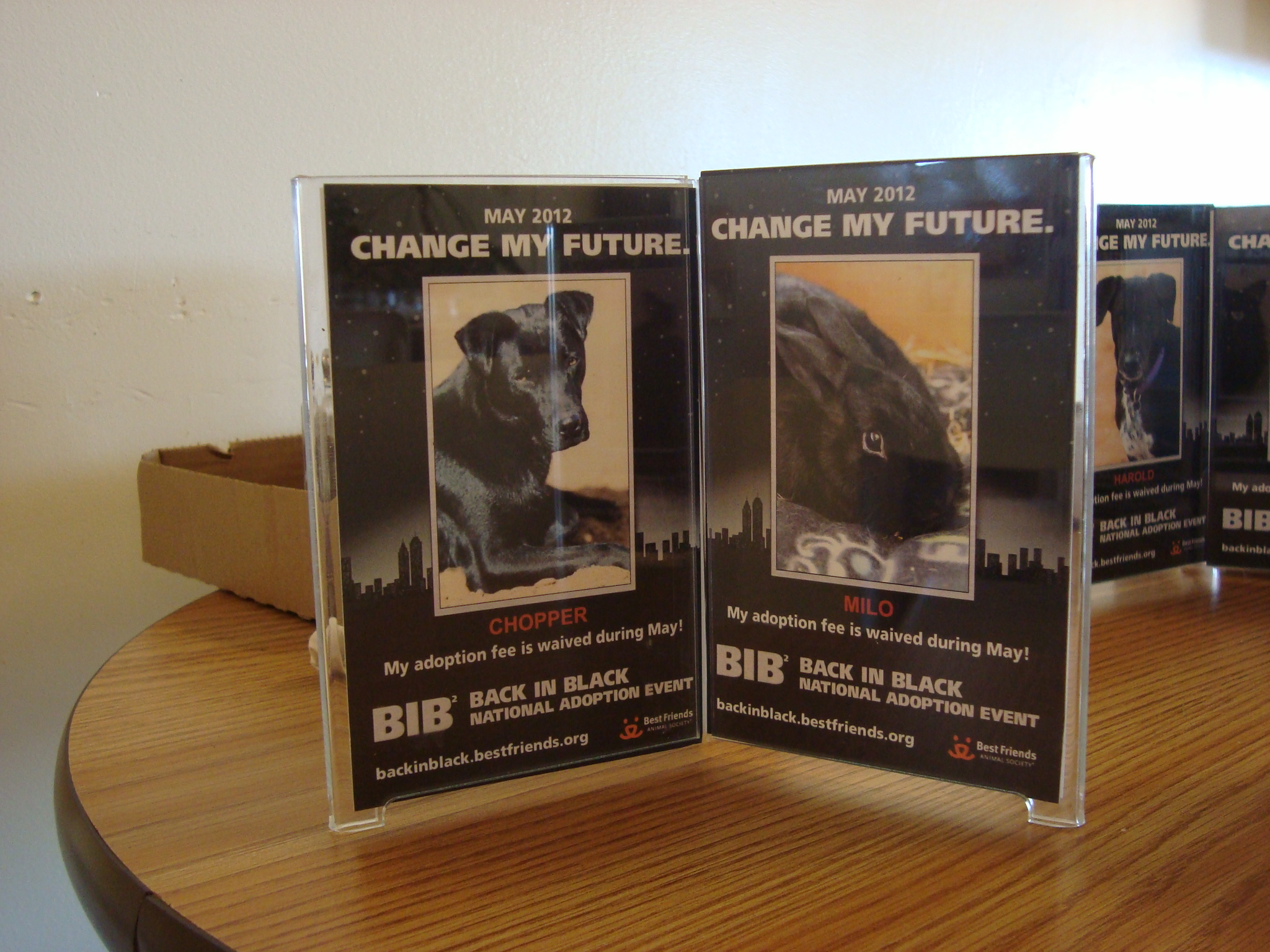
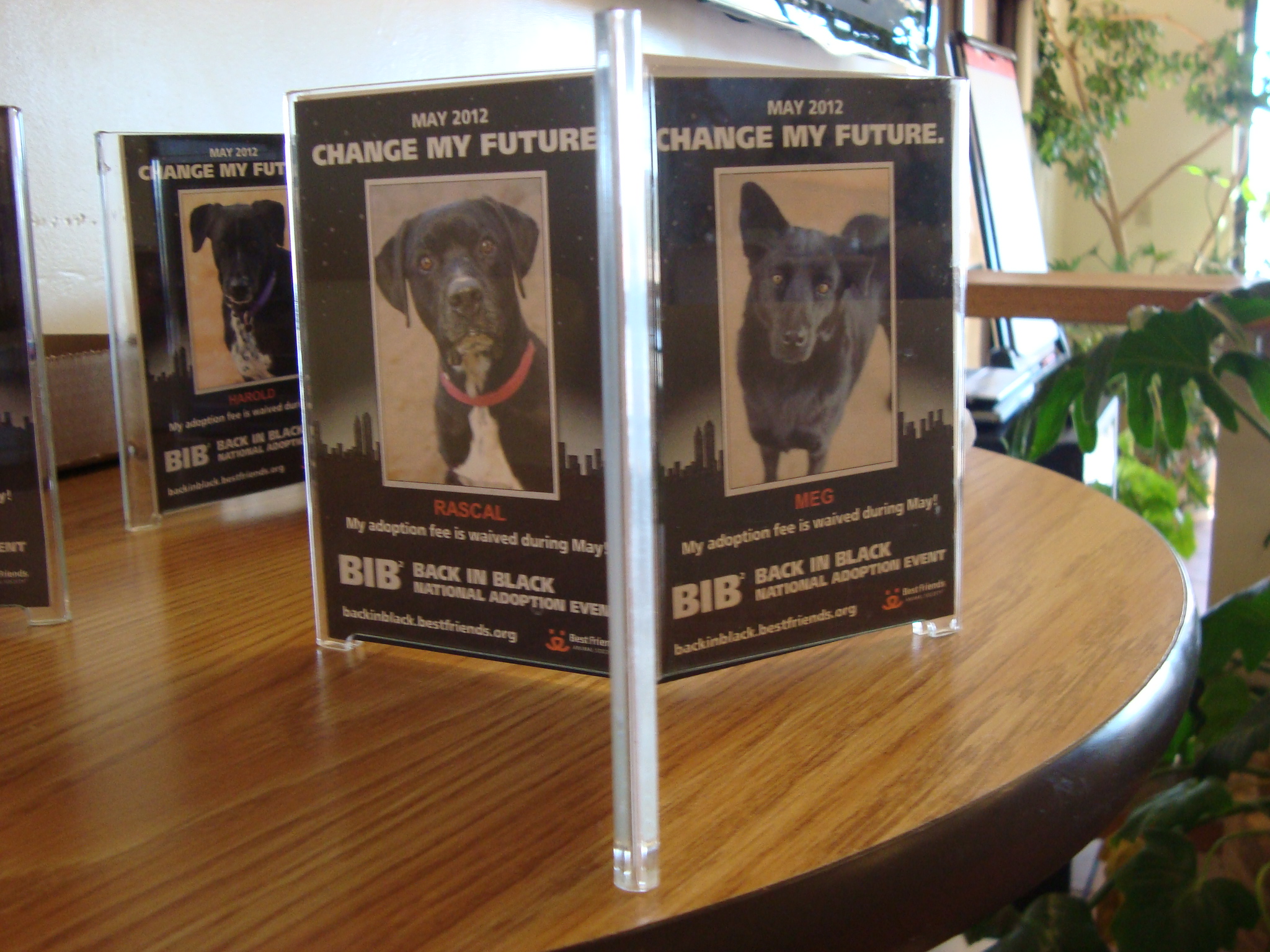
Meanwhile, rescue organisations often hold special events for the adoption of black-coated animals.  These are photos I took last year at Best Friends Animal Sanctuary during their May appeal – Back in Black… The adoption fee was waived for all black animals during the month.  Very creative!
Back in BlackBack in Black 2

Do you think Black Dog Syndrome is real?  What does your rescue organisation do to support the adoption of black dogs?

The Full Tummy Project

I love true stories about how dogs bring people together.  This one comes from Florida, where people at The Doglando Foundation have created the Full Tummy Project.

The Full Tummy Project sets up every Thursday evening at the Global Outreach Center in Bithlo, Florida (east of Orlando, home to DisneyWorld) to provide food and other essential supplies to homeless pet owners.

photo courtesy of Pets of the Homeless

photo courtesy of Pets of the Homeless

The Center has traditionally provided meals for the poor and homeless (like most soup kitchens and homeless shelters), but the folks at the Doglando Foundation recognized that many homeless also own animals and the animals suffer from their poor living conditions and inability to pay for veterinary care.

“Between 5 to 10 percent of homeless people have dogs or cats, and in some [rural] areas of the country, it’s as high as 24 percent,” says Renee Lowry, executive director of Pets of the Homeless, a national organization that helps provide food, medical care and assistance to homeless people who need help caring for their animals.

People are homeless for many reasons; for example some have mental illness but others have lost their jobs in the enduring recession and have had mortgages foreclosed.  The family, including the family pet, ends up on the streets.

So the Full Tummy Project is a soup kitchen for animals and there are currently over 150 families registered with the project.

Orlando Weekly cover

The Orlando Weekly covered the stories of the people involved in the Full Tummy Project, so read the full story by clicking on the Orlando Weekly cover page above.

Do not cry, I am with you

I stood by your bed last night, I came to have a peep.
I could see that you were crying, You found it hard to sleep.
I whined to you softly as you brushed away a tear,
“It’s me, I haven’t left you, I’m well, I’m fine, I’m here.”

Do not cry, I am with you

I was close to you at breakfast, I watched you pour the tea,
You were thinking of the many times, your hands reached down to me.
I was with you at the shops today, Your arms were getting sore.
I longed to take your parcels, I wish I could do more.

I was with you at my grave today, You tend it with such care.
I want to re-assure you, that I’m not lying there.
I walked with you towards the house, as you fumbled for your key.
I gently put my paw on you, I smiled and said ” it’s me.”

You looked so very tired, and sank into a chair.
I tried so hard to let you know, that I was standing there.
It’s possible for me, to be so near you everyday.
To say to you with certainty, “I never went away.”
You sat there very quietly, then smiled, I think you knew…
In the stillness of that evening, I was very close to you.

The day is over… I smile and watch you yawning
and say “good-night, God bless, I’ll see you in the morning.”
And when the time is right for you to cross the brief divide,
I’ll rush across to greet you and we’ll stand, side by side.
I have so many things to show you, there is so much for you to see.

Be patient, live your journey out…then come home to be with me…

Source:  Unknown (I found this in my old email files and it is so appropriate to all of us who have loved and lost a dog)

Doggy quote of the month for March

“Animals, like us, are living souls.  They are not things.  They are not objects.  Neither are they human.  Yet they mourn.  They dance, they suffer.  They know the peaks and chasms of being.”

–  Gary Kowalski, author

Christchurch’s dog hero

Headline news in New Zealand today – Dog Saves Christchurch Woman From Sex Attacker.  And this little beauty has only been in the family for two months!

copyright Fairfax NZ

copyright Fairfax NZ

I know you!

Research published in the journal of Animal Cognition shows that dogs pick out faces of other dogs, irrespective of breeds, among other faces.   They can group them into a category of their own and do so using only visual cues.

The authors of the study have concluded “The fact that dogs are able to recognize their own species visually, and that they have great olfactory discriminative capacities, insures that social behavior and mating between different breeds is still potentially possible. Although humans have stretched the Canis familiaris species to its morphological limits, its biological entity has been preserved.”

Apparatus. a, b The dog sits in front of the experimenter, on a line between the 2 screens. c When hearing an order, the dog expressed his choice by going to a given screen and putting his paw in front of the chosen image. (Credit: Image courtesy of Springer Science+Business Media)

Apparatus. a, b The dog sits in front of the experimenter, on a line between the 2 screens. c When hearing an order, the dog expressed his choice by going to a given screen and putting his paw in front of the chosen image. (Credit: Image courtesy of Springer Science+Business Media)

The authors of the research explored whether the large range of diversity in the size and shape of dogs presented a ‘cognitive challenge’ to dogs trying to recognize their species, when confronted with other species.

On a computer screen, the researchers showed nine pet dogs pictures of faces from various dog breeds and cross-breeds, and simultaneously faces of other animal species, including human faces. They exposed the dogs to diverse stimuli: images of dog faces; images of non-dog species from 40 different species, including domestic and wild animals; and humans. Overall, the dogs were shown more than 144 pairs of pictures to select from. The authors observed whether the nine dogs could discriminate any type of dog from other species, and could group all dogs together, whatever their breed, into a single category.

They did.

Source:  Springer.com

Doggy quote of the month for January

‘Compassion for animals is intimately connected with goodness of character; and it may be confidently asserted that he who is cruel to animals cannot be a good man.’

– Arthur Schopenhauer, philosopher

…and Happy New Year to all my readers and customers.

New Year Dog

Christmas skijor anyone?

For those in the northern hemisphere, Christmas is a winter holiday and why not enjoy it with your dog?  Skijoring is a winter sport where a cross-country skier is drawn across the snow pulled by their dog.  In some cases, skiers will skijor with more than one dog.  In Norwegian, the term literally means ‘ski driving.’

Breeds like Huskies, Malamutes and Samoyeds are obvious choices for this sport, where the owner and dog get their exercise together.  However Pointers and Pointer crosses are also good sled dogs (Daisy likes that idea – although at her advanced age she will be a spectator only).

Skiing with dogs 2 Skiing with dogs 3 Skiing with dogs

In this sport, the cross-country skier provides power with skis and poles, and the dog adds additional power by running and pulling. The skier wears a skijoring harness, the dog wears a sled dog harness, and the two are connected by a length of rope. There are specialist suppliers of skijor equipment to get you started.

Of course, careful winter paw care is needed and some dogs may be fitted with protective footwear for the sport.

Christmas skijor anyone?

The best things in life are free

Free Kisses

In this busy holiday season, remember that the affection your dog shows you is absolutely FREE!  Don’t buy anything today – simply enjoy time with your dog.

The driving dogs of New Zealand

I’m so proud of the SPCA Auckland  (where I used to volunteer, when I lived up that way) for its imaginative holiday promotion for rescue dogs.

The SPCA teamed up with expert dog trainers to train three SPCA rescue dogs to drive a car – a Mini to be exact.

Driving Dog

Monty, Porter and Ginny went through extensive training before being put behind the wheel of the Mini.  Last night, on national television, Monty drove himself around a go-cart track.  Porter took on the dubious task of having the reporter accompany him on his drive – and I think he suffered the nerves for it because he took a turn rather widely.

This video covers the dog’s training and moment of glory:

Monty, Porter and Ginny prove that rescue dogs are intelligent and trainable.  If considering adopting a dog this Christmas, make sure you visit your local SPCA and rescue organisations.

You can read more about New Zealand’s driving dogs at www.drivingdogs.co.nz (which brings you to their Facebook page).

Driving Dogs 2