Tag Archives: beagle

Teddy’s journey – his voice is back

Teddy is definitely feeling better these days.  Jill was worried because Teddy, normally a vocal hound, hadn’t vocalized since his amputation surgery.

Not to worry – his voice is back!

Kathleen Crisley, specialist in dog massage, rehabilitation and nutrition/food therapy, Canine Catering Ltd, Christchurch, New Zealand

Teddy’s journey: Teddy on wheels

Teddy has had another good week; he’s still getting used to being an amputee, however.

Jill and his acupuncture vet, Susanne, both noticed that Teddy was hopping on his right hind leg – balancing mostly on the stronger left side.  By the time I saw Teddy on Friday, Teddy was already improving thanks to acupuncture and an osteopathic adjustment.  I spent most of his massage session working on tension in his upper thoracic spine, and giving his hind legs a good stretch.

Because Teddy still needs to be confined, without the opportunity to engage in lots of vigorous off-lead exercise, Jill has found some novel ways of getting Teddy around the house and their lifestyle block.

She started with his crate and a flat deck trolley (a dolly to those in North America)…

Teddy's crate

and added Teddy for a trip around the house…

Teddy the Beagle on wheels2

…and then she purchased him a pram on Trade Me (New Zealand’s equivalent of eBay) and can take him around the paddocks with the other Beagles.

Teddy the Beagle in pram

The pram has an added benefit, too.  Teddy has to balance in it because of how it rides on springs.  This is helping him build strength in his core – essential to achieve our goals for rehabilitation.

Tell me what you think of Teddy’s wheels!

Kathleen Crisley, specialist in dog massage, rehabilitation and nutrition/food therapy, Canine Catering Ltd, Christchurch, New Zealand

Teddy’s journey: what the fracture looked like

They say a picture is worth a thousand words and so before next week and another update on Teddy’s progress, here is what Teddy’s elbow fracture looked like.

Compare the x-ray of the right, broken leg with that of the left.  It was a dramatic break.

Left elbow xrayRight elbow xray


We are not looking back, however.  Teddy has had a good week and we are looking forward to even more as we get him comfortable and happy in his new life as a tripod.

Kathleen Crisley, specialist in dog massage, rehabilitation and nutrition/food therapy, Canine Catering Ltd, Christchurch, New Zealand

Teddy’s journey: big improvement this week

Teddy 10_9_14Teddy, bright and alert, met me at the door this week.  He’s looking and feeling much better now that his pain is under control.  It is great to see him up on his feet again.  The mood in the entire household has lifted, too.

Teddy’s medication regime has been changed from Previcox to Rimadyl as the preferred NSAID (non-steroidal anti-inflammatory drug) with Tramadol for added pain relief.  He’s also had a second acupuncture treatment which is clearly helping to improve his energy and pain levels.

Since last week’s osteopathic adjustment, the compression in Teddy’s back has been relieved and I have been able to use more massage and acupressure techniques on him because he is no longer in pain.  I’m still using laser on Teddy, but the ability to manipulate his muscles and limbs is essential to help with the movement of blood and lymphatic fluids.

Yesterday, I gave Teddy a full body massage with emphasis on lengthening and stretching important muscles.   I did a lot of work on the latissimus dorsi – one of the major muscles that supports the back.   All of Teddy’s remaining legs have good range of motion, although some of the muscles in them need a little help to be warmed and stretched.

Teddy slept through most of his massage – another great sign that he is able to tolerate rehabilitation and that his body is able relax, which will support recovery.

The right hind leg, which has arthritis and is affected by hip dysplasia, is causing us some concern.  Teddy is noticeable wobbling on this leg and so we’re focusing on giving this leg extra attention with lasering and acupressure points.

Jill says, “To hear Teddy’s cries and whimpers was distressing for all of us.  I’m so happy that Teddy’s condition has improved.  I feel like we have turned a corner.”

The floor layout in the main living area has been improved, too.  Baby gates still restrict Teddy to a small area.  Jill has installed rugs with a foam underlay in the areas where Teddy walks.  These will help with shock absorption.

A couch with a very low seat is now Teddy’s preferred sleeping place – he can watch the garden from this position.  A foam mattress crash pad is below the sofa to ensure Teddy doesn’t do any damage to his remaining foreleg when he decides gets down.

Kathleen Crisley, specialist in dog massage, rehabilitation and nutrition/food therapy, Canine Catering Ltd, Christchurch, New Zealand

Teddy’s journey – the bandages come off

Teddy has had two consultations this week to assist his recovery.

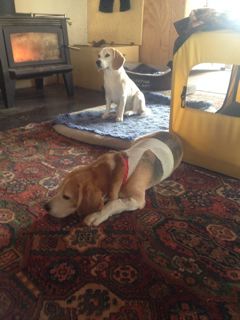
On Monday (a day after discharge), Teddy was at home resting near the log burner and constrained in either his crate or a playpen area that Jill had set up for him.  His pack mates – sister Verdi (shown in the background) and his mother, Maggie were a little confused by the new situation.  Verdi was showing some signs of dominance – growling at Teddy.

Teddy sleeping with compression bandage

Teddy’s amputation incision was covered in a compression bandage to help with swelling

Jill was using an ice pack on the incision area four times per day to help with swelling and pain relief (Teddy was also receiving pain relief through a Fentanyl patch which delivers pain medication through the skin and also Previcox, a non-steroidal anti-inflammatory drug.)

On this day, I performed an acupressure sequence on Teddy to help his body recover from the anesthesia.  We also measured Teddy for his Walkabout Harness.

Teddy received a replacement Fentanyl patch on Tuesday.

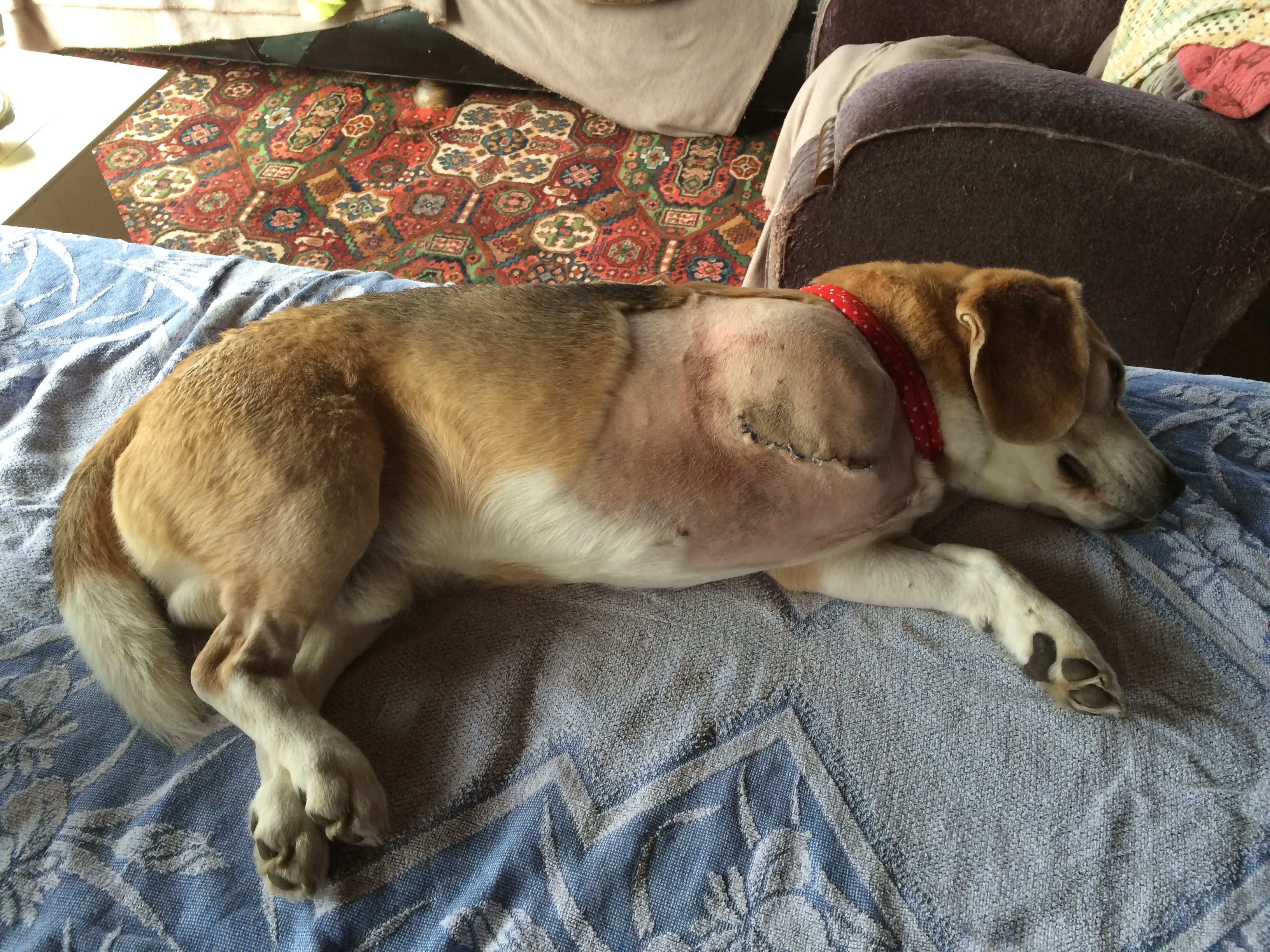
I returned on Friday to see Teddy – with his bandages removed.  This is the first time I’ve been able to view his incision up close.

Teddy's incision

Teddy on the massage table, ready for a light treatment

Teddy was very tired on Friday and favoring his right side by sleeping mostly on his left.  This is not surprising since the comfort of the compression bandage and padding on his surgery site had been removed.

We will treat Teddy conservatively and manage his comfort in the early stages of his recovery.  Consequently, I only worked on Teddy in the above, resting position.  I gently massaged over his hips and back and he received cold laser therapy over his hips and his left forepaw (which has some arthritis).

Teddy was deeply asleep after his session – a sure sign that he needed the time out and that rest is the best thing for him.

Teddy has always been a receptive dog for massage and I expect him to be even more so post-amputation.

Kathleen Crisley, specialist in dog massage, rehabilitation and nutrition/food therapy, Canine Catering Ltd, Christchurch, New Zealand


Teddy’s journey starts

Teddy is an almost 8-year old Beagle.  We’ve known each other for 4 years now because Teddy is a regular customer of my dog massage, nutrition and rehabilitation practice.

Teddy

Teddy

Teddy suffers from bilateral hip dysplasia and his owner, Jill Gordon, has been successfully managing this condition for years by giving Teddy good nutrition, massage and laser therapy, and regular osteopathic adjustments.

But Teddy wasn’t so lucky on Friday, 22nd August 2014.

On this morning, which started like so many others, Teddy was riding in his father’s van in the front seat to go to work.  When the van came to a sudden stop in traffic, Teddy slid off the front seat into the foot well.   The force of his fall and the angle in which he fell caused him to severely fracture his right front leg.

The veterinary term for Teddy’s compound fracture is a comminuted open right intracondylar elbow fracture.

Teddy’s dad rushed him to their local veterinary practice at Lincoln Village Vets where the staff there stabilised him and Alex, the vet nurse, accompanied Jill and Teddy to the local specialist surgery practice, Vet Specs.   At Vet Specs the lead surgeon, Helen Milner, assessed Teddy.  She said she might be able to save his leg through a complicated 5-hour surgery.  Jill authorised the surgery.

However, once Helen got Teddy onto the operating table, she saw in more detail than the x-rays allowed her to just how badly broken Teddy’s leg was.  It was shattered and she didn’t have enough bone fragments to successfully attempt a repair.   The only choice was amputation.

Amputation has been a devastating outcome for Jill.  We know that Teddy has a challenging journey ahead not only to recover from his amputation but also to adapt his lifestyle and surroundings so he doesn’t aggravate his hip dysplasia.

Quality of life is paramount.

Jill has chosen a healthcare team including Sarah Wisson, his osteopath, Dr Susanne Anderson, a veterinary acupuncture specialist, and me to see Teddy through this new journey.

Jill wants other owners to learn from Teddy’s experience about the need to restrain their dogs when traveling in vehicles.  And she wants owners to share in Teddy’s journey to recovery.  She has given her permission for Teddy’s story to be told here.  You will see the new category on the blog:  Teddy’s journey post-amputation.

Teddy has just been released from hospital and is recovering at home.  Jill says he’s still her handsome boy as seen here:

Teddy, before his discharge from hospital

Teddy, before his discharge from hospital

Join us for Teddy’s journey in future blog posts.

Kathleen Crisley, specialist in dog massage, rehabilitation and nutrition/food therapy, Canine Catering Ltd, Christchurch, New Zealand

Is your polar bear pregnant? Ask Elvis

Elvis is a very special beagle.  He’s been trained to sniff the feces of polar bears to determine if they are pregnant and his success rate is 97%.

Photo by Cincinnati Zoo

Photo by Cincinnati Zoo

Traditional pregnancy detection methods like hormone monitoring and ultrasounds don’t perform well when testing polar bears for pregnancy.  Scientists at Cincinnati’s Center for Conservation & Research of Endangered Wildlife decided to try the beagle training since beagles perform so well as detector dogs in other settings.

Elvis is only 2 years old and so he hopefully has a long life ahead of him helping zoos in the United States determine if their polar bears are pregnant.

Climate change is causing a decrease in the amount of sea ice, which is affecting the polar bear population because it reduces their hunting season.  There have also been reports of drowned polar bears being found in the Arctic Ocean; the bears have become exhausted when swimming because of the increased times it is taking for them to reach the safety of ice again.

Polar bears have been listed as a Threatened Species under the Endangered Species Act.  The number of Polar Bears in the wild is expected to decline primarily due to starvation and decreased reproduction.

So ugly, they’re cute

The World’s Ugliest Dog Contest has been held annually in Petaluma, California as part of the Sonoma-Marin Fair for 25 years.   This contest has grown in popularity and is now featured on cable television channel Animal Planet.

Although dog moms and dads who enter their dog mainly come from the United States, anyone can enter.  The Chinese Crested, a largely hairless breed, has figured prominently amongst the winners.

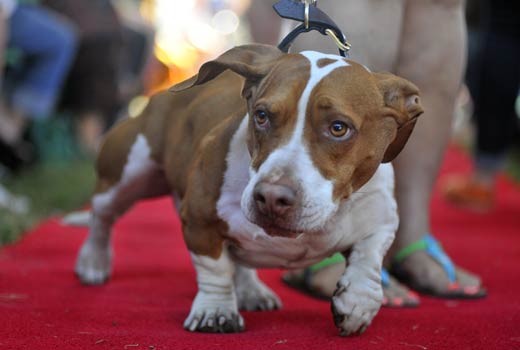
This year (2013), the title was awarded to Walle, a beagle, boxer, basset hound mix with a large head and a duck-footed walk.  He beat 29 other contestants for the title.

Walle, the World's Ugliest Dog 2013

Walle, the World’s Ugliest Dog 2013

Vicki DeArmon has written a book about the contest which profiles winners, other entrants, and their owners.  The pictures really do prove that some creatures are so ugly that they’re cute.
World's Ugliest Dog Book

Maybe the dog lover in your pack would like this book for Christmas, or perhaps you should treat yourself?

Roam by Alan Lazar

RoamThis novel, Alan Lazar’s first, is a must-read.  Roam is the story of Nelson, a Beagle/Poodle cross who enjoys and experiences his world through his sense of smell.

Mr Lazar does an excellent job at describing Nelson’s story from Nelson’s point of view; for example: ‘The first thing Nelson smelled was grass…The smell had many layers to it.”

Nelson’s cross-bred litter was an accident to an elderly breeder who would sell poodles and beagle pups for extra income.  Nelson is sent to a Boston pet store to be sold and he experiences his first ‘bad’ person – the store owner who resents having to sell a cross-bred pup.

And then Katey, a pianist, enters his life.  Katey becomes Nelson’s Great Love and for a time, they enjoy a happy life together with a routine that includes daily piano practice, with Nelson sitting contentedly under the piano.  “Here Comes the Sun” becomes a special song for Nelson.  Nelson particularly enjoys the flowers in the garden:  “His favorite of all was the beautiful white tuberoses that Katey had planted a few months earlier.  Their scent was pretty during the day, but Nelson particularly loved inhaling them at night, when their true, mystical fragrance emerged.”

Then, as Katey’s marriage is in trouble, a gate is left open one day and Nelson follows his nose.   He roams far from home, living on the streets where a homeless man quickly steals his prized collar to sell for a dollar.  Since Nelson is not micro-chipped, he loses his only means of identification.

Roam tells the story of Nelson’s eight years on the run.  We meet his truck driving companion, Thatcher; his girlfriend, Lucy; a wolf family; and other characters.  Nelson, as a stray dog, narrowly escapes being euthanized in an animal shelter on two occasions.  And he loses his leg to a vehicular accident.

The e-version of this book comes complete with a musical score consisting of original pieces by Lazar, who is also an accomplished composer.

Throughout Nelson’s eight years, he thinks of his Great Love.  Although he bonds with other people, it is Katey that has won his heart.

Will he ever see Katey again?  I’ll leave that for you to find out, when you read Roam.

What’s the diff, Cliff?

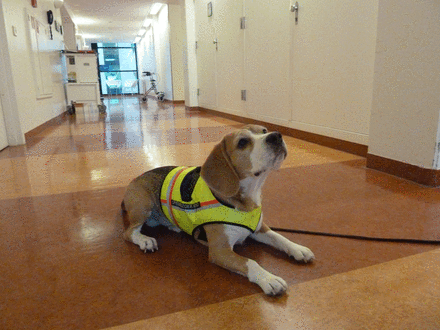
Cliff, a Beagle, is a specially trained detector dog working in two Dutch teaching hospitals.  He’s been the centre of a major study into detection of Clostridium difficile (‘C diff’ for those who are professionals in the field), an infectious bacteria that can run rampant through hospitals, rest homes and other healthcare facilities.

Detector dog on hospital ward

Symptoms range from mild diarrhoea to more severe conditions like colitis. The bacterium can be transmitted through either personal contact or the environment and the testing for the bacteria is time consuming.

The research involved 300 patients, 30 which had C diff infection.  Cliff was guided along the wards by his trainer and the trainer had no idea if the person was infected or not.  Cliff was trained to sit or lie down when C diff was detected.

The Results?  Cliff was an expert at identifying infections of C diff – with around 90% accuracy –  regardless of whether he was sniffing out stool samples or identifying infected patients in the hospital.  Cliff is only one dog, but with these results, the concept of using dogs to identify C diff infections has been proved.

This comprehensive video explains Cliff’s training and the research:

Source:  British Medical Journal