Tag Archives: behavior

Behaviour in dogs depends on the paw preference

I’ve previously written about how to test if your dog is right-pawed or left pawed.  Researchers at the University of Adelaide led by Dr Luke Schneider tested a group of 73 dogs using 50 manipulations of an object to determine their paw preference.  They then interviewed the dog owners about their dog’s behavior to see if there was a pattern.

“We found that dogs with a preference for left paws were reported by their owners to show high levels of aggression towards strangers. The left pawed dogs scored almost twice as high as ambilateral (ones with no preference) and also higher than dogs with right paws.

“There is research in the human world as well that positive and negative emotions can be located in the left and right hemispheres and it seems to go the same way in humans and other animal species, that the negative emotions are located in the right hemisphere. There are many, many overlaps between human and animal brains.”
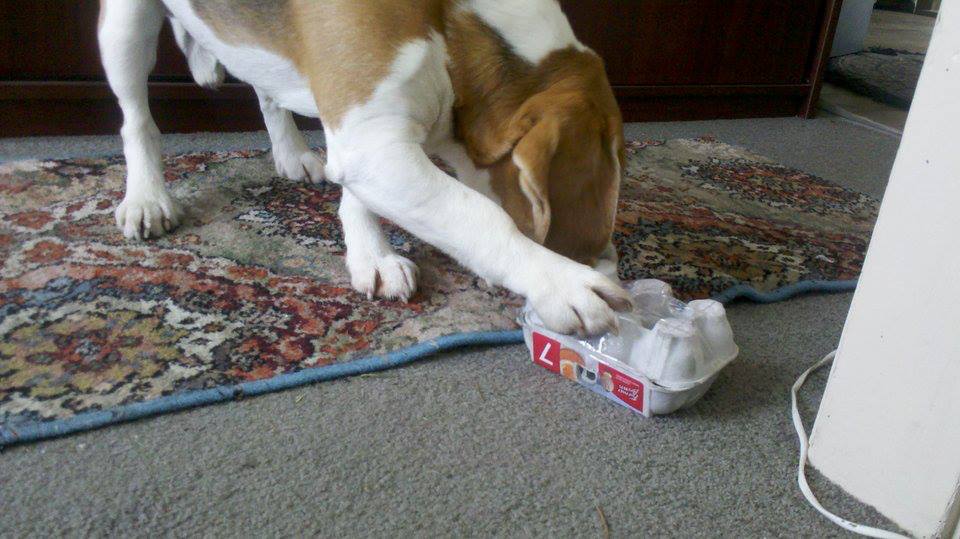
Blake the Beagle shows his preference for the right paw

Blake the Beagle shows his preference for the right paw

When testing dogs for paw preference, the research team found a roughly even split between those dogs that had a right paw preference vs those with a left paw preference.

None of the dogs in the study were noted as particularly aggressive, and so the research team wants to do more work with dogs who are noted for aggression-type responses.  A larger testing group would also help to validate results.  The research team’s study has been published in the Journal of Veterinary Behavior.

When something isn’t right with your senior dog

Old dog_dementiaWe love them to bits.  And gradually we notice changes that signal they are getting older.  They may no longer hear the doorbell and, thanks to this new deafness, they may sleep very deeply.

But  changes in an old dog need to be considered carefully.  Behavioral changes can often be the signs of other problems, like diabetes, hypothyroidism or hyperthyroidism, dental disease, and cancers.

One thing that I’m learning more about is canine cognitive dysfunction syndrome (CDS).  Veterinarians describe this as a ‘diagnosis of exclusion’ which means they look to diagnose another disease or disorder first before deciding that the dog is suffering from CDS.

When assessing for symptoms and severity of CDS, veterinarians follow the acronym DISHA.  DISHA stands for:

D= Disorientation

I = Interaction changes

S = Sleep/wake cycle changes

H = House soiling

A = Activity level changes

Disorientation can present as changes in spatial awareness, loss of ability to navigate around familiar obstacles, and/or wandering behavior.

Interaction changes can include a decreased interest in social interaction, petting, greetings, or dependent behaviors.

Restlessness or frequent waking during the night, panic or panting (particularly at night), and increased sleep during the daytime are indications of changes to sleep/wake cycles.

House soiling can increase when there is a loss of signal from the brain so your dog doesn’t realise it needs to eliminate; signs of incontinence or fouling indoors when this has never been a problem are symptoms.

Changes in activity can include decreased exploration and response to stimuli, decreased grooming, change in appetite, increased anxiety with signs of restlessness or agitation and/or separation anxiety.

Most vets offer senior wellness checks  for older dogs.  It’s well worth observing your older pet and discussing all changes with your vet before dismissing the changes as simply old age.

Source:  Ohio State University College of Veterinary Medicine

Dogs help to improve moods of teens in treatment

Lindsay Ellsworth, a doctoral candidate at Washington State University,  has a new, mood-boosting therapy for teenagers in drug and alcohol treatment.

The treatment is shelter dogs!

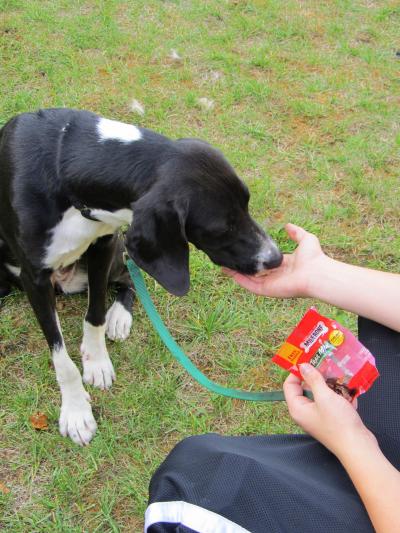
A participant at Excelsior Youth Center in Spokane, Wash., gives treats to a shelter dog from the Spokane Humane Society. A first-of-its-kind study demonstrates how dog-interaction activities improve the mood of teenagers living in residential treatment centers.  Photo courtesy of Washington State University

A participant at Excelsior Youth Center in Spokane, Wash., gives treats to a shelter dog from the Spokane Humane Society. A first-of-its-kind study demonstrates how dog-interaction activities improve the mood of teenagers living in residential treatment centers. Photo courtesy of Washington State University

On Friday afternoons, a group of approximately four dogs from the Spokane Humane Society visit the Excelsior Youth Center, where teenagers in treatment there can help brush, feed and play with the dogs.

“We found one of the most robust effects of interacting with the dogs was increased joviality,” she said. “Some of the words the boys used to describe their moods after working with the dogs were ‘excited,’ ‘energetic’ ‘and happy.'”

Ellsworth’s study is the first of its kind to demonstrate how dog-interaction activities improve mood among teenagers living in residential treatment centers.

Ellsworth’s methodology is fairly standard to research projects, involving a test group and a control group.  Once a week, during the daily recreation time at the Center, Ellsworth breaks about eight participants into two groups. One group plays pool, video games or basketball provided in the treatment center. The other group interacts with the shelter dogs for about an hour.

Before the activity period, participants identify 60 mood descriptors on a scale of one to five on what is known as the PANAS-X, a self-reporting method organizational psychologists use to scale and study emotion. After the activity, the participants fill out the same scale.

Robert Faltermeyer, executive director of the youth center, and the staff are hopeful this kind of science-based program could be established as part of treatment centers’ structured activities.

“It’s an opportunity for kids in a real chaotic life, making unhealthy choices, to focus in on a specific task with an animal,” he said. “It empowers them to make positive changes even on the simplest scale of correcting the animal’s behavior.”

Source: Washington State University media release

The importance of pain management

Whenever I take on a new client, I use a health questionnaire that covers current conditions as well as the dog’s health history.  One of the issues I address is any recent changes to the dog’s behaviour or living conditions.

What I am trying to ascertain is if a dog is in pain or having adjustment difficulties. There is a clear link between pain and aggression and this has been supported in a recent study by researchers at the Autonomous University of Barcelona in Spain.

In the Spanish study, which has been published in the Journal of Veterinary Behavior, 12 dogs that were brought in by their owners for ‘aggression problems’ were studied.  All were found to have pain-induced aggression with eight diagnosed as having hip dysplasia.

The breeds in the study were:  a Giant Schnauzer, Irish Setter, Pit Bull, Dalmatian, two German shepherds, Neapolitan Mastiff, Shih-tzu, Bobtail, Catalan Sheepdog, Chow Chow and Doberman.

The researchers concluded “if the pet is handled when in pain, it will quickly act aggressively to avoid more discomfort without the owner being able to prevent it.”

So, when a dog is behaving differently or is “out-of-sorts”, a visit to the vet is recommended.  Behaviour changes can be the first indicator that something is wrong and your vet can help to run appropriate tests to see if there is an underlying health problem.

Dogs have a way of not telling us they are in pain until a problem is more pronounced because their natural instinct is to protect themselves by not exhibiting any noticeable vulnerabilities.  Therapies such as massage and low level laser (which I employ in my canine rehabilitation practice) are useful in helping to manage pain through appropriate stimulation of acupressure points and managing muscle, tendon and ligament condition.  I’m also a strong supporter of acupuncture and refer clients to a local vet who is trained in veterinary acupuncture.

These complementary therapies can be employed alongside traditional pain medications such as NSAIDs to support your dog’s quality of life.  When pain is managed, quality of life improves for everyone in the household.

Source:  Plataforma SINC. “If your dog is aggressive, maybe it is in pain.” ScienceDaily, 13 Jun. 2012. Web. 15 Jun. 2012.

What is your dog thinking? Researchers are on the case!

Researchers at Emory University have published new research into canine cognition.  Entitled Functional MRI in Awake Unrestrained Dogs, the paper outlines findings of research that required two dogs to remain motionless in an MRI machine.

Yes – that’s right. Motionless.  The two dogs were outfitted with special ear muffs to protect them from the noise of the MRI and trained to rest their heads on a chin rest inside the machine.   As the MRI took scans of the dog’s brain activity,  hand signals were used to show the dogs whether there was or wasn’t a food reward.

This is a first-ever study on awake dogs, rather than those that have been sedated.  Importantly, part of the animal ethics of the study was to ensure the dogs were willing participants.

The findings show a definite brain activity response when the hand signals indicated a food reward.  Those dogs are paying attention!

The lead researcher, Professor Gregory Berns, says “We hope this opens up a whole new door for understanding canine cognition and inter-species communication. We want to understand the dog-human relationship, from the dog’s perspective.”

Professor Bern’s dog Callie in training in a mock-up of the MRI scanner (copyright Emory University)

Listen to Professor Berns talk about this project in the Emory University YouTube video:

Source:  Emory University press release 4 May 2012

In Defence of Dogs

John Bradshaw, in his book In Defence of Dogs, explains that most dogs today live in urban environments where they are “expected to be simultaneously better behaved than the average human child and as self-reliant as an adult.”  Yet, many dogs still retain their natural traits such as herding instinct which are viewed as ‘problematic.’

Add on top of this the popularity of dog trainers who insist on the theory of dominance, and Mr Bradshaw says that our dogs are in crisis and need our support.

Mr Bradshaw’s book is about breaking down misconceptions.  He says in his Introduction, “We must strive to better understand their needs and their nature if their niche in human society is not to diminish.”

Mr Bradshaw is a passionate supporter of dogs and his book demonstrates his beliefs clearly.   If you are a dog owner who is concerned about the increasing restrictions on dogs in our modern, living environments or you are simply open-minded enough to explore other ways of looking at canine behaviour,  then this book is for you!