Thought for Friday…
Should I start offering couples massage?
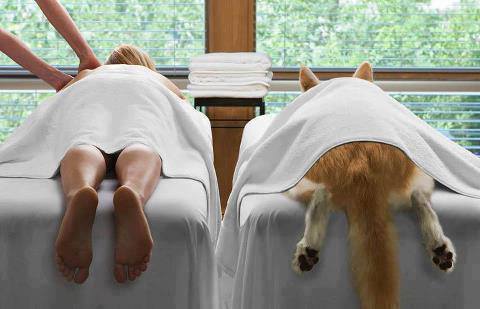

Thought for Friday…
Should I start offering couples massage?
This isn’t exactly what I do for a living….but some people think it’s like this!
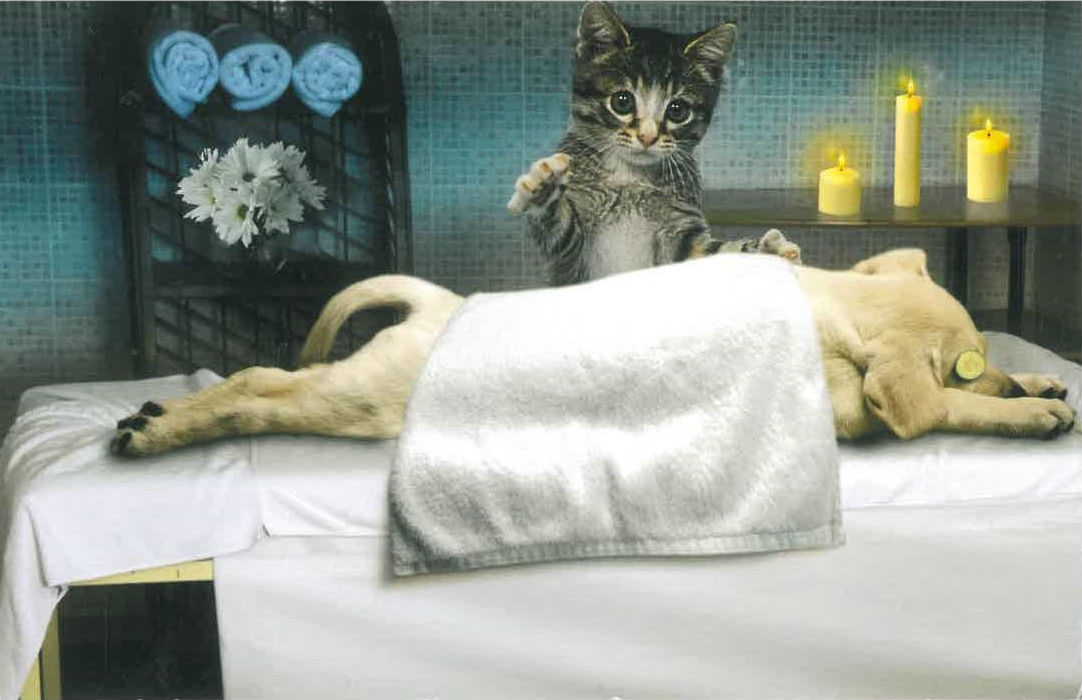
Most of my regular readers know that I work as a canine massage therapist and helping elderly dogs and those recovering from injuries is very rewarding for me. Many of my clients use massage for their dogs as a way of staving off the need for non-steroidal inflammatory drugs (NSAIDs), or at least to keep the dosages of these drugs as low as possible.
So here’s a wee story of something that happened to me this week.
I was working on a dog who I have been seeing for 18 months. He’s a lovely Labrador and he is starting to have the aches and pains of old age. With a regular 5-weekly regime of massage, he’s been pain free.
Because I know this boy well, I could pick up that he was tight through his hind legs – a muscle called the biceps femoris. When I said ‘he’s tight down here’ to his owner, she replied, ‘I didn’t want to say anything…I wanted to see if you’d notice.’
This happens fairly often. Some people like to test me to see if I actually know what I’m doing (some owners remain doubtful about complementary therapies) but most of the time it is because owners doubt if the changes they observe are real. When you live with someone with a chronic health condition and see them on a daily basis, it is often hard to pick up changes in their condition.
In this case, it was the latter. This lady wasn’t confident that she was really seeing her dog running stiffly. He was tight, but was moving freely when he left after his massage.
Success for the week!
What’s the lesson here? It’s unrealistic to expect a massage therapist to ‘solve’ a dog’s problem in a single visit. Dogs have to get used to the therapist and massage is a new experience for them. So, the first visit is usually a time when they aren’t as relaxed because they are uncertain.
Because I keep notes on every massage session, I can refer back to these to track a dog’s condition. This is no different than what your vet does. When I am familiar with a dog and their unique characteristics, I’m much better able to pick up changes and act swiftly to help.
Please consider your dog’s therapist as a member of your healthcare team and part of your dog’s preventative healthcare regime. It’s much better than the ‘ambulance at the bottom of the cliff.’

Kathleen at work with Zara (another happy customer) copyright June Blackwood
Located in Barnstable, on Cape Cod, is the Lamb and Lion Inn. Build in 1740 as a farmhouse, the old barn in the back is now accommodation with further additions to the property dating from the 1800s through to the 1960s. Some say it is a cross between a bed and breakfast and a small luxury hotel.
Speaking of cross-breeds, the best part is that the Inn is dog-friendly.

Guests are offered a package with dog sheets to cover the furniture and a towel for when their dog goes to the beach. They also receive a flashlight for taking their dog for a walk during the night.
The Inn sports a yoga and massage studio on the property; the massage therapist also offers dog massage to relax and treat your dog during your vacation.

Of course, like all dog-friendly establishments, there are some rules.
The house rules are:
1. We accept dogs year-round, however in the summer months there is a 25-pound pet weight restriction.
2. Aggressive dogs need not apply! If you’re remotely concerned with your dog around other, sometimes smaller pets, or children, please leave him or her behind.
3. Dogs cannot be left in the room unattended. We ask that you take Fido with you when you leave the property. An in-room pet sitter may be arranged with advanced notice. There is also a wonderful doggie day care with a “doggie cam” 5 minutes away (they require papers)
4. All dogs must be leashed while on the property.
5. There is a $25/night per pet fee (with a $100 maximum per pet).
6. Our Inn will only accept 3 pets at a time. Please inquire before booking yours.
7. We ask that all dogs (and guests) be well groomed prior to arrival. A $30 cleaning fee will be applied for excessive fur left behind.
8. Bring bedding or a portable carrier for your pet to sleep in if you have any.
9. Pet sheets, towels, and water bowls are available free of charge at the Inn.
10. Please don’t leave any Cape Cod souvenirs! We have 4 acres for your pooch to walk on and ask that you please pick up after them.
Posted in dog-friendly accommodation
Tagged Barnstable, dog friendly accommodation, dog massage, Lamb and Lion, yoga
Whenever I take on a new client, I use a health questionnaire that covers current conditions as well as the dog’s health history. One of the issues I address is any recent changes to the dog’s behaviour or living conditions.
What I am trying to ascertain is if a dog is in pain or having adjustment difficulties. There is a clear link between pain and aggression and this has been supported in a recent study by researchers at the Autonomous University of Barcelona in Spain.
In the Spanish study, which has been published in the Journal of Veterinary Behavior, 12 dogs that were brought in by their owners for ‘aggression problems’ were studied. All were found to have pain-induced aggression with eight diagnosed as having hip dysplasia.
The breeds in the study were: a Giant Schnauzer, Irish Setter, Pit Bull, Dalmatian, two German shepherds, Neapolitan Mastiff, Shih-tzu, Bobtail, Catalan Sheepdog, Chow Chow and Doberman.
The researchers concluded “if the pet is handled when in pain, it will quickly act aggressively to avoid more discomfort without the owner being able to prevent it.”
So, when a dog is behaving differently or is “out-of-sorts”, a visit to the vet is recommended. Behaviour changes can be the first indicator that something is wrong and your vet can help to run appropriate tests to see if there is an underlying health problem.
Dogs have a way of not telling us they are in pain until a problem is more pronounced because their natural instinct is to protect themselves by not exhibiting any noticeable vulnerabilities. Therapies such as massage and low level laser (which I employ in my canine rehabilitation practice) are useful in helping to manage pain through appropriate stimulation of acupressure points and managing muscle, tendon and ligament condition. I’m also a strong supporter of acupuncture and refer clients to a local vet who is trained in veterinary acupuncture.
These complementary therapies can be employed alongside traditional pain medications such as NSAIDs to support your dog’s quality of life. When pain is managed, quality of life improves for everyone in the household.
Source: Plataforma SINC. “If your dog is aggressive, maybe it is in pain.” ScienceDaily, 13 Jun. 2012. Web. 15 Jun. 2012.
Tagged acupressure, aggression, Autonomous University of Spain, behavior, behaviour, Bobtail, Catalan Sheepdog, Chow Chow, Dalmatian, Doberman, dog massage, dogs, german shepherd, Giant Schnauzer, health history, hip dyplasia, Journal of Veterinary Behavior, ligament, low level laser, massage, mastiff, muscle, NSAIDs, pain, Pit Bull, research, tendon, therapies, veterinary acupuncture
There are lots of jokes that circulate at this time of year about a dog’s resolutions for the new year (e.g., kitty-box crunchies are not junk food, etc.). But what about your resolutions for your role as a Doggy Mom or Doggy Dad?
Here are my suggestions for new year resolutions:
1. Resolve to feed your dog the highest quality dog food you can afford. Not sure what to feed or even if you are feeding the right amount? That’s where a nutritional assessment comes in. People like me are trained in reading the labels of your existing dog food and with some information about your dog’s condition and lifestyle, we can tell you a lot about whether you are feeding the right amount and make un-biased suggestions about your core dog food.
In my case, I’m not affiliated with any veterinary practice or brand of dog food (many professionals take their nutrition training from a programme offered by dog food manufacturer – ask about this when selecting a provider for nutritional advice!)
2. Exercise more – for your dog and yourself! Exercise is important mental and physical stimulation for both you and your dog. Discover new walks, link up with walking partners and doggy buddies for more variety, and manage your exercise according to the temperatures of the day (your dog doesn’t have the heat regulation system that you do in the summer; and their paw pads can be irritated by road salt and ice during the winter).
3. Groom your dog – regularly. If you don’t know what to do, then take your dog to a professional groomer and get advice on maintenance that you can do at home. It breaks my heart to hear about veterinary nurses and groomers that have to work on severely matted dogs because their owner has neglected their grooming responsibilities.
4. Make time for your dog. I signed off last month’s newsletter to my Canine Catering customers saying “remember that the best thing you give your dog this holiday season is your time.” It goes for the rest of the year, too. Your dog is a social animal and needs your love and attention throughout the year.
5. Keep a watchful eye on your dog’s health, ensuring they are not overweight (or underweight) and that they receive regular veterinary care. (For a dog to be accepted into my dog massage and rehabilitation practice, the owner must certify for me that their dog is under regular veterinary care.)
6. Have fun together – play time is essential. Dog walks are not the only stimulation for your dog. Choose an activity that suits both you your dog. It could be agility or obedience training, rally-o, fetch, cross-country skiing, hiking/tramping, or the use of interactive dog toys.
I wish you and your dog a wonderful 2012. Contact me through this blog or my website for information on any topic I cover in this blog.
 I’m pleased to introduce my new loyalty card for all of my canine massage customers.
With every massage/laser treatment your dog receives, I will initial your card. After five treatments, you are able to select a bag of treats from my Canine Catering range to the value of $10. It’s that simple.
I aim to keep my prices reasonable, and offer a fully mobile service to your door in Greater Christchurch. This card is just another way of showing you that I appreciate your support and the trust you show in me to work with your dog.
Posted in dog care
Tagged Canine Catering, dog massage, laser, loyalty card, massage
Today I massaged a Leonberger, who unfortunately has had to have cruciate ligament surgeries in both legs over the years and as a consequence she is starting to have lots of aches and pains. What a beauty! She was the epitome of the ‘Gentle Giant’ and, despite her size, amongst the easier dogs I have handled in my dog massage career.
I’ve done some research on the breed and so I thought I’d share it with you. Leonbergers originated in Germany in the town of Leonberg. The mayor there wanted a dog that resembled the lion image of the town’s crest. The breed is a combination of Newfoundland, Saint Bernard, and Pyrenean Mountain Dog.
 If you are interested in owning one of these giant dogs, I recommend that you do your own research on the breed and then contact your local breed club for information on breeders and upcoming litters.
In New Zealand, we have approximately 300 Leonbergers in the country. The Leonberger Club New Zealand has an excellent and easy to navigate website.
Kathleen Crisley, specialist in dog massage, rehabilitation and nutrition/food therapy, The Balanced Dog, Christchurch, New Zealand

Welcome to my new blog – about everything dog! Unlike my column for a previous NZ-based website, this one is totally under my control. It won’t be going anywhere (except growing in content). Join me as I discuss all sorts of topics related to the love and care of dogs.
Kathleen Crisley, specialist in dog massage, rehabilitation and nutrition/food therapy, The Balanced Dog, Christchurch, New Zealand







 DoggyMom.com