
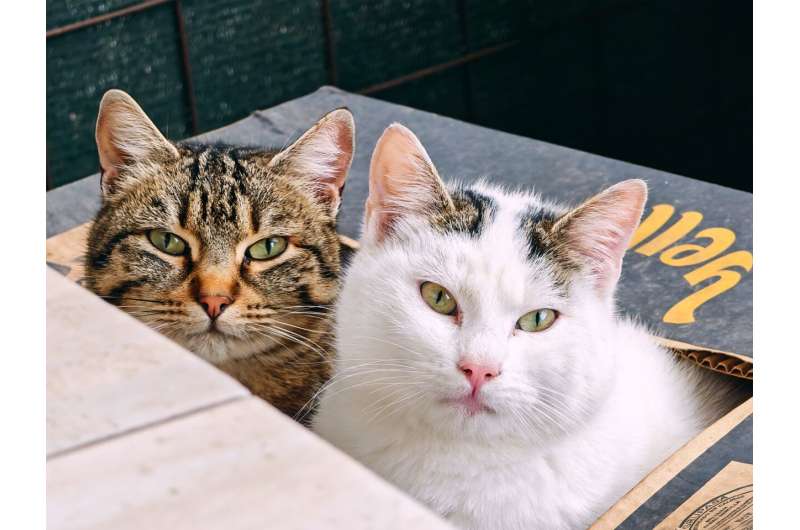
People experiencing homelessness, victims of domestic violence and economically vulnerable people are at higher risk of social exclusion. For them, pets are an important source of emotional support.
A study by the Affinity Foundation Chair for Animals and Health of the Universitat Autònoma de Barcelona (UAB) and the FAADA Foundation, published in the Frontiers in Psychology journal, highlights the importance of this support from a multidimensional perspective, drawing on the experiences of 100 individuals in vulnerable situations.
The study, conducted with a diverse group of people ages 19–80, concludes that pets play a crucial role in the support networks of vulnerable individuals, who view them as family members—primarily because they provide companionship and emotional well-being. In 90% of cases, dogs and cats serve as the respondents’ sole source of support, as well as their only opportunity for physical contact and care. Ninety-one percent of participants said that when they are angry or sad, their pet is the one they most want to be with, and for 90%, the animal provides a reason to get up every morning. Furthermore, 71% believe their pet is the one who would remain by their side if everyone else were to abandon them.
According to Jaume Fatjó, a researcher in the UAB Department of Psychiatry and Legal Medicine, director of the UAB Affinity Foundation Chair in Animals and Health, and one of the study’s lead researchers, “cats and dogs play a central role in the lives of many vulnerable people.” Although they do not replace human relationships, “they provide forms of help, such as companionship and emotional comfort, that can be crucial when other sources of support are unavailable,” Fatjó said. “Protecting the bond between these individuals and their animals also means protecting their well-being.”
The study indicates that one of the most valued qualities of pets is their availability compared with that of people, as well as the fact that they offer unconditional, nonjudgmental love, something highly appreciated by vulnerable individuals, who often feel stigmatized.
Research shows that, rather than acting as substitutes for human relationships, companion animals serve as a complementary component of the social networks of vulnerable individuals. Noe Terrassa, head of the social department at FAADA—who was also involved in the research—said that “the study demonstrates that the bond between family animals and vulnerable people, far from replacing human ties, enriches them.”
This evidence “reinforces the need to promote comprehensive social support programs that prevent separating people from their animals. In this regard, collaboration between research and social action is key to providing more effective and inclusive solutions.”
Isabel Buil, director of the Affinity Foundation, said that “scientific knowledge takes on a particularly valuable dimension when it helps address social challenges.” This study “provides evidence that has already made it possible to improve social interventions and guide public policies that take into account the role of family pets in many people’s support networks.”
The research concludes that protecting the bond between vulnerable individuals and their pets is crucial because otherwise, a significant component of their already fragile social network would be lost.
Publication details
Mónica Boada et al, Dogs and cats as sources of companionship and emotional support in vulnerable animal caregivers, Frontiers in Psychology (2026). DOI: 10.3389/fpsyg.2026.1831814
Journal information: Frontiers in Psychology
Source: Phys.org







